Happy end of the year!
After several months in Mexico (San Cristóbal de las Casas already published, Oaxaca forthcoming), I'm currently with family, recalibrating and enjoying the holidays.
I closed the last "From the editor's desk" with an admission of some personal disenfranchisement with travel writing and the economic logics that often accompany it (affiliates, ad networks, paid sponsorships, etc.). This is neither an indictment of those who work within those systems for whatever reason, nor a separation of myself from them (I too hope to monetize The Catalog via some of these). But for me, the distance has become clearer. At worst, I feel offput by, and at best, I feel fundamentally uninterested in the idea of building an entire body of work primarily along those lines.
I’ve lately reflected on how often I’ve been looking sideways and studying other people’s trajectories towards their versions of success, and in turn measuring myself against structures that were never built for what I’m actually trying to make.
If I follow anyone else’s path, I know I won’t reach my own unique potential, nor The Catalog’s.
So I’ve been distilling.
Here are four commitments I've landed at, at least for now.
1) Nomad Earth Catalog makes art.
First and foremost.
Not “content.” Not assets. Not lifestyle media.
I've recently adored Yancey Strickler's articulation of the difference between a creator and artist. It names, with an almost uncomfortable precision, a tension I’ve felt in my work for a long time, but never had language for: the pull between producing legible (business) outputs and staying faithful to a slower, stranger, less instrumental way of making.
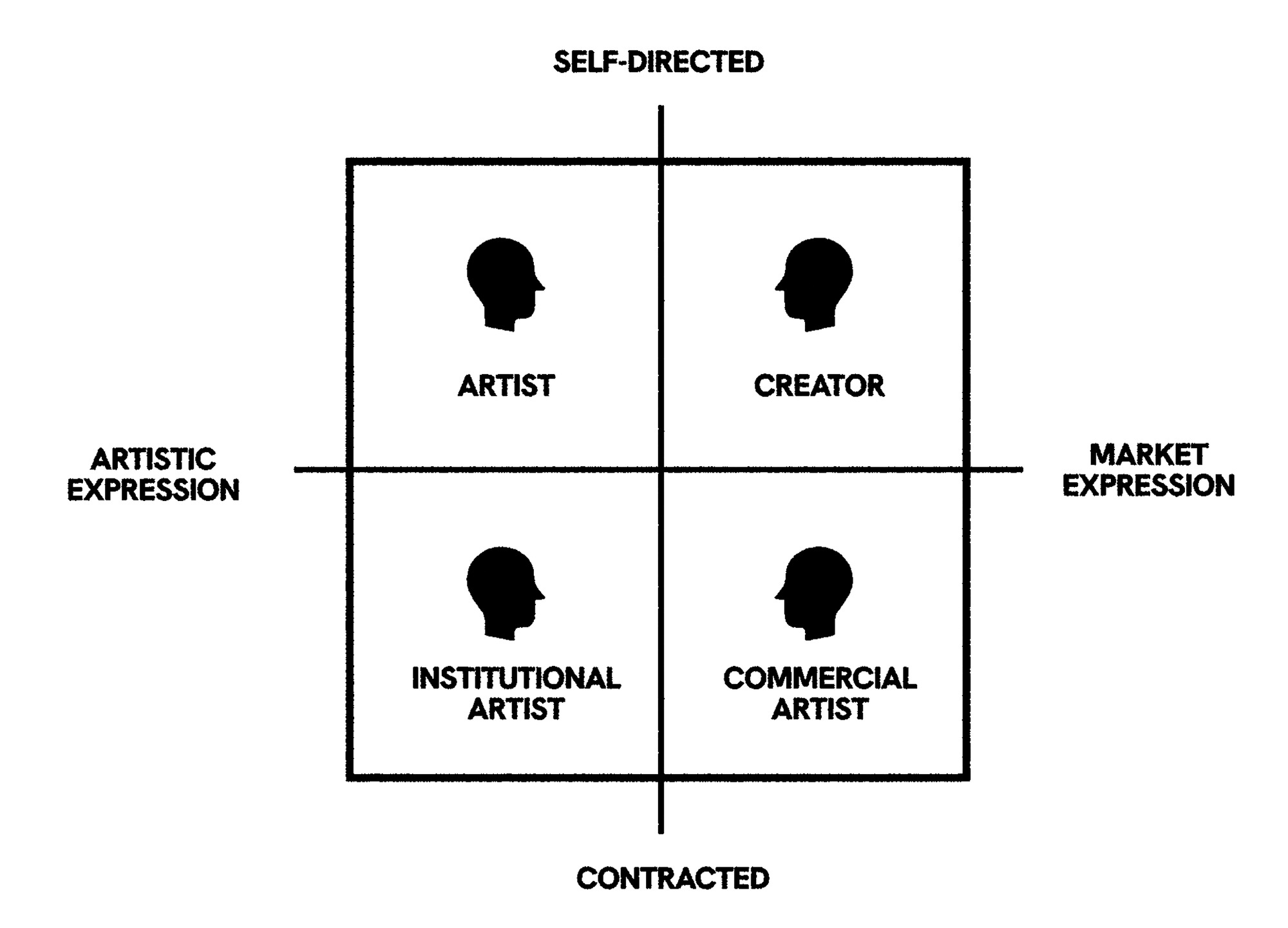
This also aligns with developments in the realm of others whose work I admire, for instance Elle Griffin's recent assertion "I am an artist first and a journalist second."
Likewise, it made me recall an anonymous comment I read a very long time ago, specific to the design profession but I think applicable more broadly:
"By default, the position of the post-industrial designer can never be that of an autonomous agent who is free of institutions and their hegemony. And when the designer comes a truly free-thinking actor in the power struggle, s/he becomes an artist."
In The Field of Cultural Production, Bourdieu describes cultural work as unfolding within a structured field shaped by power, capital, and legitimacy, where autonomy is never simply given, but negotiated against markets, institutions, and symbolic reward systems. What strikes me is how clearly he names the cost of that negotiation: the more one’s work orients itself toward economic or institutional capital, the more it is shaped by those logics; the more it insists on autonomy, the more precarious it tends to become, while also retaining the capacity to generate new values, meanings, and possibilities at the edges of the field.
I want to concern myself less with the market and more with what I believe deserves articulation. Right now, the closest thing I make to art (in the sense of work that is not meaningfully market-driven) is probably the Nomadics essays, and the occasional portrait-style Places post (like this one). In the future, I hope this expands into documentary films, zines, collaborative research projects, and other forms that allow for slowness, ambiguity, and shared authorship.
A small but important note: in what follows, you’ll notice the word "other" recur—other knowledge, other social relations, other futures. Art needs no such qualifier. Art is already other. It stands apart from utility, refuses easy capture, and unsettles the systems that would otherwise make it legible, productive, or profitable. This commitment is not about repositioning The Catalog within a market category, but about stepping, deliberately, outside of one.
2) Nomad Earth Catalog makes other knowledge.
Alongside art, there’s a parallel impulse: investigation.
The Catalog lives at the margins—between travel writing, philosophy, political economy, and lived experiment. I want to lean harder into that. Less curation, more research. Fewer answers, better questions.
This is where Margins (tentative name, may change) comes in: a kind of informal research cooperative or think tank. A space to actually study things—mobility, work, infrastructure, borders, alternative economies—without institutional affiliation or corporate alignment.
I’m considering making parts of this a paid space (because attention, time, and sustained inquiry require support) and/or seeking aligned sponsorship where appropriate.
What I know is this: the knowledge produced here will remain independent and accountable to readers.
Where sponsorship does appear, it will be explicit and project-based: aligned companies funding specific research, without editorial control.
Note: Places will remain affiliate-supported, largely because that ecosystem already exists and could help fund other work in the future. But I’m still feeling my way toward the right balance between access and sustainability. Right now, The Catalog makes nothing and gets about 10 views per day, so this is all very speculative.
3) Nomad Earth Catalog makes other social relations.
Beyond the conventional digital product suite (ebooks, courses, etc.), I’m interested in exploring how The Catalog can cultivate different social relations through technology.
Before launching The Catalog, my career was in digital product (software/app) design. And while there’s now an abundance of AI development tools that can produce a working prototype, I’m far less interested in solo-building than in shared inquiry. I’d much rather explore this terrain with others, particularly those who are drawn to the same questions.
So my current thinking is to work backward, from the questions that animate this publication, from sketches of preferable futures, and from a felt sense of what is absent, constrained, or underdeveloped in the present—and to ask what kinds of tools might help those futures become more imaginable, inhabitable, or tangible. Rather than beginning with a product idea, I want to begin with inquiry: treating many of the core Nomadics themes—mobility, community, freedom, power, work, meaning—as sites of potential transformation, where different arrangements, relations, and rhythms might be tested. This isn’t to suggest that technology can resolve deeply entrenched structural conditions, but rather to envision what meaningful interventions could look like that subtlety shift how we relate, organize, and move together.
A more specific line of inquiry follows from this. The dominant pattern is familiar: products are built for people, rarely with them. What would it look like to create a digital product that emerges from a subculture, niche, or dark forest, and remains dynamically responsive to it over time? A tool that adapts as the community adapts, without requiring a central intermediary to authorize or translate those changes. A tool that is deliberately shaped to serve a particular context, set of values, or social fabric, without any aspiration to scale beyond it, and without treating scale itself as a measure of success.
The things we make, in turn, make us. Technologies afford certain ways of being together, and foreclose others. I want to work consciously at that level and shape tools that feel aligned with the futures this publication in service of.
4) Nomad Earth Catalog makes other futures.
Our ethos gestures toward our vision of a preferable future.
I'm not much into forecasting, but I do believe in prefiguration: living, writing, and building as if the world we want already exists in fragments, and is ours to make.
This commitment is really just about the ongoing realization of commitments 1-3.
Not an endpoint, but a posture worth maintaining.

