Once a prominent city of ancient Lycia, Myra sits quietly now in the hills near Demre, whispering its layered histories to the rustle of olive trees and the echo of footfalls in stone. At its height during the Roman and Byzantine eras, Myra was not only a regional capital but a place of intricate devotion, its rock-cut tombs, dramatic amphitheater, and stunning reliefs reveal an urban world that was deeply architectural, performative, and reverent.
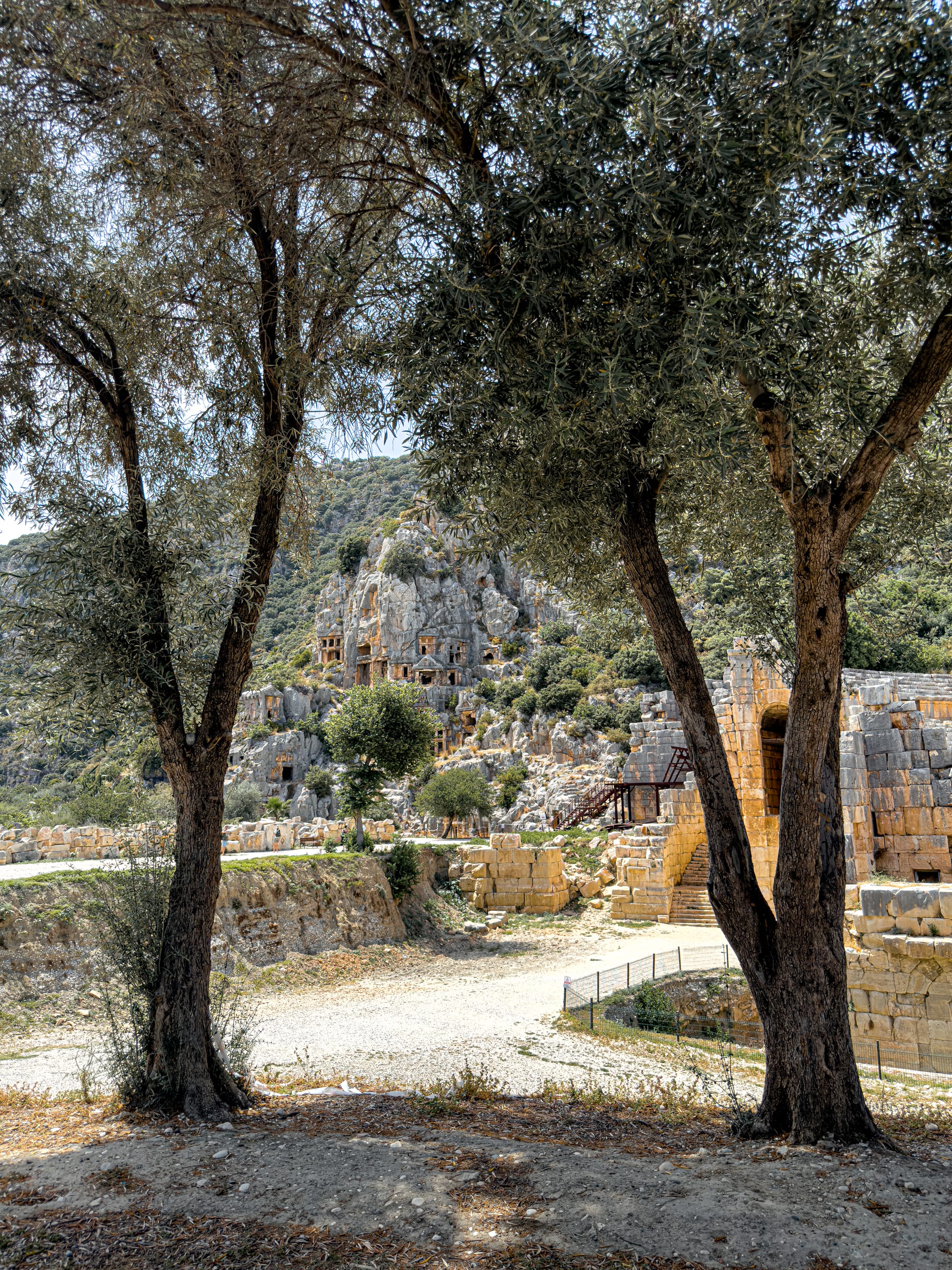
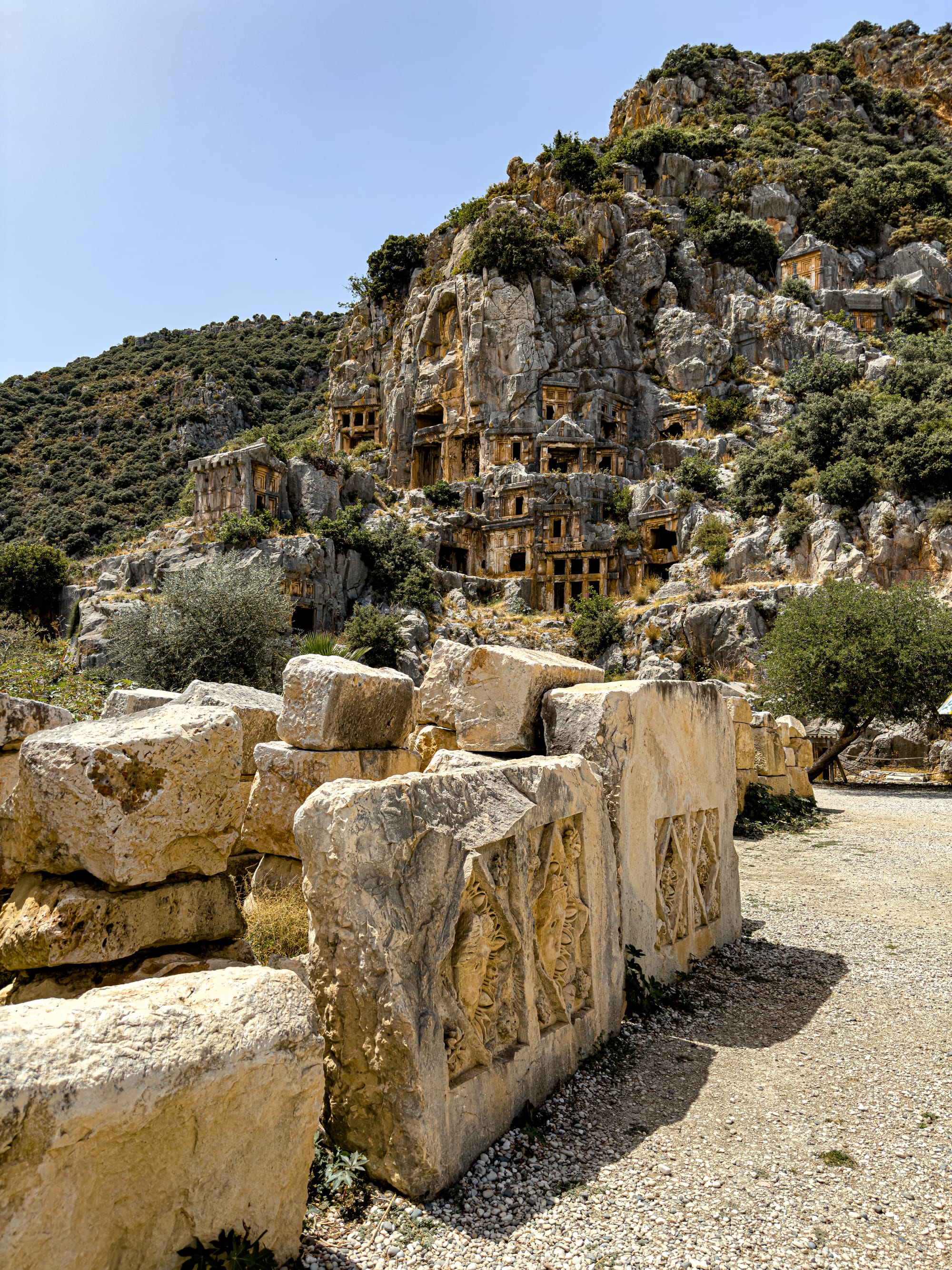
Olive trees frame the path into Myra, where sculpted stone blocks and towering cliffside tombs reveal the city’s layered artistry
Myra rises not with grandeur, but with intricacy, with carvings, tombs, and stone faces that feel startlingly present. From sculpted theater masks to cliffside sarcophagi, the artistry of Myra reveals a distinctly human impulse to leave impressions, both literal and cultural, upon the earth.
Nestled near the town of Demre in Turkey’s Antalya Province, Myra is best known for its spectacular necropolis carved directly into the cliff and its remarkably intact Roman theater. But what continues to captivate visitors isn’t just what has endured, it’s how expressive the remains are. Though much of what was once a thriving port city has disappeared under layers of earth, agriculture, and time, what remains above ground speaks with remarkable clarity.
What’s extraordinary about visiting Myra today is the sharp contrast between the stillness of the present and the intensity of the past you can so clearly imagine.
The best way to get to Myra from Antalya is going on a day tour that also entails other sites in the area. We visited as part of this tour which combines Myra with a visit to the sunken city of Kekova and Church of St. Nicholas, both of which we also enjoyed.
Location: Demre, Antalya Province, Turkey (150 km / ~2.5 hours from Antalya)
Entrance fee: 400 TL (2026). Covered by Museum Pass Turkiye.
Opening hours: Daily. 8:30 a.m.–7:30 p.m. (Apr–Oct), 8:30 a.m.–5:30 p.m. (Nov–Mar)
Visit duration: 1–2 hours for the ruins. Add time for St. Nicholas Church (1 km away, separate ticket) and Andriake Museum.
Best combined with: Kekova sunken city + St. Nicholas Church (most day tours include all three)
How to get there: Organized day tour from Antalya (recommended), or drive/bus to Demre
A name carved in history
The name Myra is often thought to be linked to myrrh, the aromatic resin once prized for its use in incense, medicine, and religious rituals. Given Myra’s location along ancient trade routes, it’s possible the city gained its name from the export or symbolic significance of this valuable substance. Other theories suggest the name could relate to ancient words for rare oils or dyes, hinting at Myra’s reputation as a place of wealth and cultural refinement.
While the true origin of the name remains uncertain, the associations with fragrance, offering, and value feel fitting for a city so richly carved, sculpted, and layered in meaning.
Everyday life in Lycian Myra
Long before Roman influence arrived, Myra was a significant Lycian settlement, part of a confederation known for its relatively democratic governance. The Lycian League is even cited in the U.S. Constitution as an example of successful federation.
Daily life in Myra likely centered around agriculture, trade, and civic gatherings. The proximity to the Mediterranean made it a maritime hub, and the fertile plains of the Demre River Valley would have supported olive cultivation, grapes, and grain. Temples and communal baths reveal a population attuned to both spiritual and physical wellbeing. Religious worship here blended Anatolian traditions with Greek and Roman overlays, most notably in the later veneration of Saint Nicholas, who served as bishop in the city.
So why carve tombs into cliffs? Lycian beliefs held that the dead should be placed in high places to be closer to the sky and the gods. Carving tombs into vertical rock faces wasn’t just an engineering feat, it was a spiritual architecture, designed to elevate the departed and protect them in ornate, often domestic-looking stone dwellings. The living stayed below. The honored dead looked out.
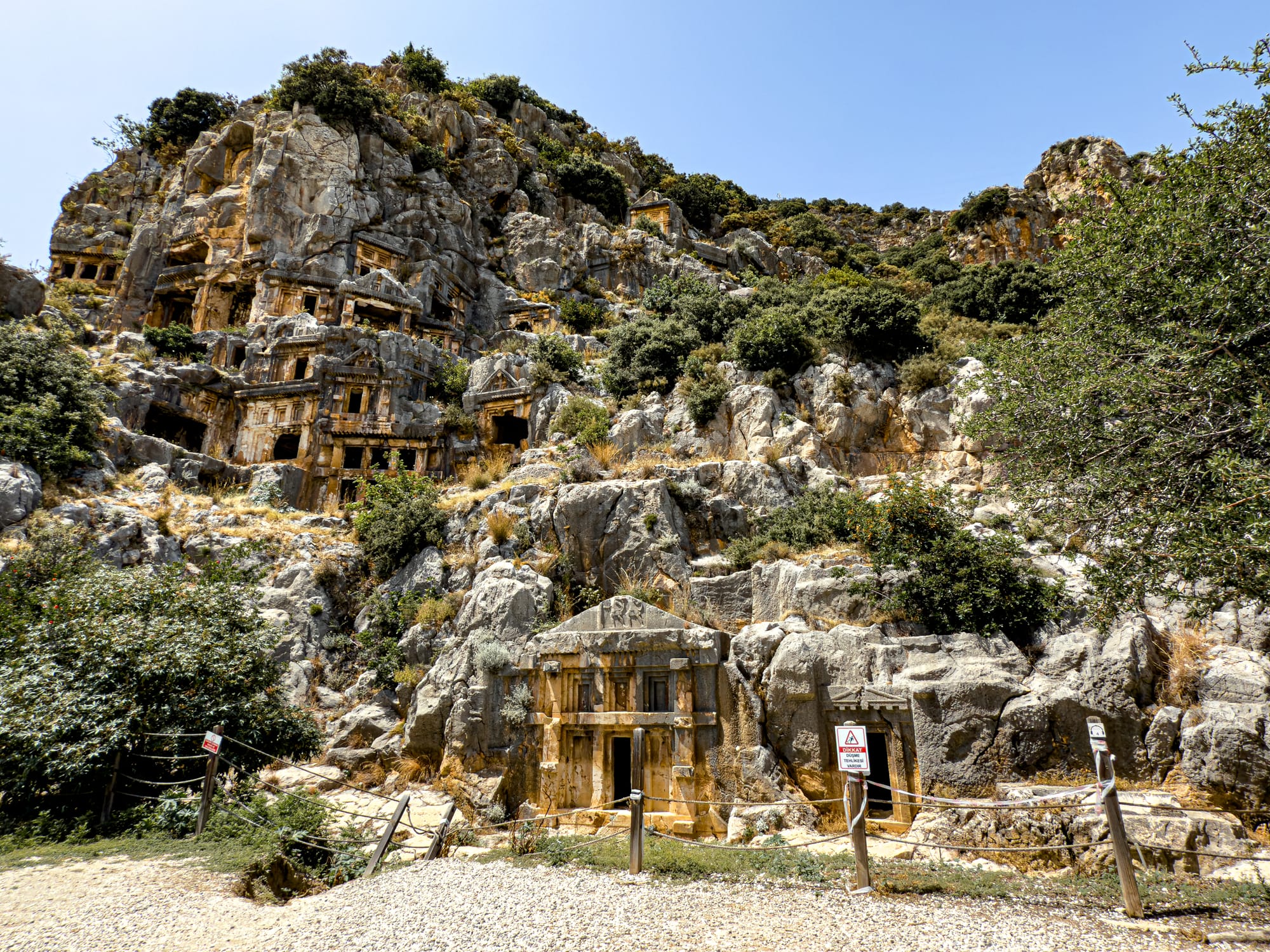
In Lycian culture, burial was more than private mourning. In Myra, the necropolis served as both memorial and monument. Even now, the placement of the tombs, high on the cliff, overlooking the land, suggests a city where the dead remained in visual conversation with the living.
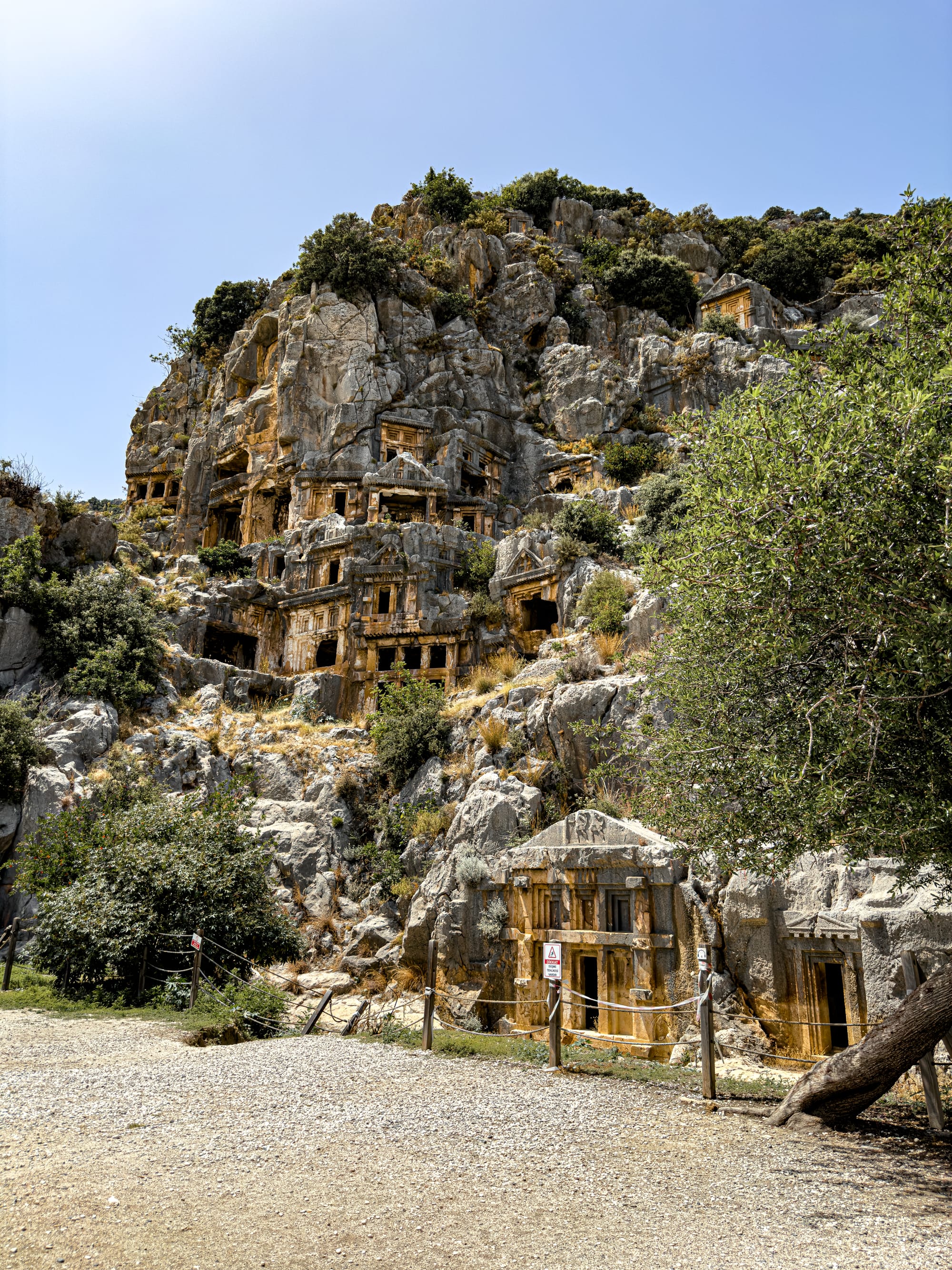
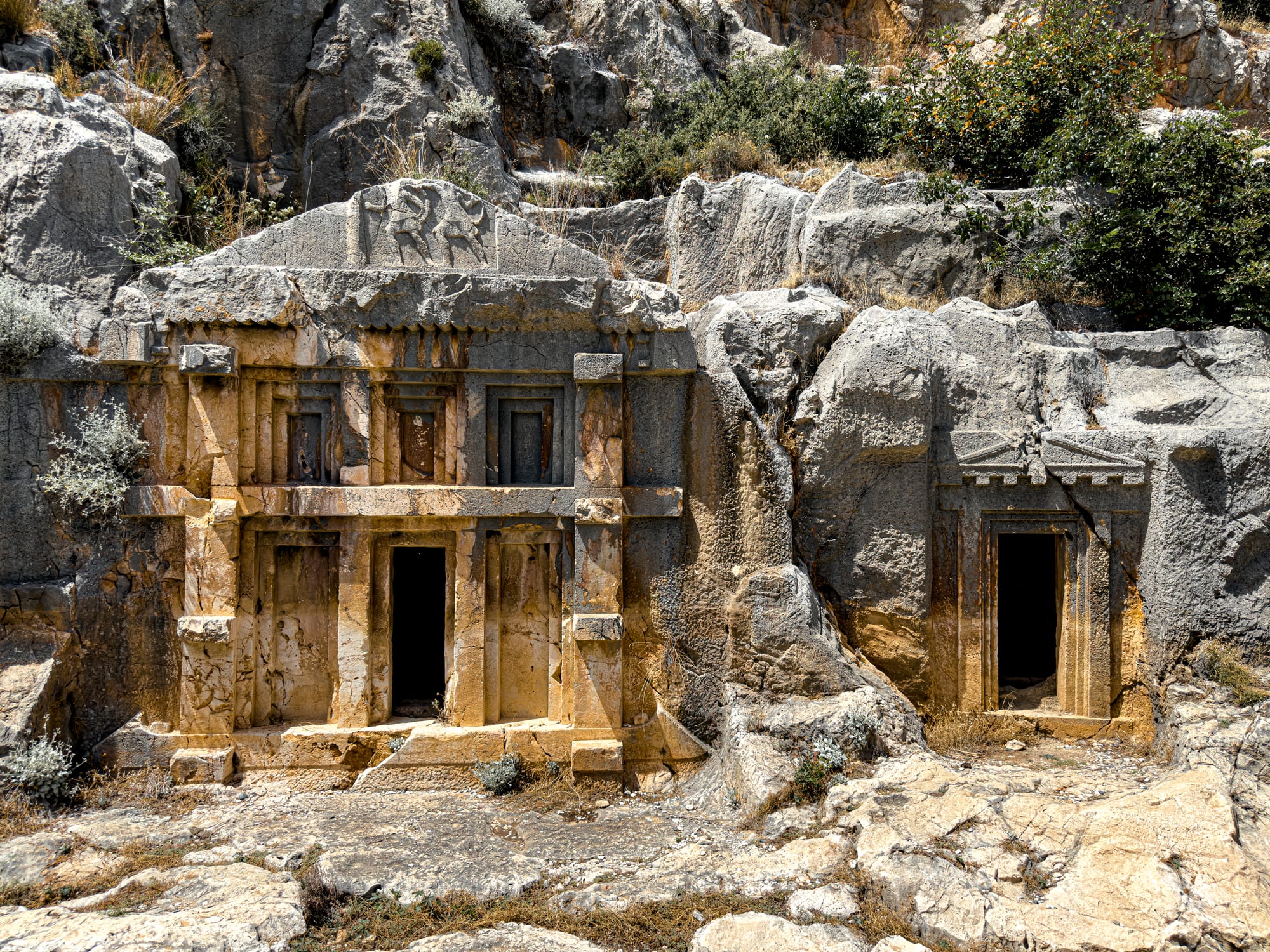
Closer view of Myra’s Lycian tomb facades, carved with architectural detail into the cliffside rock
Though few detailed records survive of Lycian religious rituals, the spatial layout of Myra suggests regular festivals tied to performance, burial, and civic assembly. The theater would have hosted dramatic competitions, religious reenactments, and processions. The tombs may have been sites of annual visitation and offering. Some scholars believe that carved reliefs showing feasting or reclining figures depict not just funerals, but recurring rites of remembrance. Walking through Myra today, one gets the sense of a city that didn’t isolate death from daily life, it structured it into the rhythms of the year.
Myra also sits along the Lycian Way, a long-distance hiking trail that traces the coast between Fethiye and Antalya, connecting it to other Lycian sites.
Myra’s urban layout
Although most visitors today focus on the tombs and theater, Myra’s full city plan would have included a large agora, a stoa-lined marketplace, Roman baths, temples, and possibly a bouleuterion. Excavations in Demre have uncovered remains of mosaic flooring, columns, and drainage systems, showing that Myra, like other Lycian cities, was a blend of function and ornament. Much of the original city now lies beneath farmland or modern buildings, but enough survives above ground to sketch a vision of a thriving urban center.
The Myra Roman theater
As you step through the stone archway into Myra’s Roman theater, there’s a sensory shift. The air cools. The acoustics amplify. And the semicircular sweep of seats, once able to hold up to 11,000 people, seems to tilt toward a single point, the stage.
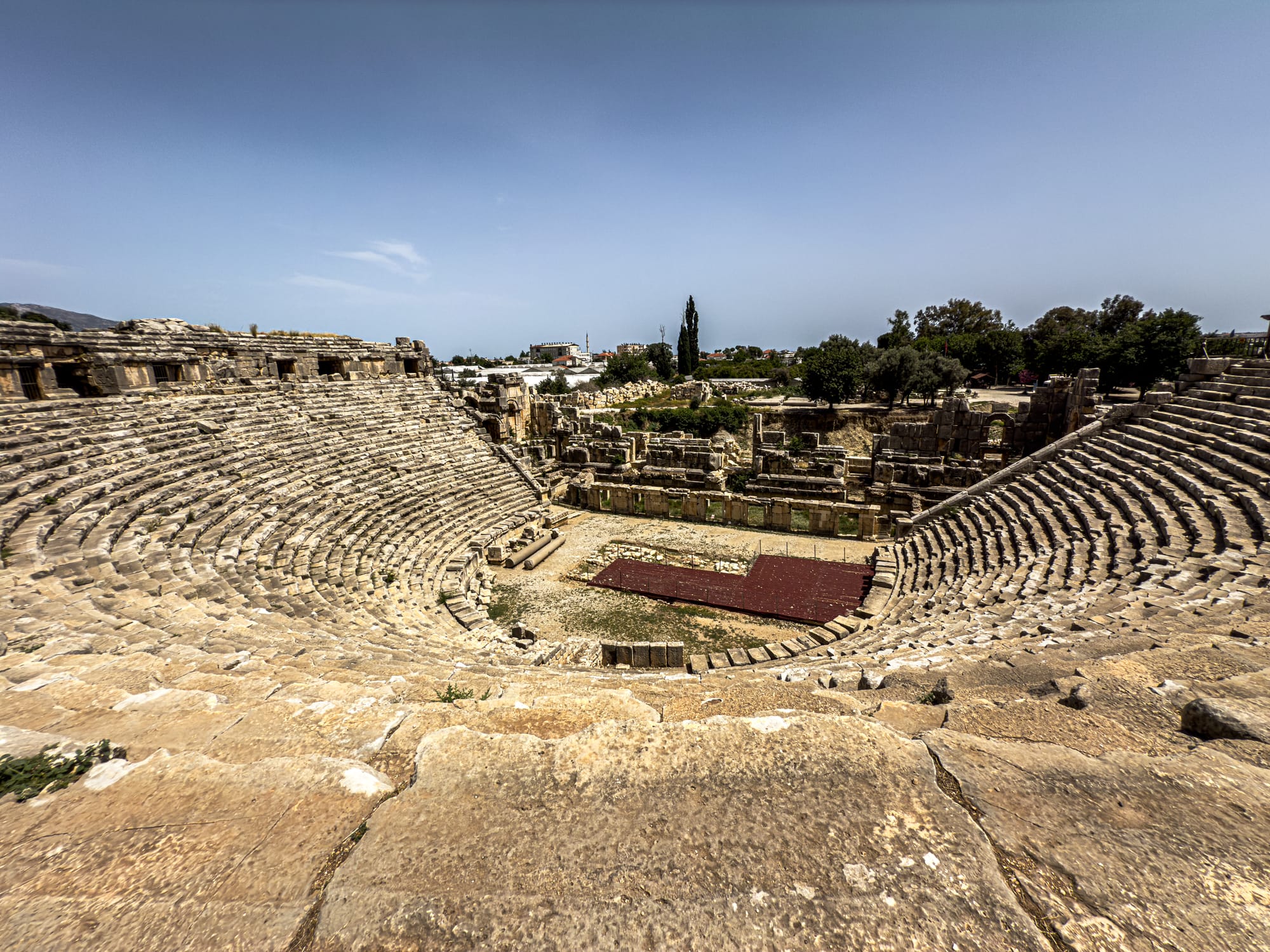
Constructed during the 2nd century CE and rebuilt after an earthquake, the theater is among the best preserved in the region. The stage backdrop still holds niches and columns, along with fragments of decorative friezes. Walk the upper tiers, and you’ll see how the structure both dominates and harmonizes with the rocky slope it was built into.
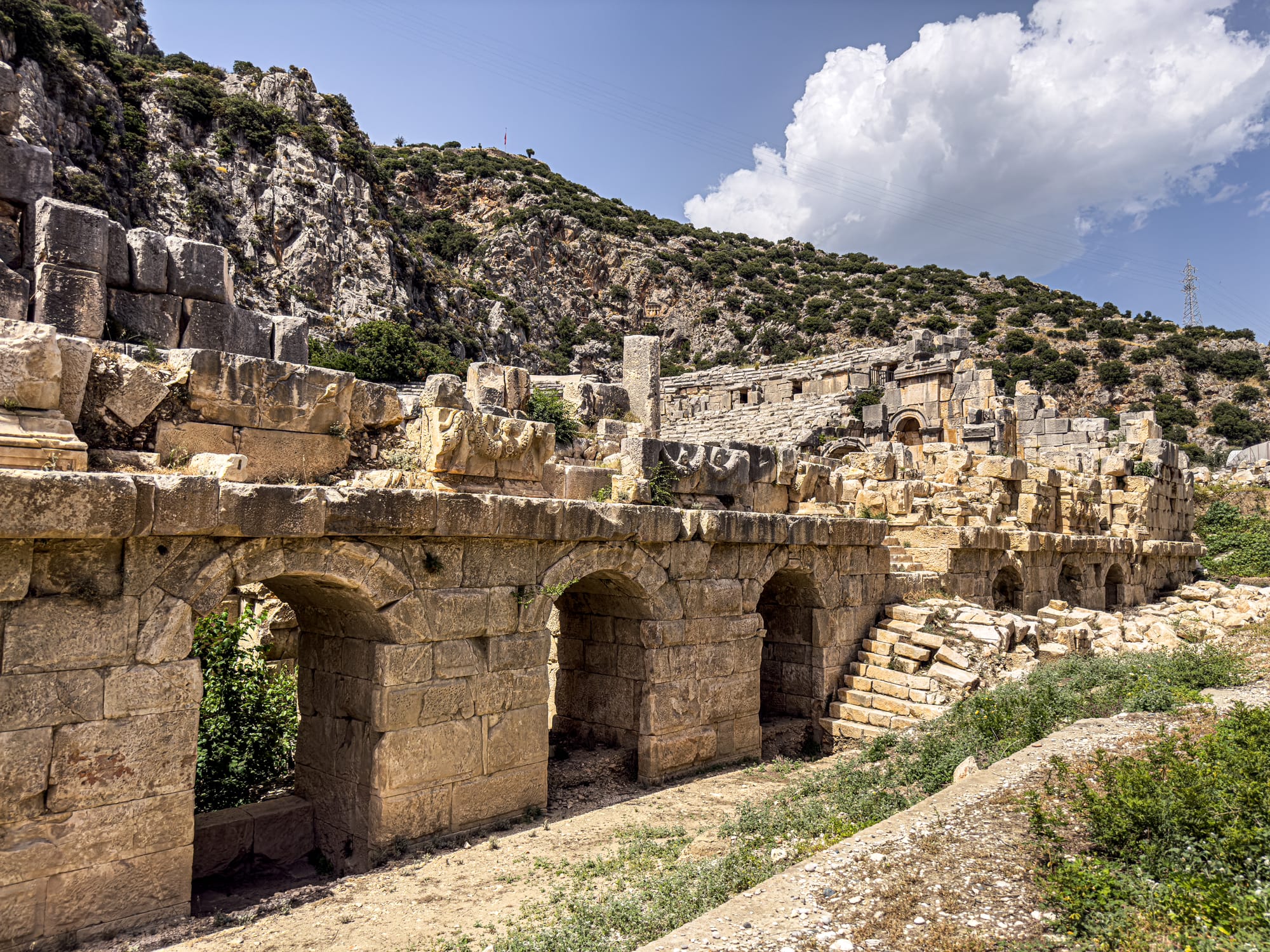
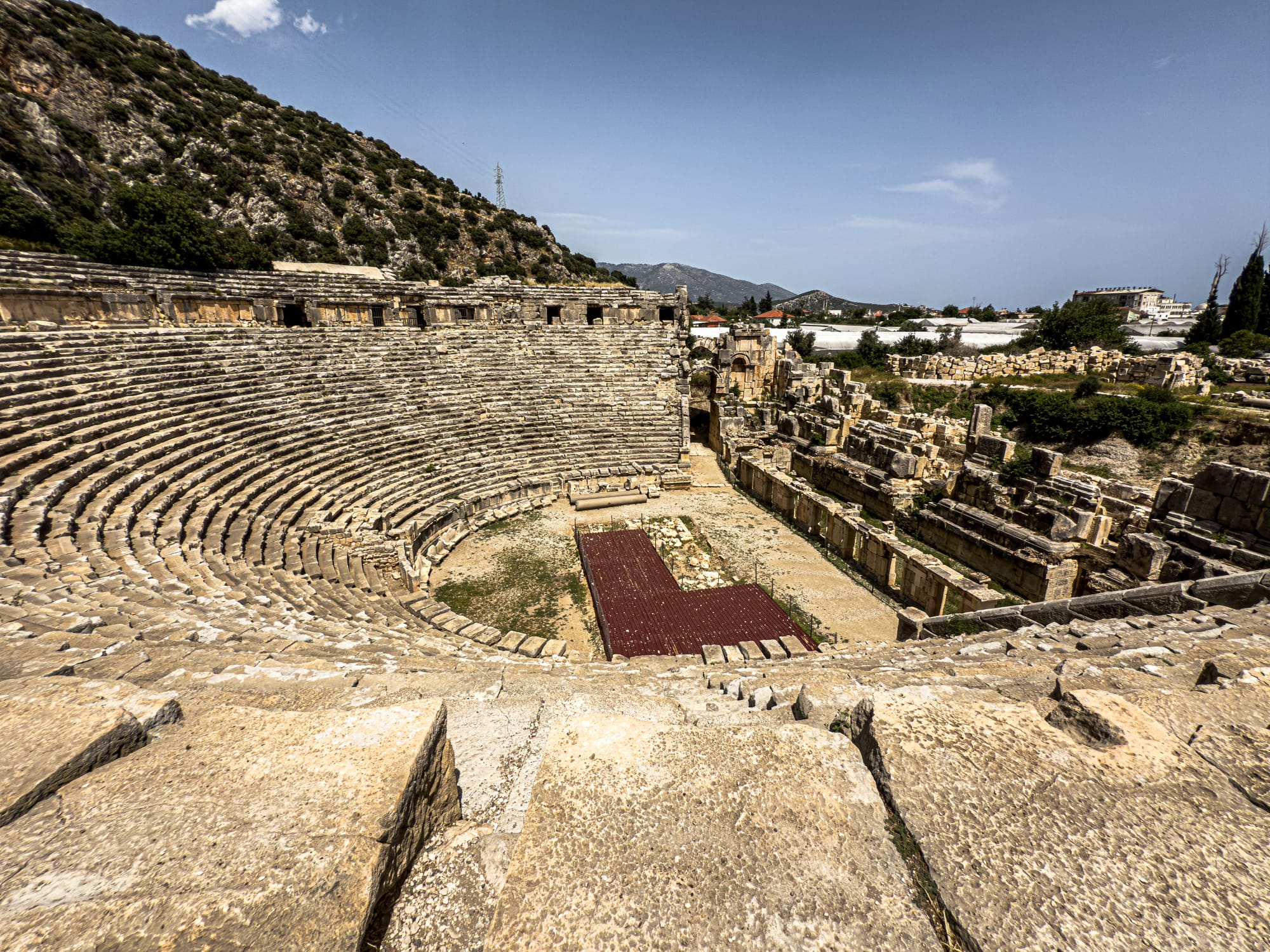
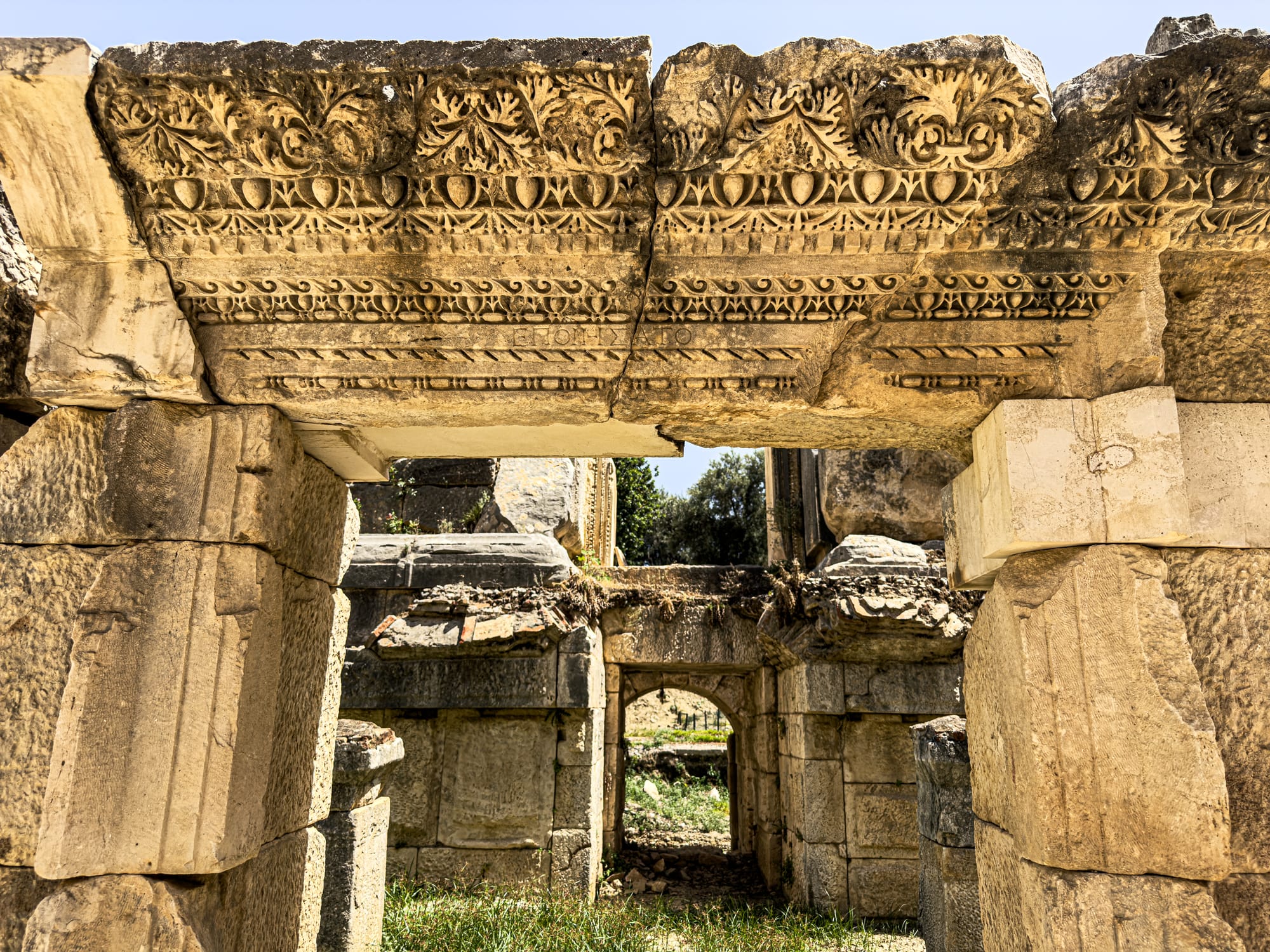
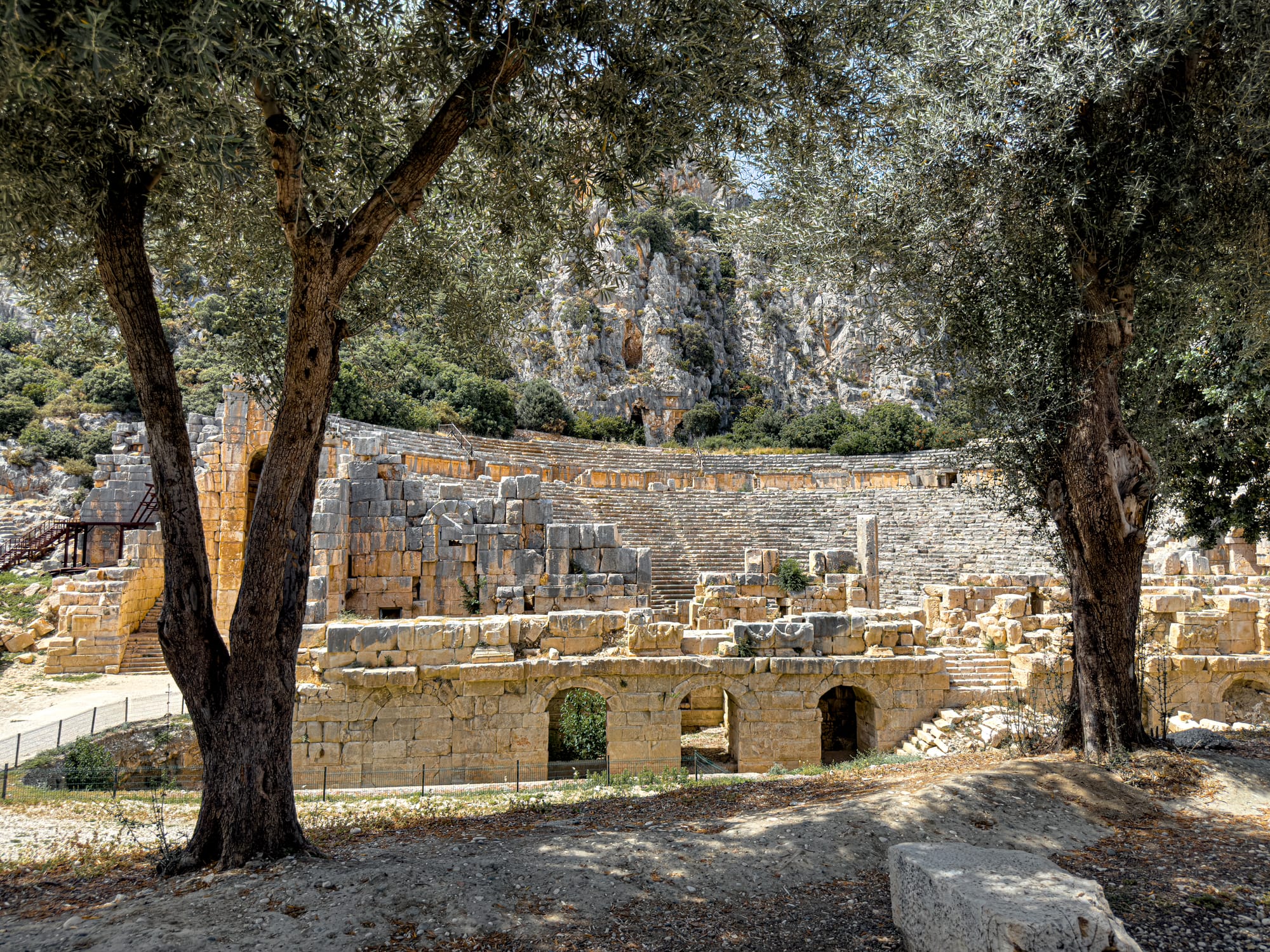
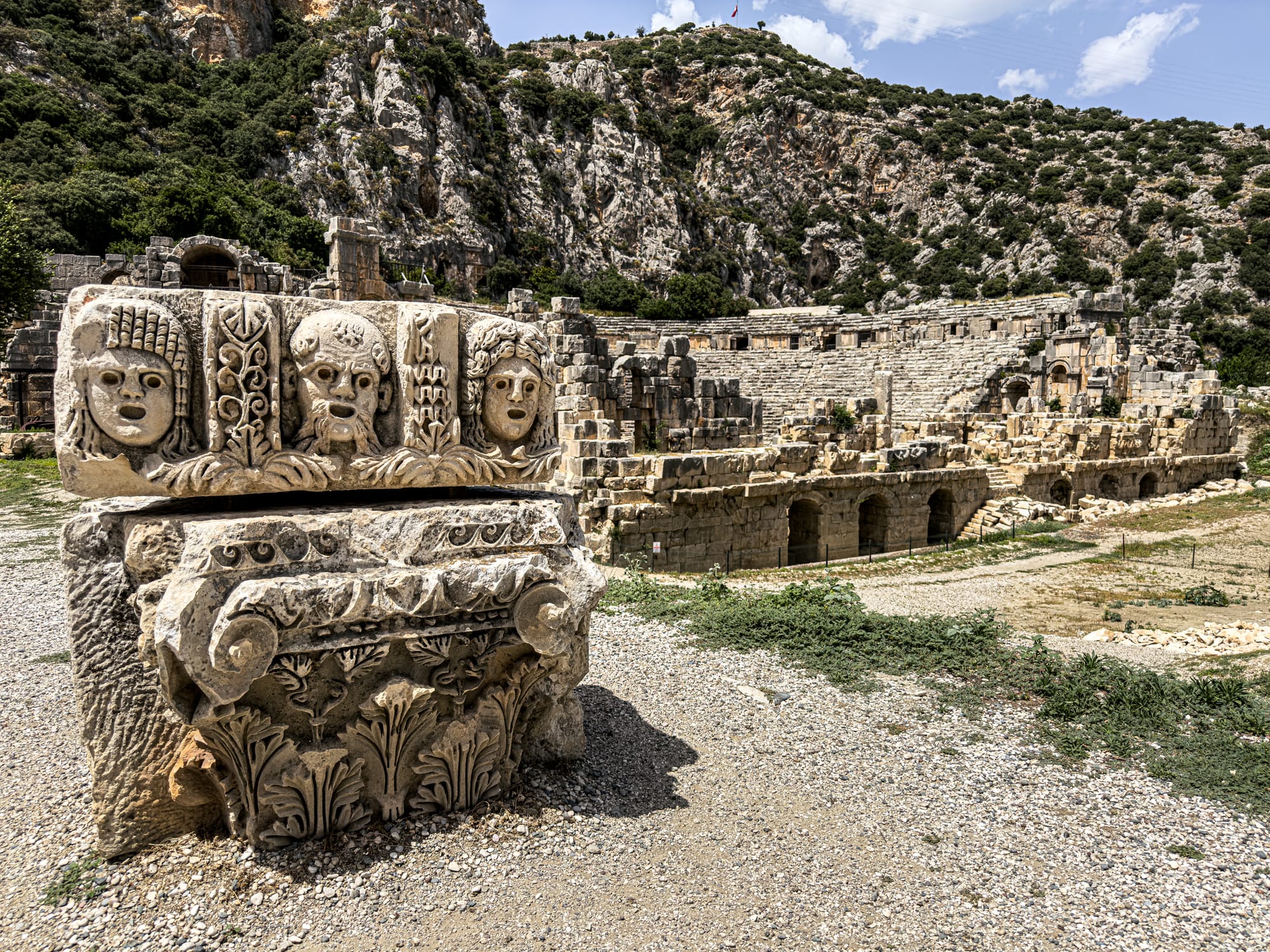
Views of Myra’s Roman theater from multiple angles, showing arches, carvings, and shaded stone paths
Roman theaters were not just venues for performance, they were civic symbols. They demonstrated Romanization, imperial patronage, and a city’s status within the empire. Myra’s theater likely hosted dramatic performances, public announcements, and religious festivals. The presence of so many theatrical masks in the sculpture fragments suggests a deep cultural investment in drama, not just as entertainment, but as a shared language of emotion and myth.
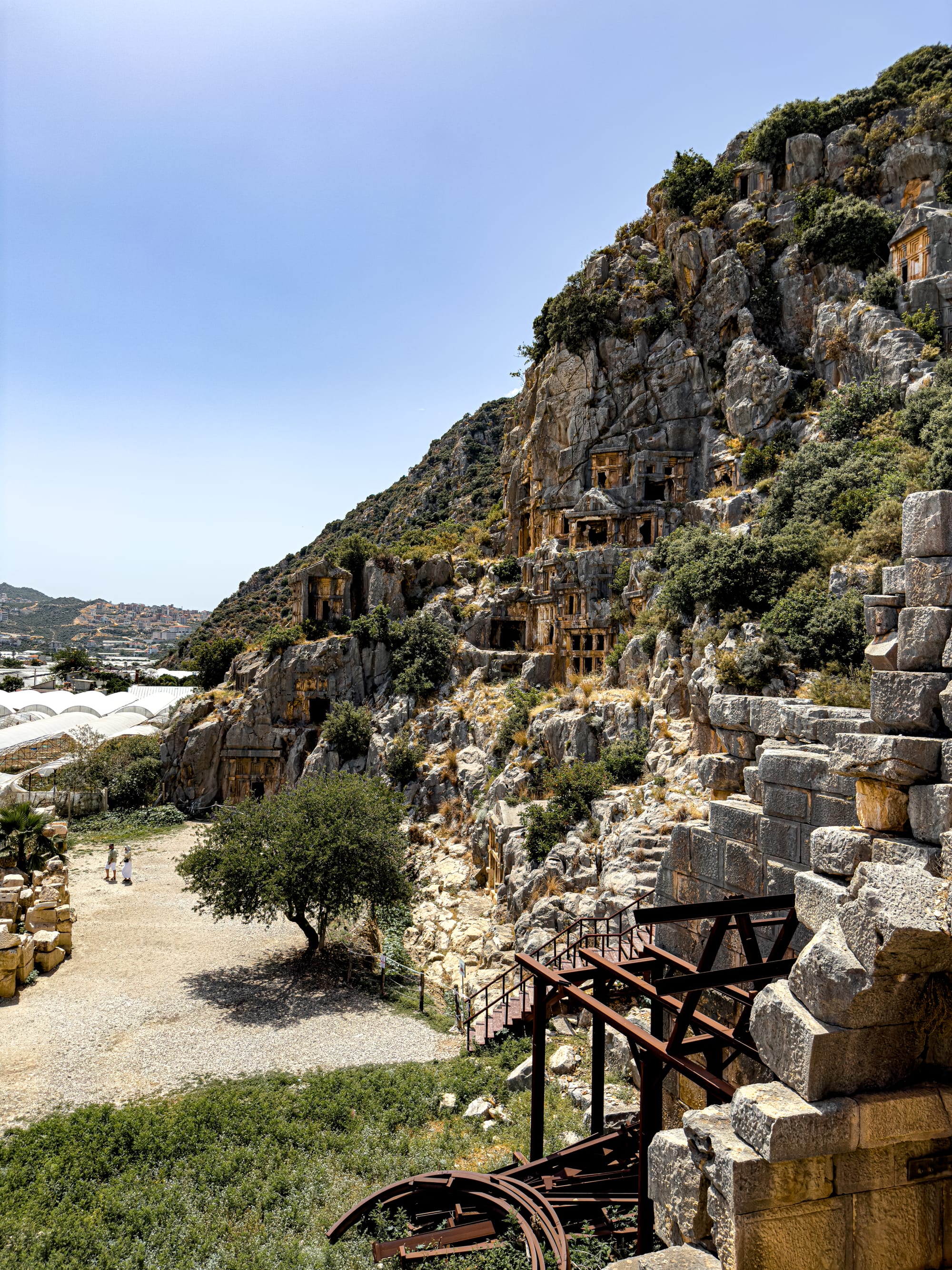
Look closely, and you’ll see flowers sprouting from between stone joints, their roots following the same lines carved by Roman chisels. Pause near the top, and your view extends to the carved tombs across the valley, giving you a simultaneous glimpse of Myra’s civic and funerary worlds. One for the living. One for the honored dead.
Photographs show this: the honey-colored stone gleaming under sun, the curved rows framing wildflowers, the contrast between solid architecture and encroaching nature.
Myra necropolis: Lycian rock tombs carved into the cliff
No image of Myra is more iconic than its rock-cut tombs, multistoried, temple-fronted facades etched into the cliffside like a vertical city. These aren’t anonymous resting places. Many were carved with detailed pediments, reliefs of family life, and inscriptions, some now lost. They mimic the look of Lycian homes, as if to suggest that the soul should remain among familiar comforts.
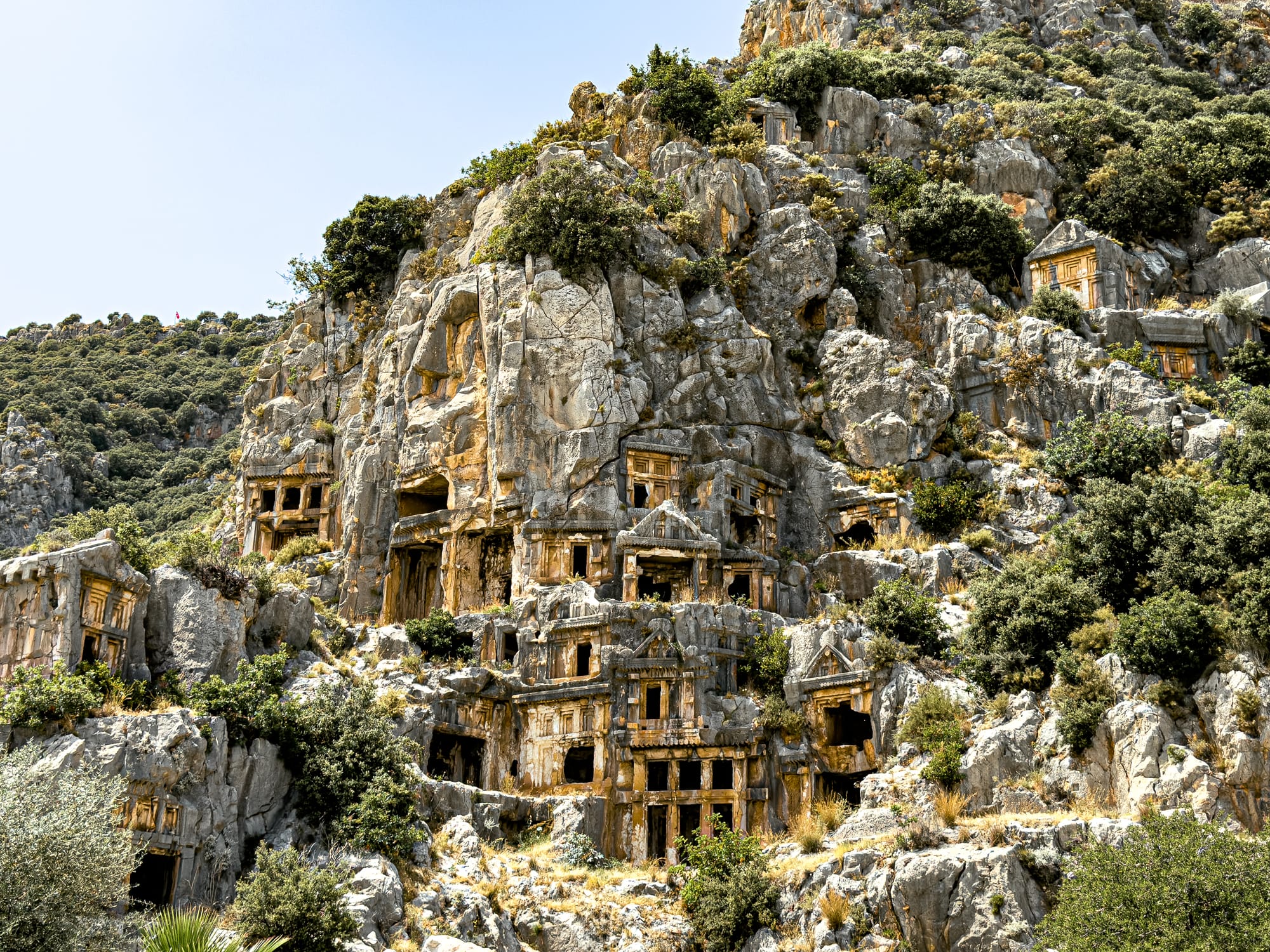
While some tombs are standalone sarcophagi, many are stacked, almost urban in density. And though looting over the centuries has left many empty or broken, the artistry endures. These aren’t just burial spaces, they’re declarations of lineage, belief, and architectural ambition.
Many Lycian tombs follow specific proportional patterns, a kind of sacred geometry that reflects both aesthetic and spiritual considerations. In Myra, the alignment of the tombs along the cliff may have followed a grid lost to erosion, but certain alignments remain visible. Tombs often face east, the direction of rebirth. The theater, too, is oriented toward the valley, giving it a naturally amplifying backdrop. These weren’t random choices. They were deliberate spatial compositions, meant to align human action with natural forces, sunlight, sound, elevation, and time.
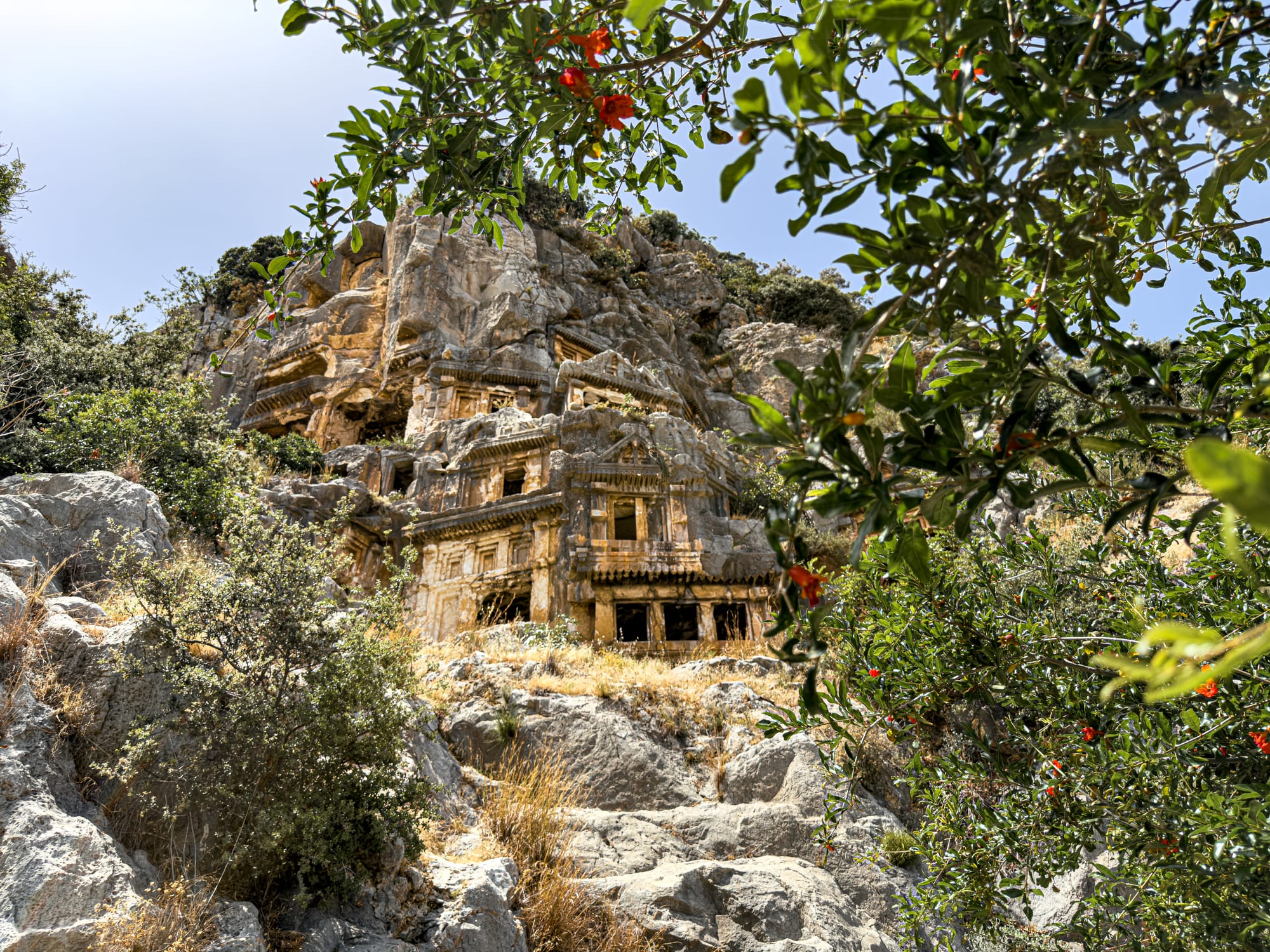
Approach from below and the necropolis looms, a honeycomb of memory. You can imagine the processions. The rituals. The sense of presence that the Lycian elite hoped would transcend death.
One of the astonishing facts about Myra is that almost all of it was carved on site from local stone. There was no quarry elsewhere, no imported marble. The city was sculpted out of the very cliffs it clung to. The engineering precision required to cut large, rectilinear tomb chambers directly into vertical rock faces, without modern tools, is difficult to overstate.
Stone storytelling: expressive carvings in the open air
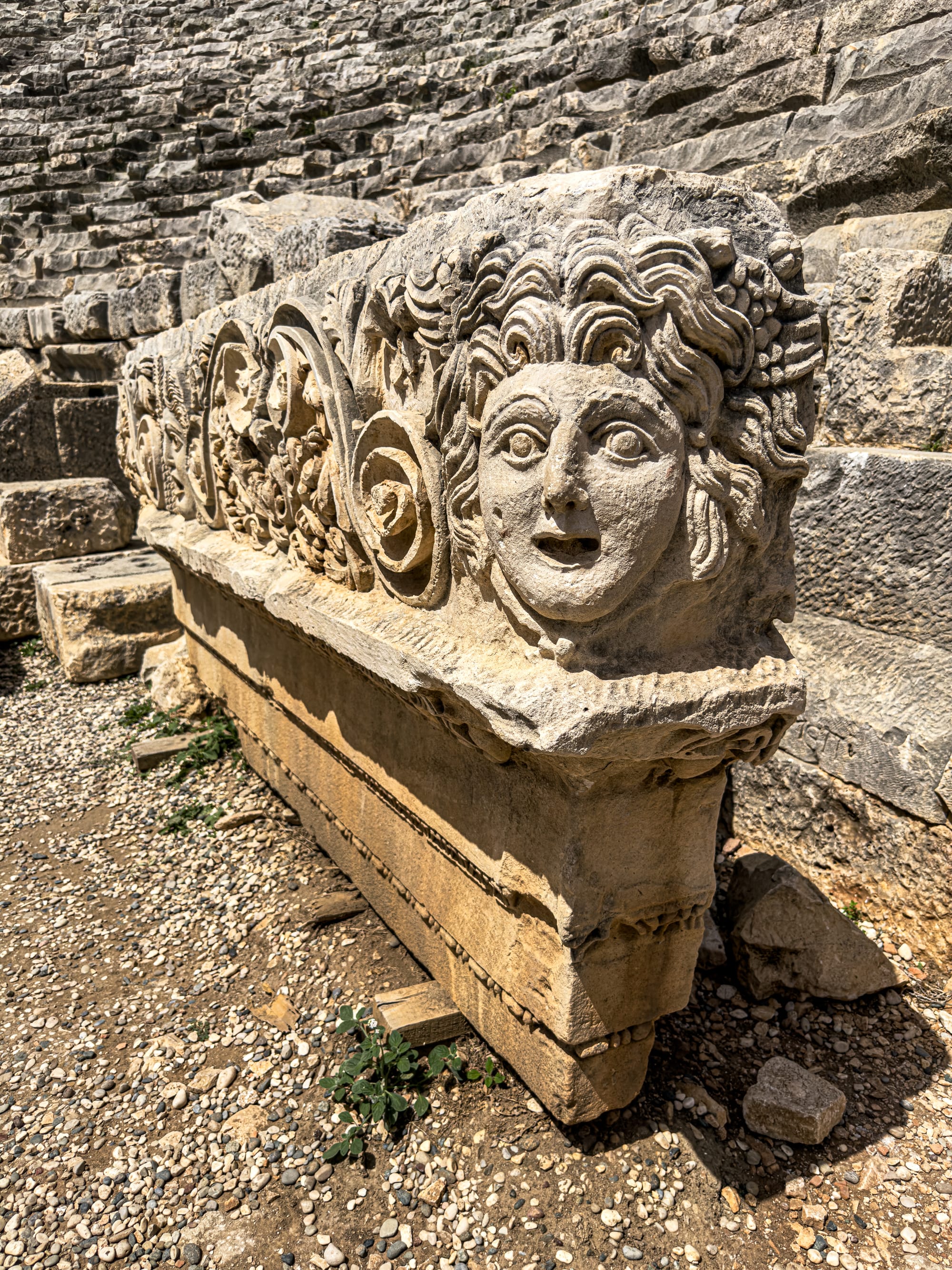
What’s most arresting in Myra isn’t just scale. It’s the expressiveness of the sculptural work. Walk through the open-air sculpture garden and you’ll see countless carved stone blocks, each a fragment of narrative.
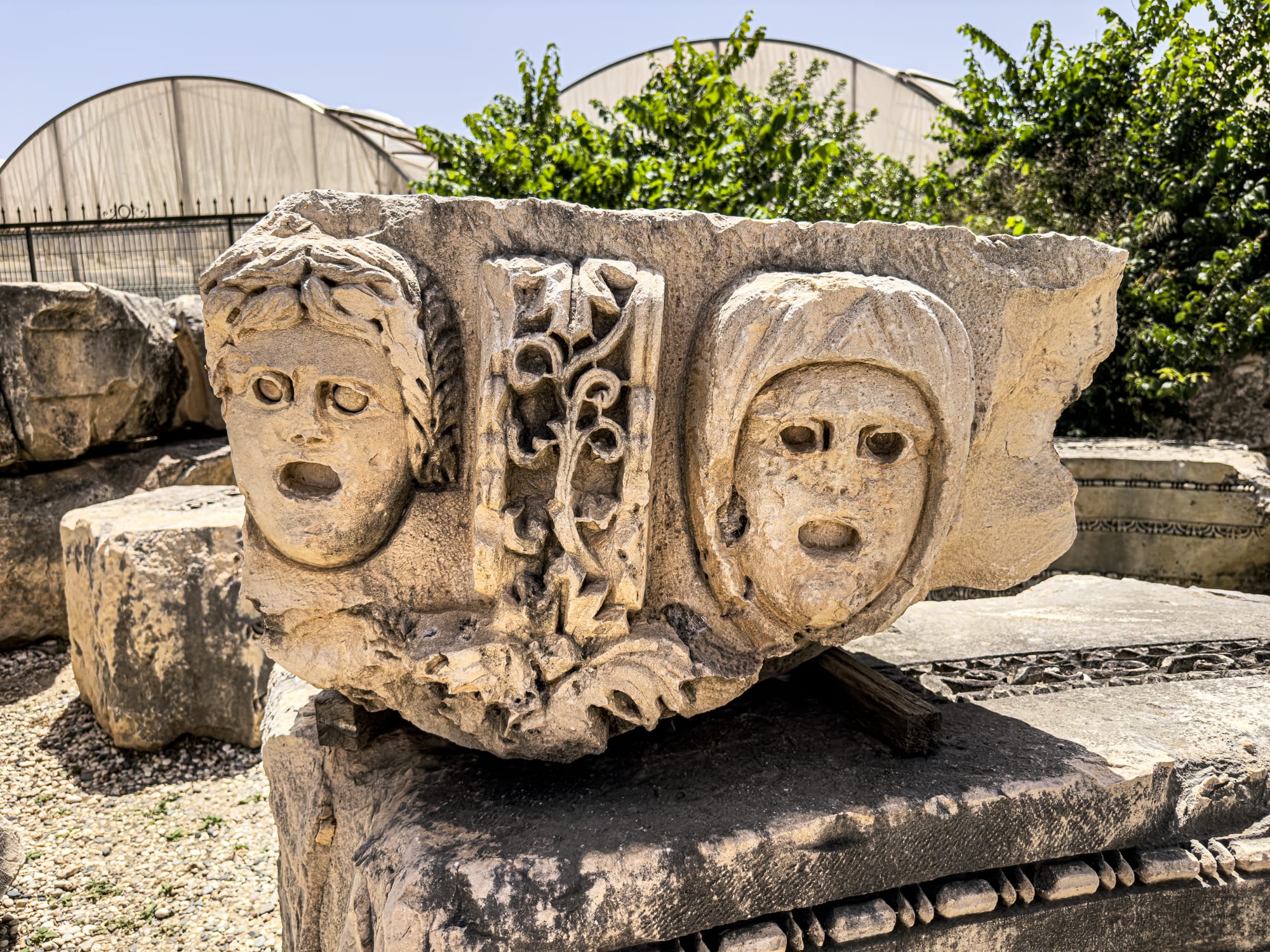
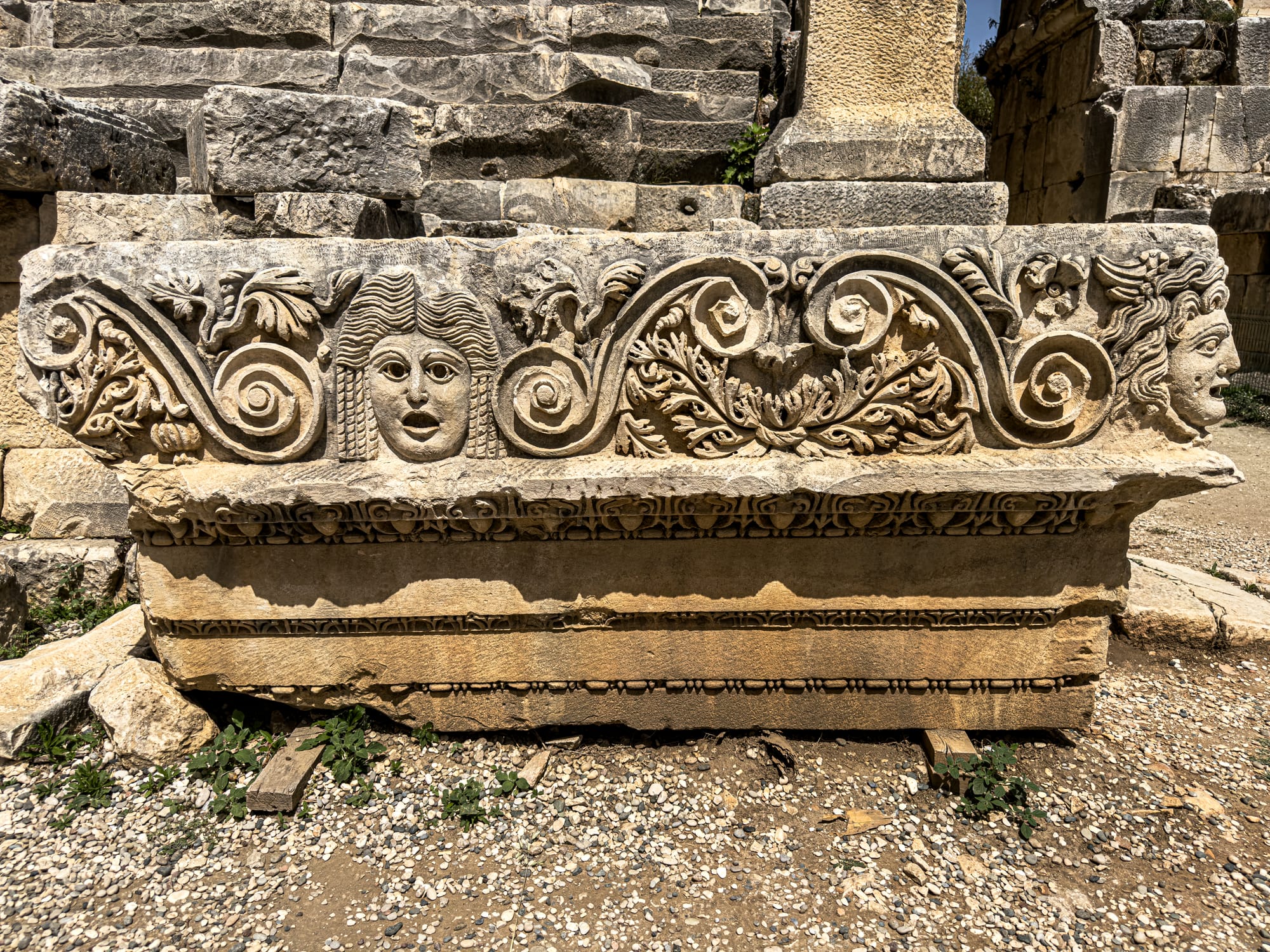
There are theatrical masks with exaggerated mouths and arched eyebrows. There are Medusa heads, floral rosettes, scrolls, lions, and eagles. Some faces are serene. Others appear mid-speech, as if caught in conversation. These weren’t mere decorations, they served specific architectural purposes while also conveying mythology, mood, or civic identity.
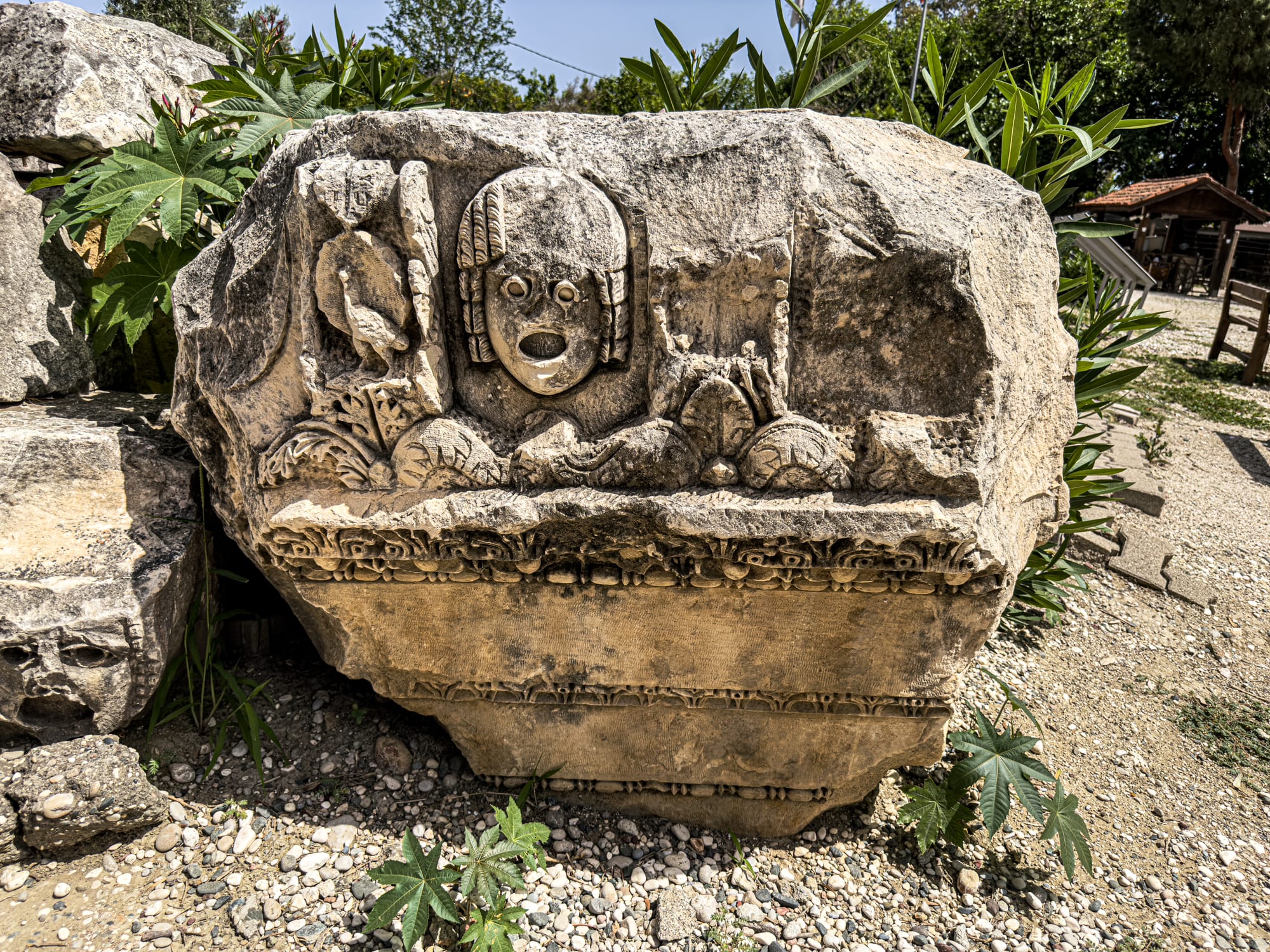
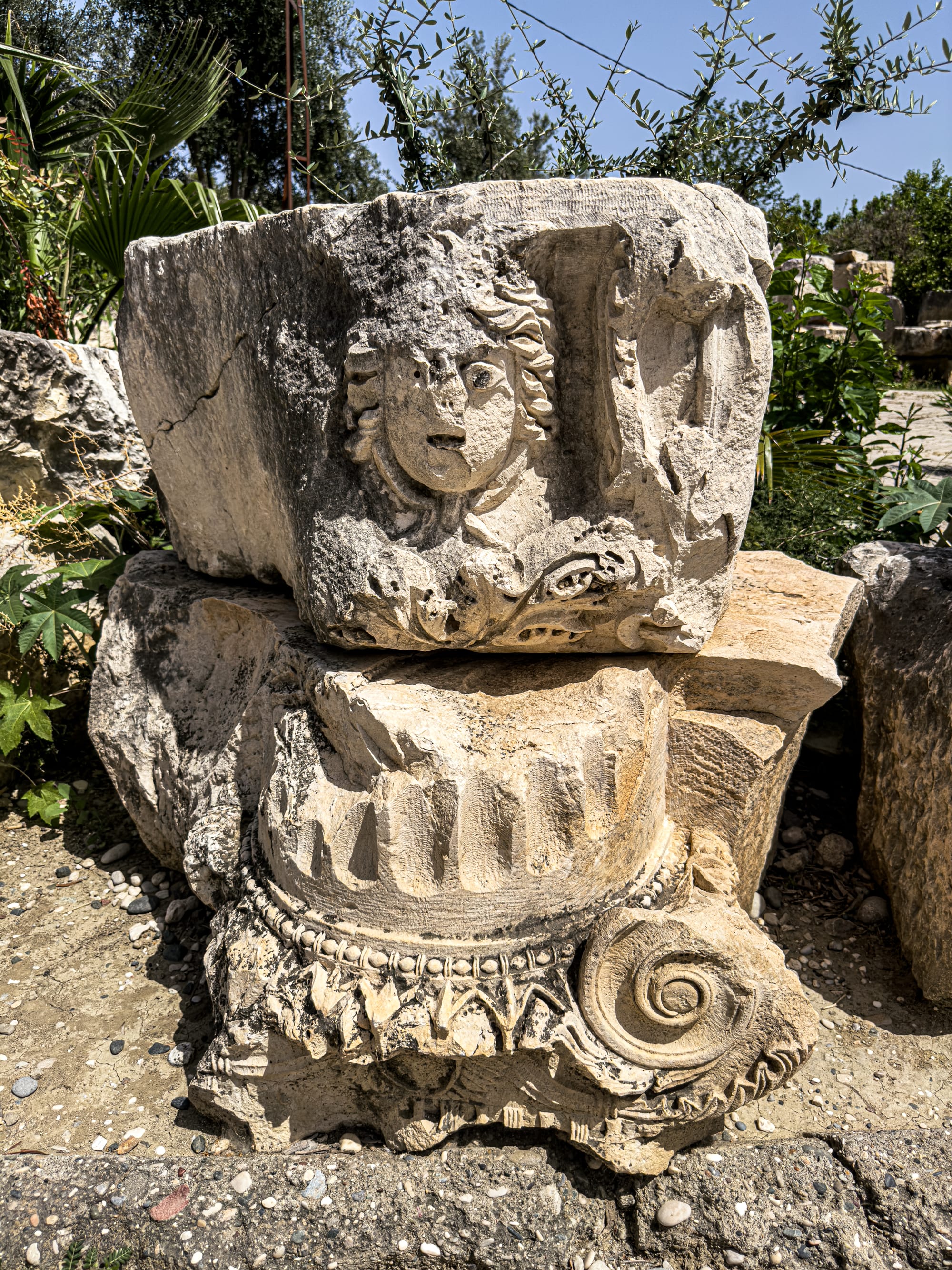
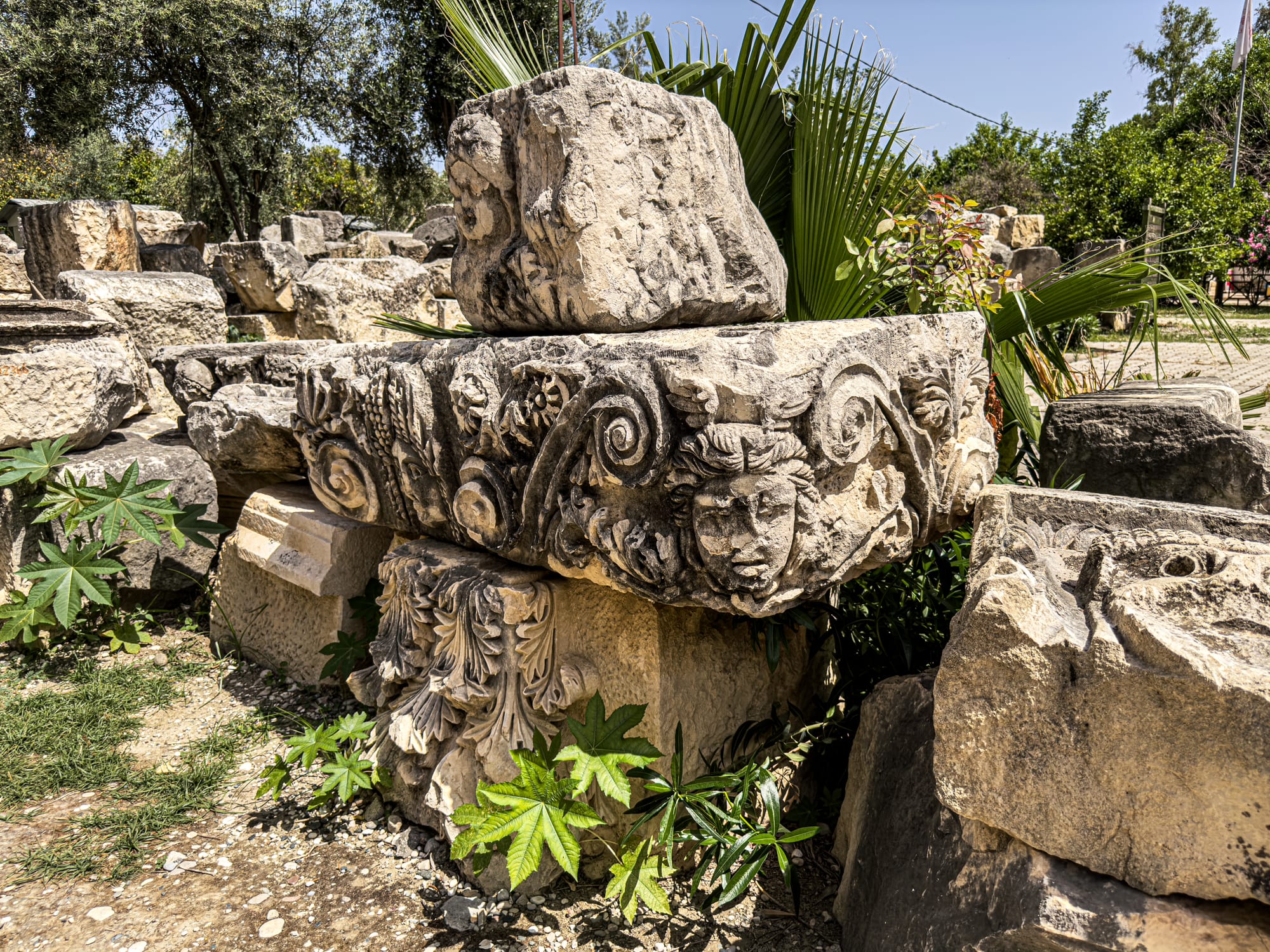
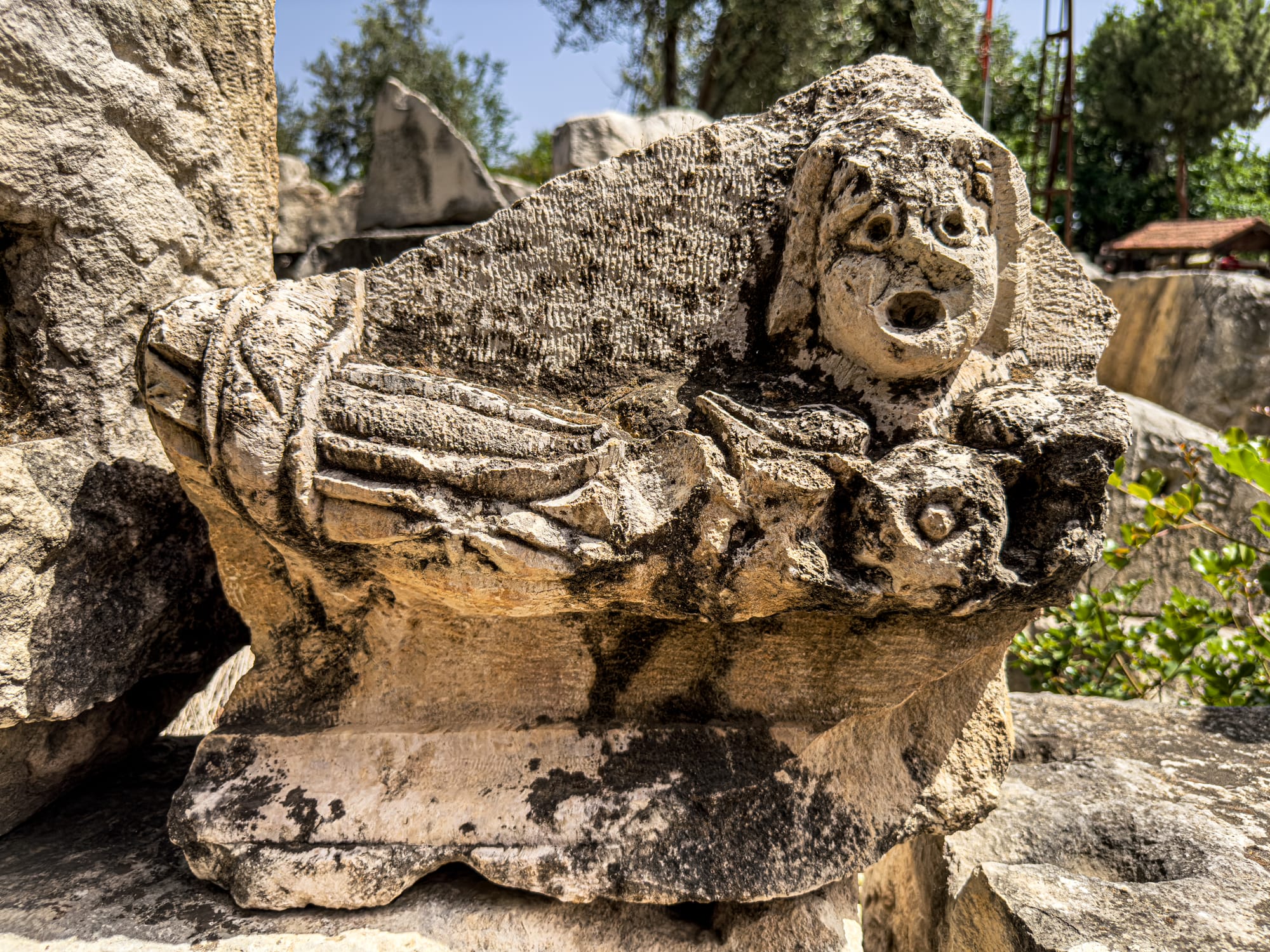
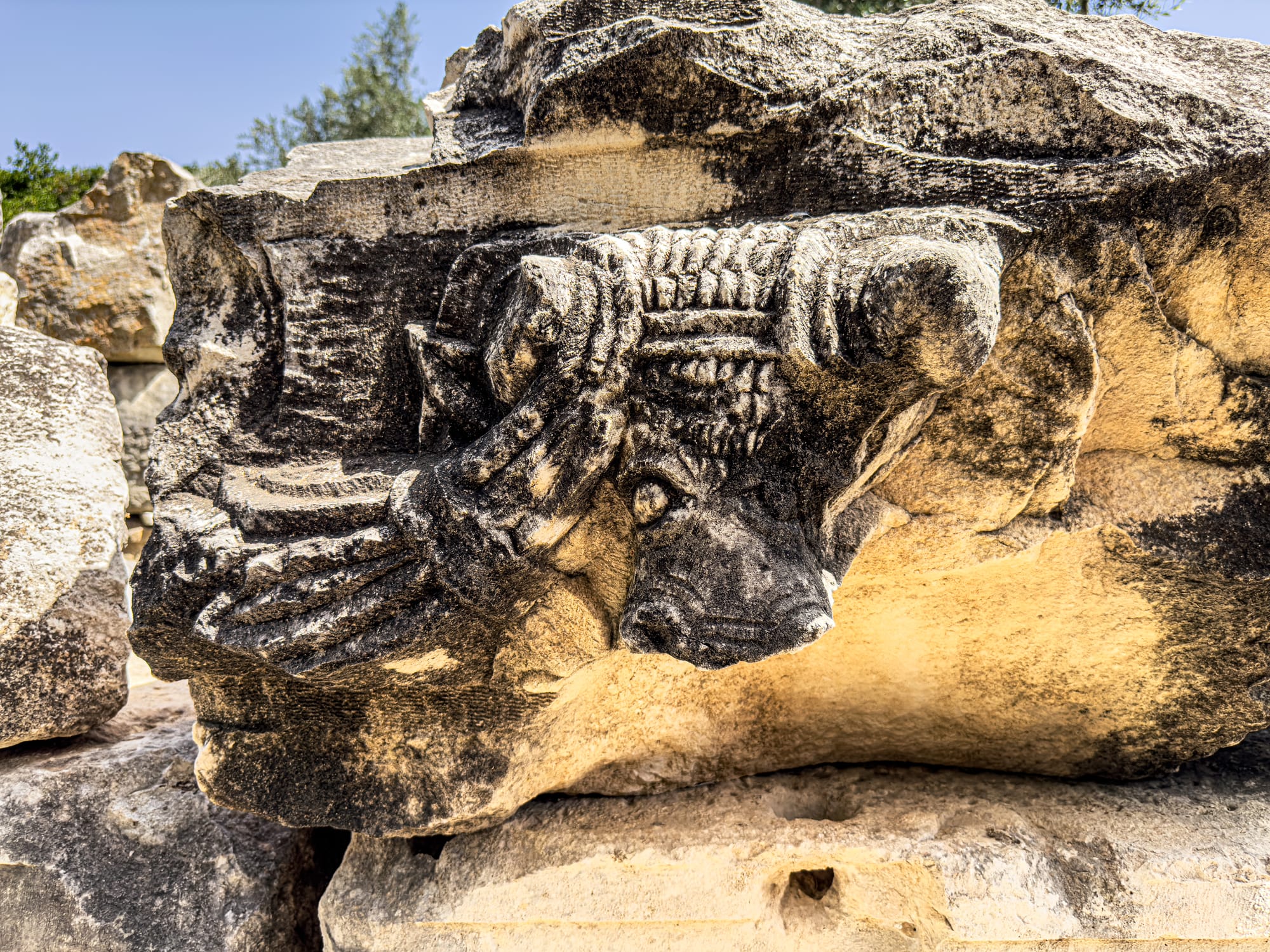
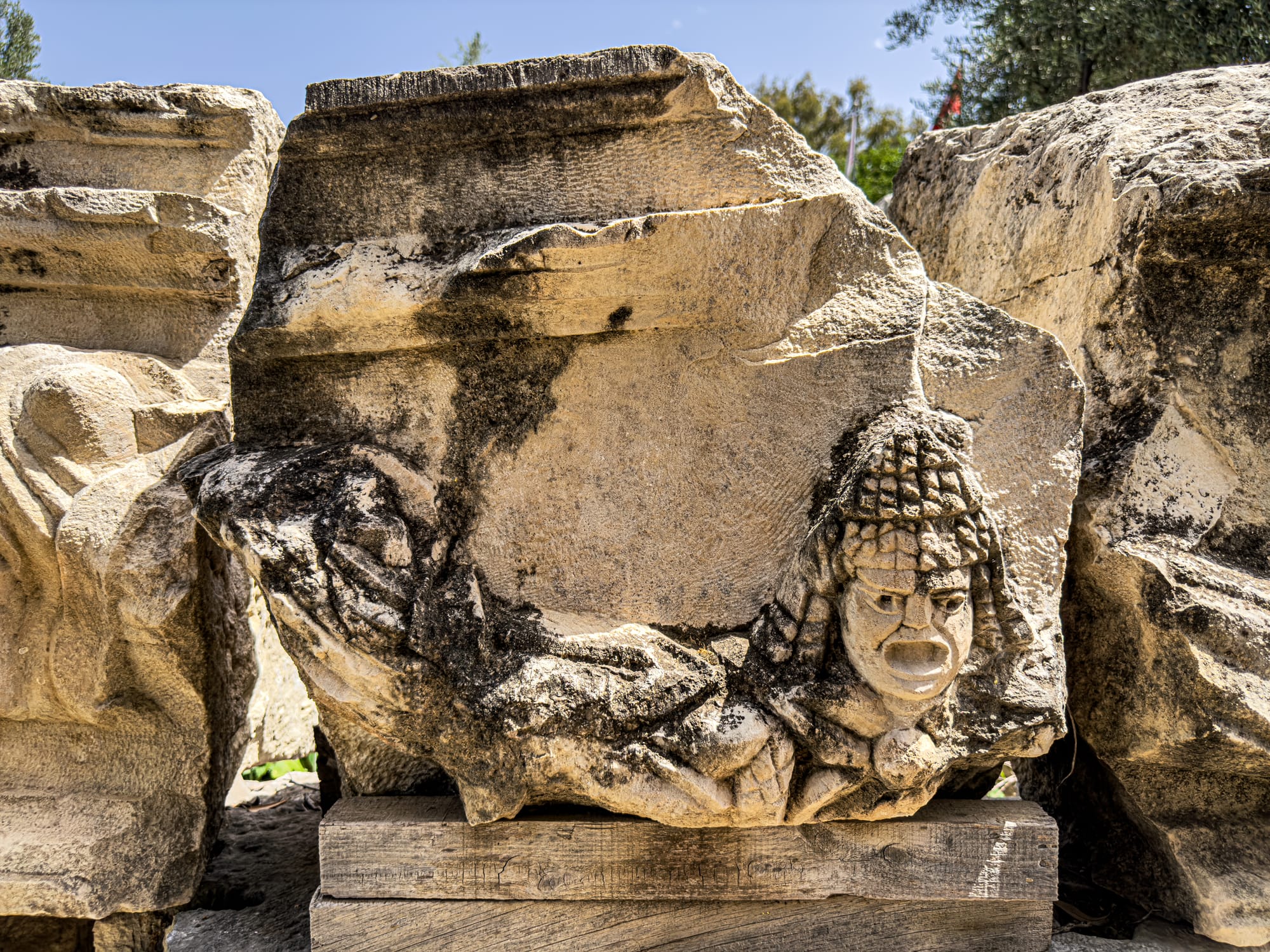
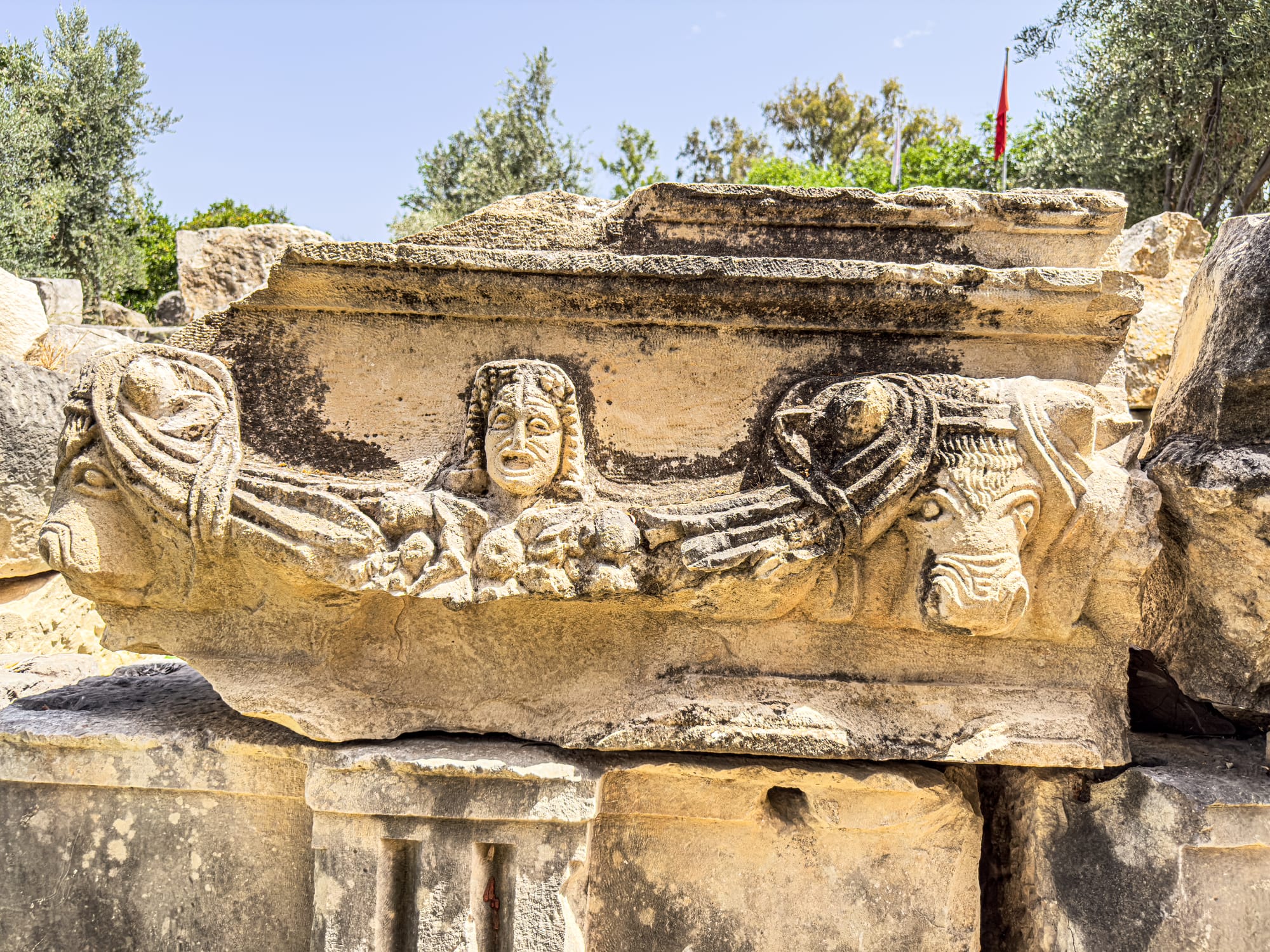
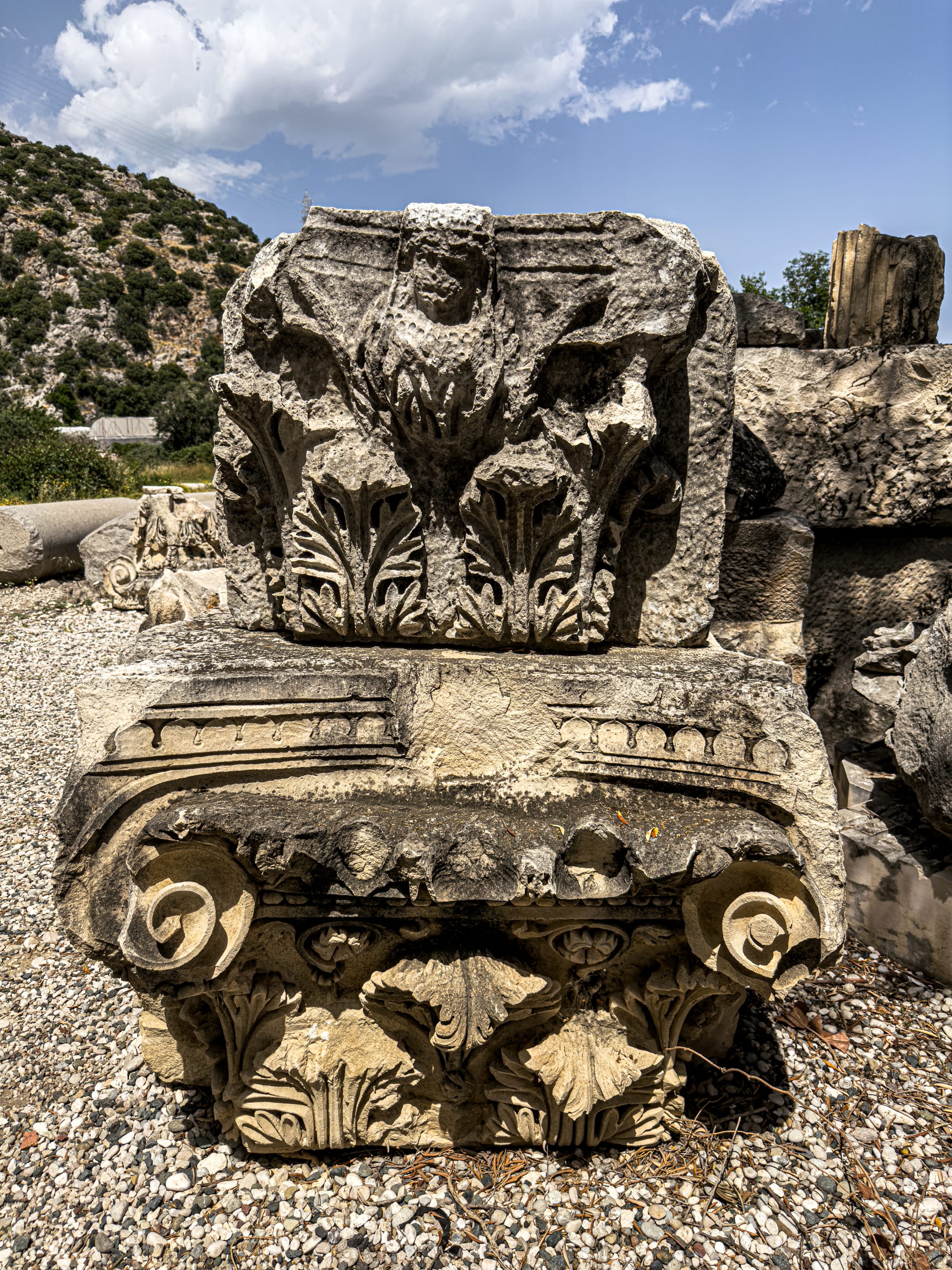
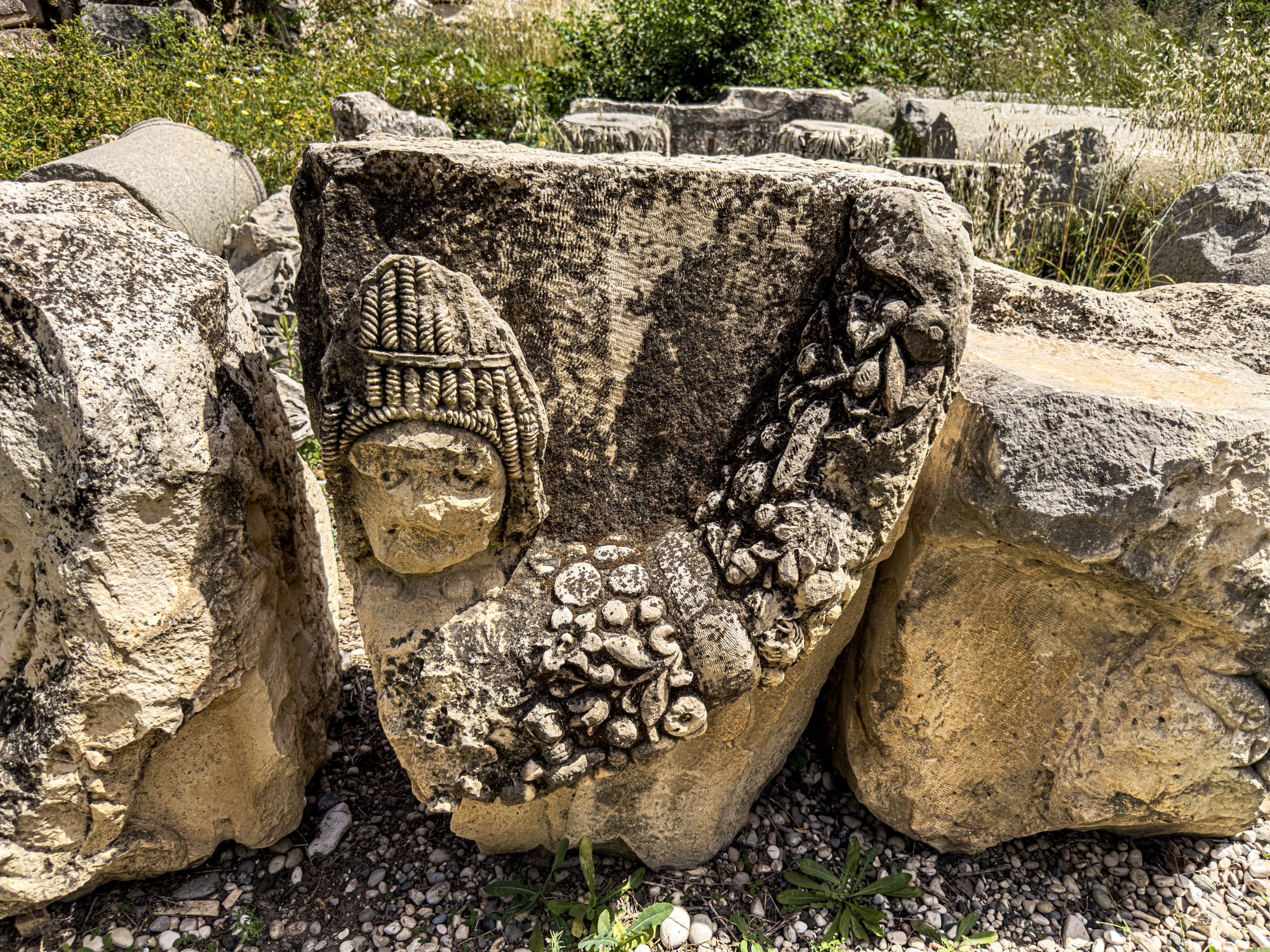
Fragments of stone carvings scattered across Myra’s open-air sculpture garden, full of expressive details
Many were likely part of the theater’s stage building or other civic structures, dislodged by earthquakes or time. Some show chisel marks. Others, deep weathering. But the craftsmanship is undeniable.
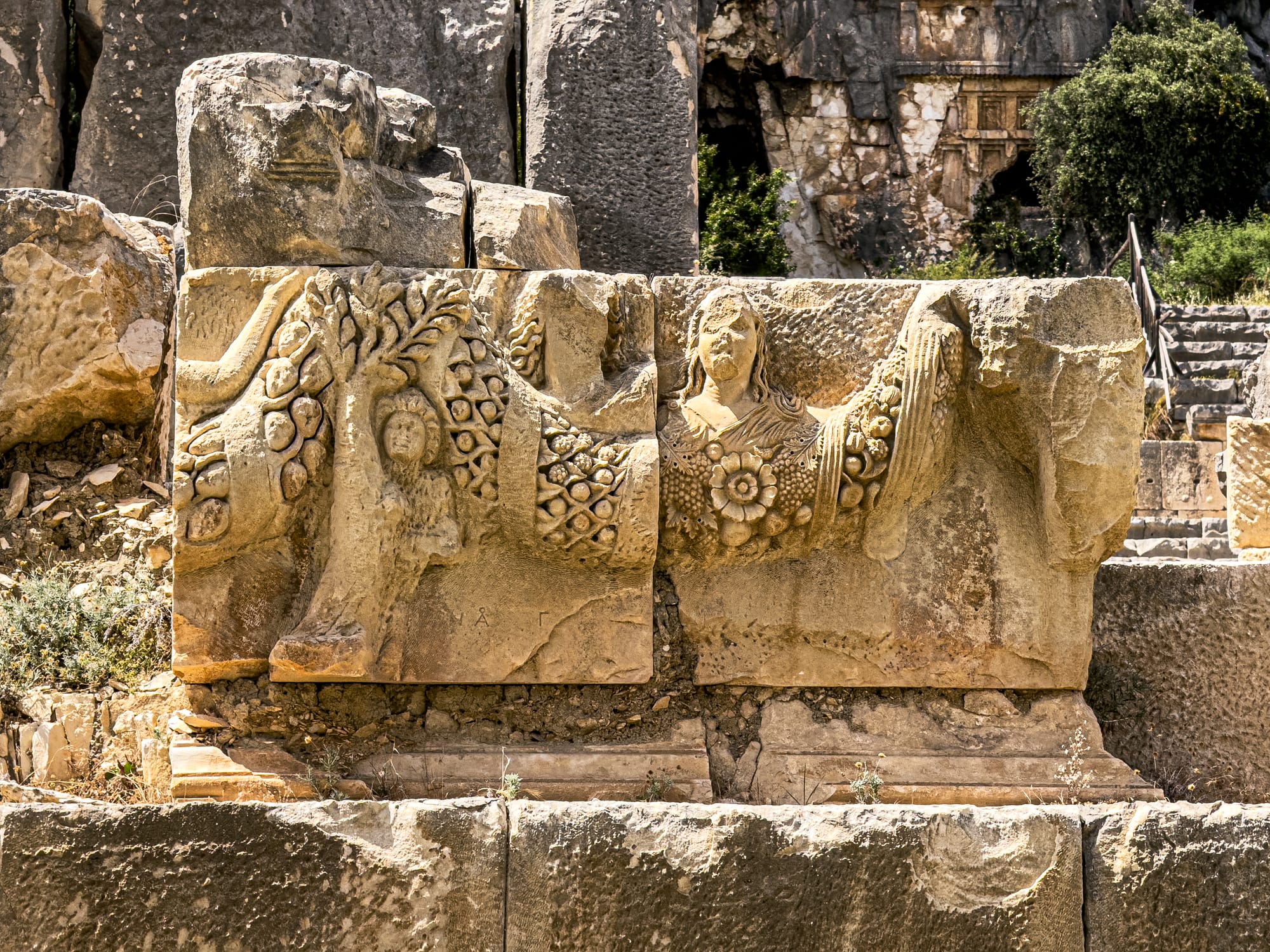
Close-ups reveal this drama: the curve of a lip, the precision of a curl, the way shadow and light move across ancient cheekbones.
Masks, garlands, and divine theater
The sculptural fragments scattered throughout Myra suggest a sophisticated visual vocabulary rooted in mythology, civic pride, and ritual performance. Masks, often associated with Dionysian theater, appear in exaggerated forms, wide-mouthed, furrow-browed, ecstatic. Interspersed among them are garlands of laurel and ivy, symbols of victory, fertility, and festivity.
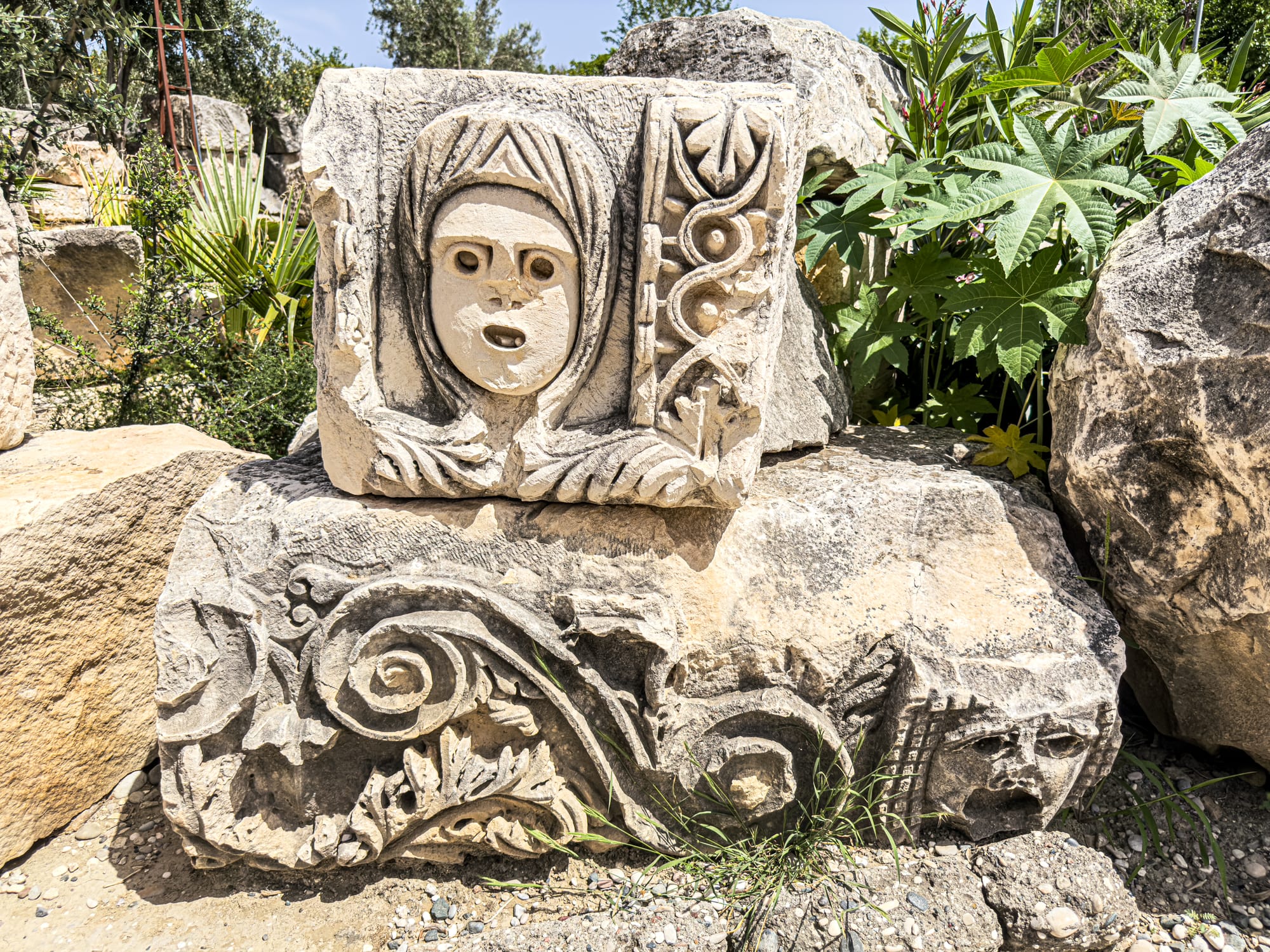
These weren’t merely decorative; they were part of a coded language that connected Myra to both Greco-Roman artistic tradition and local religious expression. One carved block might contain a chorus of motifs: a thyrsus staff, a wine jug, a mask with arched brows, all indicators of a city in constant dialogue with performance and celebration.
The Medusa motif: protection and paradox
Among the carvings near the theater and tombs, Medusa heads are surprisingly frequent. The gorgon (part monster, part warning) was commonly used in Roman architecture as a protective symbol, meant to ward off evil.
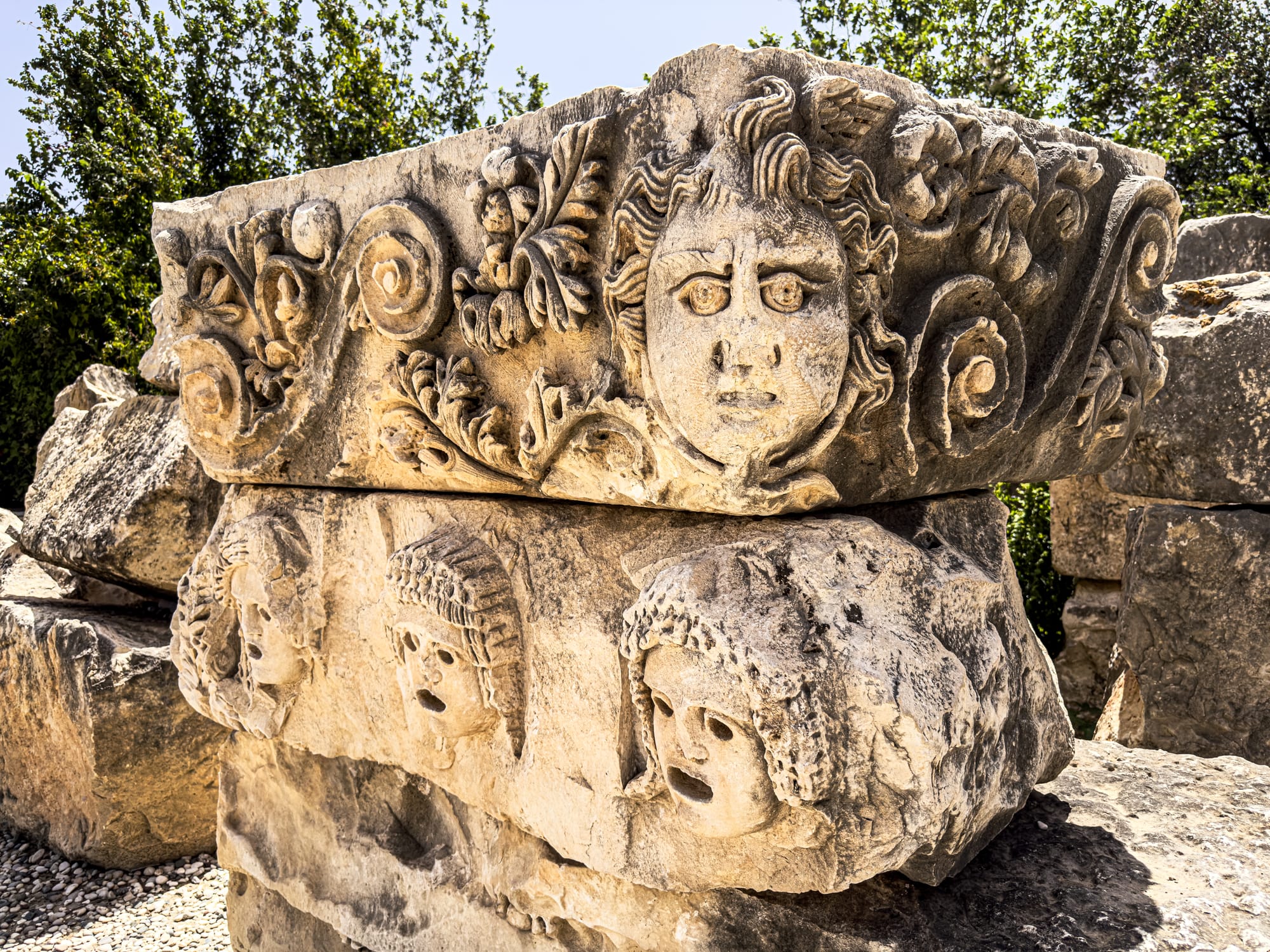
At Myra, the Medusa appears with a stylized expression, neither ferocious nor benign, but somewhere in between. Her presence near funerary sites and theatrical spaces points to a broader belief in the protective power of image.
The paradox of using a petrifying gaze to protect carved stone gives these motifs an almost poetic weight, guardians embedded within the architecture itself.
Pattern as protection, not just decoration
Repeated across friezes and lintels are patterns that at first seem purely ornamental: bead-and-reel borders, egg-and-dart moldings, palmette scrolls. But in Lycian and Roman contexts, these motifs carried layered meanings. The bead-and-reel, for instance, symbolized continuity and the flow of life. Palmettes, leaf-like fans, were associated with resurrection and victory over death.
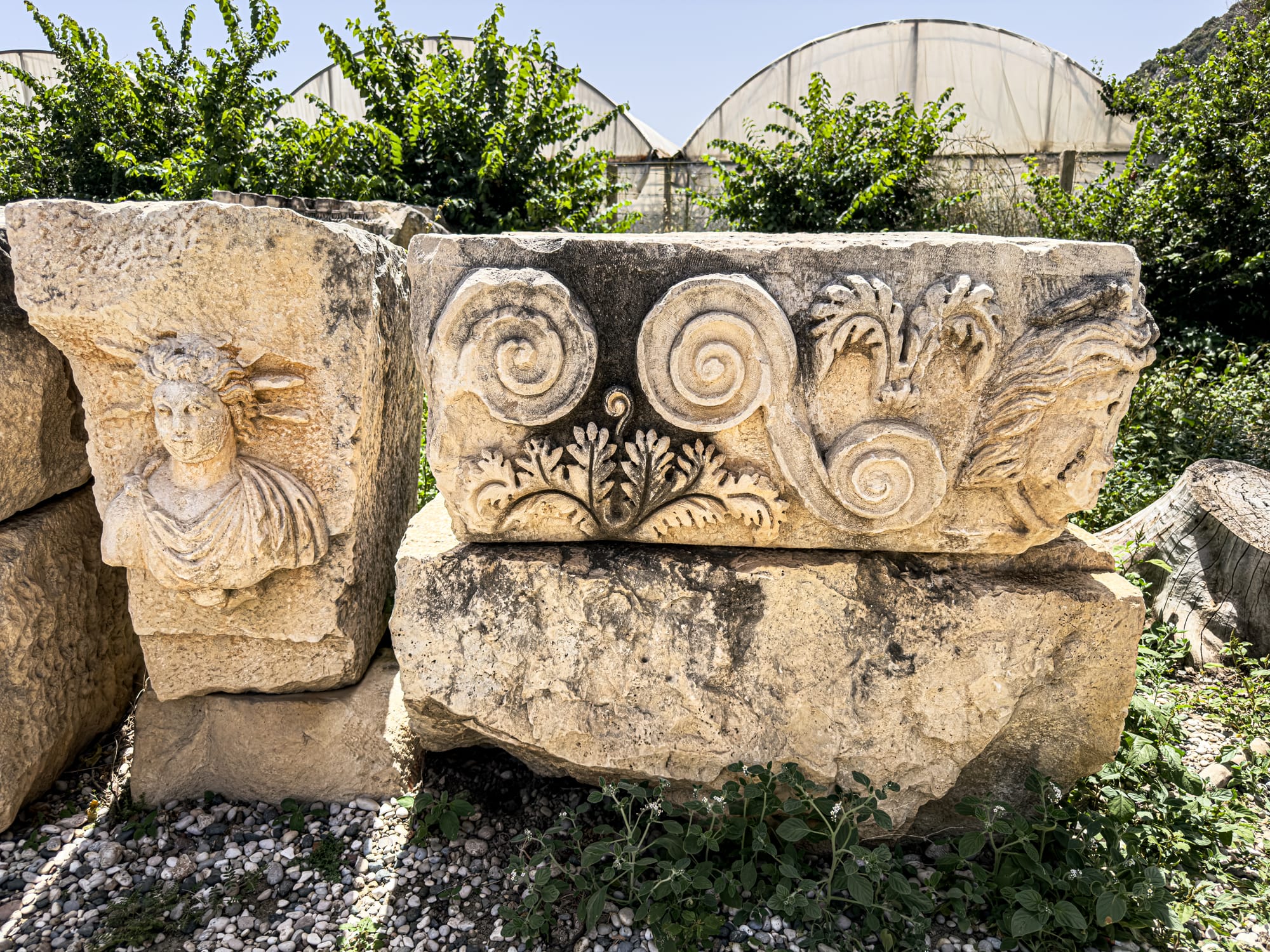
These repeating patterns weren’t just decorative flourishes. They were visual prayers: geometric offerings that encircled sacred space with symbolic assurance.
Portraiture and the politics of remembrance
Though most of Myra’s sculpture now lies fragmented, some carved heads suggest attempts at true portraiture, real faces, not just idealized forms. In Roman civic sculpture, such individualized representations were often reserved for benefactors or public figures.
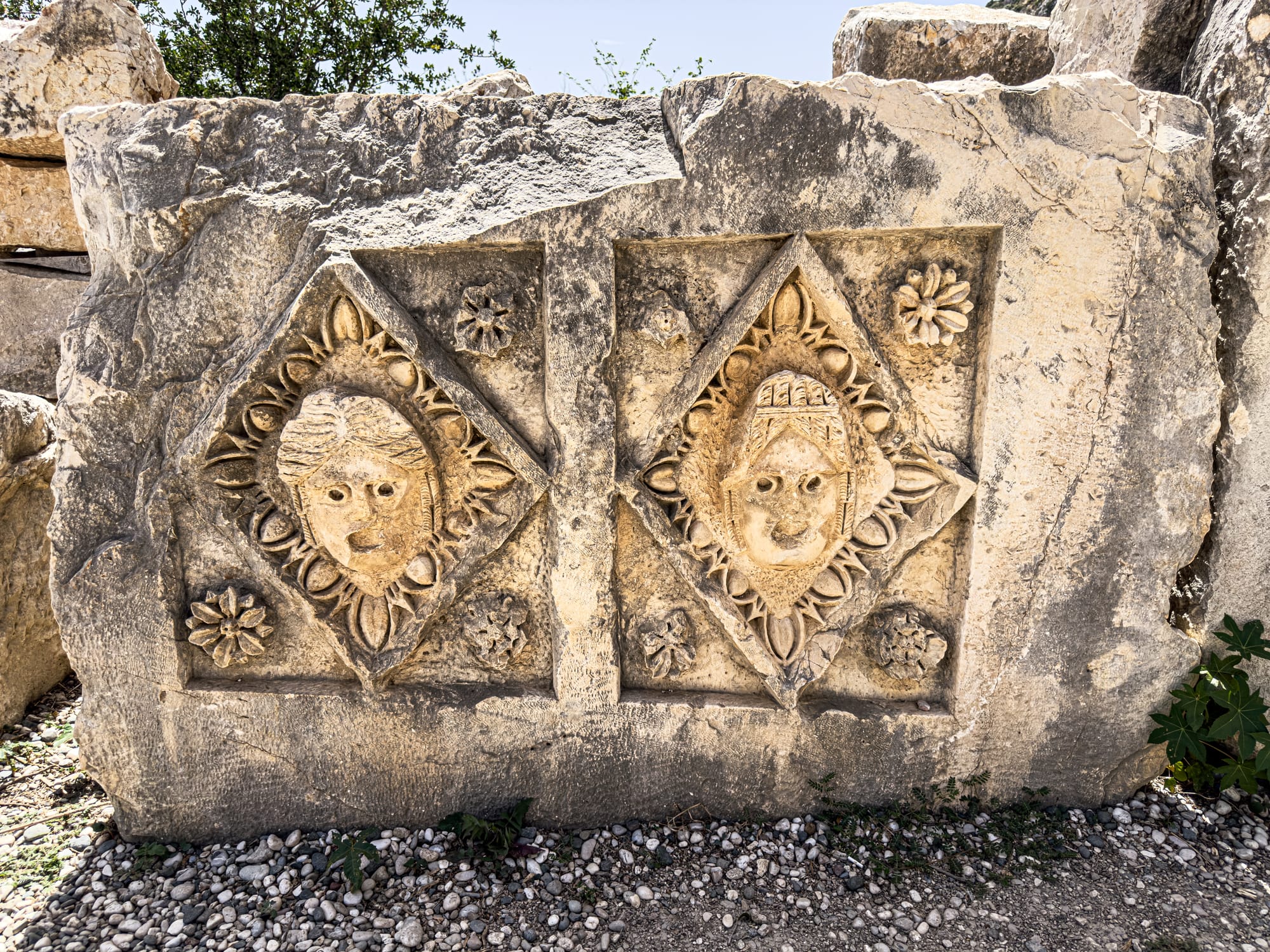
At Myra, these remnants may indicate a culture of visible memory: to honor someone wasn’t simply to bury them; it was to place their likeness into the city’s enduring materials.
A city carved from belief
The ingenuity of Lycian and Roman stonework is evident everywhere in Myra, not just in theaters and tombs, but in city infrastructure. The roads, the drainage channels, the use of elevation and sunlight. It was a city carved not just from rock, but from belief.
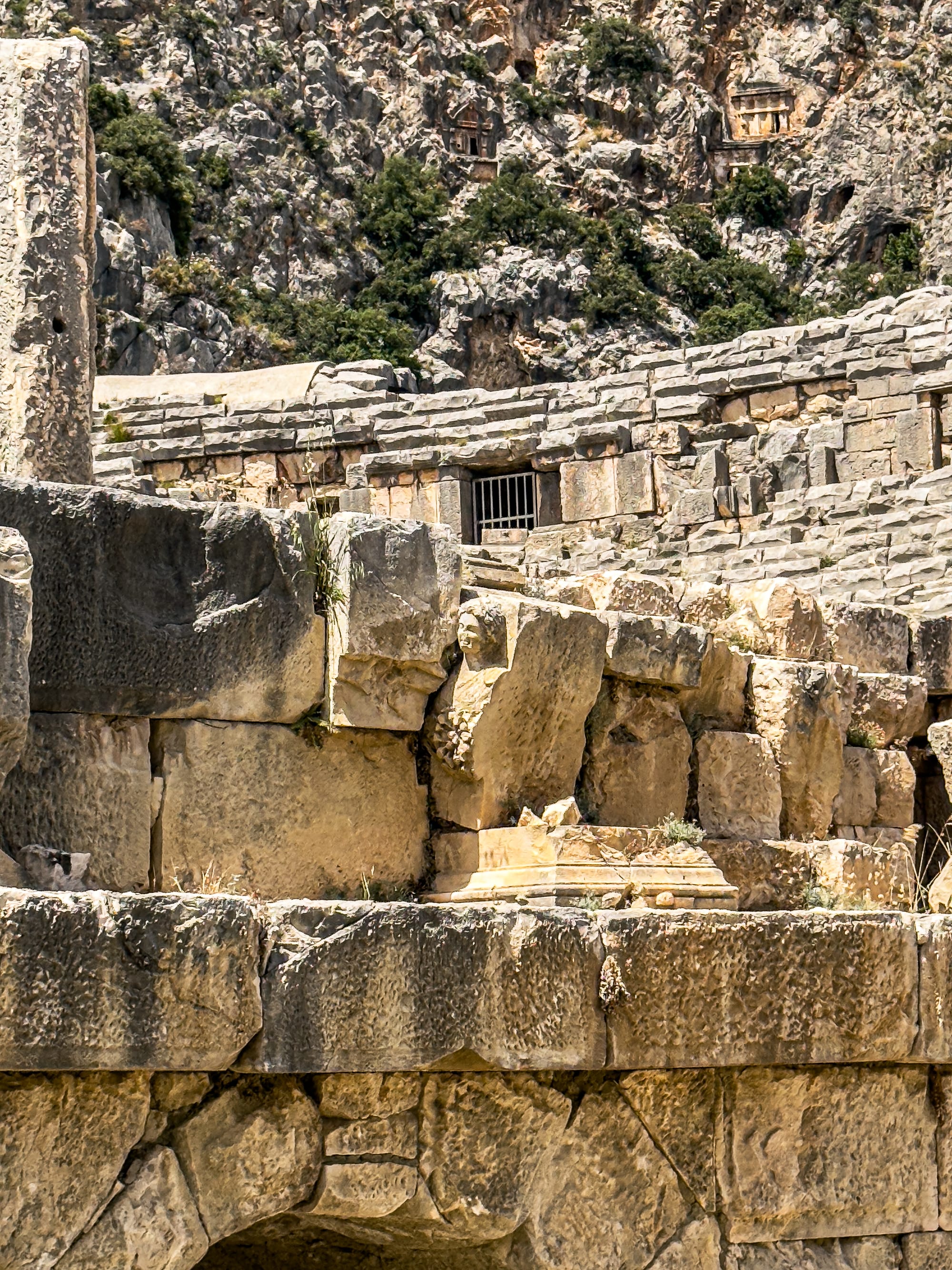
As with Termessos, the absence of modern intrusions enhances the atmosphere. Though more visited, Myra still offers moments of quiet, especially in early morning. The stone retains the night’s coolness. Oleander petals fall soundlessly. And among fragments of gods, rulers, and citizens, you walk not as a spectator, but as a participant.
Earthquakes and the reshaping of Myra
Myra, like much of Lycia, was shaped by seismic activity as much as it was by politics and religion. The region sits atop a seismically active zone, and archaeological evidence shows that multiple earthquakes altered Myra’s architecture over time. The Roman theater, for example, was rebuilt after a major tremor in the 2nd century CE. Some of the fragmented sculptures and dislodged architectural blocks seen today may not have fallen from neglect, but from the earth itself shaking the city apart.
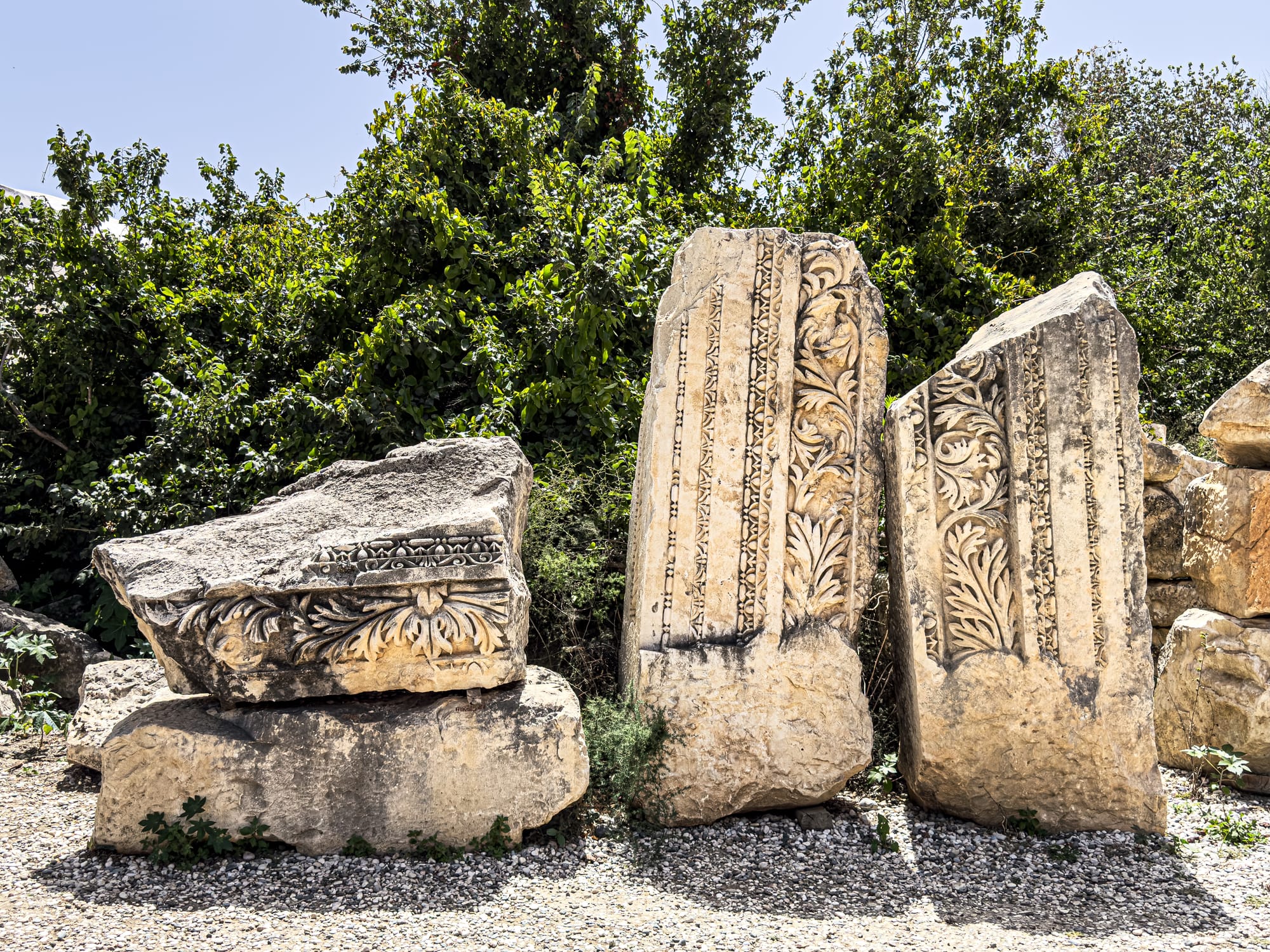
In a strange way, these natural disruptions have contributed to Myra’s expressive landscape, exposing layers that might otherwise have remained buried.
Archaeological work at Myra continues to uncover new layers. In 2026, researchers from Akdeniz University announced the discovery of an 1,850-year-old thermal complex dating to the 2nd century CE, adding another dimension to the understanding of Roman civic life in the city.
A layered afterlife
Myra’s story didn’t end when its last civic building was abandoned. Over the centuries, locals repurposed its stones for new homes, churches, and even agricultural walls. Some tombs were reused by later Christian communities, while others became makeshift shelters. During the 19th century, European travelers, eager to photograph or sketch ancient cities, “discovered” Myra anew, often romanticizing its decay.
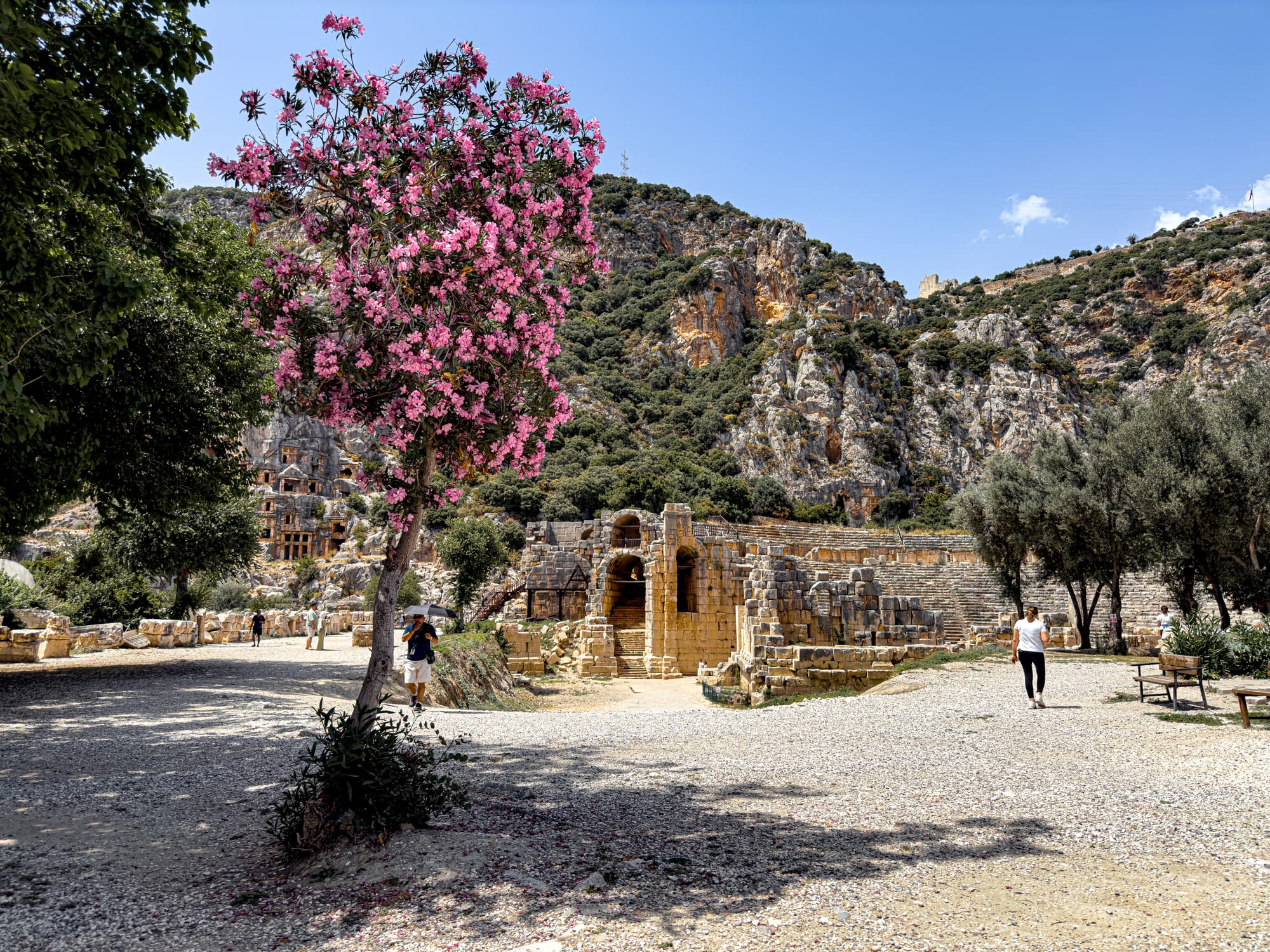
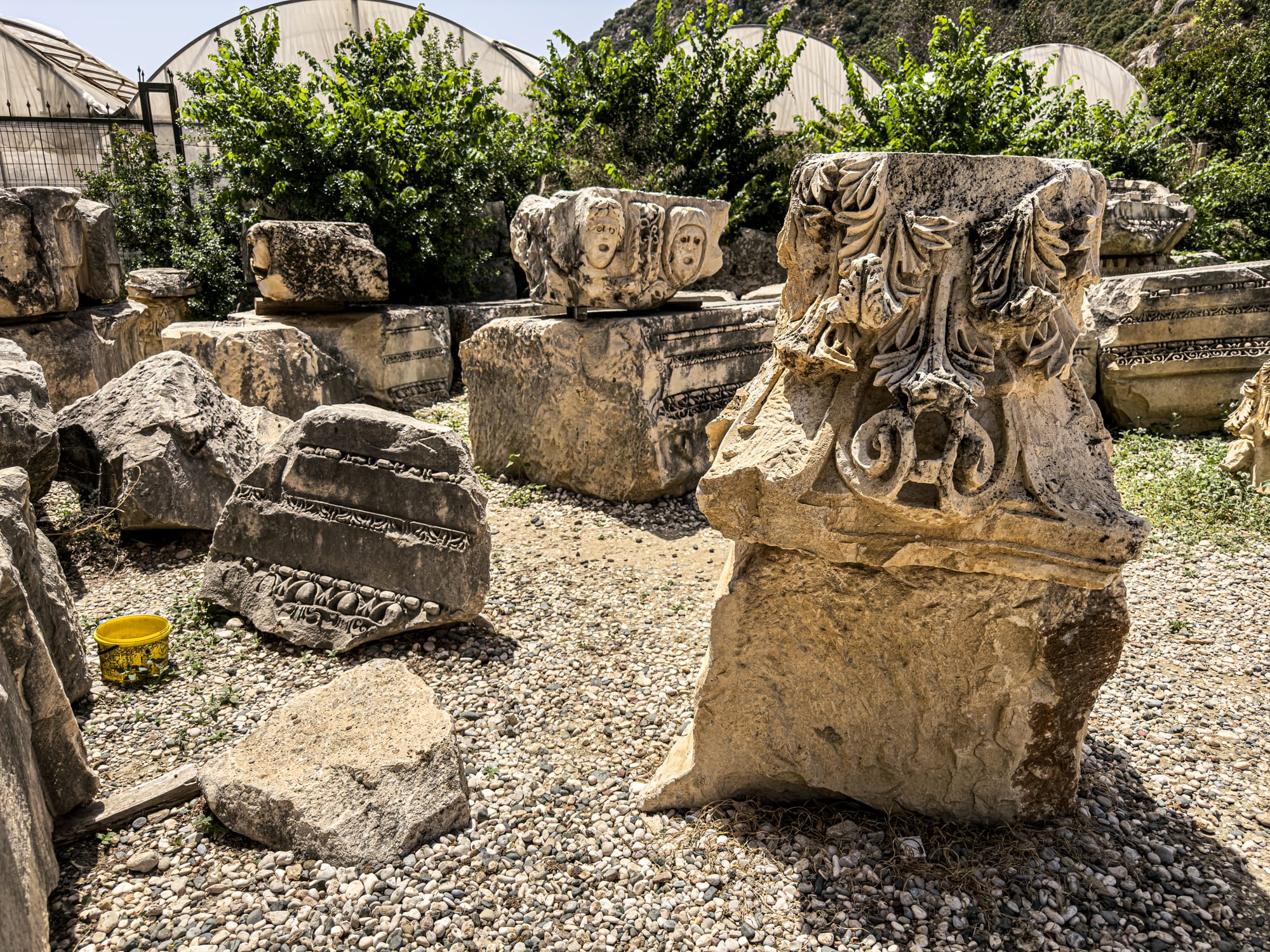
Oleander in bloom near the theater, and decorative fragments in Myra’s open-air sculpture yard
In this way, Myra has lived multiple afterlives: as a Lycian capital, a Roman theater city, a Byzantine bishopric, a source of inspiration, and now a slow, sculptural landscape for those willing to walk with time.
Visiting Myra from Antalya
We visited Myra as part of a day-long tour from Antalya that also included the sunken city of Kekova and Saint Nicholas Church in Demre. It’s an ideal way to experience the region’s layered history in a single day.
Our guide provided detailed historical context and gave us plenty of time to explore. We really enjoyed each part of the experience.
Visiting Myra is not simply an archaeological stop; it’s a tactile immersion into one of Lycia’s most expressive cities. It’s history as texture, as form, as memory. And for travelers seeking more than just ruins, who want connection, context, and continuity, Myra delivers all three.
Myra is also commonly paired with a stop at the Church of St. Nicholas in Demre town center, about 1 km from the ruins. Nicholas served as bishop of Myra in the 4th century and is the historical figure behind the Santa Claus tradition. The church is a separate ticket (400 TL, or covered by the Museum Pass Turkiye).
Practical info for Myra ancient city
Tickets
Tickets can be purchased at the entrance. The Museum Pass Turkiye (approximately 5,500 TL, valid 15 days) covers Myra, St. Nicholas Church, and hundreds of other sites across Turkey. If you’re visiting three or more paid sites during your trip, the pass is usually worth it.
Entrance fee
The entrance fee for Myra Ancient City is 400 TL (2026). St. Nicholas Church in Demre town center is a separate site with its own ticket, also 400 TL. Both are covered by the Museum Pass Turkiye.
Opening hours
Myra is open every day of the year, including public holidays.
- Summer (April–October): 8:30 a.m. to 7:30 p.m.
- Winter (November–March): 8:30 a.m. to 5:30 p.m.
In either season, the last entry is 30 minutes before closing.
How to get to Myra from Antalya
By organized tour
Most visitors reach Myra as part of a day tour from Antalya that combines Myra with Kekova and the Church of St. Nicholas. We took and recommend this full-day tour.
By car
Myra is approximately 150 km from Antalya, about 2.5 hours by car via the D400 coastal road. The ruins are signposted from Demre town center and located about 1.5 km from the center.
By bus
Long-distance buses run from Antalya’s otogar (bus station) to Demre, taking approximately 2.5 hours. From Demre center, a local dolmuş (minibus) can take you the short distance to the Myra site entrance for about 5 TL.
Best time to visit Myra
Spring (April–May) and autumn (September–October) offer the most comfortable temperatures for exploring the outdoor ruins. Summer visits are possible but hot. There is little shade at the site.
Most guided tour groups arrive between 10:00 a.m. and early afternoon. Arriving early (before 10:00) or late afternoon gives you a quieter experience.
Allow 1–2 hours for the ruins. A quick visit covering the theater and main tomb viewpoint takes about an hour. A fuller exploration including the upper tiers, western necropolis area, and sculpture fragments takes 1.5–2 hours.
Frequently asked questions about Myra
How long does it take to visit Myra?
A focused visit takes about 1 hour. To fully explore the theater, both necropolises, and the sculpture fragments, allow 1.5–2 hours.
How do you get to Myra from Antalya?
Myra is approximately 2.5 hours from Antalya by car or bus. Most visitors come via an organized day tour that combines Myra with Kekova and St. Nicholas Church.
Is Myra the same as Demre?
Myra is the ancient Lycian city. Demre is the modern Turkish town built near its ruins. The archaeological site is about 1.5 km from Demre town center.
What is the connection between Myra and Santa Claus?
Saint Nicholas, the historical figure behind the Santa Claus tradition, served as bishop of Myra in the 4th century CE. The Church of St. Nicholas in Demre, about 1 km from the Myra ruins, is a significant pilgrimage site.
Is the Museum Pass worth it for Myra?
If you’re visiting three or more paid archaeological sites in Turkey, the Museum Pass Turkiye (approximately 5,500 TL, valid 15 days) is usually worth it. It covers Myra, St. Nicholas Church, and hundreds of other sites including Topkapi Palace and Ephesus.
Can you take photos at Myra?
Yes. Photography is permitted outdoors at Myra without restriction. Inside St. Nicholas Church, photography is allowed but flash is prohibited.
Is Myra on the Lycian Way?
Yes. Myra sits along the Lycian Way, a long-distance hiking trail running between Fethiye and Antalya along the Turkish Mediterranean coast.
Other archeological sites near Antalya
For those visiting multiple archaeological sites in Turkey, the Museum Pass Turkiye covers both Myra and St. Nicholas Church, along with sites across the country including Topkapi Palace, Ephesus, and Cappadocia’s underground cities. The pass costs approximately 5,500 TL (2026) and is valid for 15 days.
Nearby, the Andriake Lycian Civilizations Museum at Myra’s ancient harbor is worth adding if time allows. It houses artifacts from the site including votive statuettes and funerary reliefs.
For other ancient sites in the Antalya region, consider Termessos (a mountain-top Pisidian city), Perge (a Roman colonnaded city), and our full roundup of day trips from Antalya.
For more on the region, see our digital nomad guide to Antalya, Turkey.


