
We visited Hierapolis as part of a guided day trip from Antalya that also included Pamukkale, a pairing that makes sense geographically and atmospherically. Both sites offer a portal into geological marvels and classical ruins. Together, Hierapolis and Pamukkale form a UNESCO World Heritage Site, designated in 1988 for their combination of natural travertine formations and Greco-Roman archaeological significance.
But Hierapolis, perched above the cotton-white travertines, held its own distinct spell. Wide, golden fields. Crumbling colonnades. Shadowy amphitheaters. Snake coils carved in stone. Paragliders drifting slowly overhead.
A city of sacred breath
Founded in the 2nd century BCE by the Attalid kings of Pergamon, Hierapolis was always a city of contradiction, part spa town, part necropolis. A place of both healing and death. It grew rich from its hot springs, which still bubble through the earth, and gained spiritual power through the Plutonium, a cave that ancient priests believed to be an entrance to the underworld.
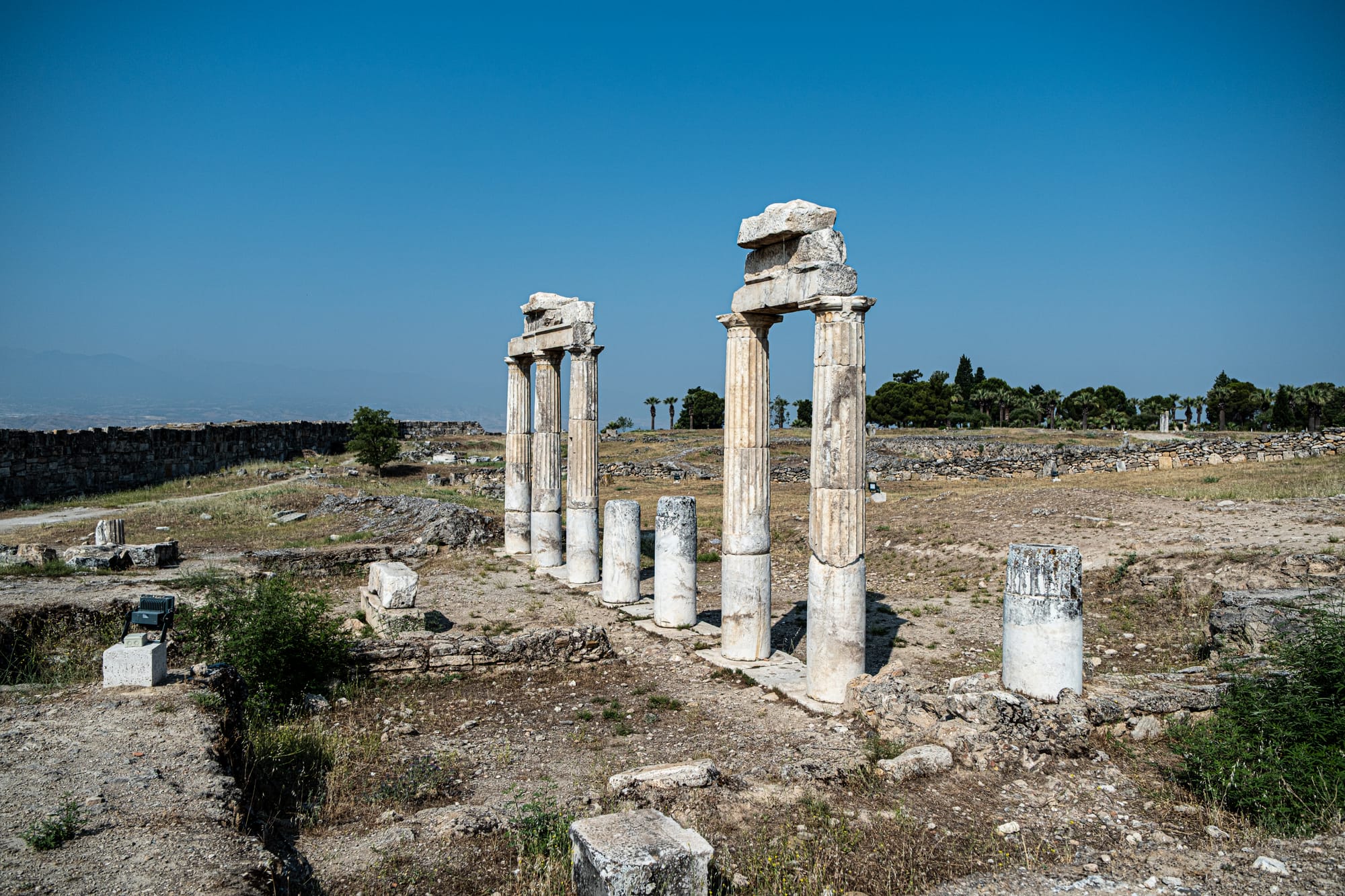
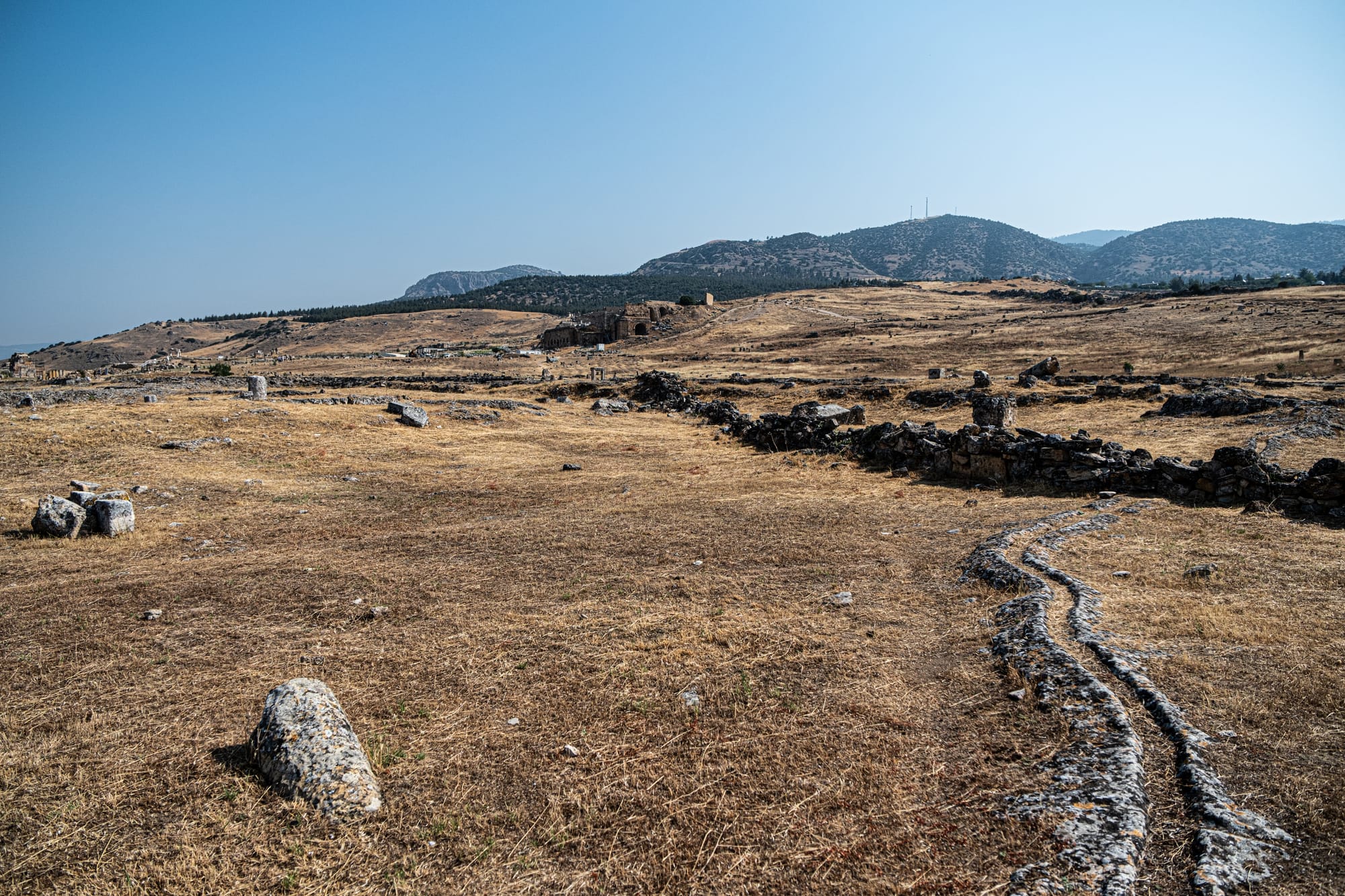
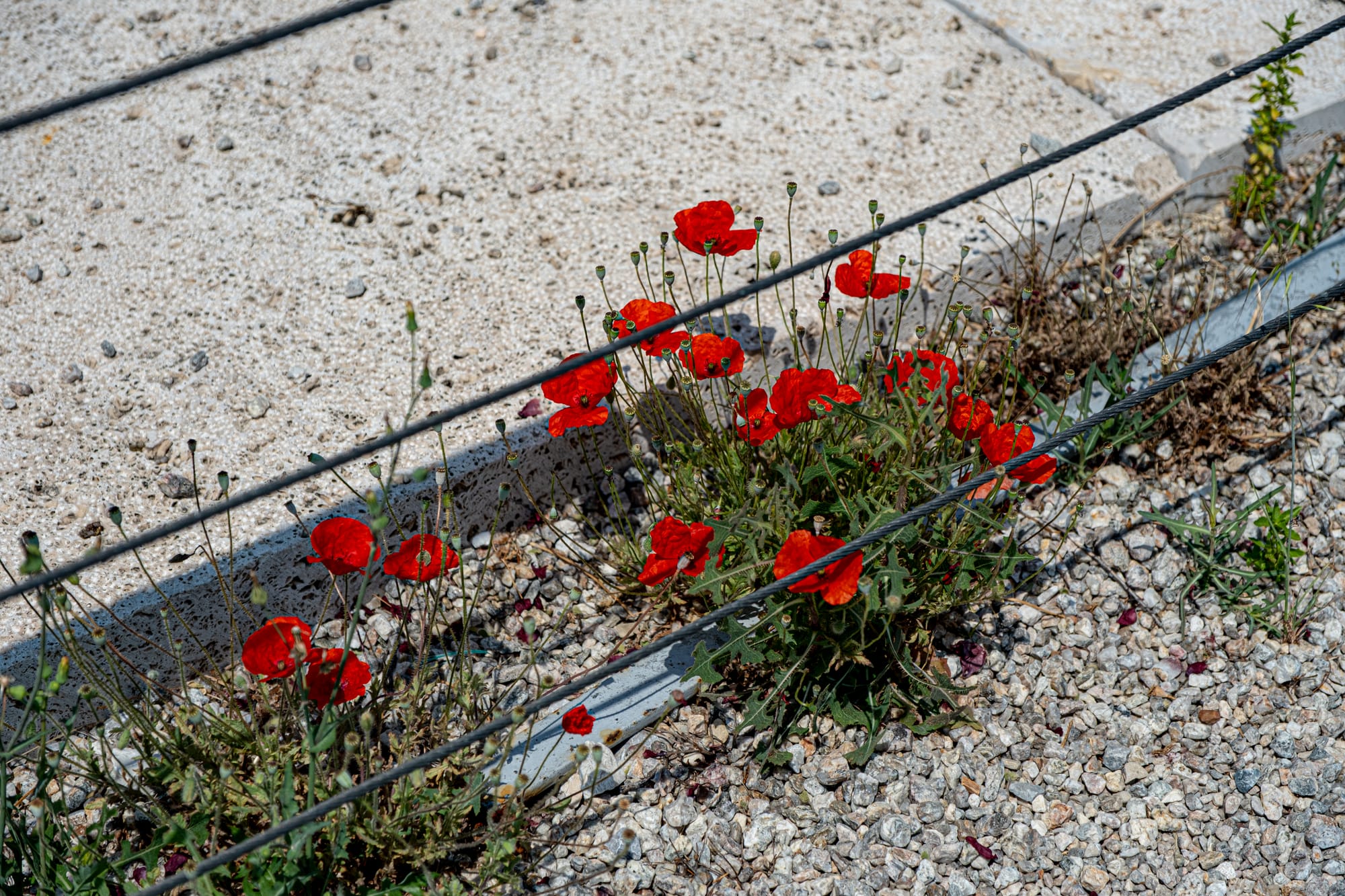
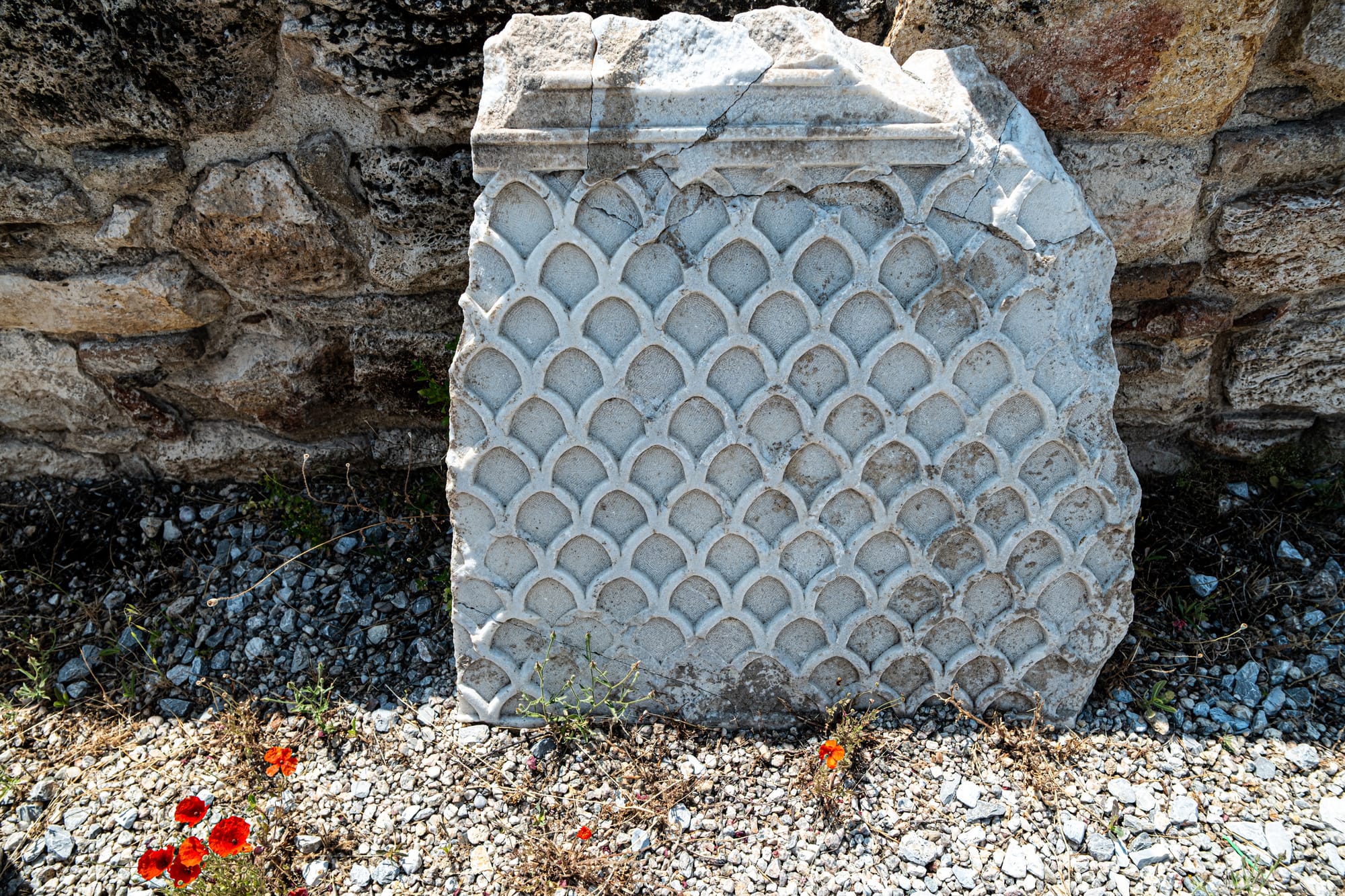
Wandering through Hierapolis reveals weatherworn columns, blooming wild poppies, and winding stone paths
The Plutonium in Hierapolis is one of the few surviving ancient “Gates to Hades” and remains one of Hierapolis’s most distinctive features.
The Romans later expanded the city, building grand theaters, temples, and bathhouses. An earthquake in 60 CE devastated the city, but Hierapolis was rebuilt, again and again. Today, what’s left are the stones, long roads, fractured altars, theatrical façades, and the dry echo of wind.
Hierapolis was also the birthplace of Epictetus, the Stoic philosopher whose teachings on inner freedom and resilience have influenced Western thought for nearly two millennia.
The Hierapolis theater
The theater at Hierapolis is the most visually intact structure, and it rises unexpectedly from the hills. Built into the slope, it would have once seated more than 12,000 spectators for performances and imperial ceremonies. From the top rows, the views reach beyond the stage into the hazy sweep of the Menderes Valley.
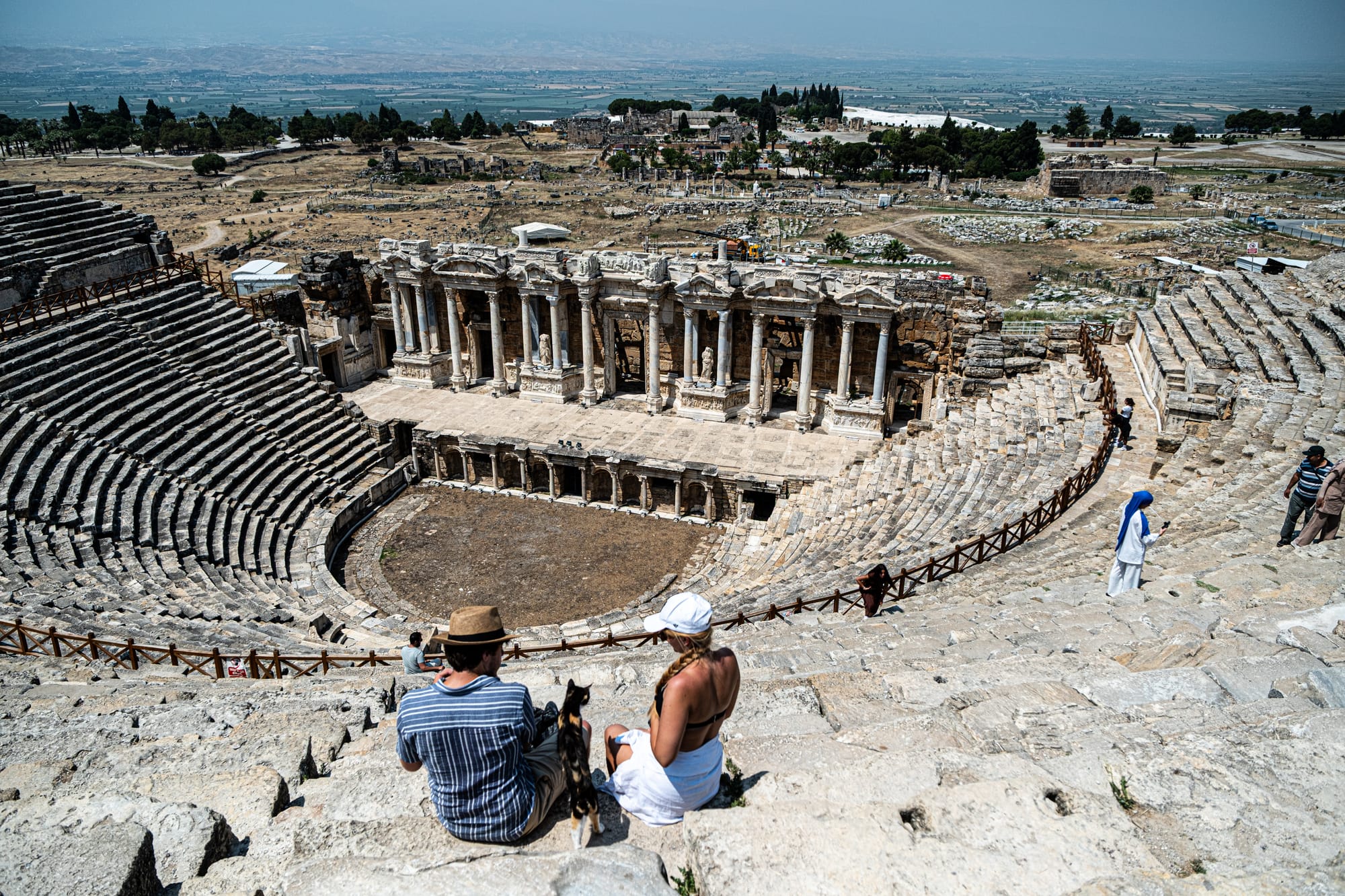
The stage itself still shows bas-reliefs, mythological scenes, winged figures, and vegetal patterns. It is one of the best-preserved examples of Roman imperial theatre architecture in Anatolia, and it feels massive, mythic, and oddly silent.
The museum
Housed inside a former Roman bath, the small museum on site is dense with expression. You will find intricately carved sarcophagi featuring scenes of battles, banquets, and abductions.
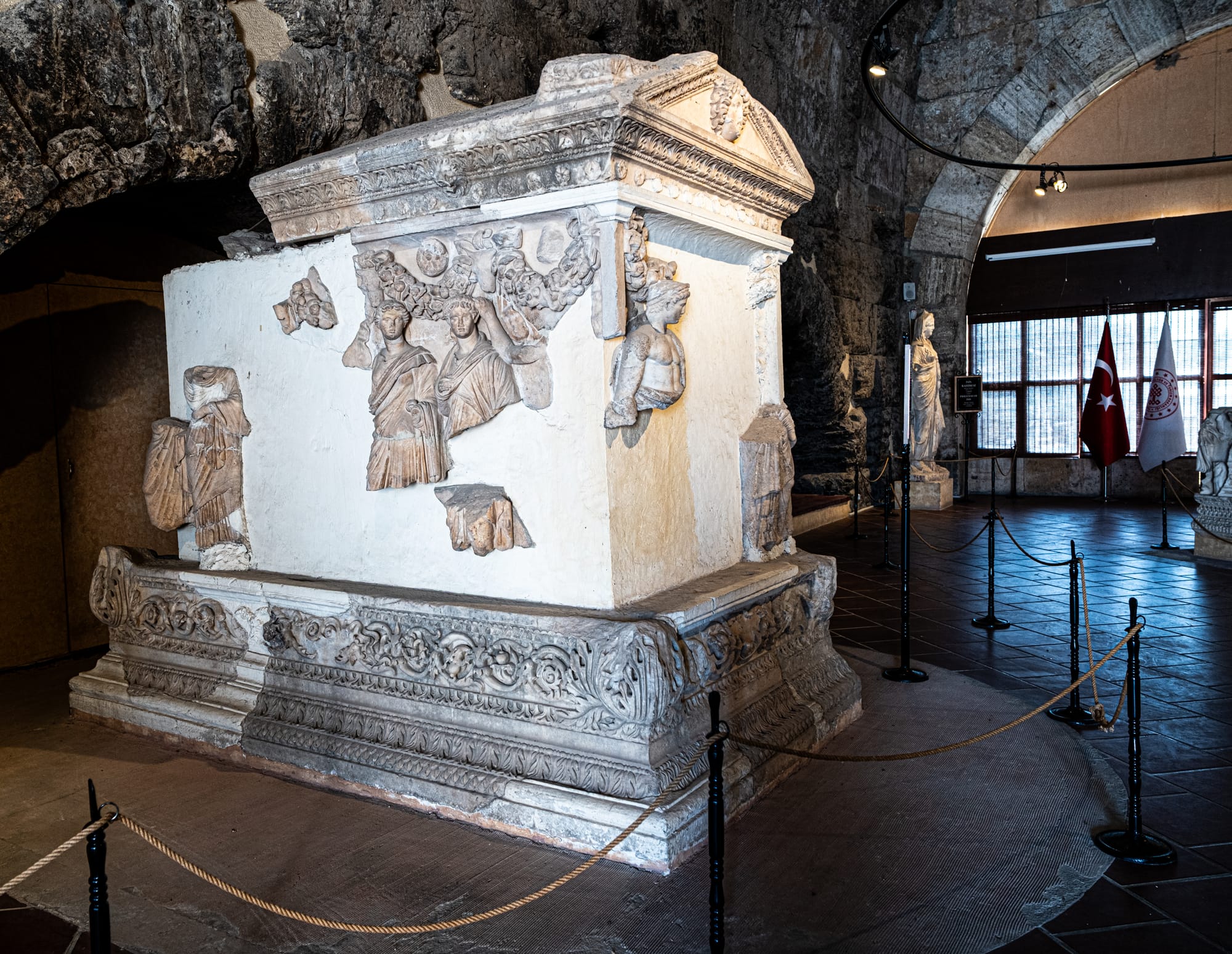
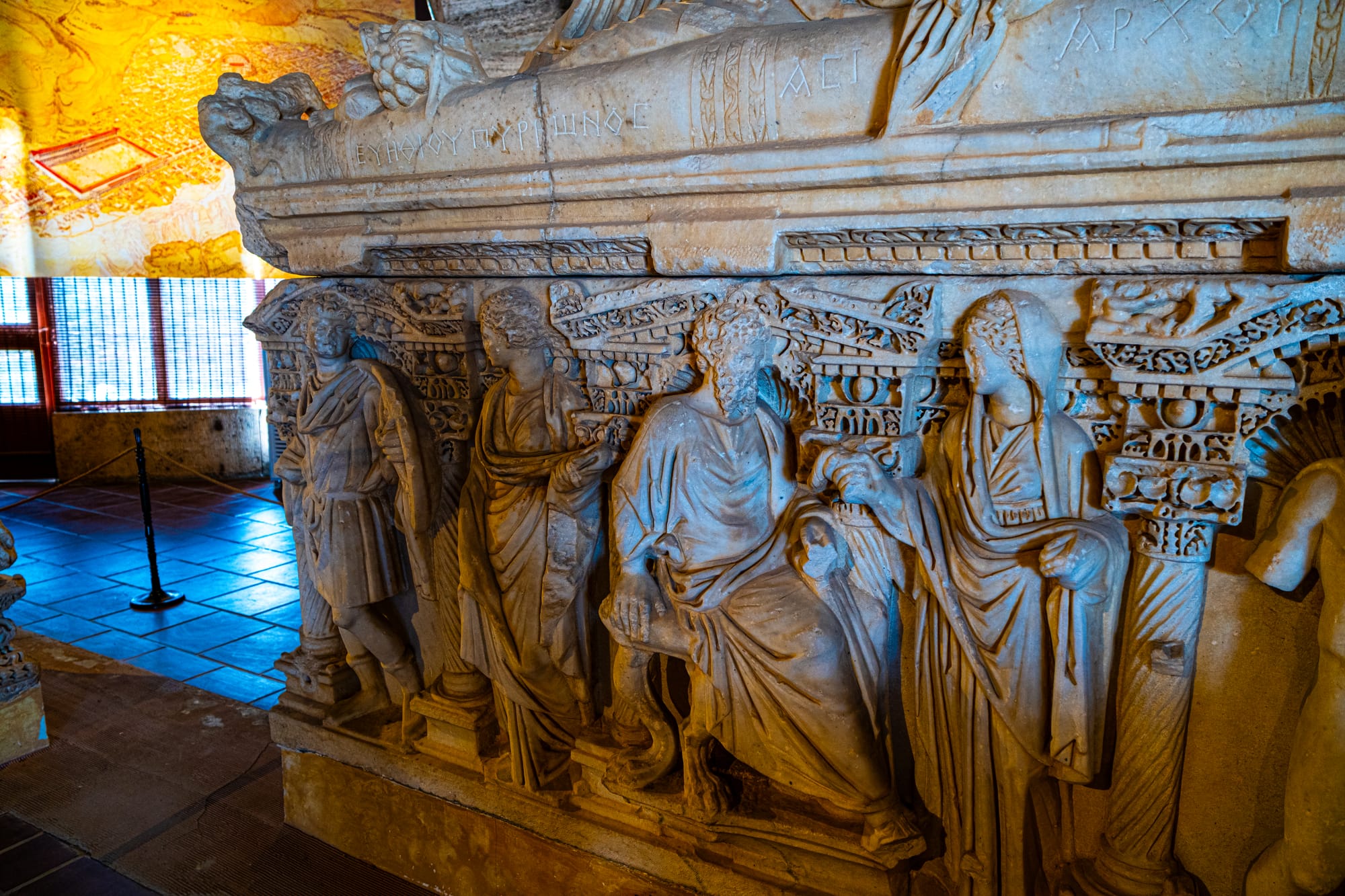
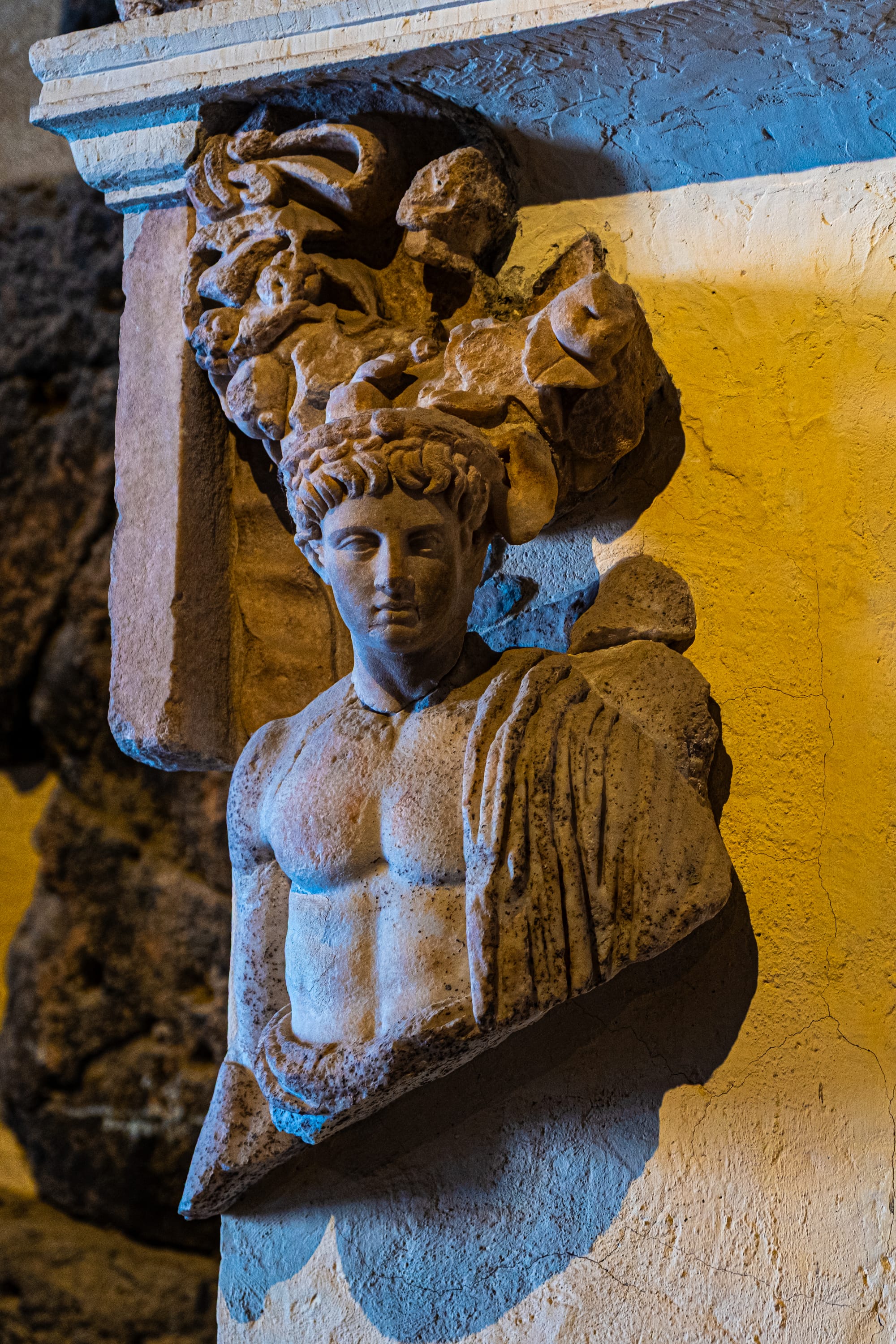
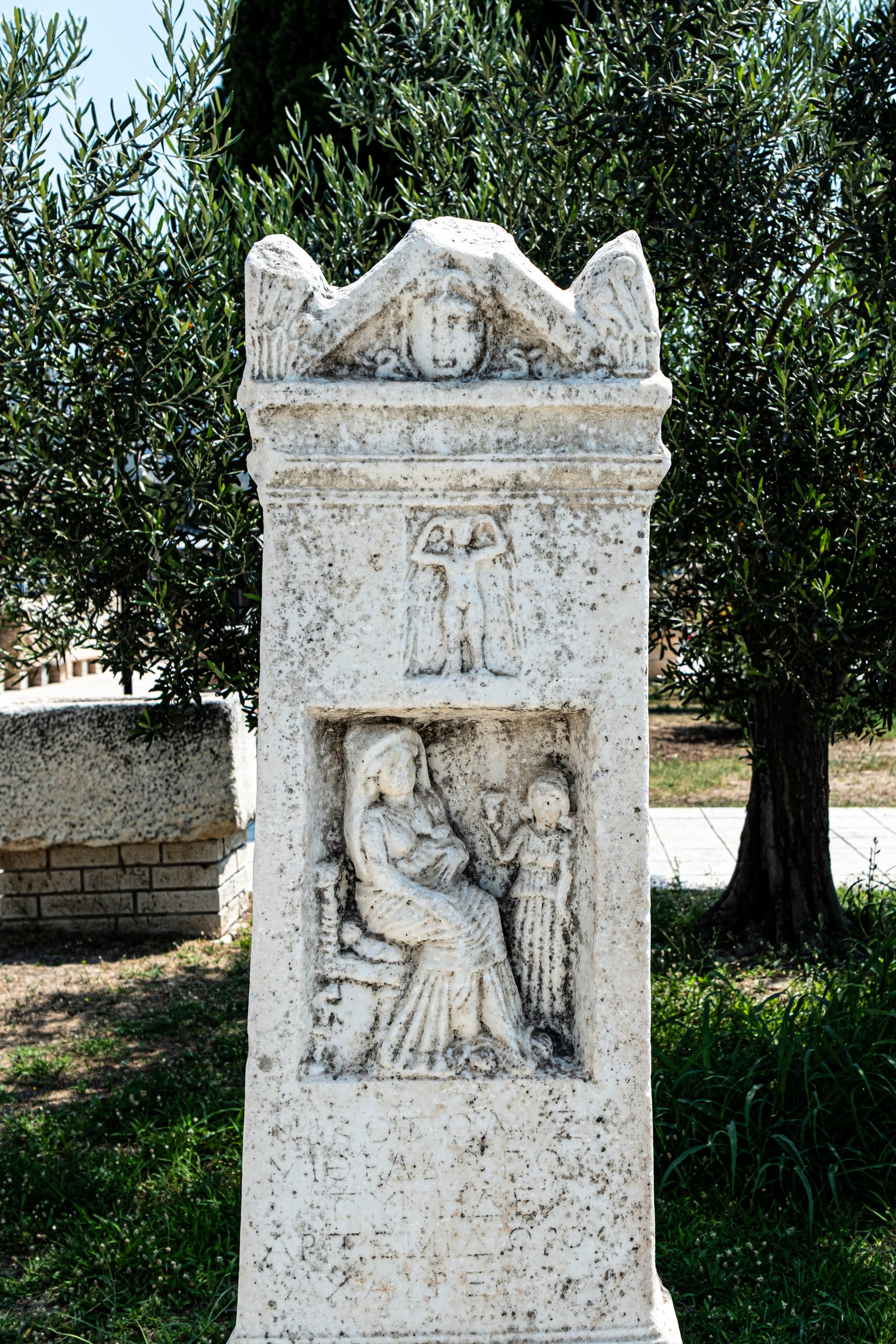
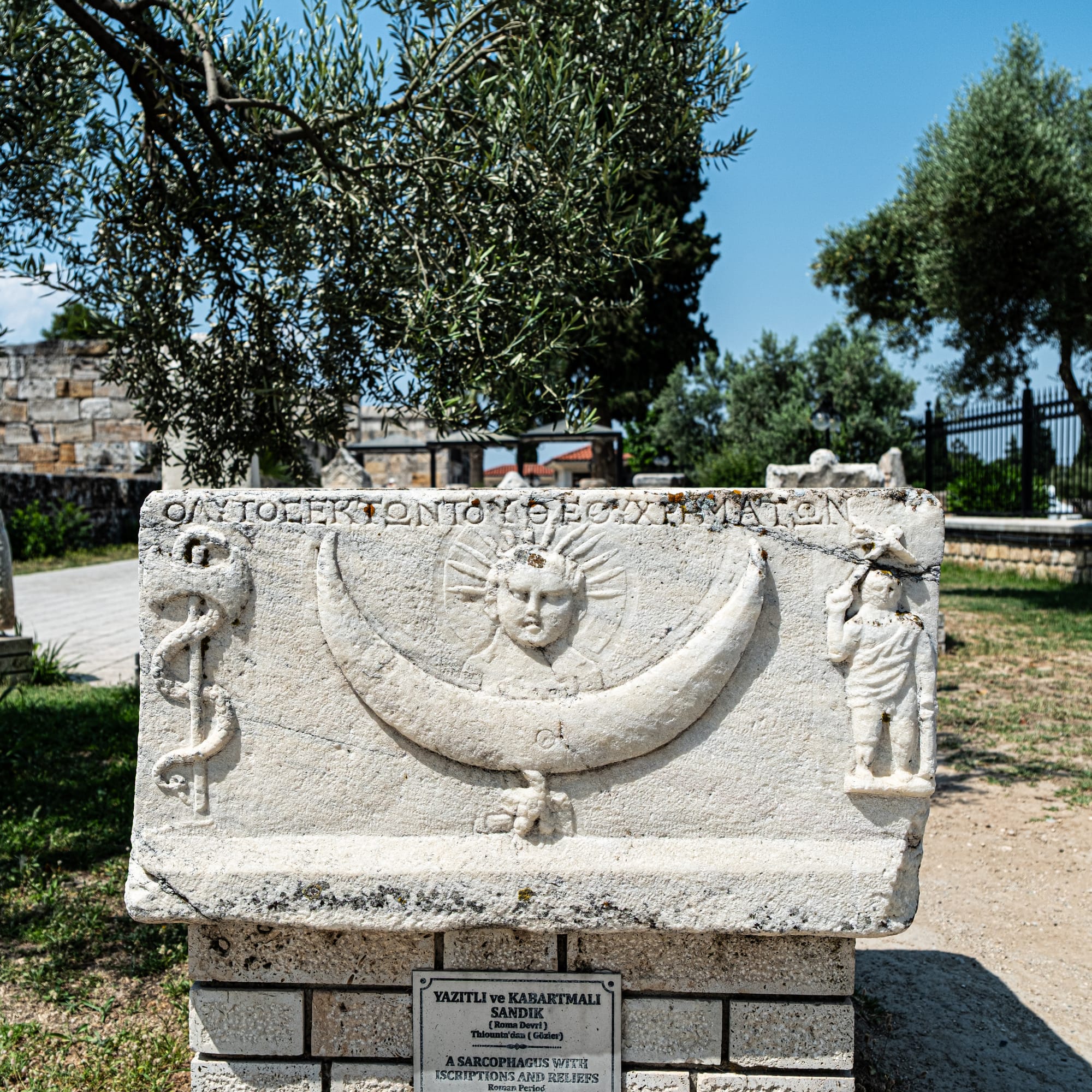
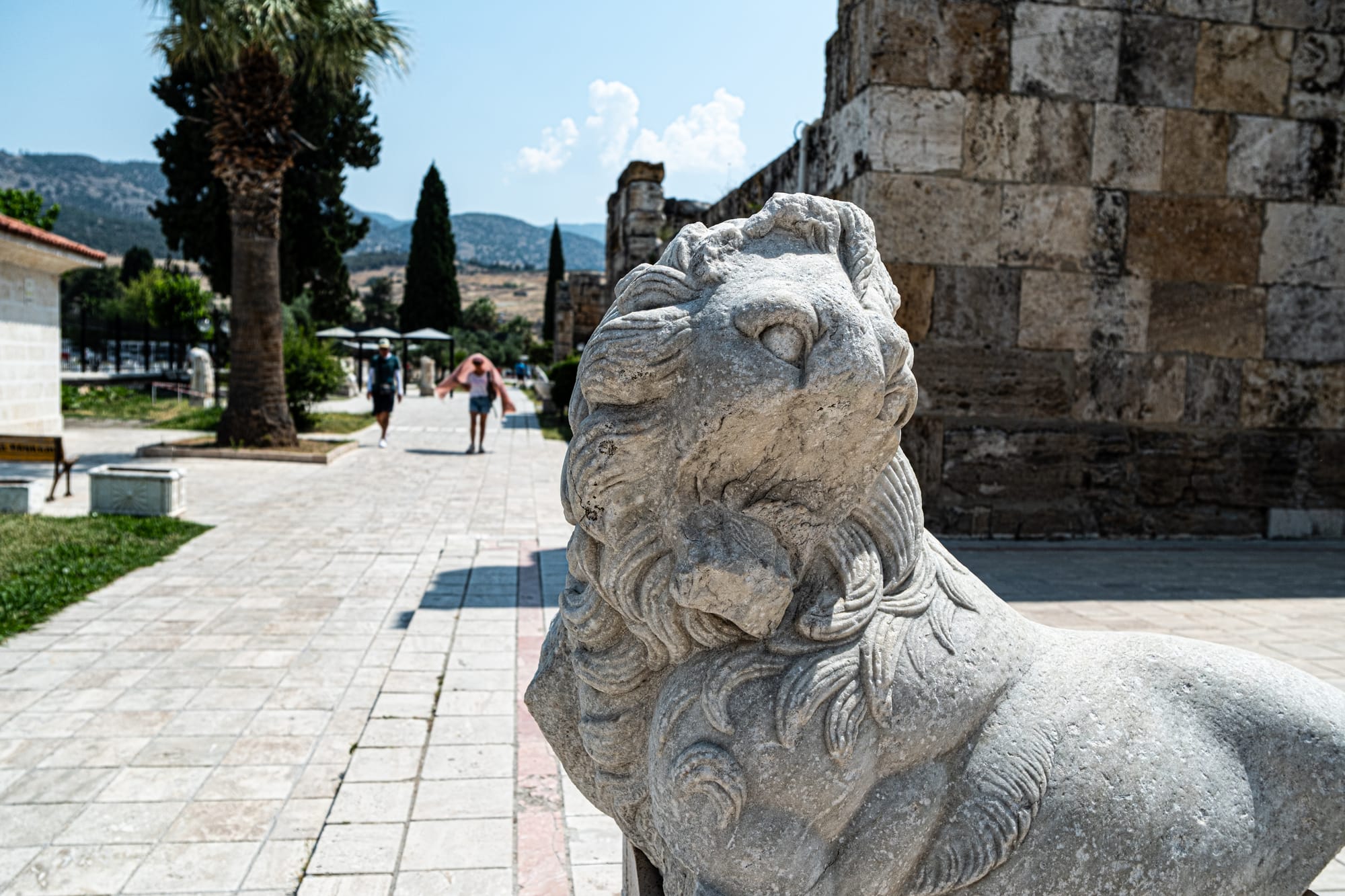
Intricately carved sarcophagi, statues, and relics inside the Hierapolis Archaeological Museum and surrounding grounds
There are fragments of statues, torsos, lions, and laurel wreaths.
The spiral serpent of healing
One of the most captivating details in Hierapolis is a carved stone relief of a spiral-shaped snake, often missed by visitors, but deeply symbolic. This coiling serpent is thought to represent Asklepios, the god of healing, and was likely tied to the city’s reputation as a sanctuary of wellness.
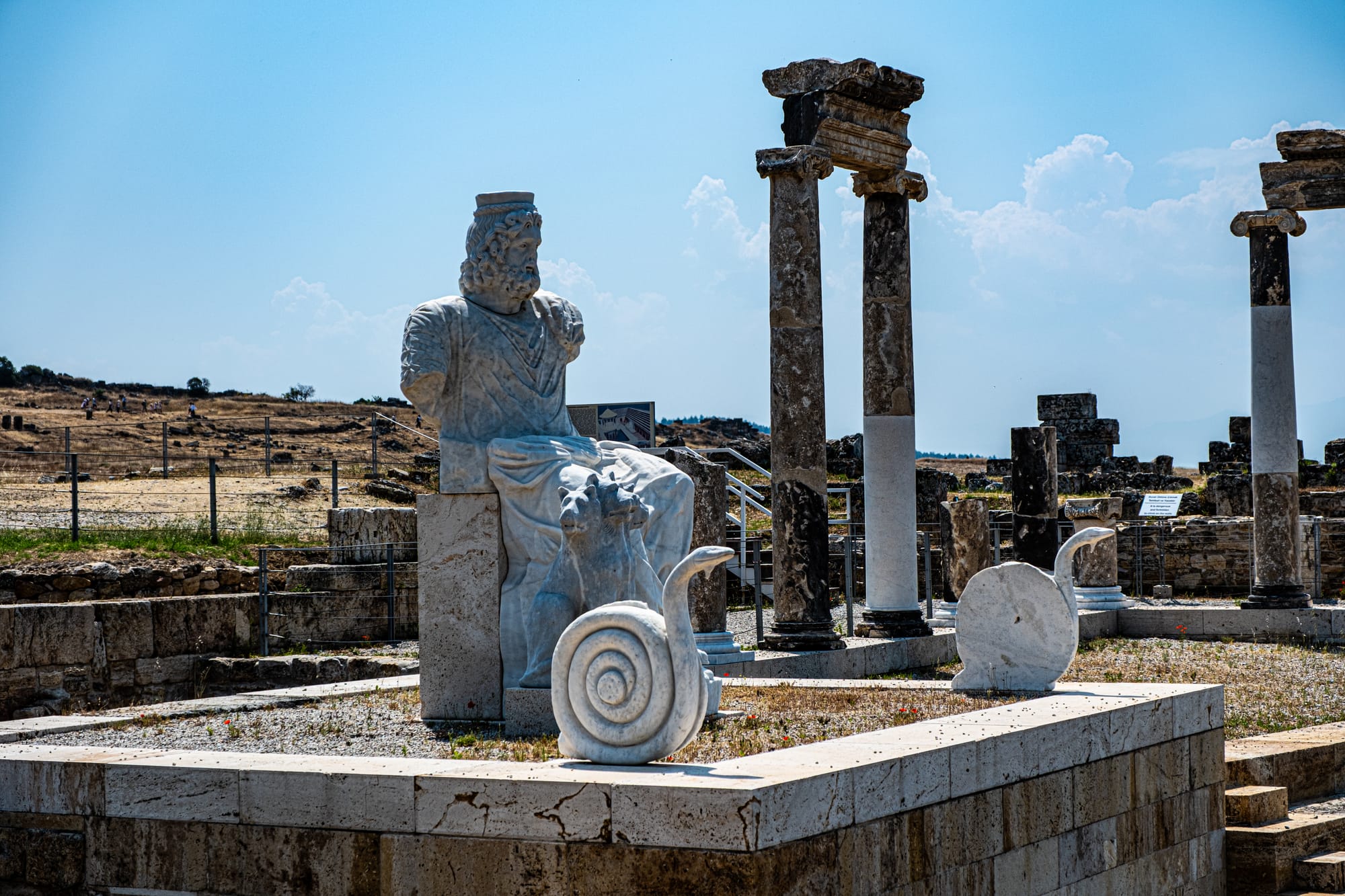
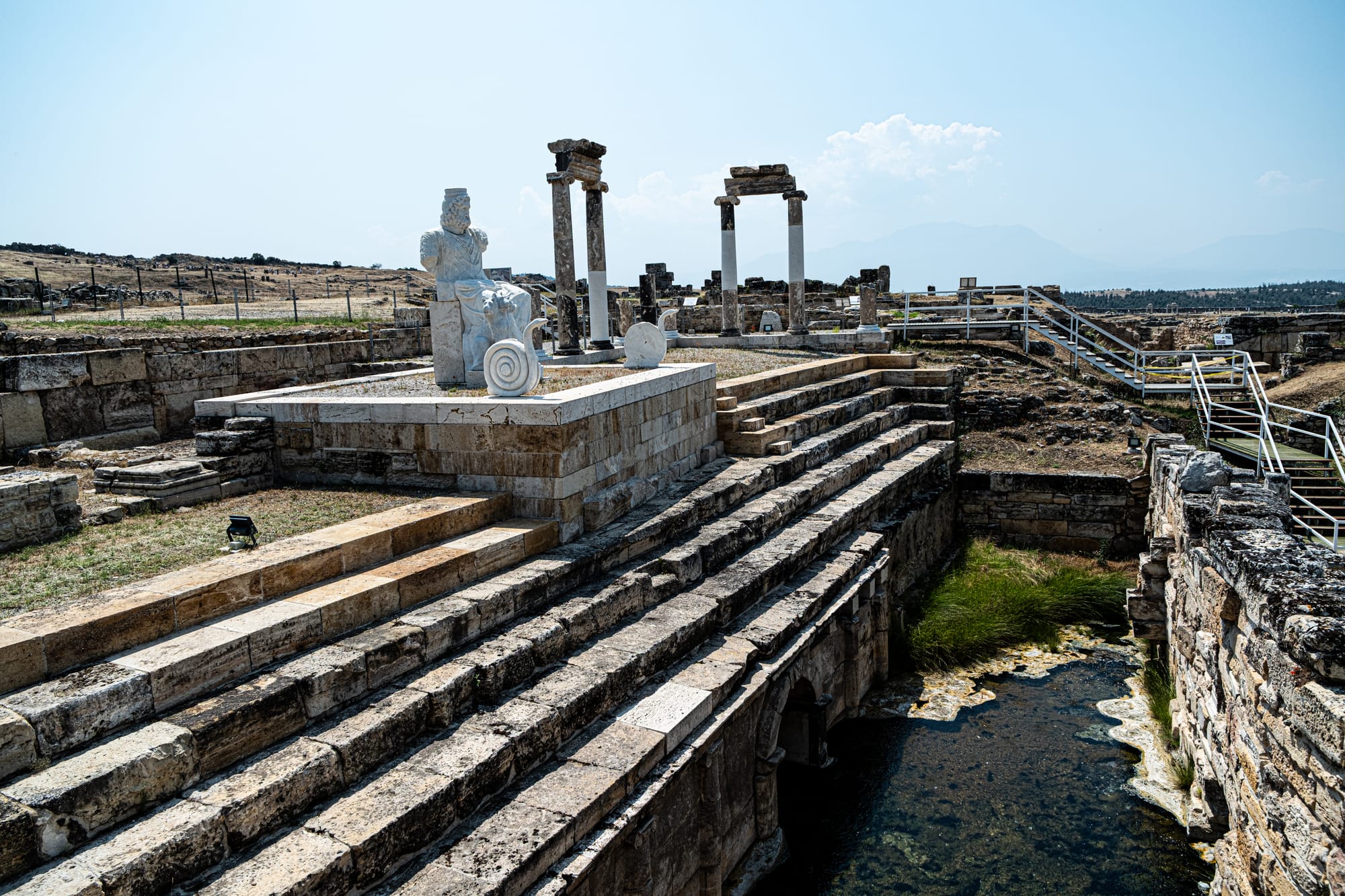
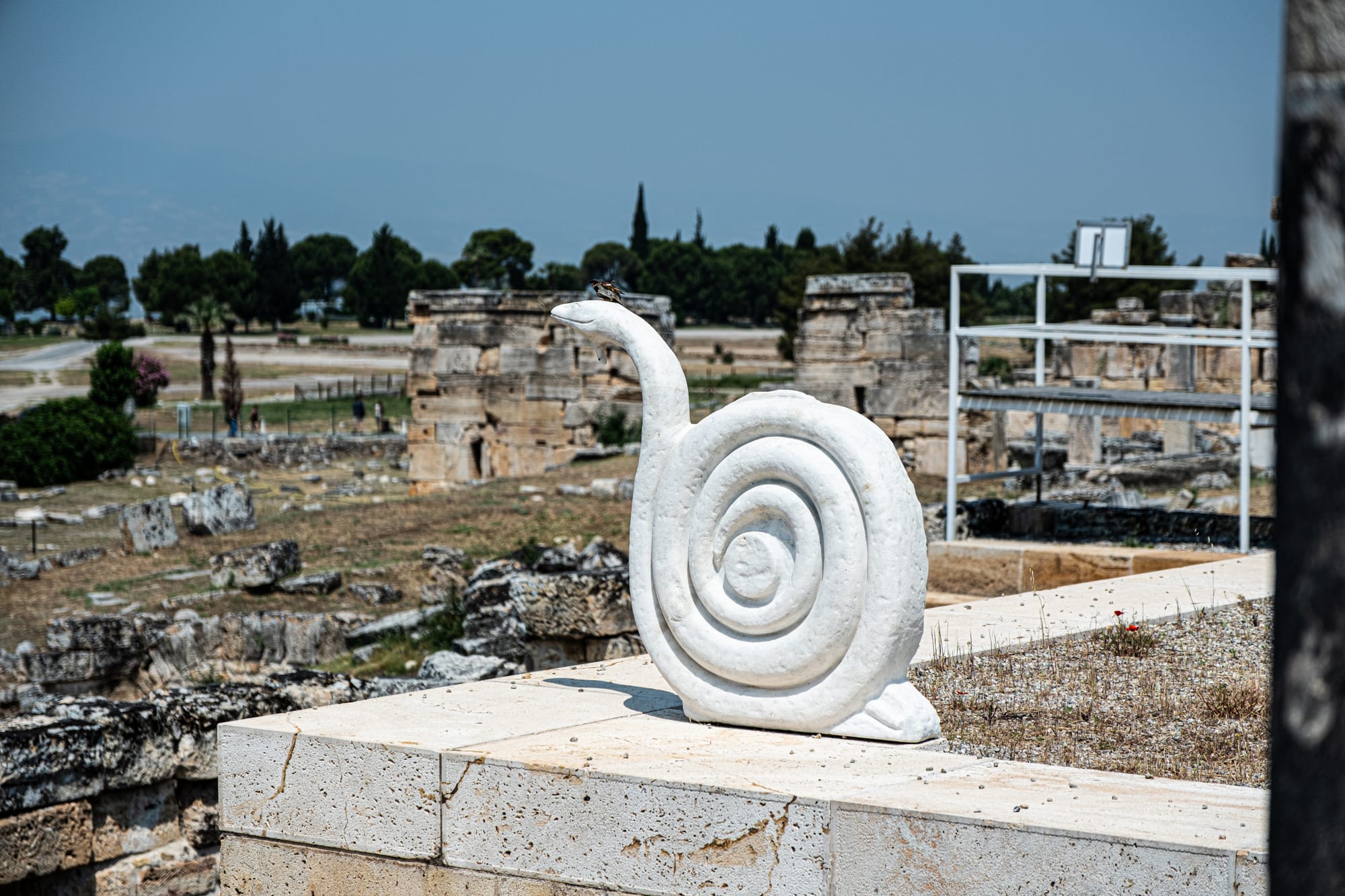
This serpent-shaped sculpture represents Asklepios, an ancient Greek symbol of healing and medicine
The motif is echoed in the modern symbol of medicine, and its presence here speaks to the site’s long history as a place of therapeutic springs and sacred rituals. Smooth and precise, the spiral grooves feel timeless, like a memory curled in stone.
The Cleopatra Pools
Although we did not get to experience the Cleopatra Pools ourselves, they were closed during our visit, they are typically a highlight for many visitors to Hierapolis. Also known as the Antique Pool, this thermal spring is said to have been a favorite of Cleopatra herself.
Today, the pool is filled with warm, mineral-rich water and scattered with submerged Roman columns, believed to have collapsed during an ancient earthquake.
When open, the Cleopatra Pool (also called the Antique Pool) charges a separate entrance fee of approximately 130–150 TL on top of the site ticket. Visitors swim among submerged Roman columns that toppled into the warm, mineral-rich water during an ancient earthquake. The pool is typically open year-round during site hours
Even if you are just passing by, the setting is surreal, sunlight glinting off broken marble beneath the water, framed by travertines and pine trees. If open, it is worth at least stopping for a look or a dip.
The agora and Frontinus Street
Several paths radiate outward from the heart of the city. One leads toward what is believed to be the agora, or ancient marketplace. This area is more ruin than reconstruction, but with imagination, you begin to see the skeletal outline of stalls, meeting points, and shaded arcades.
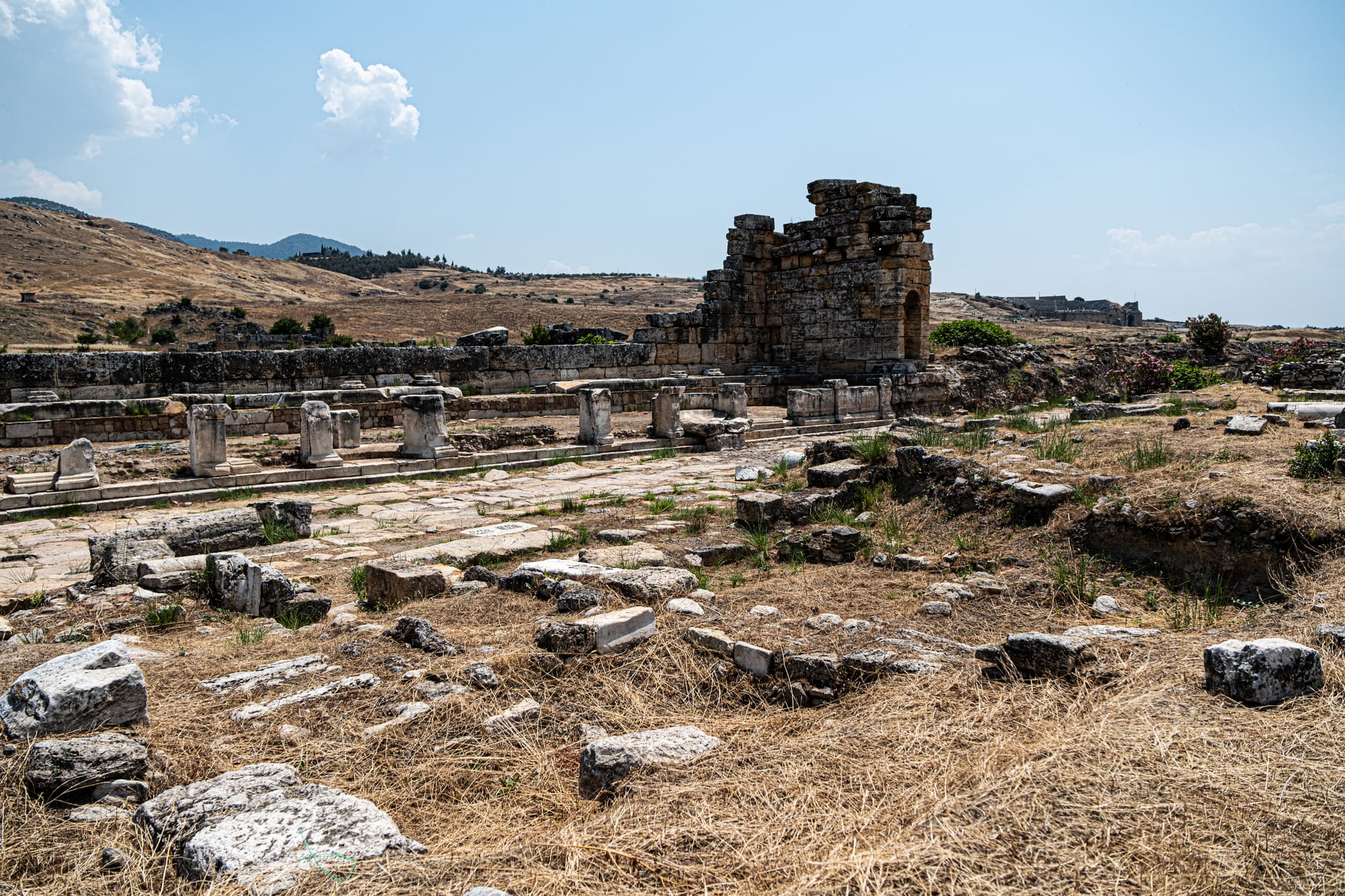
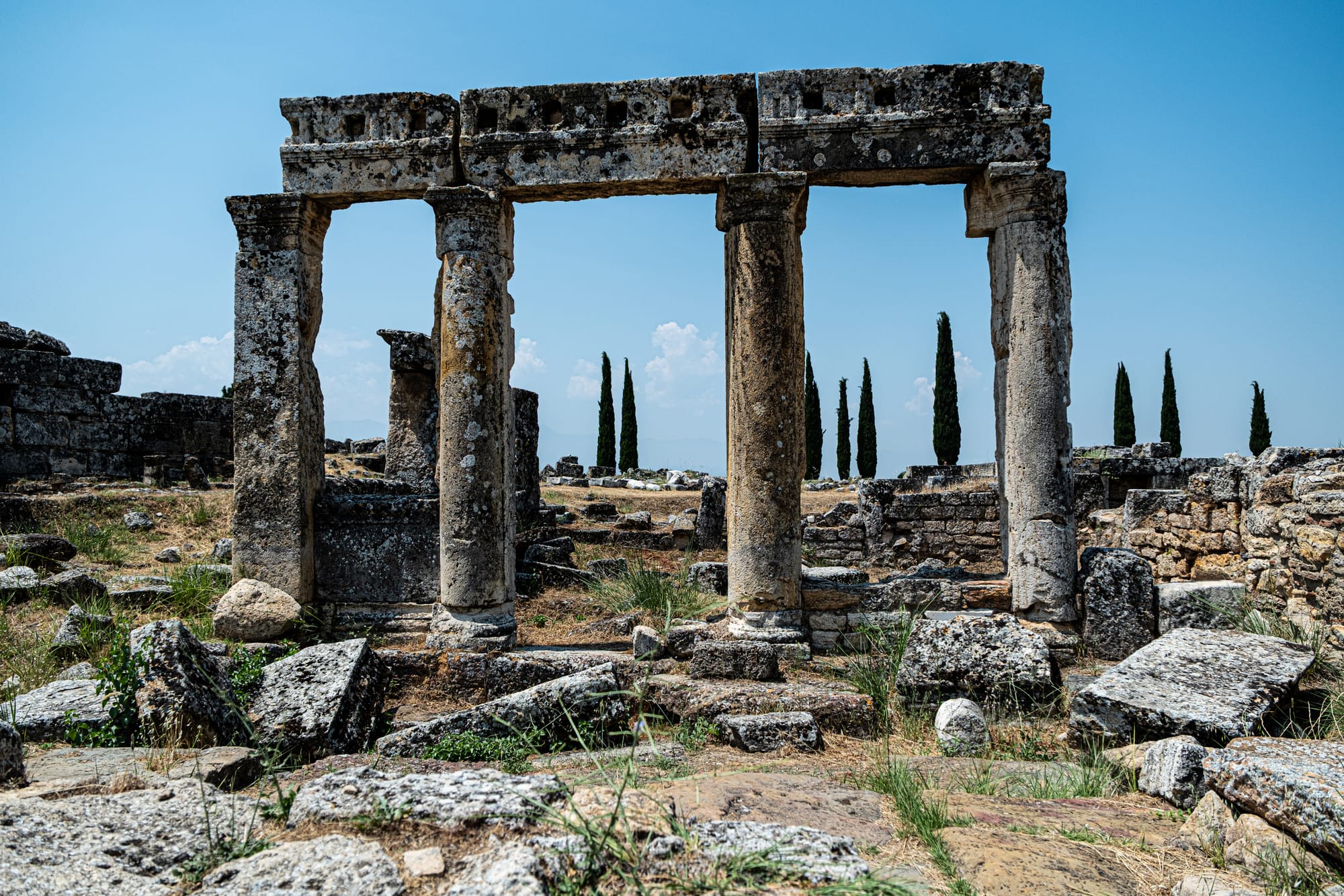
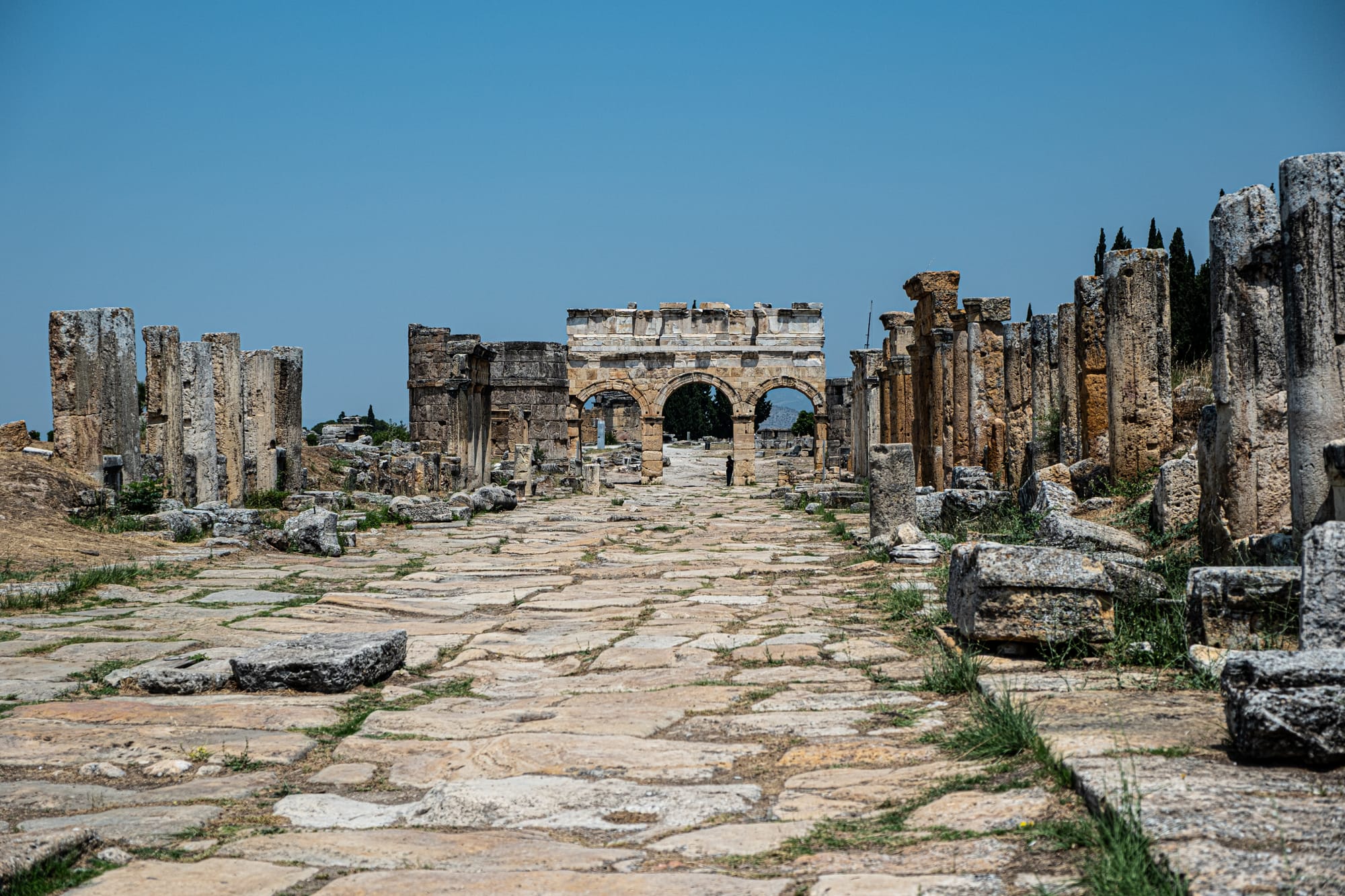
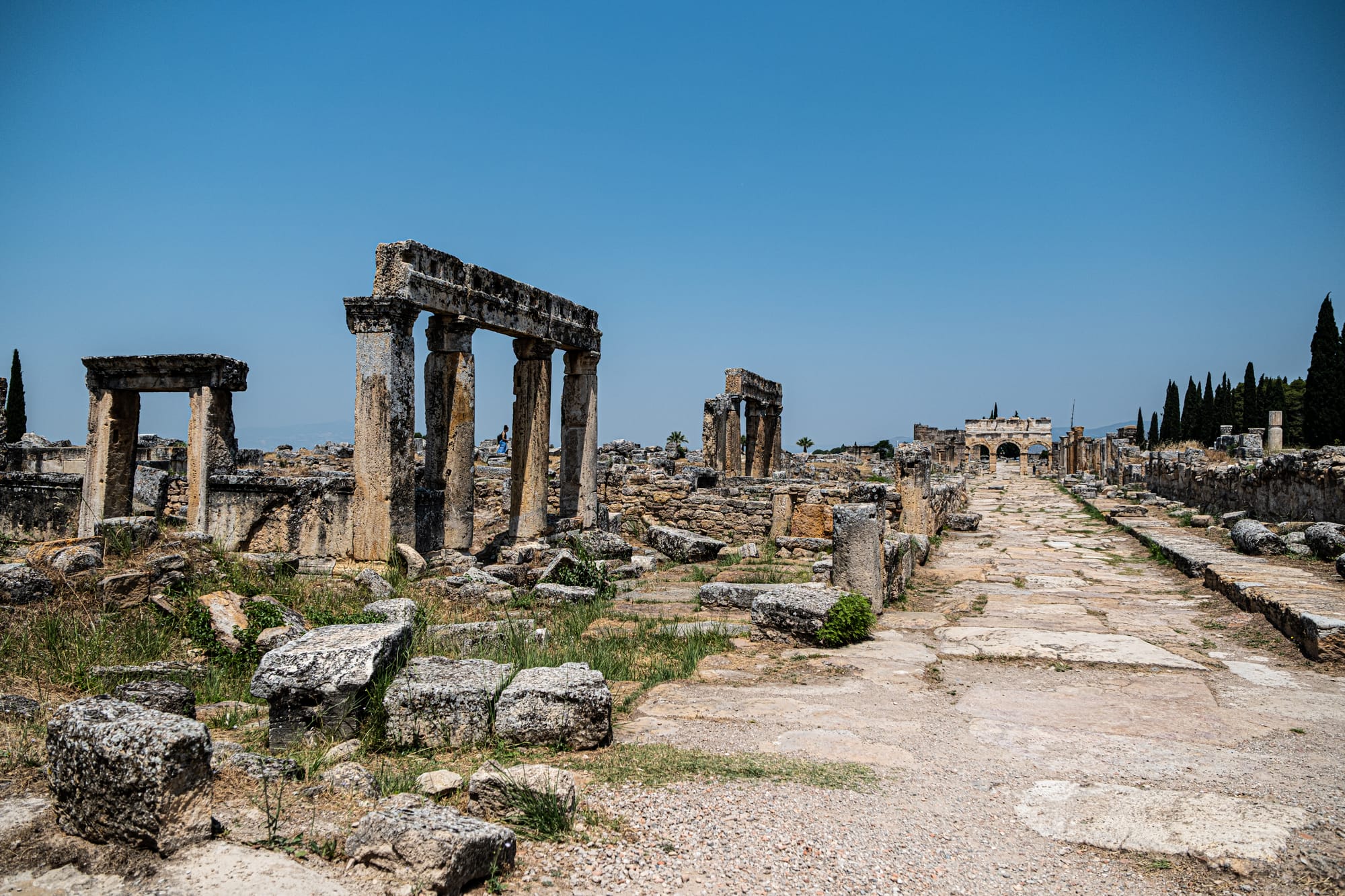
Ancient streets and crumbling columns trace the cityscape of Hierapolis, once a thriving Greco-Roman spa town
The main colonnaded road, known as Frontinus Street, runs the length of the ancient city from north to south. Named after the Roman proconsul who built it in the 1st century CE, the street is flanked by toppled columns, broken capitals, and the remains of civic buildings. At its northern end stands the triple-arched Frontinus Gate, the monumental entrance to the Roman city.
Elsewhere, long stone streets stretch underfoot, lined by toppled columns, broken capitals, and low cypress trees. It is easy to walk in silence here, the dry grass brushing your ankles. Occasionally, you will spot wildflowers or a poppy growing between marble cracks.
The Hierapolis necropolis
The Hierapolis necropolis is one of the largest and best-preserved in all of Turkey, containing approximately 1,200 tombs spanning the Hellenistic, Roman, and early Christian periods. Burial styles range from simple rock-cut graves to elaborate sarcophagi with mythological reliefs and family mausoleums with inscriptions. Many tombs contain curses carved in stone, intended to deter grave robbers. The necropolis extends for over two kilometers north of the city walls, making it a substantial walk but a rewarding one.
The sheer number of tombs, sarcophagi, domed graves, and family mausoleums, speaks to how central the idea of death was to this place.
Built for wealthy Romans, Phrygians, and early Christians alike, the tombs offer a mix of architectural styles. You will notice lion motifs, inscriptions, and weathered reliefs. Despite their number, there is a quiet dignity here. The light moves slowly. Shadows of cypress trees fall on stone.
Paragliders and the living sky
One of the unexpected joys of visiting Hierapolis is looking up. Throughout our visit, paragliders floated down from the sky, catching the thermals that rise from Pamukkale. It is a strange, beautiful contrast, ancient ruins below, modern figures suspended in color above.
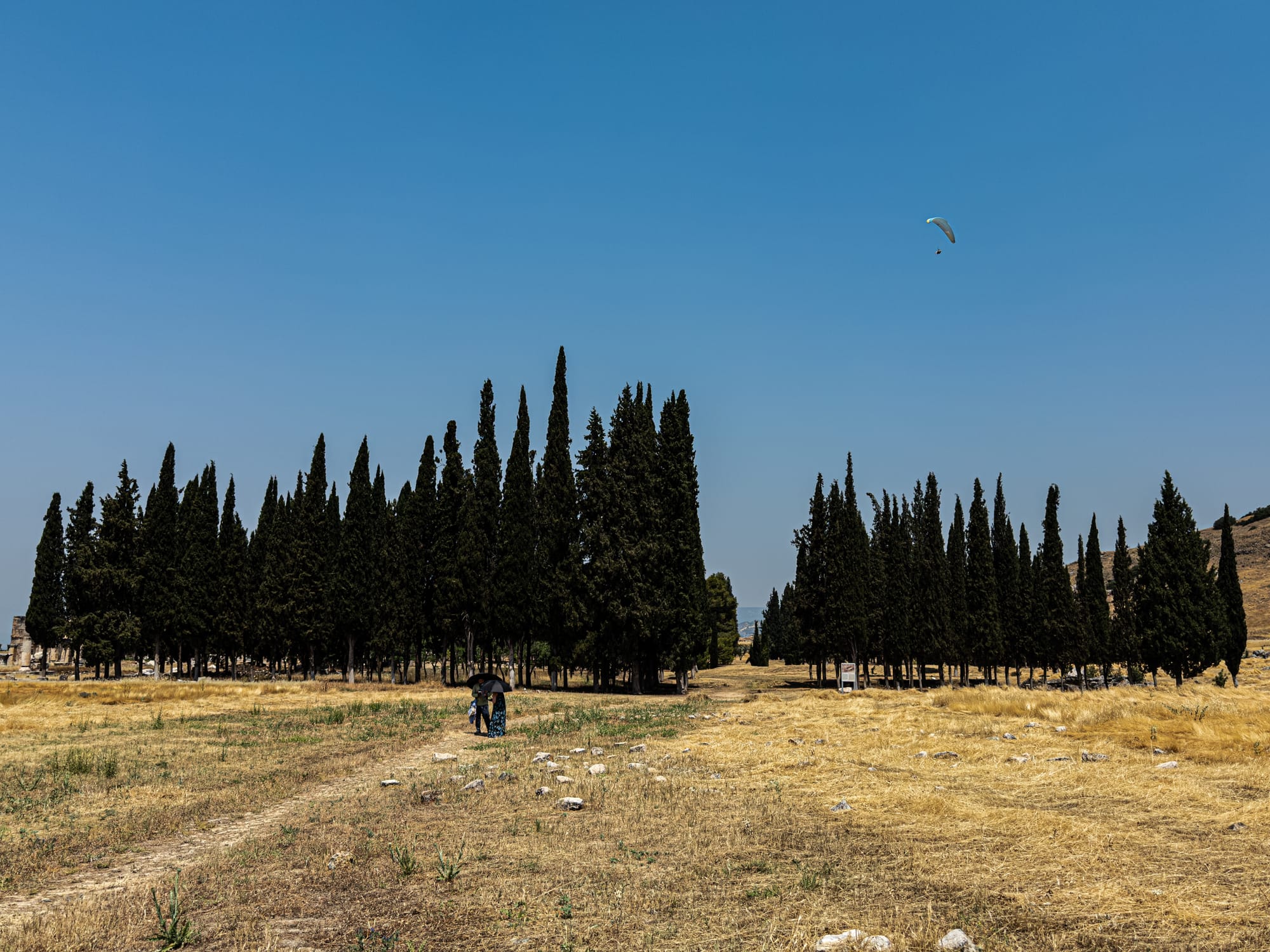
It is hard not to read it as metaphor, the weight of history, the lightness of now.
Walking the landscape
More than any specific monument, it was the act of walking through Hierapolis that stayed with us. The ochre fields. The wildflowers. The wide, horizontal composition of stone against sky. The textures of age and abandonment.
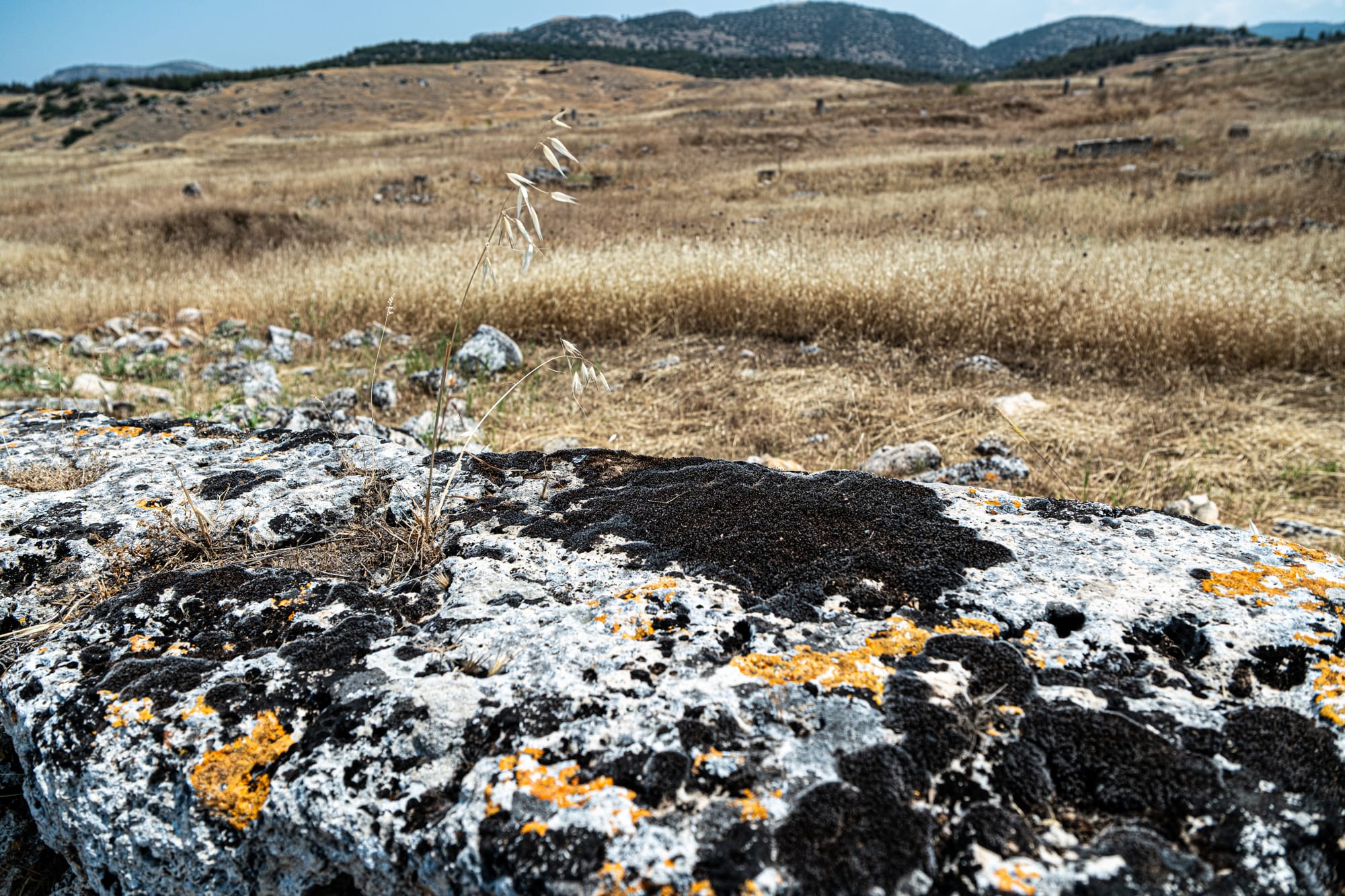
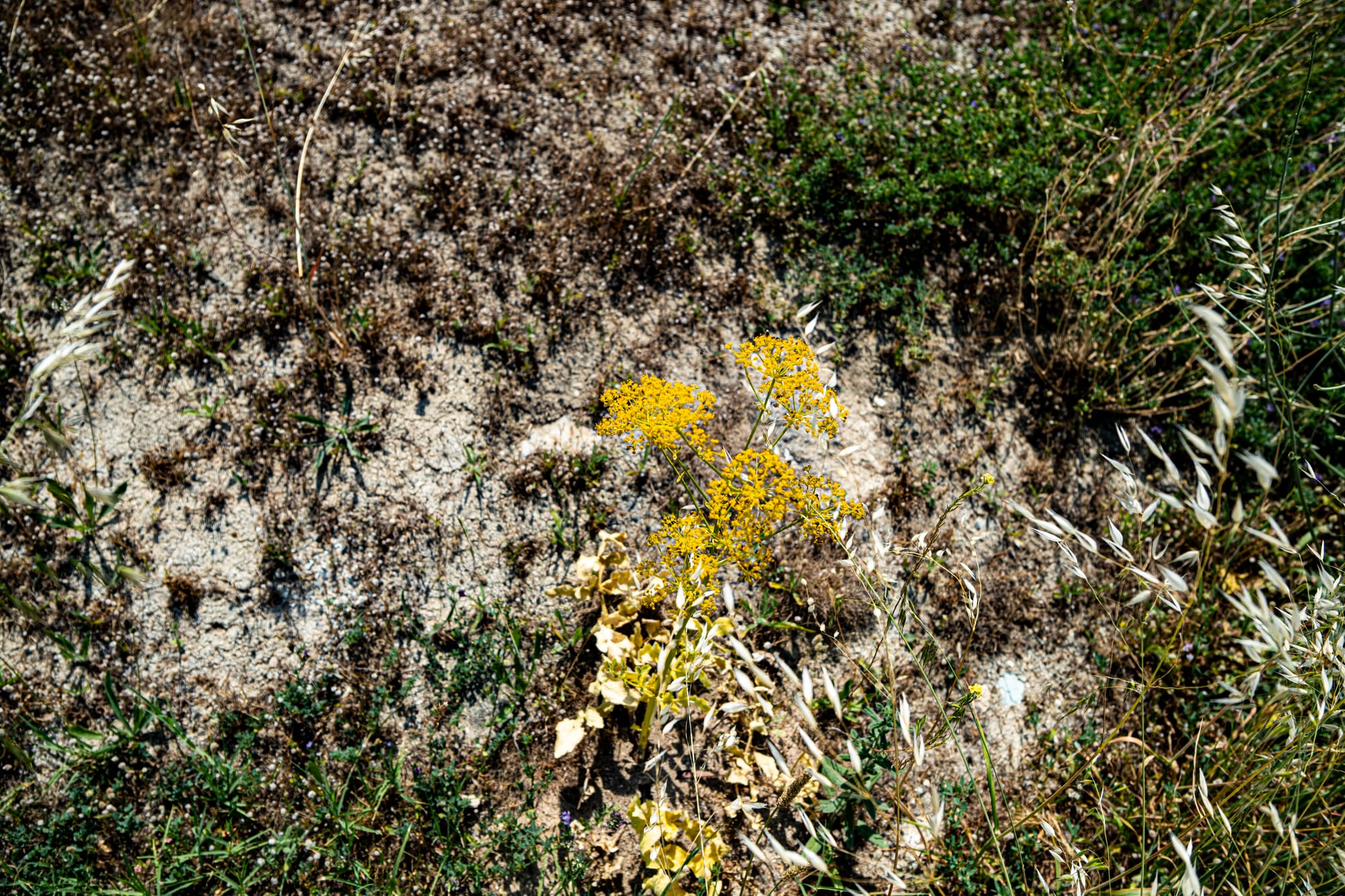
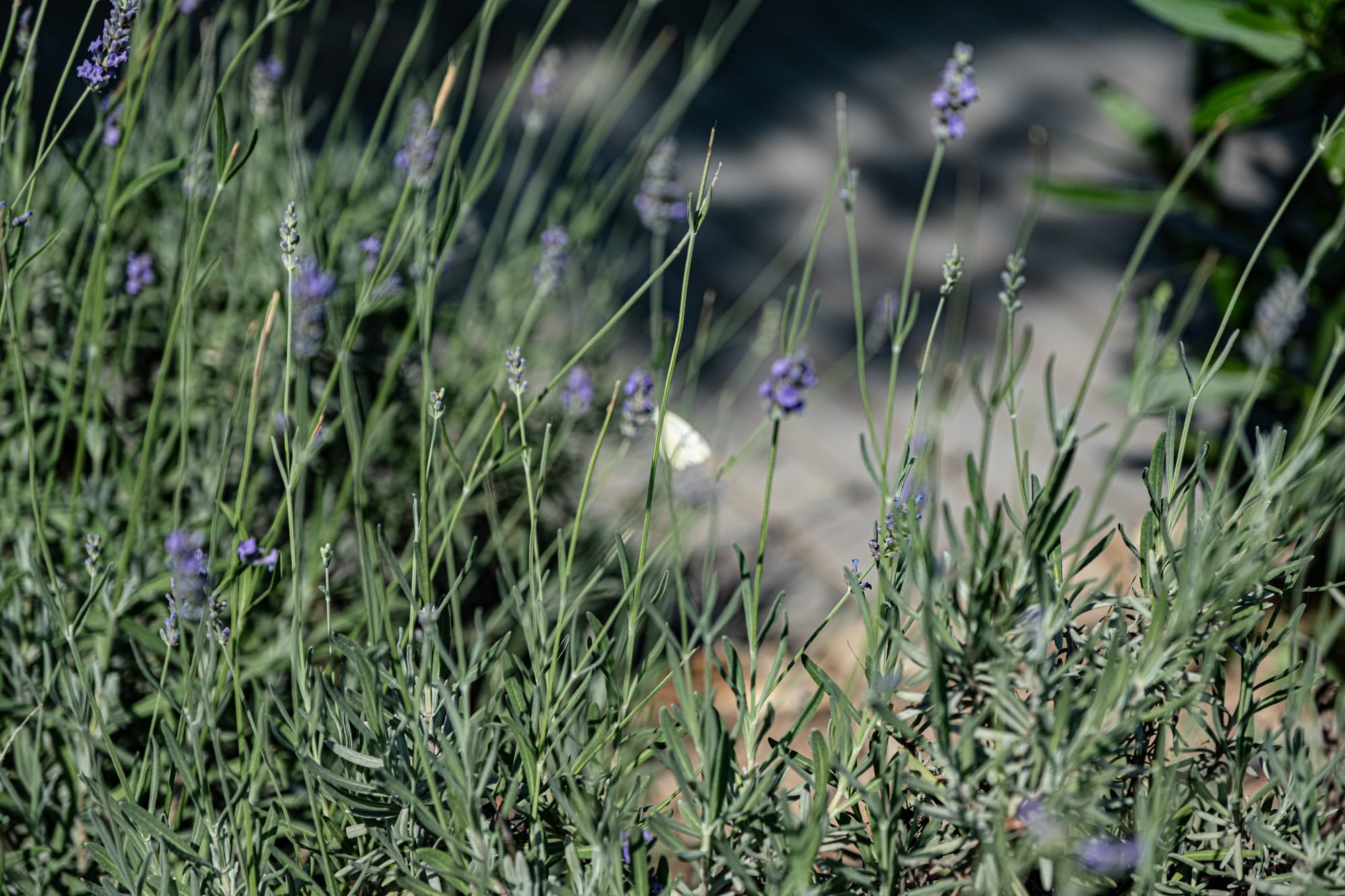
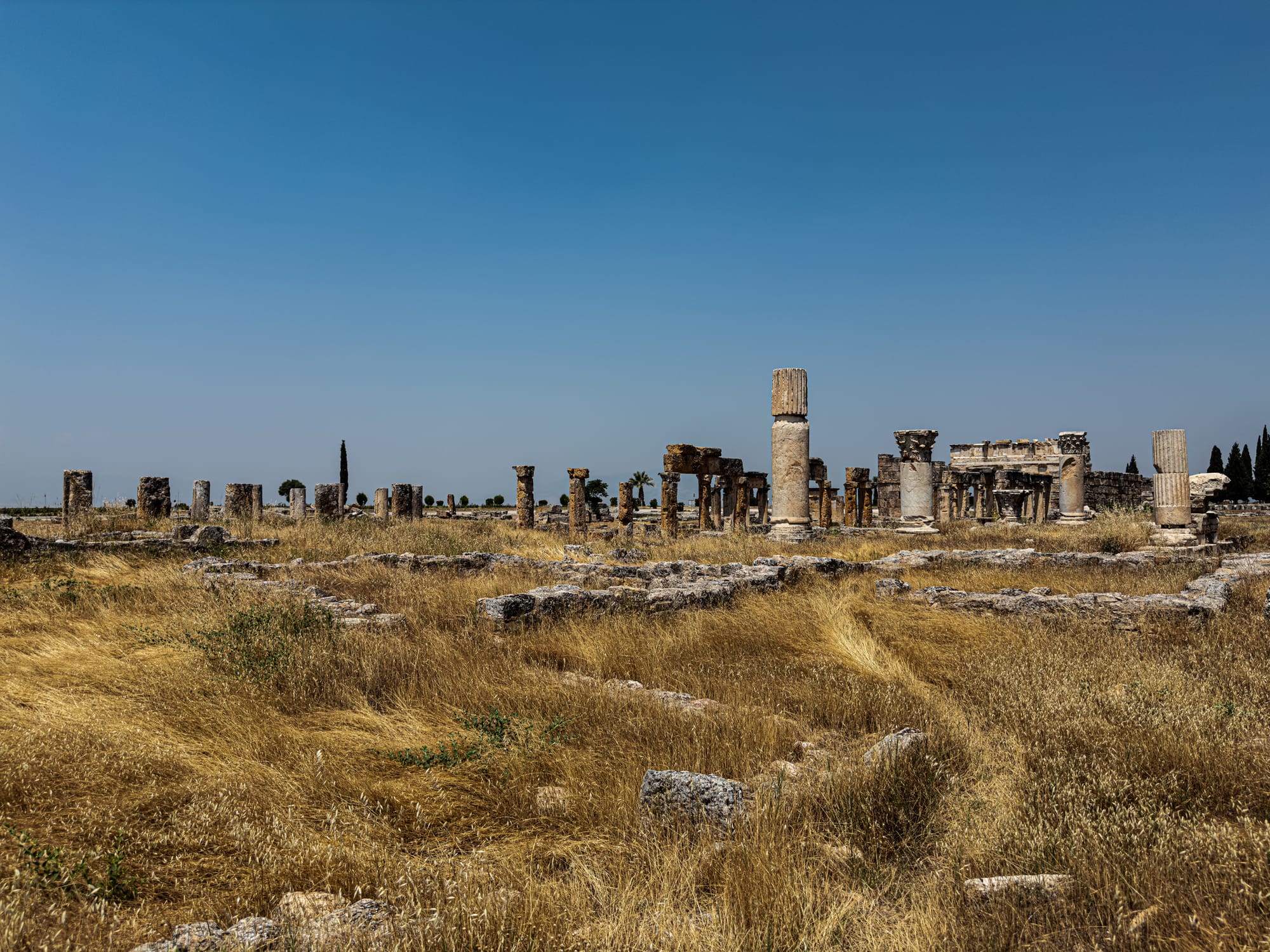
Wildflowers, lichen, and sun-bleached grasses grow freely between the ruins of Hierapolis
Even in the heat, even with limited signage, it is an intuitive place.
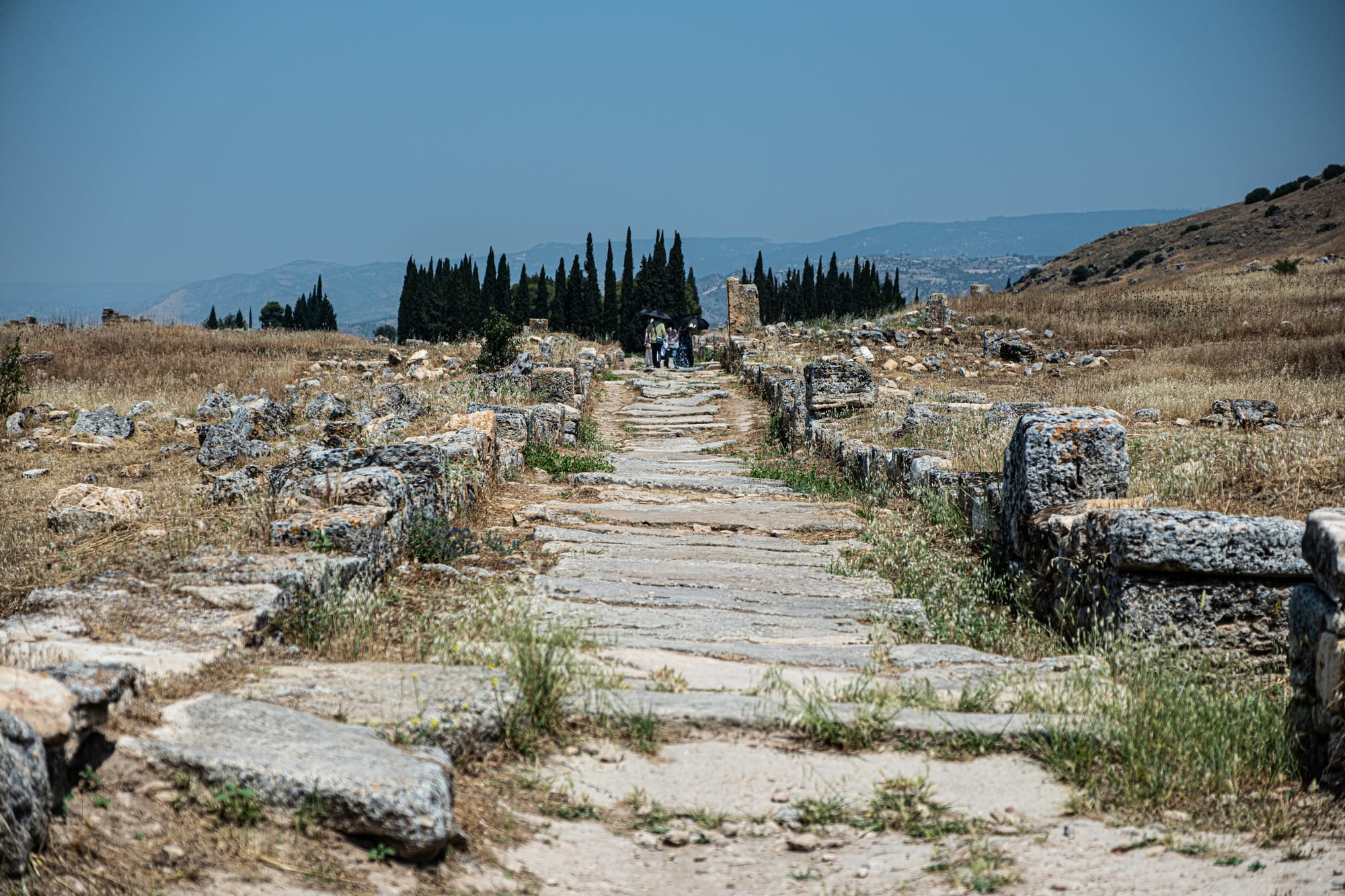
There are moments of quiet awe, sitting on a carved block of marble, watching a crow land on a distant column. Paths that do not really lead anywhere, but feel worth following anyway.
Saint Philip and the Christian legacy of Hierapolis
Hierapolis holds deep significance in early Christian history. Saint Philip, one of the twelve apostles, is believed to have spent his final years in the city and was martyred here around 80 CE. The Martyrium of Saint Philip, an octagonal structure on the hilltop above the theater, marks the traditional site of his death. Although the climb is steep and the structure is largely ruined, the views from the top are expansive.
During the Byzantine period, Hierapolis actually became an important Christian center, with a cathedral, baptistery, and multiple churches built within and around the ancient city. The transformation from pagan spa town to Christian pilgrimage site is one of the most layered transitions visible in Hierapolis’s surviving architecture.
How to visit Hierapolis from Antalya
Hierapolis is approximately 3 hours from Antalya by road. Most visitors take an organized day tour that combines Hierapolis with Pamukkale. Independent visitors can drive or bus to Denizli, then take local transport to Pamukkale town.
By organized tour from Antalya
Most visitors from Antalya take an organized day tour that combines Hierapolis with Pamukkale. Tours typically include transport, lunch, entrance fees, and 3–4 hours of free exploration at the site. We took this full-day tour from Antalya and recommend it.
By car or independent transport
Drive from Antalya to Denizli (approximately 2.5–3 hours), then continue to Pamukkale town (20 minutes further). The site has three entrances: the south gate and north gate are accessible by car at the top of the hill, while the village entrance in Pamukkale town is at the bottom of the travertine terraces.
If arriving by bus, services run from Antalya’s otogar to Denizli’s bus station, from where local dolmuş (minibuses) run to Pamukkale town.
Which entrance to use
The south entrance offers the closest parking and access to the theater, museum, and Cleopatra Pool. The village entrance at the bottom allows you to walk up through the Pamukkale travertines barefoot before reaching the Hierapolis ruins at the top. Many independent visitors prefer the village entrance for the experience of walking the terraces.
How to Visit Hierapolis
A single ticket covers both Hierapolis and the Pamukkale travertine terraces. The entrance fee for foreign visitors is approximately €30 (2025/2026 pricing).
The site is also covered by the Museum Pass Türkiye.
Important: Tickets are single-entry. Once you leave the site, you cannot re-enter with the same ticket, even on the same day. Plan to see everything in one visit.
How much does it cost to visit Hierapolis?
The entrance fee for foreign visitors is approximately €30 (2025/2026). This includes access to both Hierapolis and the Pamukkale travertines.
The Cleopatra Pool (Antique Pool) requires a separate fee of approximately 130–150 TL.
What are the opening hours for Hierapolis?
Summer (April–October): 6:30 a.m. to 9:00 p.m.
Winter hours (November–March): hours vary; the site typically closes earlier (around 5:00–6:00 p.m.).
The site is open every day. Night visits are available from 7:00 p.m., with selected ruins and the travertines illuminated. However, only a few areas are lit, so arrive in daylight if you want to see Hierapolis properly.
Frequently asked questions about Hierapolis
Is Hierapolis the same as Pamukkale?
No. Hierapolis is the ancient Greco-Roman city. Pamukkale is the natural travertine terrace formation below it. They share the same site and are covered by a single ticket, but they are distinct attractions. Together they form a UNESCO World Heritage Site.
Can you re-enter Hierapolis after leaving?
No. Tickets are single-entry. Once you exit the site, you cannot re-enter with the same ticket, even on the same day.
How long does it take to visit Hierapolis?
Allow 2–3 hours for the ruins alone. Combined with the Pamukkale travertines and Cleopatra Pool, plan for a full half-day.
Is the Cleopatra Pool worth it?
If it’s open, yes. Swimming among submerged Roman columns in warm mineral water is a unique experience. The pool charges a separate entrance fee (~130–150 TL). It’s occasionally closed for maintenance.
Is Hierapolis a UNESCO World Heritage Site?
Yes. Hierapolis-Pamukkale was designated a UNESCO World Heritage Site in 1988, recognized for its combination of natural travertine formations and Greco-Roman archaeological remains.
What is the Plutonium at Hierapolis?
The Plutonium is a sacred cave beneath the Temple of Apollo that emits toxic volcanic gases. Ancient priests believed it was an entrance to the underworld. It’s one of the few surviving ancient 'Gates to Hades' and a unique feature of Hierapolis.
Book the experience
Hierapolis is one of several ancient sites within reach of Antalya that reward slow, unhurried exploration.
The best way to see Hierapolis is by combining it with Pamukkale in a guided day trip from Antalya. We took this tour and genuinely recommend it.
You will usually have three to four hours of free exploration at the site, which is enough for a full circuit of the amphitheater, museum, necropolis, and main colonnades. Wear good shoes, bring water, and prepare to walk in the sun.
For a very different kind of ruin, Termessos offers solitude and pine-scented mountain trails through a Pisidian city Alexander the Great couldn't conquer. Closer to the coast, Perge is a spacious Roman city with colonnaded streets and a 12,000-seat stadium, easily visited in a half day. Myra, near Demre, is known for its cliff-carved Lycian tombs and expressive sculptural fragments. And for something entirely different, the sunken city of Kekova lets you drift by boat over submerged ruins along the Mediterranean coast.
For the full picture, see our favorite day trips from Antalya or our digital nomad guide to Antalya, Turkey.


