Amarantonio is a local friend of ours that we met at Huerto Roma Verde, a community garden tucked into the city. He has such a lovely and peaceful aura, and we connected instantly.
Not long after we started talking food sovereignty, he began pointing out small patches of amaranth growing around the space. Some were easy to overlook, growing at the edges of paths or between other plants. He had planted some of them himself, and others had spread naturally. Walking with him, it became clear that his relationship to the plant was not just agricultural, but something more ongoing and embedded in the city itself.
Amarantonio works across several forms. He grows and shares amaranth through his product line, but his practice extends well beyond that. He is also a regenerative artist and poet, alongside being a musician and organizer. His work often moves through public space, whether through planting, performances, or informal exchanges. Rather than operating from a fixed location, his approach is distributed, shared, and constantly in motion.
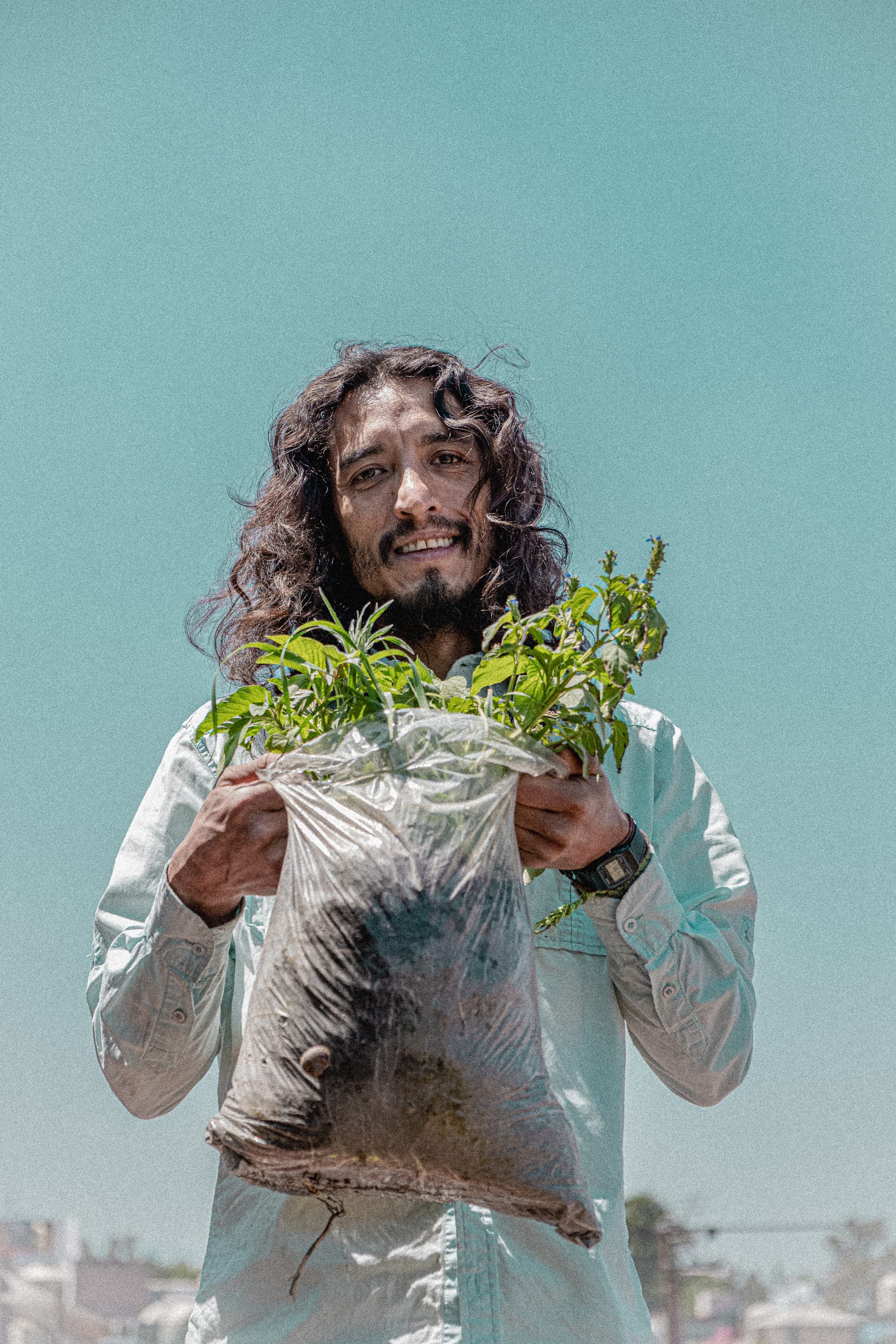
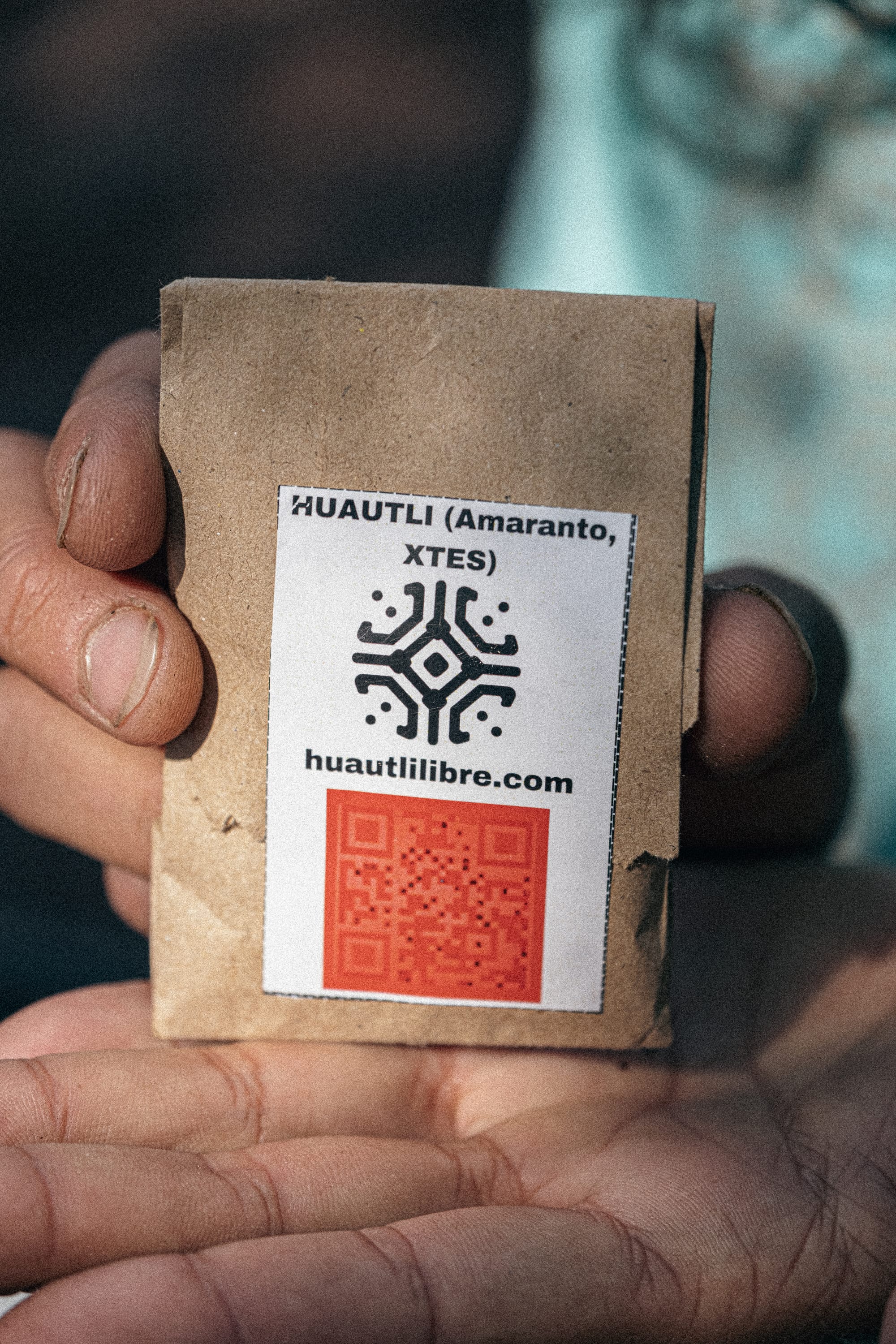
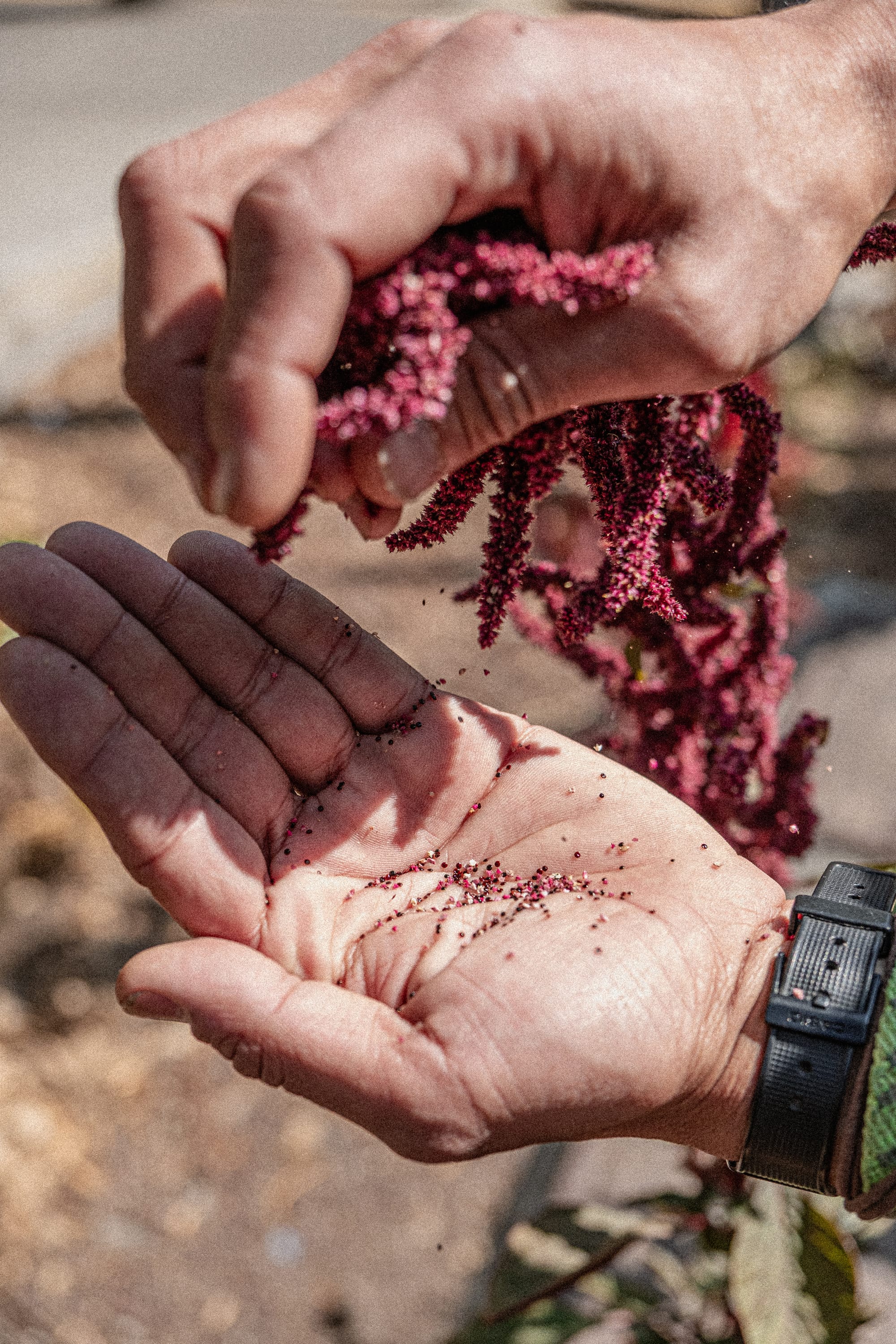
Amarantonio, amaranth plants, and amaranth seeds
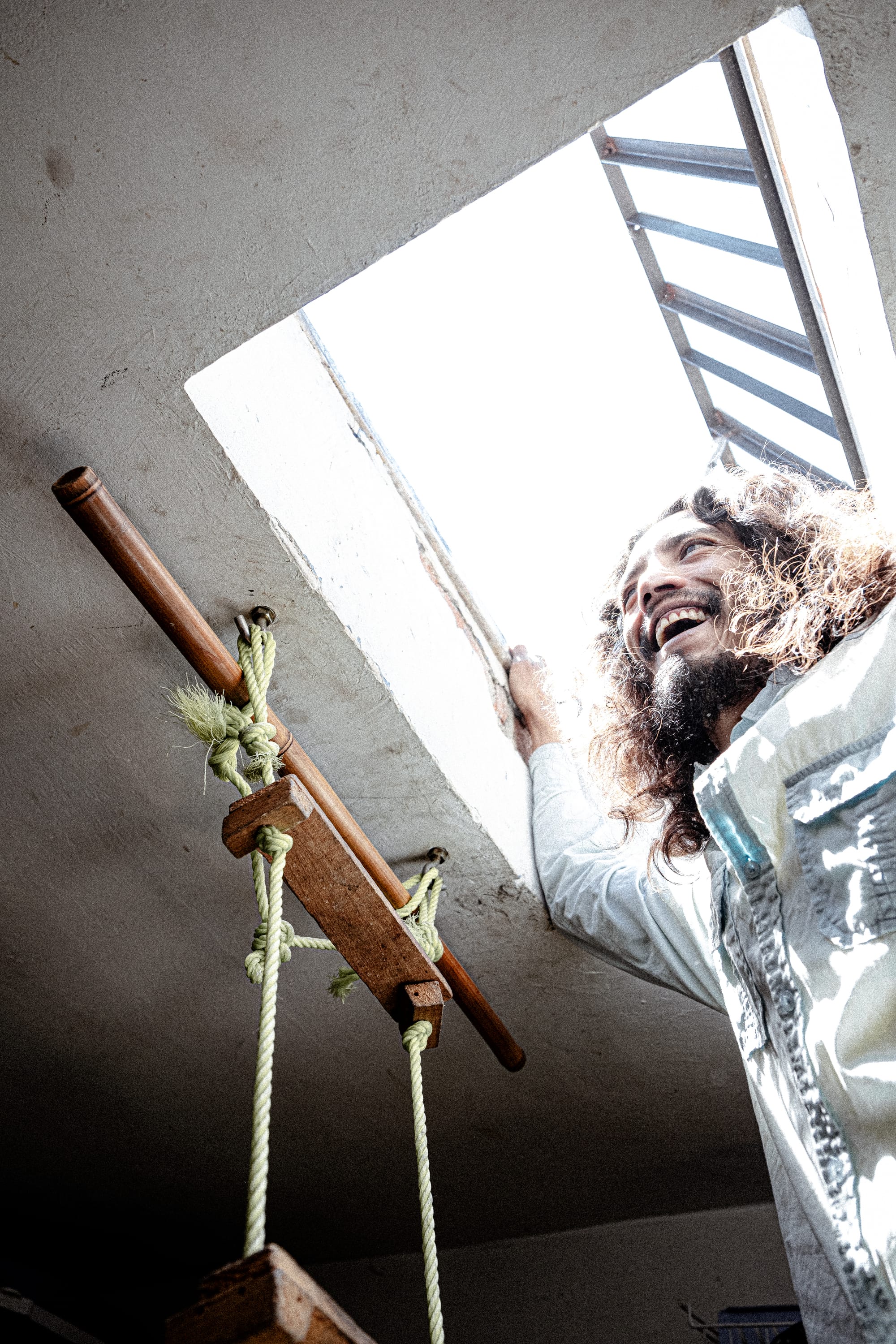
Shortly after meeting, Amarantonio invited us to see his rooftop garden, where he grows different varieties of the amaranth, among other things.
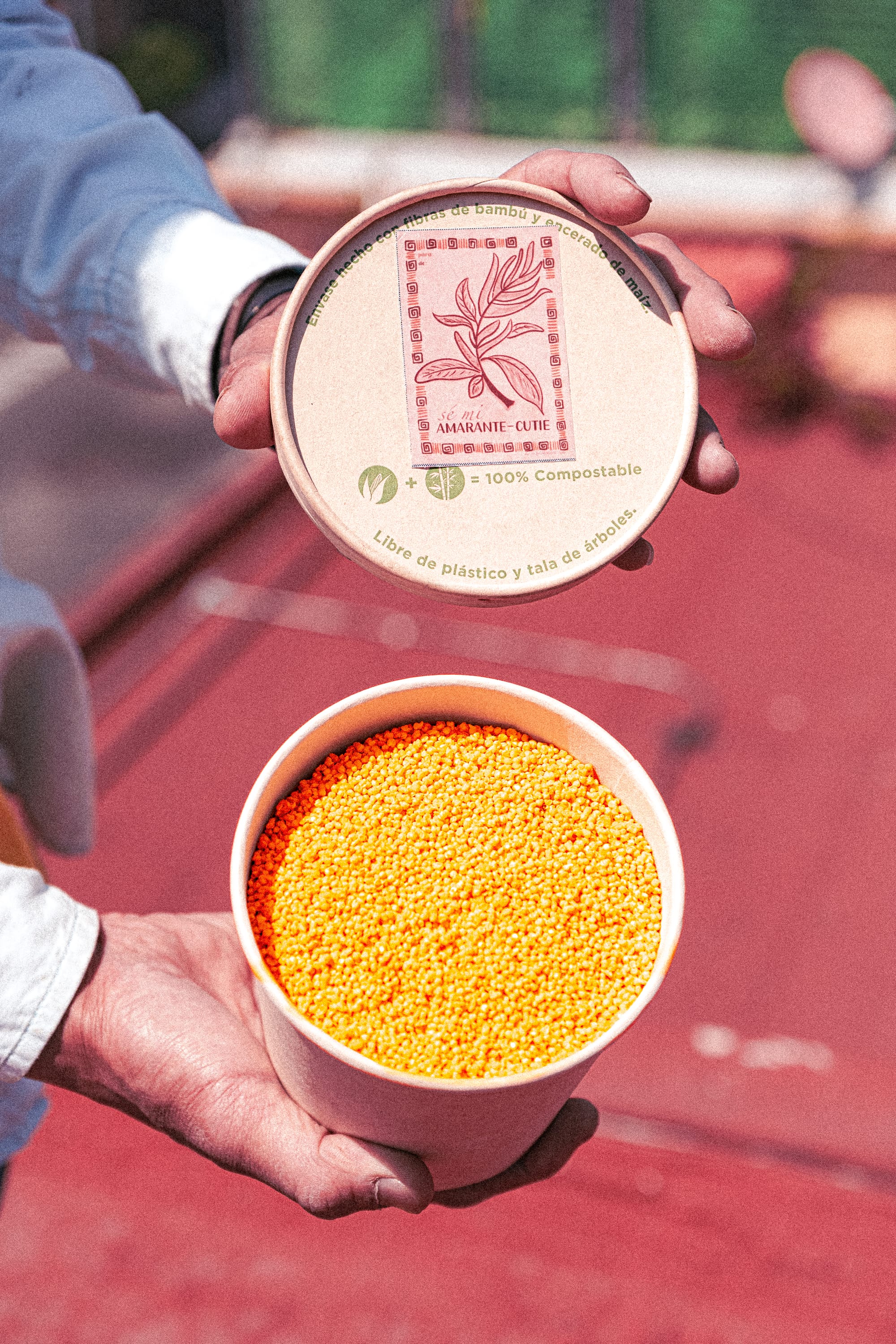
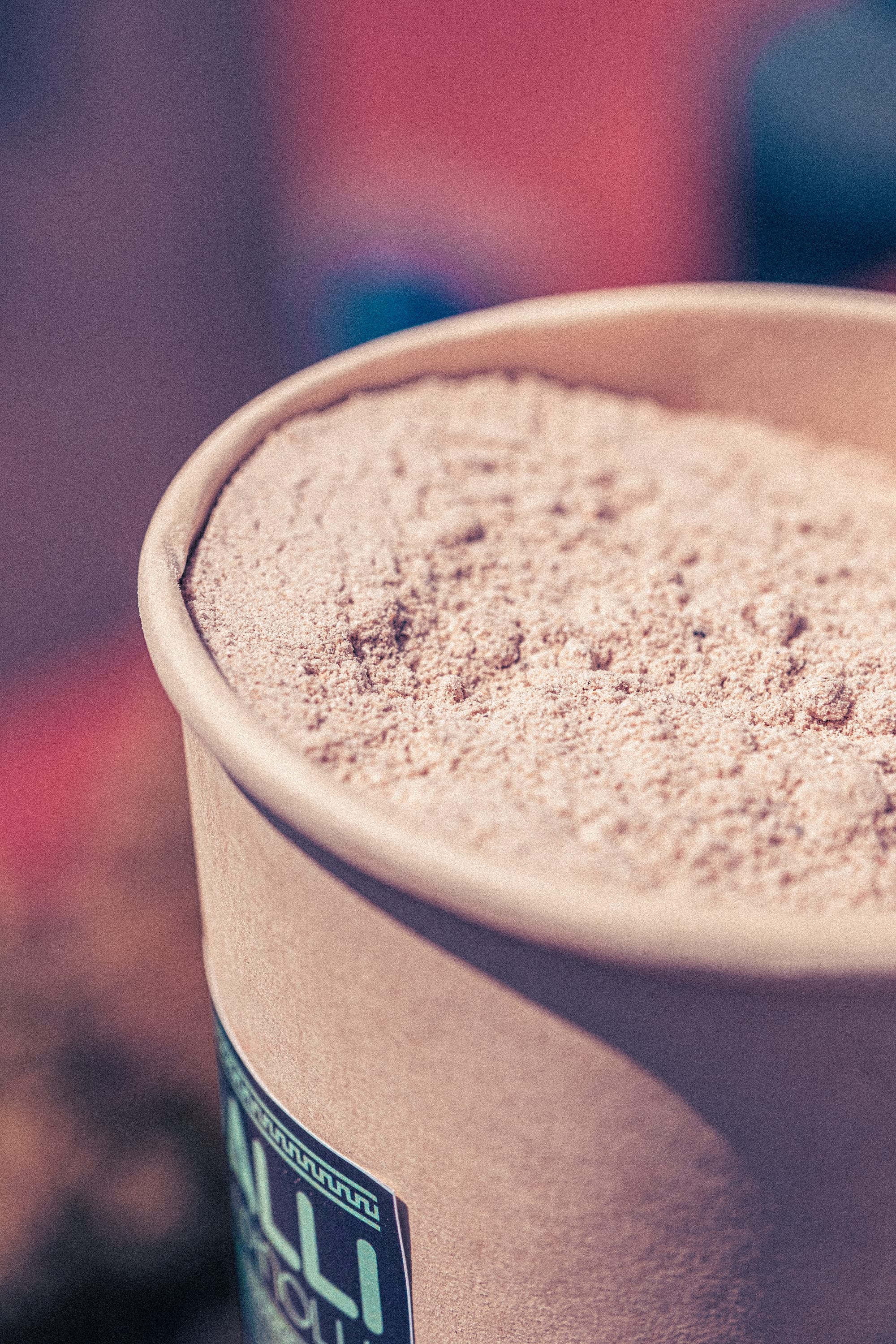
Amarantonio's products: amaranth with organic honey, and grounded amaranth, chia, and ceremonial cacao
Moving through the space with him added another layer to the conversation, making visible the day-to-day practice behind what he describes.
 Nomad Earth Catalog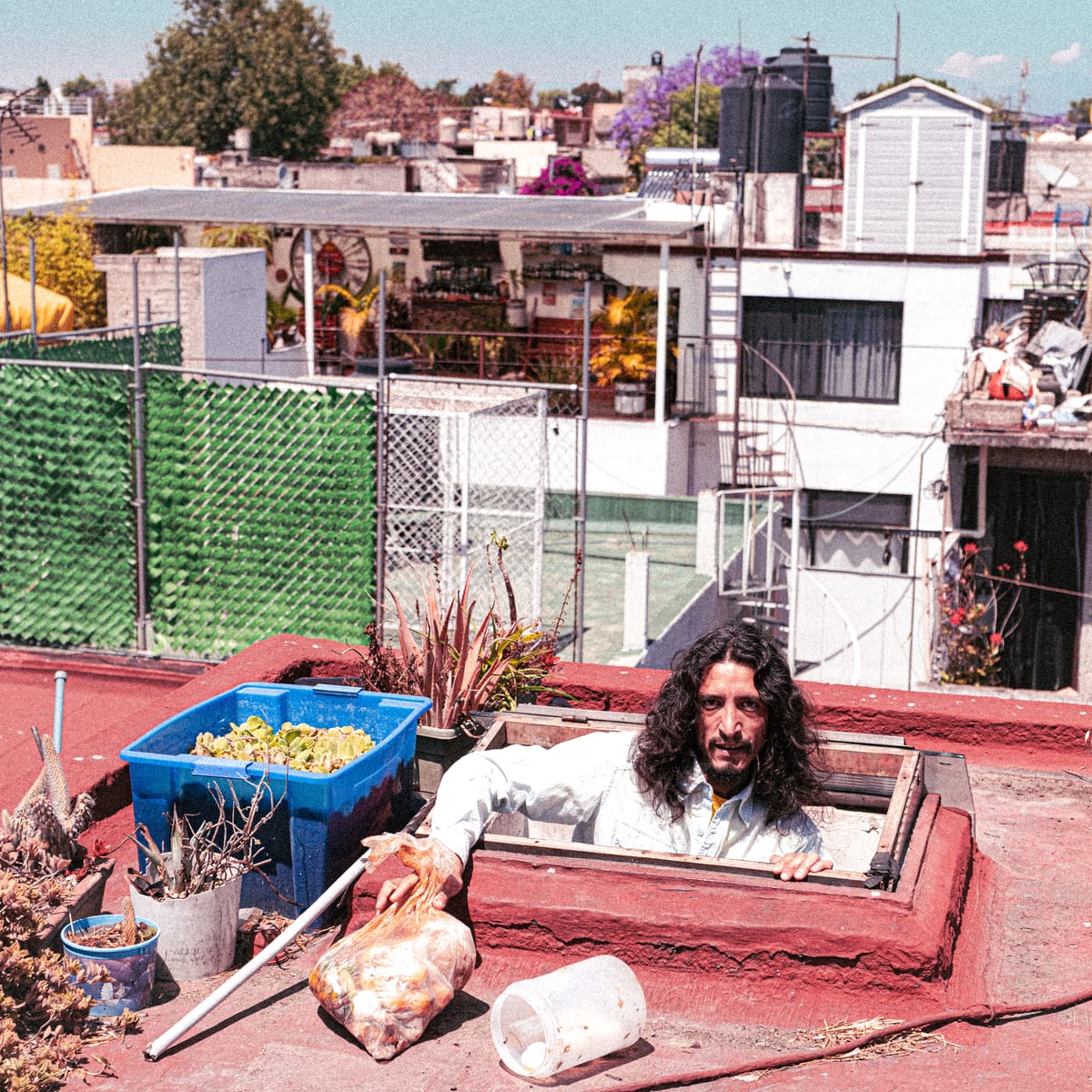
Throughout our conversation, Amarantonio returns often to the idea of the “regenerative.” For him, this is not just a concept, but a way of thinking about how to live, how to create, and how to relate to others and to the environment. Amaranth becomes one entry point into that broader perspective, connecting questions of food, health, history, and autonomy.
What follows is a conversation that begins with amaranth, but gradually expands into a wider reflection on the city, on work, and on what it might mean to build something different within existing systems.
Nomad Earth Catalog
Why amaranth? What got you into it?
Amarantonio
There’s a lot of history behind it.
The short version is that I started to feel something in my body, some pain, and that changed the way I feel, think, and move forward in life.
The longer version goes back to when I was a child. I saw warriors dressed in traditional Mexican clothing. I don’t remember exactly what they told me, but it stayed with me. Later, I spoke with my parents and my uncle, they looked at me in a powerful way, like they understood something.
Then later in life, I met my first best friend. Her name was Amarita. That stayed with me too.
Another important moment, my second close friend had a relative, an astronaut, who took amaranth into space. That connection made me curious.
But the real turning point came when I started feeling pain in my stomach. That changed my perception. I began to look at food differently, and I found the milpa, corn, beans, but I started asking, "Why isn’t amaranth here?"
Amaranth is one of the most powerful plants in the world. It has everything, amino acids, tryptophan. It nourishes deeply. So I asked myself, what happened?
Then I discovered that it had been prohibited. Stigmatized. Suppressed, supposedly for religious reasons, but that’s not true.
That pushed me to research more.
Nomad Earth Catalog
What did you find in your research?
Amarantonio
I found incredible things.
For example, a researcher, Dr. Mary Délano Frier here in Querétaro, did a study with elementary school children. She gave them about 30 grams of amaranth every morning.
The results were amazing. The children became more concentrated. They grew more, about 5 cm more. They had fewer behavioral problems.
This is linked to tryptophan, which helps produce serotonin.
If your body is nourished, your mind stabilizes.
That changed everything for me.
Now, amaranth is the first thing I eat every morning. It’s something I never skip.
Nomad Earth Catalog
Can you talk about your art practice? You work with poetry, music, and performance.
Amarantonio
Yes. What we’re doing, we call regenerative art.
We create masks covered with amaranth seeds, using beeswax to bind them. When we perform, we share these objects, and the seeds can grow without deliberate planting, just through movement.
It’s inspired by birds. They eat seeds and spread them naturally.
We do this with masks, hair, piñatas, and clothing with pockets for seeds.
We’re also experimenting with food packaging, embedding seeds into materials so that when people throw them away, it’s not waste. It becomes something regenerative.
The idea is simple: Nothing should be waste. Everything should return.
Nomad Earth Catalog
You mentioned poetry and music as well. How do those connect?
Amarantonio
In life, many things happen that are painful or difficult.
I read a book by Pema Chödrön, where she talks about how we filter experience, how we take in the world.
In meditation, sometimes we breathe in the bad and transform it into something good.
That idea influenced me deeply.
So my poetry works like that, taking something negative and transforming it into something generative.
Then those poems become music.
And the music becomes something people can sing, affirmations that reconnect us with what we really are.
For me, nature is the greatest technology.
Everything, our bodies, our thoughts, is evolving.
Nomad Earth Catalog
You organize events, ceremonies, jams, gatherings. What do those look like?
Amarantonio
This isn’t just an activity. It’s a way of life.
A regenerative way of living.
I left a normal job because it felt like slavery. Instead, I started building a different kind of abundance, based on seeds.
We have this idea that money is value.
But I ask, "What are you returning to the world?"
So when I earn money, I use it to give seeds to people, to help them grow their own food.
We organize music jams, bike rides across the city, seed-sharing events, and gatherings with food, art, and poetry.
Sometimes we even use crypto donations to reward people, not with money, but with seeds.
Because seeds are the real value.
Nomad Earth Catalog
You plant amaranth across the city. Where and how do you do that?
Amarantonio
Everywhere.
Near Huerto Roma Verde, in parks like Chapultepec, in many places.
We don’t have a fixed location. That’s what makes us different.
We move through the city, sharing seeds.
If someone notices the plants, they can take care of them.
We are now a network, about 550 people, sharing and growing amaranth across different areas.
Some people support us. Others remove the plants.
But we continue.
Nomad Earth Catalog
How do people respond?
Amarantonio
It varies.
Some people are starting to appreciate it and just let it grow.
Others still remove it.
But more and more people are becoming involved.
The key is not ownership, it’s sharing.
Nomad Earth Catalog
You used to be a systems engineer. What made you change your life?
Amarantonio
Yes. I was a certified Microsoft professional.
I worked in system architecture, migrations, enterprise design, and technical strategy.
I was growing in that world.
But something happened.
Many of my colleagues, experts in different technologies, died.
At the same time, I took a trip to Chiapas.
That changed everything.
Nomad Earth Catalog
What happened in Chiapas?
Amarantonio
That trip could be a whole book.
We visited rural areas where forests and jungles were being destroyed to produce more food.
Everything was being cut down.
That made me think:
What if we returned to the city and started from zero?
What if people grew their own food?
What if we created food sovereignty?
That idea stayed with me.
Nomad Earth Catalog
Why is food sovereignty so important?
Amarantonio
Because people are not well nourished.
And when you are not nourished, your cognition declines, your mood declines, and your humanity declines.
In the past, amaranth was widely used, about 70% of people consumed it.
When we lost it, we lost something fundamental.
Now, people are hungry, people are angry, and people are sad.
We try to imitate “first world” lifestyles, but we forget what it means to be human.
Being human means taking care of yourself, nourishing your body, and living in balance.
Nomad Earth Catalog
Some people choose to leave the city. You chose to stay. Why?
Amarantonio
People told me, “There’s nothing here. Let’s leave.”
That affected me.
But I decided the opposite: don’t run, return, change things here.
The city has space. It has potential.
We just need to use it differently.
Nomad Earth Catalog
How does your work intervene in local problems?
Amarantonio
Through community.
We have a movement called Amitla Nochi, a music jam that started locally and is now international.
We create spaces where people can make music freely, people can eat healthy, and people can connect.
It’s not about being a professional artist. It’s about participation.
Nomad Earth Catalog
What are the biggest problems affecting people in Mexico?
Amarantonio
Food.
People are not nourished.
That’s why they are sad.
That’s why they are struggling.
The experiment with amaranth showed me that when you nourish people, everything changes.
Nomad Earth Catalog
What does “regenerative” mean to you?
Amarantonio
For me, it’s a personal transformation that impacts others.
It’s about restoring instead of destroying, giving instead of extracting, and sharing instead of owning.
Seeds should be free, like open source software.
But today, people patent them, control them.
We believe seeds belong to everyone.
Everything I do is not easy.
We are breaking stone, little by little.
But when you live regeneratively, your life changes.
It becomes powerful, meaningful, and full of trust.
And that’s enough to continue.
Amaranth is a traditional food of Mexican people. Its original name is Huautli in the Nahuatl language. Libre means "free," following the ethos of software libre / free software.


