

Situationist International (1957–1972) was a loose collective of artists, writers, and political theorists who sought to re-imagine everyday life as a site of radical possibility. Emerging from postwar Europe, they fused avant-garde art with Marxist critique, arguing that modern life had been colonized by what Guy Debord called the society of the spectacle: a world where authentic experience was replaced by images, consumption, and staged appearances.
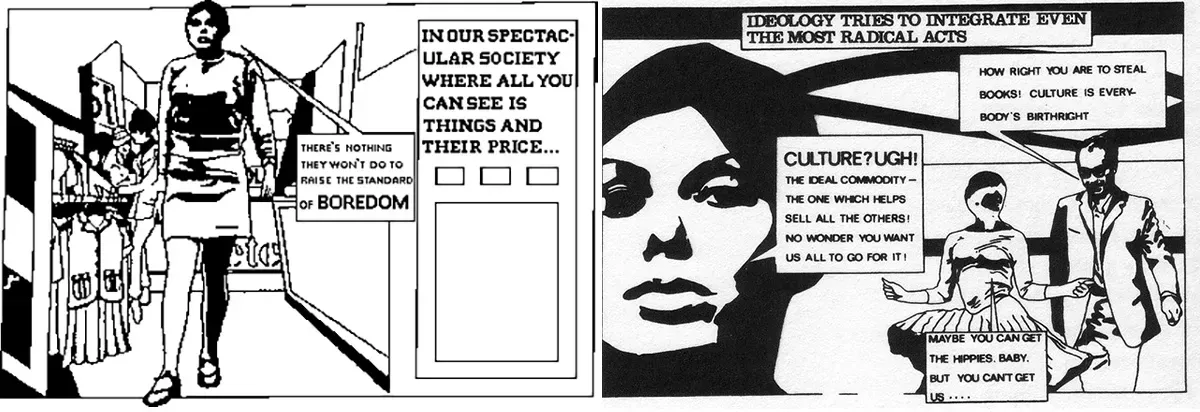
Rather than accepting this as inevitable, the Situationists proposed practices of resistance. Dérive (drift) invited people to wander cities according to mood and affect rather than function or commerce. Détournement reworked mass media and advertising into critical parody, subverting the very forms that sought to manage desire. Their May 1968 graffiti in Paris declared “Sous les pavés, la plage” (“Beneath the pavement, the beach”), collapsing protest and poetry into a single gesture.
The Situationist International dissolved after only 15 years, but its influence lingers in urban theory, activist media, and experimental art. Situationism reminds us that movement can be more than transit, that images can be more than consumption, and that the textures of daily life (streets, signs, detours) are the very ground on which liberation is practiced.
The group was founded in July 1957 at a meeting in Cosio d'Arroscia, a village in northern Italy, when the Lettrist International, the International Movement for an Imaginist Bauhaus, and the London Psychogeographical Association merged. Guy Debord and the Danish painter Asger Jorn were among the founders.
Its ideas spread through the journal Internationale Situationniste, twelve issues published in Paris between 1958 and 1969, and through two books from 1967: Debord's The Society of the Spectacle and Raoul Vaneigem's The Revolution of Everyday Life.
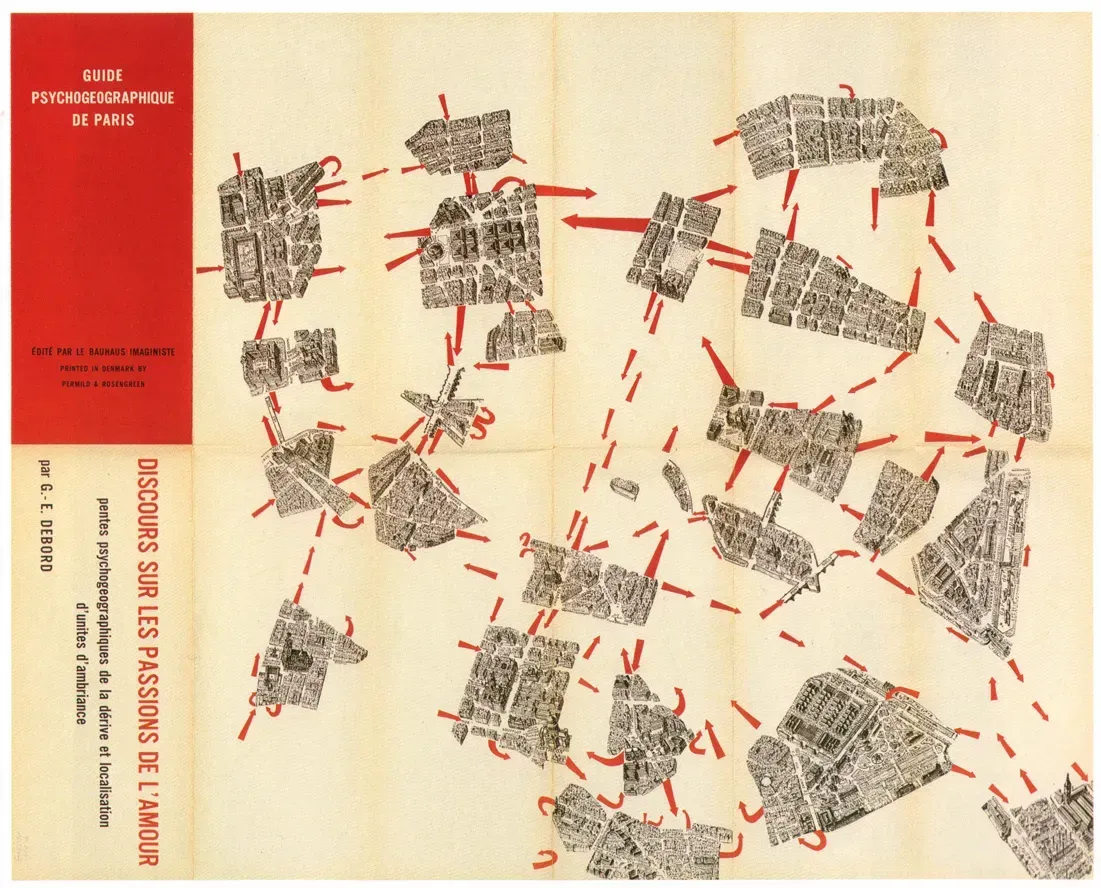
Psychogeography, the study of how a city's layout affects mood and behaviour, came out of the same circle. Debord's 1957 map Guide psychogéographique de Paris cut the city into pieces joined by red arrows, a record of drifts rather than streets. Tate's glossary has a short overview of the group and its art.
See also: New Babylon
Images from Design After Capitalism and Artforum.
