


Nossa Senhora da Paz is a small white chapel on a hill above Vila Franca do Campo, on the south coast of São Miguel in the Azores. It's free to visit, and the main draw is the staircase of 100 steps with blue-and-white tiled landings, plus the view over the town and its round islet. You can drive almost to the top or climb the stairs from below, and 30 minutes to an hour is enough. Come early in the morning or late in the afternoon for the softest light. It's our favorite church on the island.
To see the islet up close, this biologist-guided eco boat tour to the Ilhéu de Vila Franca leaves from Vila Franca. To book, check prices at GetYourGuide.
High above the red roofs of Vila Franca do Campo, the Santuário de Nossa Senhora da Paz is a landmark you climb up to on foot, a bright emblem of faith and resilience, and, in our eyes, the most elegant church on the island of São Miguel.
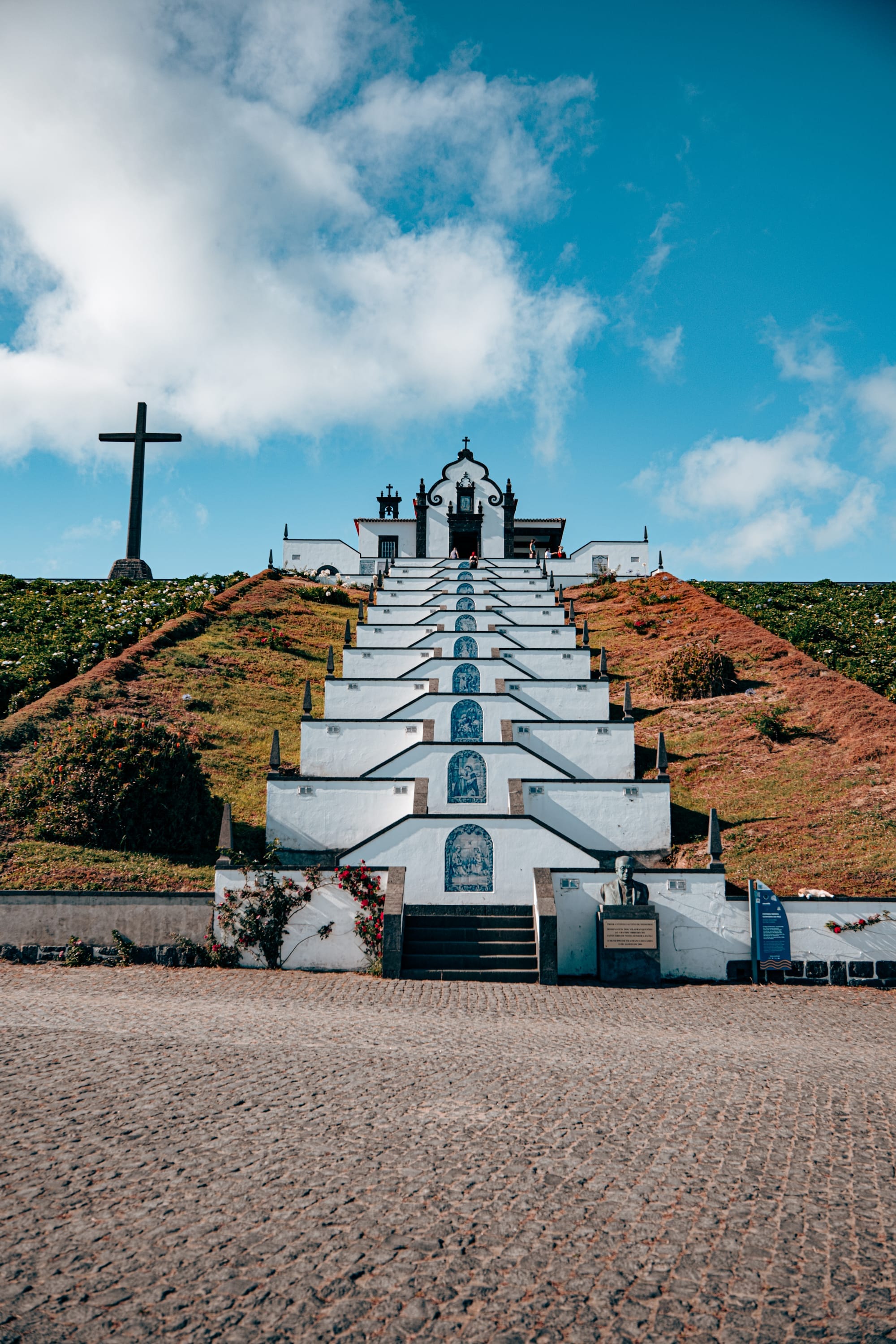
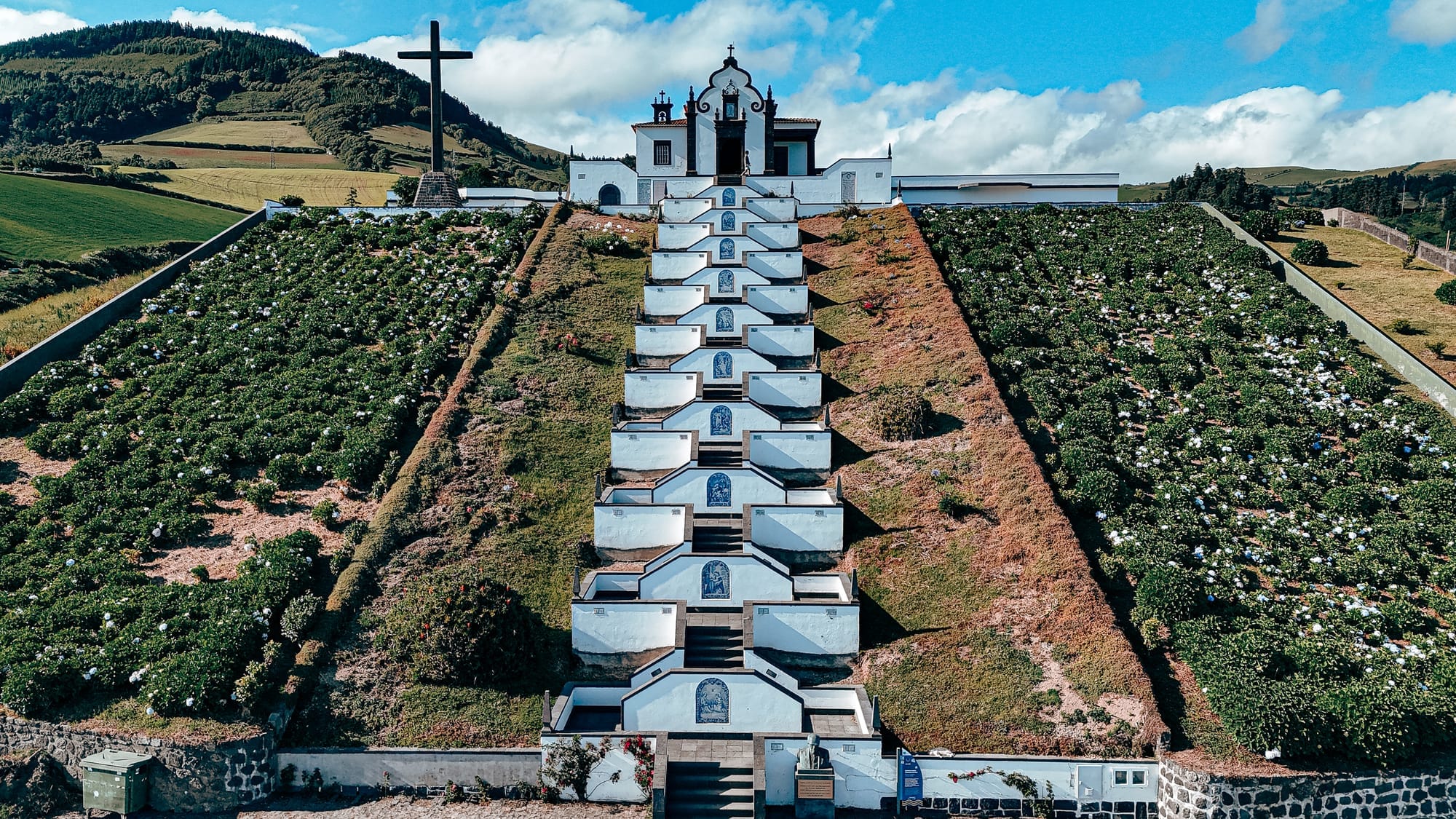
The tiled staircase rising to Santuário de Nossa Senhora da Paz
You can see it from the town below or walk up its green hillside to reach it, and either way, the church's clean architecture and commanding view make it one of the most distinctive and poetic buildings in the Azores.
Nossa Senhora da Paz at a glance
Here are the practical basics before you go.
Full name: Ermida de Nossa Senhora da Paz (Chapel of Our Lady of Peace), now a diocesan sanctuary, so you'll see both "Ermida" and "Santuário" on maps.
Where: on the hill above Vila Franca do Campo, on São Miguel's south coast, roughly half an hour's drive east of Ponta Delgada.
Cost: free. The stairs, gardens, and viewpoint are outdoors, with no ticket.
Time needed: 30 minutes to an hour, more if you climb the full staircase from the bottom.
Best time: early morning or late afternoon, on a clear day.
Inside the chapel: it isn't always open outside services, so treat a look inside as a bonus.
| Details | |
|---|---|
| Full name | Ermida de Nossa Senhora da Paz, now a diocesan sanctuary |
| Where | Hill above Vila Franca do Campo, about half an hour east of Ponta Delgada |
| Cost | Free, no ticket |
| Staircase | 100 steps in ten flights with tiled landings (built 1967) |
| Time needed | 30 minutes to an hour, more from the bottom of the stairs |
| Best time | Early morning or late afternoon on a clear day |
| Inside the chapel | Not always open outside services |
How to get to Nossa Senhora da Paz
The easiest way is by car. From Vila Franca do Campo, follow the signs for Nossa Senhora da Paz up the hill. The road is narrow and winding in places, so take it easy, especially if you meet a car coming down. There's a small parking area near the top, by the viewpoint, which fills up on sunny weekends.
If you'd rather climb, start at the bottom of the staircase and walk up all ten flights. It's steep but short, and it's the way the chapel was meant to be approached. Walking up from the town center adds a fair climb on top, so wear comfortable shoes and bring water on warm days.
Without a car, you can take a bus from Ponta Delgada to Vila Franca do Campo, then walk or take a taxi up the hill. Check the current bus times before you go, as services are limited.
If you're building a day on the south coast, Our Guide to São Miguel has the chapel in the same chapter as the Vila Franca islet and whale and dolphin watching.
Which way up suits you depends on your knees and your time:
| Option | Effort | Good to know |
|---|---|---|
| Drive to the viewpoint car park | Low | Narrow, winding road. The viewpoint doubles as the parking area, and it fills on sunny weekends |
| Climb the staircase | Medium | 100 steps in ten flights. The best way to see the tile panels in order |
| Walk up from the town center | High | Adds a steep climb through town before the stairs, so go in the cooler part of the day |
| Bus plus a walk or taxi | Medium | Buses from Ponta Delgada are limited, especially on Sundays and holidays |
If stairs are hard for you, driving up is the way to go. The car park is at the top, though we can't confirm step-free access into the chapel itself.
The history of Nossa Senhora da Paz
This hilltop church is tied to stories of divine intercession and local devotion. According to local lore, it was first built in the 16th century after the Virgin Mary appeared and saved a shepherd from Moorish pirates. The image of peace, Nossa Senhora da Paz, is said to have been found on top of this very hill. Out of reverence, the townspeople built a small chapel on the site, as a gesture of gratitude and a place of refuge.
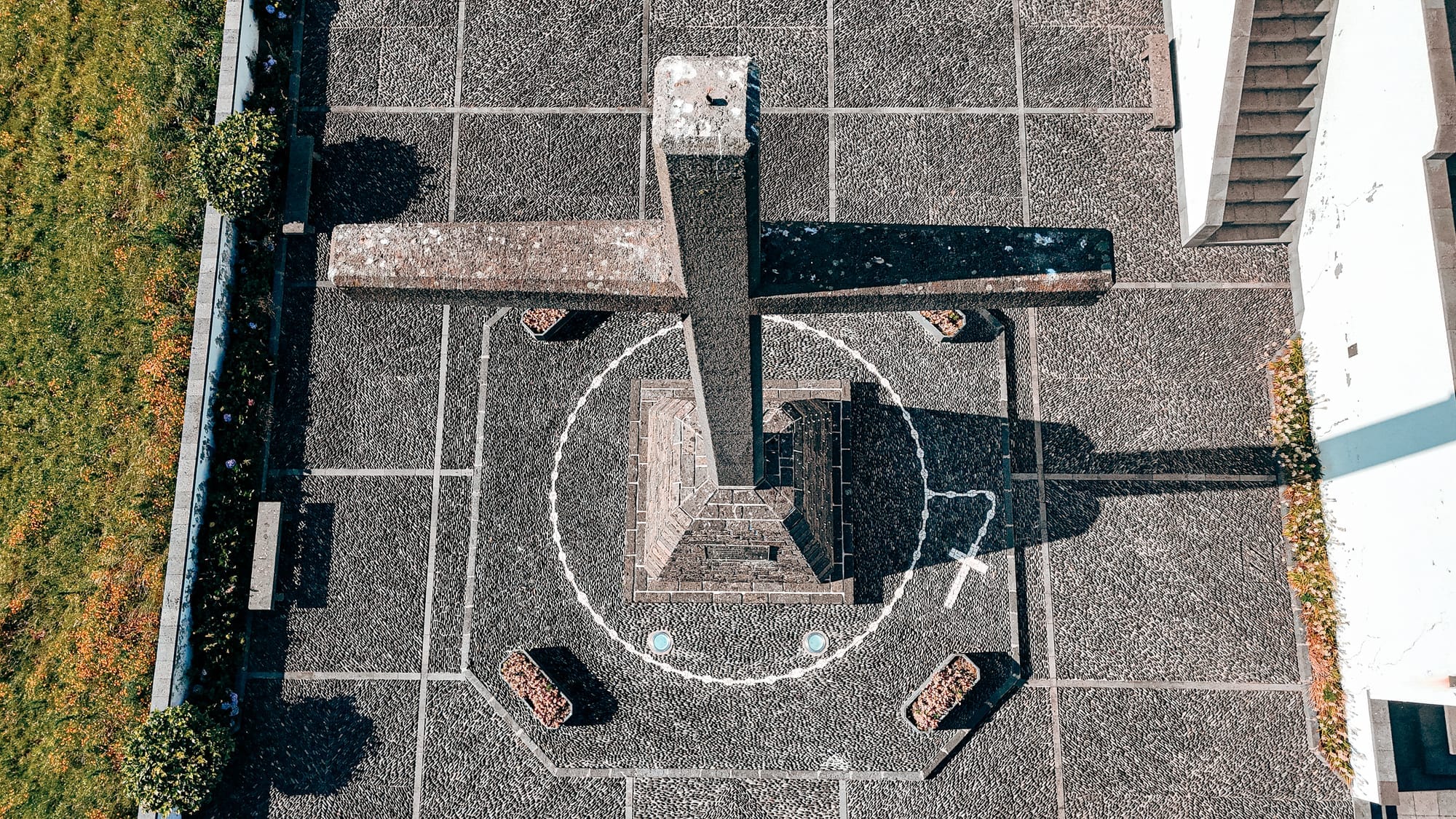
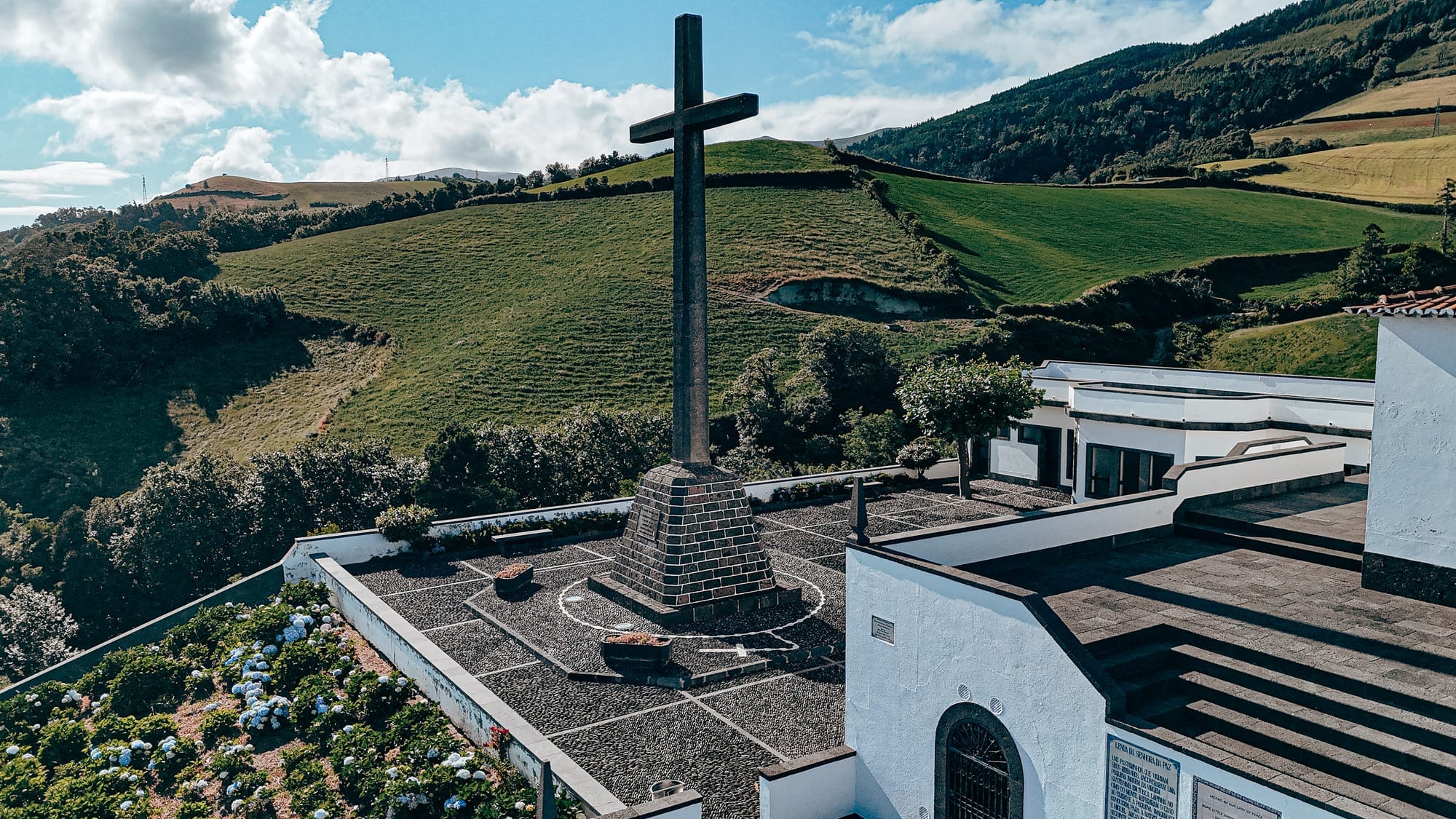
A striking cross casts its long shadow over the basalt-tiled forecourt of the sanctuary
The original structure was destroyed during pirate raids, but the chapel was faithfully rebuilt in 1764. It has since become a much-loved pilgrimage site, especially during the Feast of Nossa Senhora da Paz in July, when the church fills with processions, prayer, and music.
The dates are well recorded. The chapel belongs to the Diocese of Angra (listed on GCatholic as the Ermida de Nossa Senhora da Paz), and according to RTP, Portugal's public broadcaster, the present chapel was built in 1764 on the site of an earlier, simpler temple, possibly from the 16th century, where a shepherd is said to have found an image of the Virgin in a grotto. The Azores regional government classified it as a Property of Public Interest in 1991.
The famous staircase is much newer than the chapel. Wikipedia's Vila Franca do Campo page says it was built in 1967, which is when the simple hermitage turned into one of the town's main sights. In April 2024 the Diocese of Angra decided to raise the chapel to a diocesan sanctuary, after more than twenty years of requests, and the ceremony took place at the start of 2025. RTP reports that it's the first Marian sanctuary on São Miguel.
At the foot of the staircase there's a bust of Prior António Jacinto de Medeiros, who served as the town's parish priest for 58 years, according to the regional guide byAçores. The same guide gives a slightly different version of the founding legend: shepherds found an image of the Virgin in a cave and carried it to the parish priest, but it kept turning up back in the cave, which locals took as a sign that a chapel belonged there.
The elevation ceremony was held on 1 January 2025, the Catholic World Day of Peace, a fitting date for Our Lady of Peace (RTP).
The chapel's history is also tied to the town's. Vila Franca do Campo was the capital of São Miguel until an earthquake and landslide on 20 October 1522 destroyed it and killed about 5,000 people, after which the capital moved to Ponta Delgada.
Climbing the zigzag staircase, one step at a time
The most striking feature of the church is the staircase that zigzags up the hill toward it, like a ladder to the top. It's a way up, but it's also a devotional route. There are ten levels of steps, each with a small landing decorated with hand-painted azulejo tiles showing scenes from the life of Christ and the Virgin Mary. Symmetrical stone balustrades guide you upward, bordered by blooming hydrangeas and neatly trimmed hedgerows.
There are 100 steps in all. The layout is symbolic: the flights stand for the Our Father and the joyful and sorrowful mysteries of the rosary, with ten flights for the Hail Marys, which is why the tiled scenes follow the life of Christ and the Virgin as you climb. Read the panels in order on the way up and the climb makes much more sense.
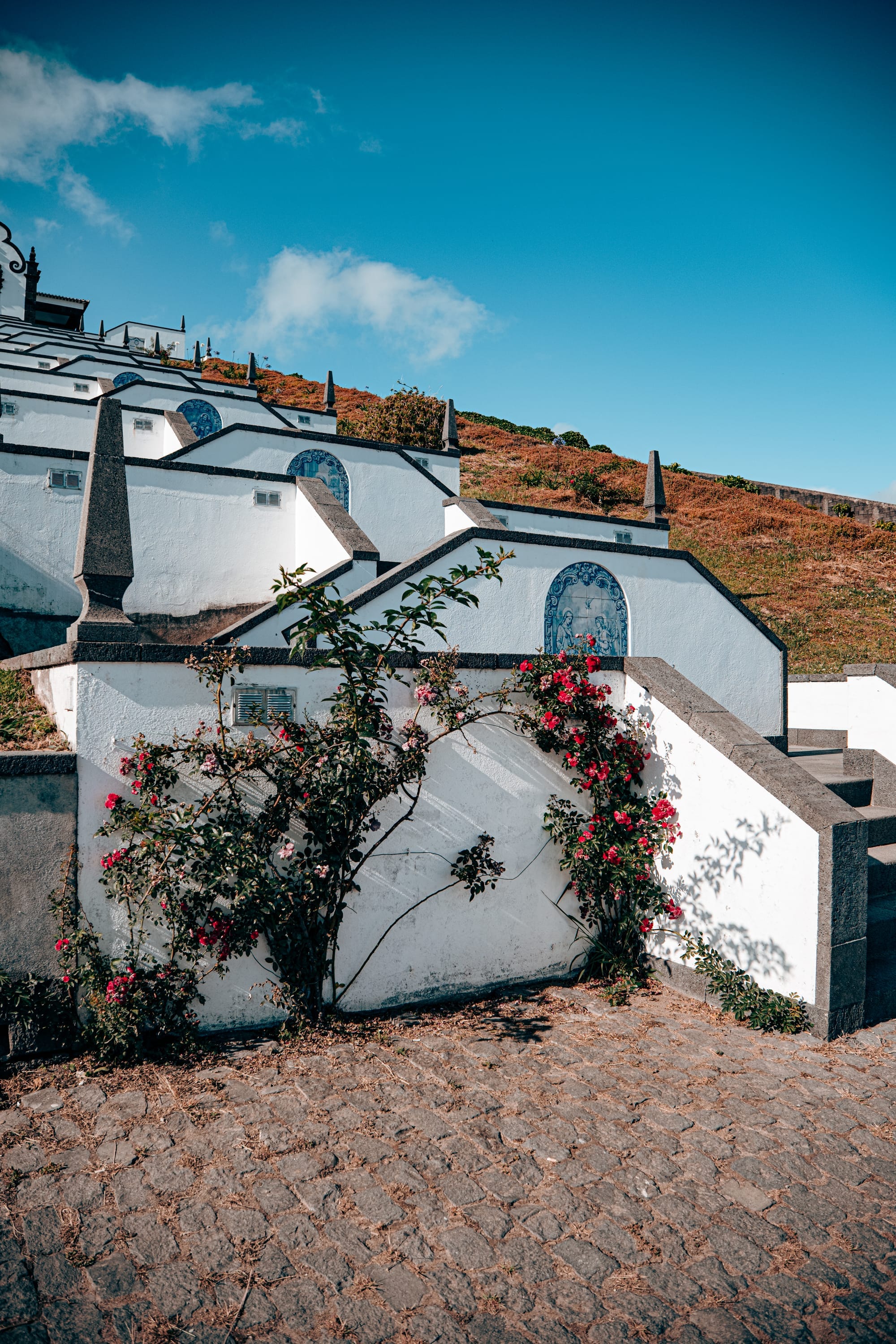
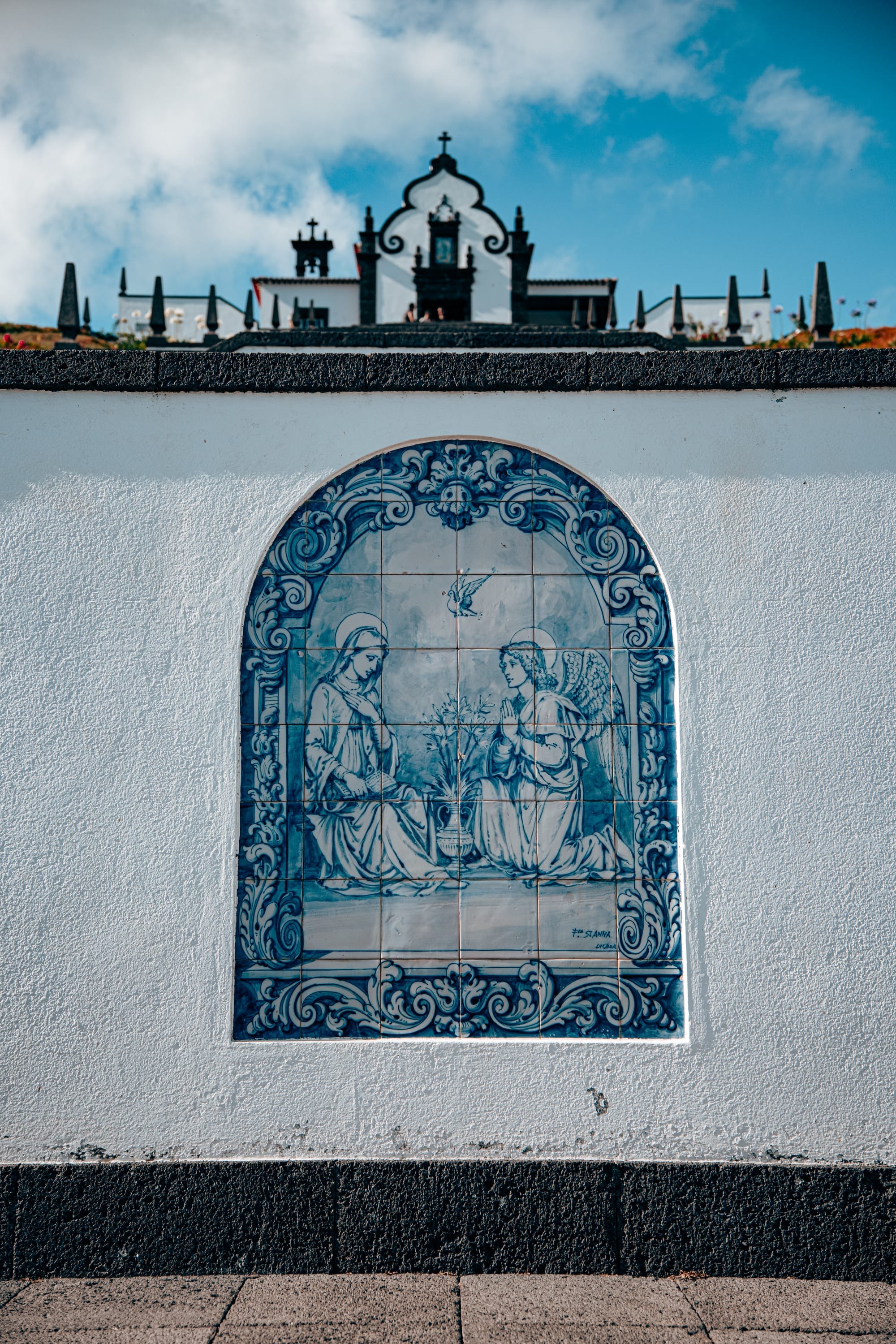
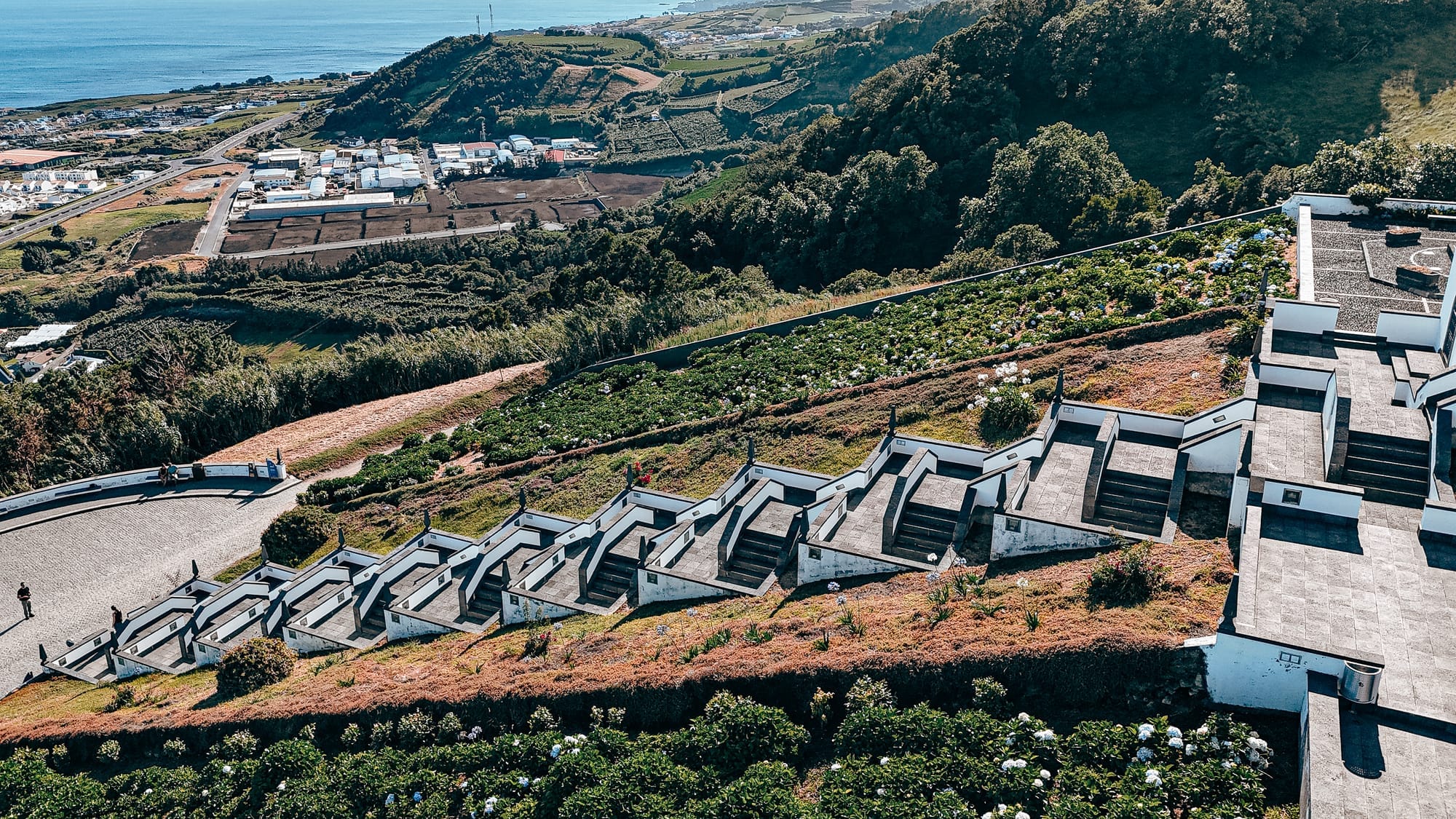
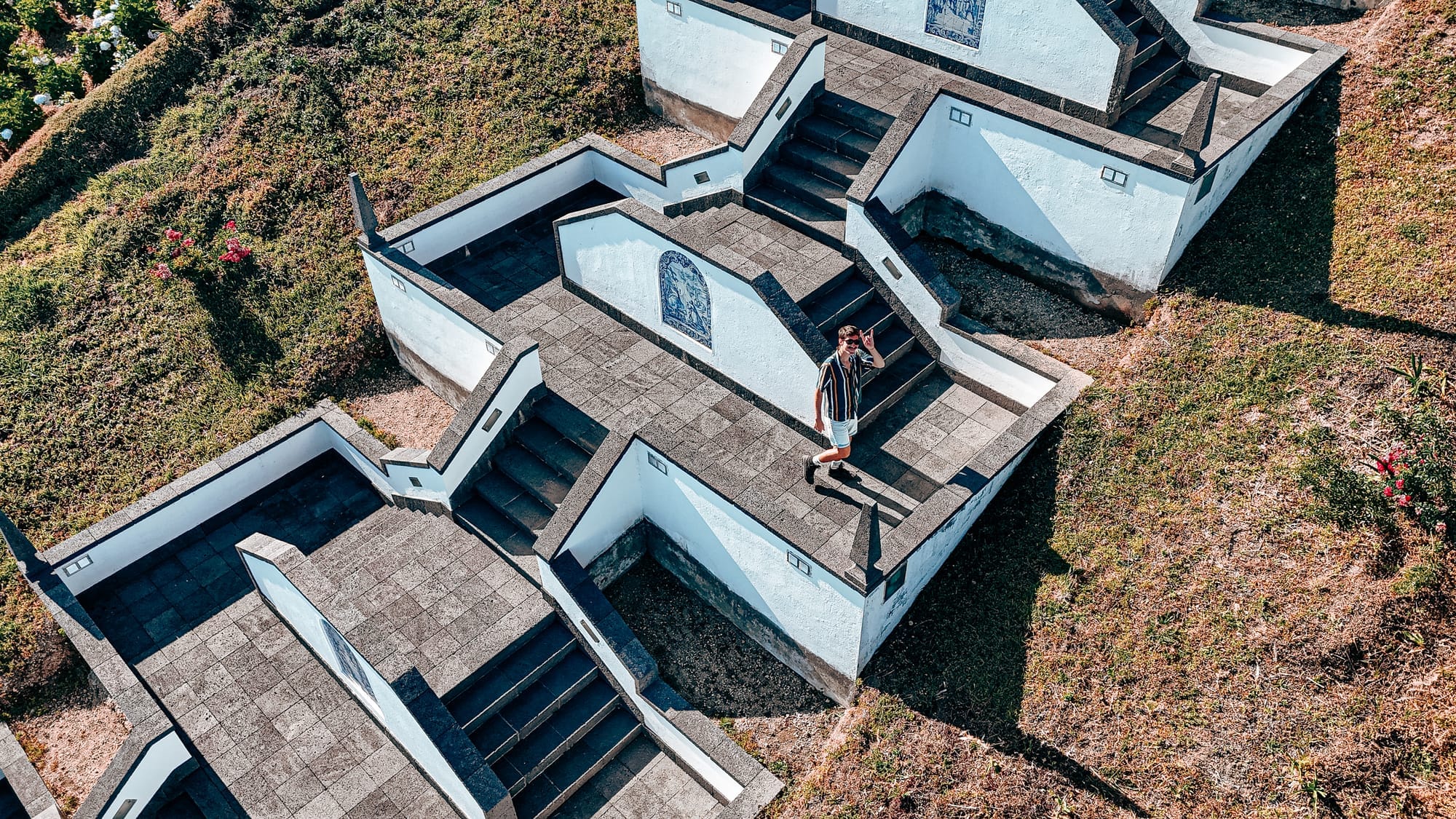
The dramatic zigzagging staircase to Santuário de Nossa Senhora da Paz, each landing marked by hand-painted blue tile panels
Seen from above, the staircase forms a neat and satisfying geometric pattern. Its layout is both spiritual and cinematic, a sacred space built for movement and fresh air. This is not an accident. The tradition of placing churches on high ground is full of symbolism: the height stands for being closer to the heavens, both literally and spiritually. Here, it also offered protection from storm surges and sieges, a shelter from both human and natural threats.
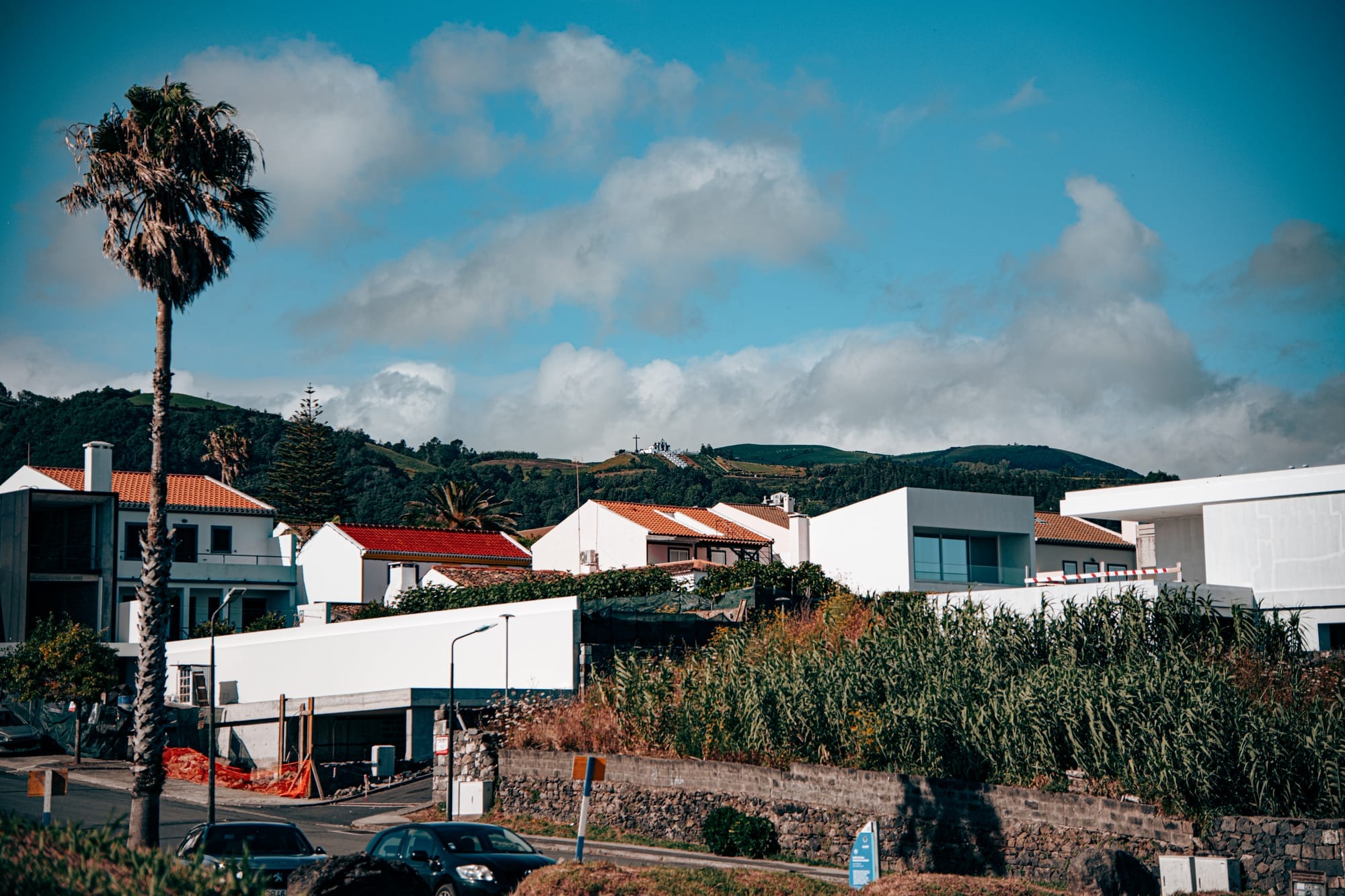
Viewing the church from Vila Franca do Campo, down below, shows just how high up it sits.
The architecture: white walls and basalt stone
From afar, the church stands out bright against the green and terracotta around it. Its façade is crisp, painted white and trimmed with basalt stone, a style common to the Azores. The contrast of light and dark materials draws your eye upward to the bell tower at the very top.
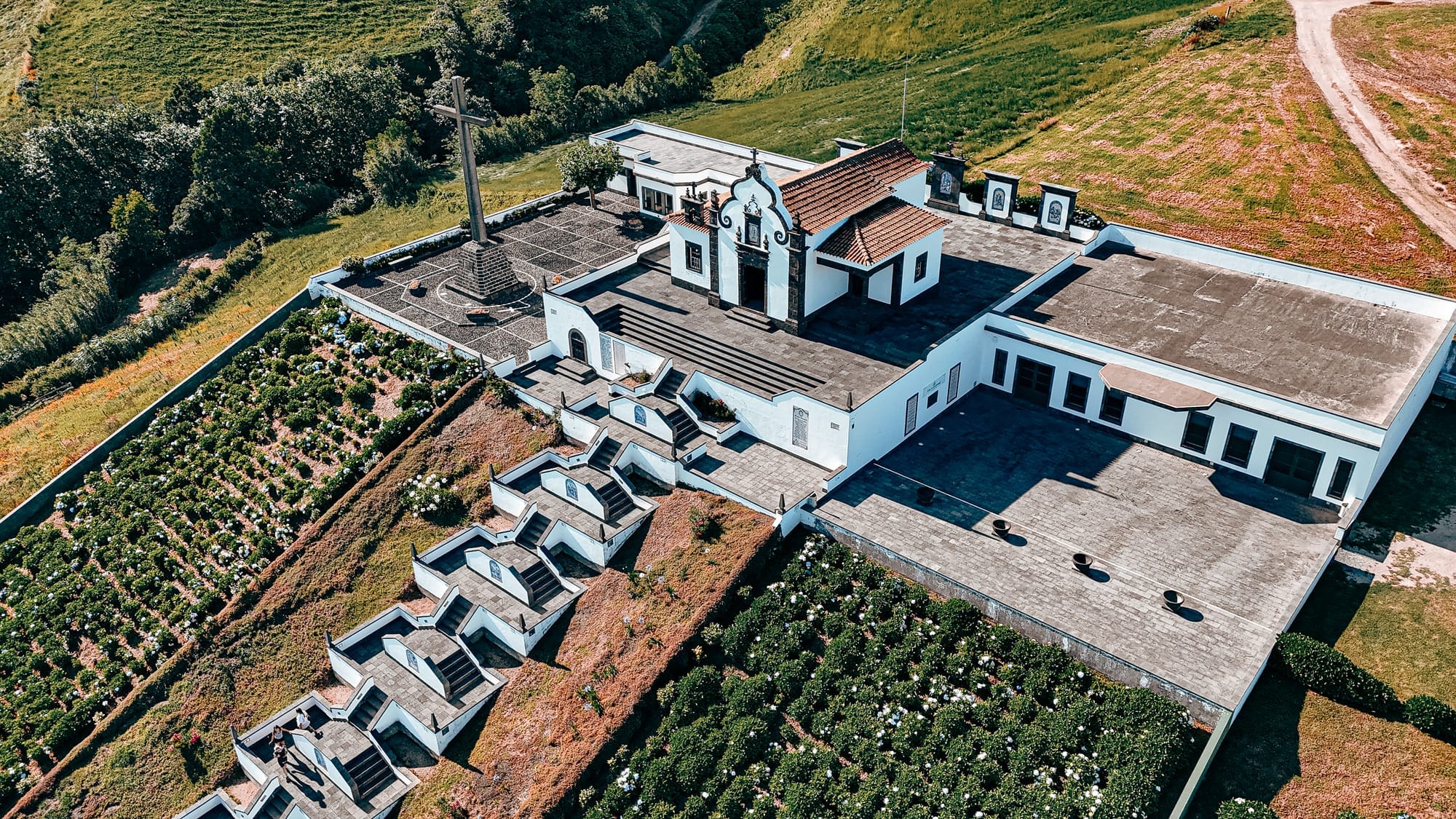
Though modest in size, the church holds its own through good proportions and careful design. The volcanic stonework points to the island's geologic past, while the decorative elements, including the cross-topped pinnacles and tiled portals, reflect the devotional style of the region. It's this mix of earth and height, simple and sacred, that makes the site so good to look at.
Vistas and perspectives
One of the best parts of a visit is the view: a wide look over Vila Franca do Campo, the Atlantic Ocean, and the iconic Ilhéu de Vila Franca do Campo, a crater islet that has become one of the island's best-known landmarks. From this height, the town below flattens into a map of garden plots and red roofs, and the sea fades out into shades of blue.
The viewpoint is about 215 m above sea level, high enough to see the islet's full ring, including the narrow gap where the sea flows into the crater. In summer you can watch the yacht club's boat crossing back and forth from the marina below.
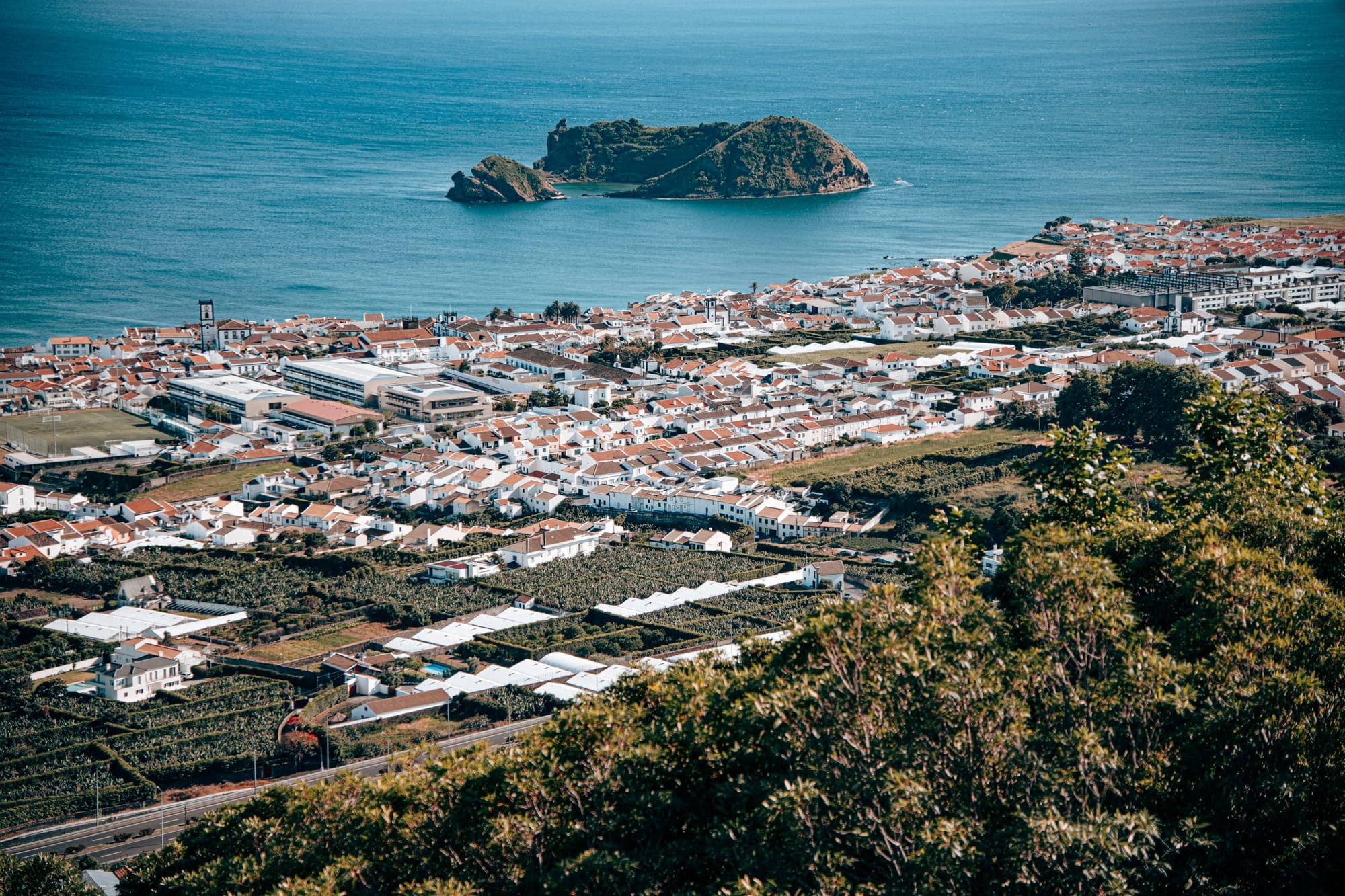
The best time to visit is early morning or late afternoon, when the light falls long across the hillside and the air is full of birdsong. On clear days, the view extends all the way to the southern curve of the island. On misty mornings, the clouds roll in over the fields like tides, which makes the church feel even more remote, peaceful, and graceful.
Prefer to go with a guide? One popular option is an eco boat trip to the Vila Franca islet. You can check dates and prices here:
Best time to visit Nossa Senhora da Paz
Pick a clear day if you can, because the view is half the reason to come. The light is softest in the early morning and the late afternoon, when the staircase throws long shadows. Midday in summer is bright and hot on the stairs, with very little shade.
Weekday mornings are the least busy. On sunny weekends and holidays, the small car park and the top of the stairs get crowded. The hydrangeas along the stairs flower in summer, which is when the staircase looks its most colorful.
A church that's still in use
The church is a heritage site, but it's also very much in use. Locals still come here for weddings, religious festivals, and personal prayer. It's also a point of pride for Vila Franca do Campo, whose residents clearly take good care of the site.
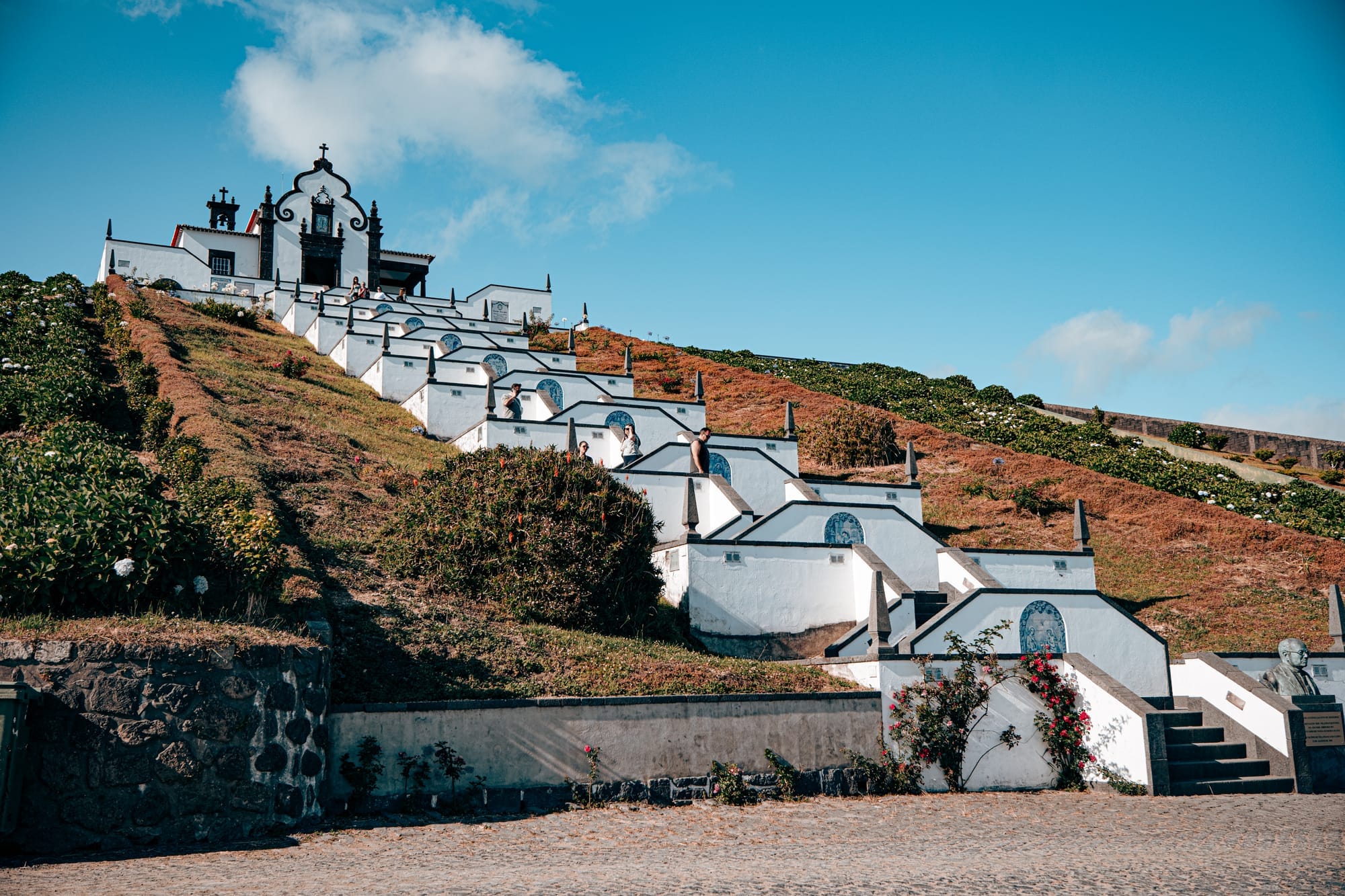
During the Feast of Nossa Senhora da Paz, the church becomes the center of a town-wide celebration. Pilgrims climb the staircase barefoot, candles are lit at every landing, and the azulejos shimmer in the flickering light. It's a rare mix of solemn and festive, and a good example of how architecture, landscape, and belief can work together.
The azulejos: blue tile stories on the steps
Azulejo tiles are a defining feature of Portuguese religious architecture, but the way they are used here feels especially personal. Each step tells a story, and taken together, they work like a visual catechism. These panels are devotional stations as much as decoration, and they give the climb a steady, reflective pace.
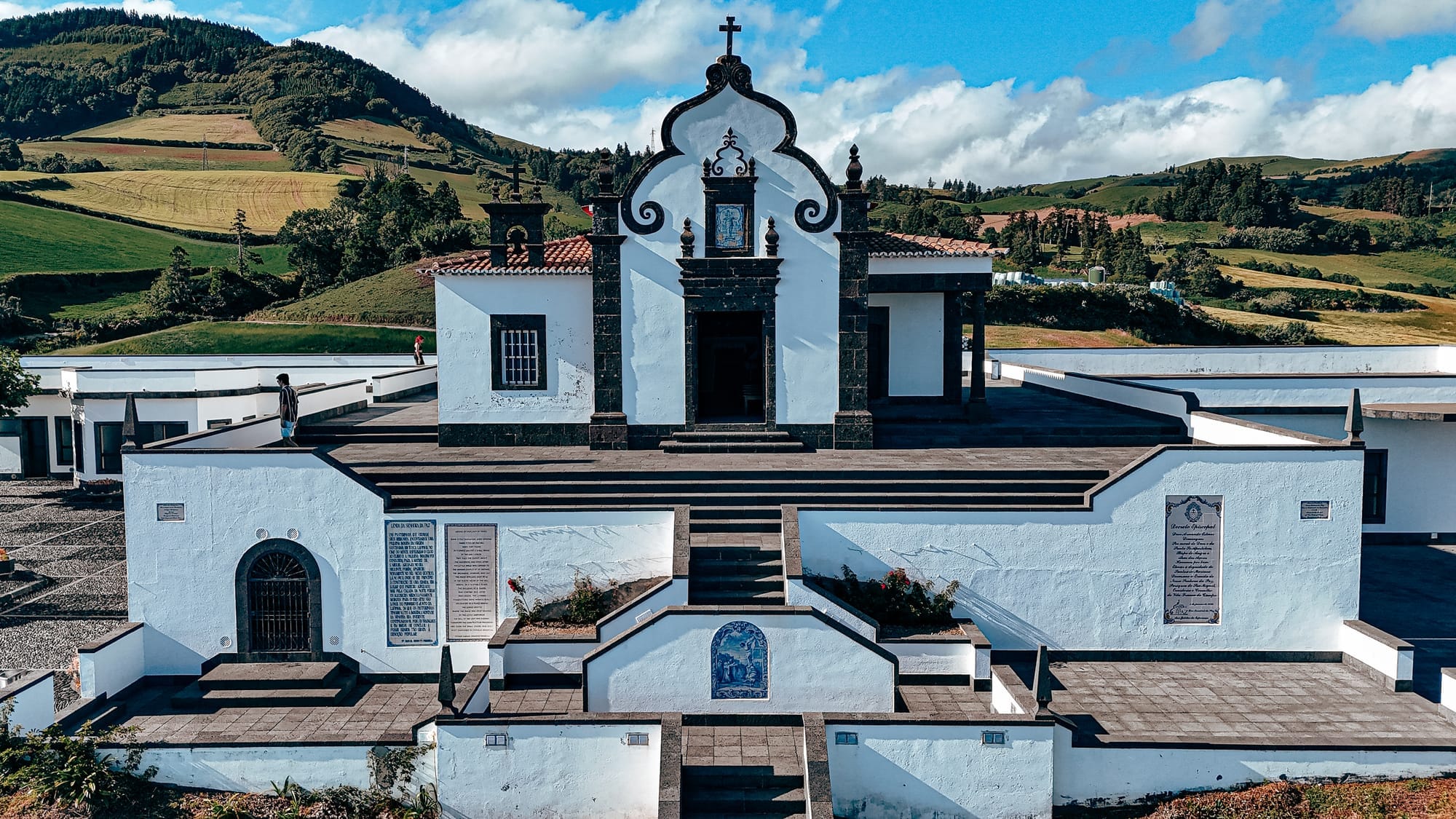
On our visit, we noticed that some of the tiles had been restored recently, while others showed signs of wear. Their patina shows that this is a place still used and handed down between generations, not a museum.
Photographing the church
Photographers will find plenty to shoot here: formal symmetry, changing light, floral borders, and ocean backdrops. Every step gives you a new frame.
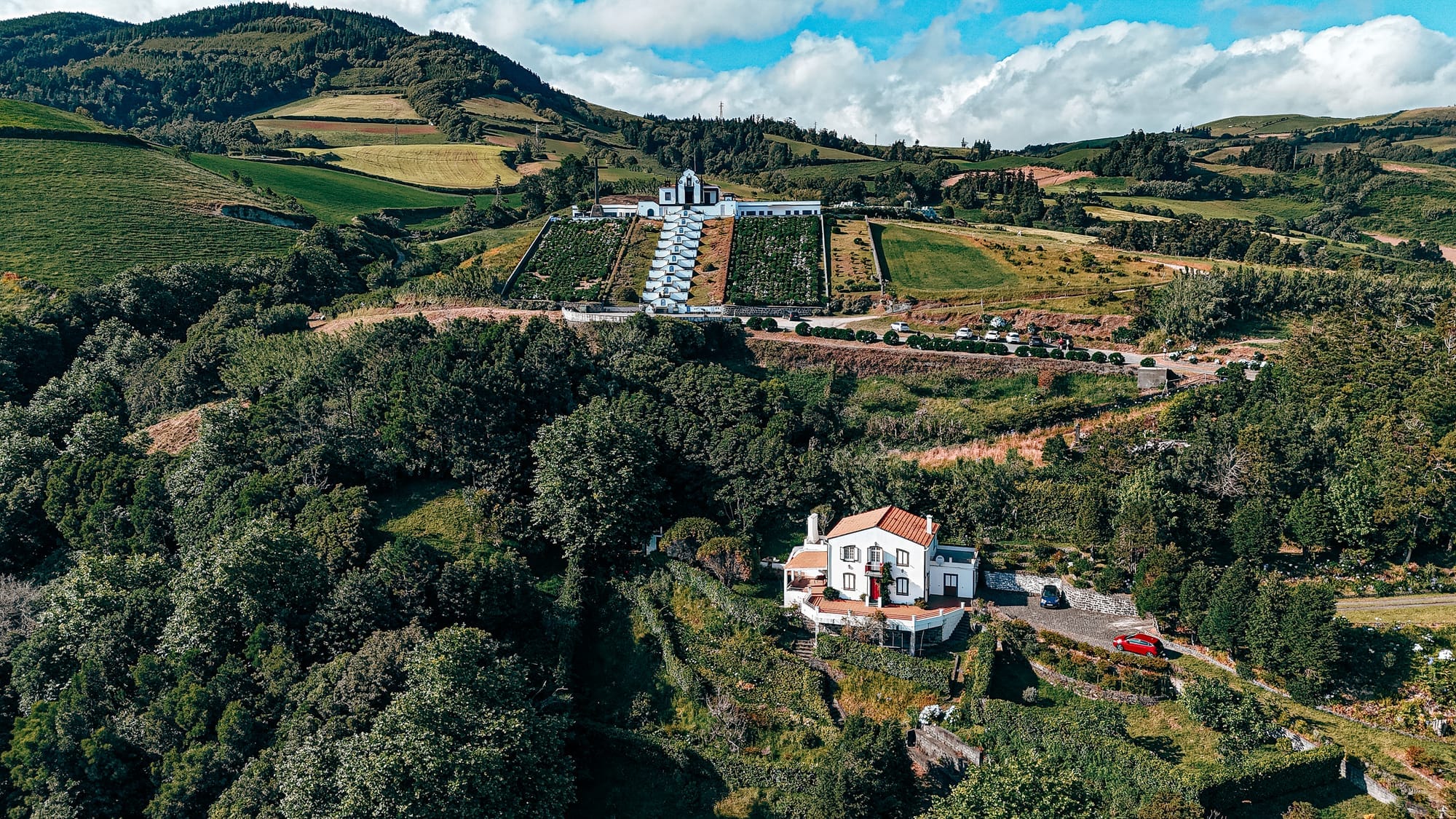
It's also a peaceful spot. We noticed many visitors pause halfway up the steps, and not only to catch their breath, but to enjoy a moment of silence.
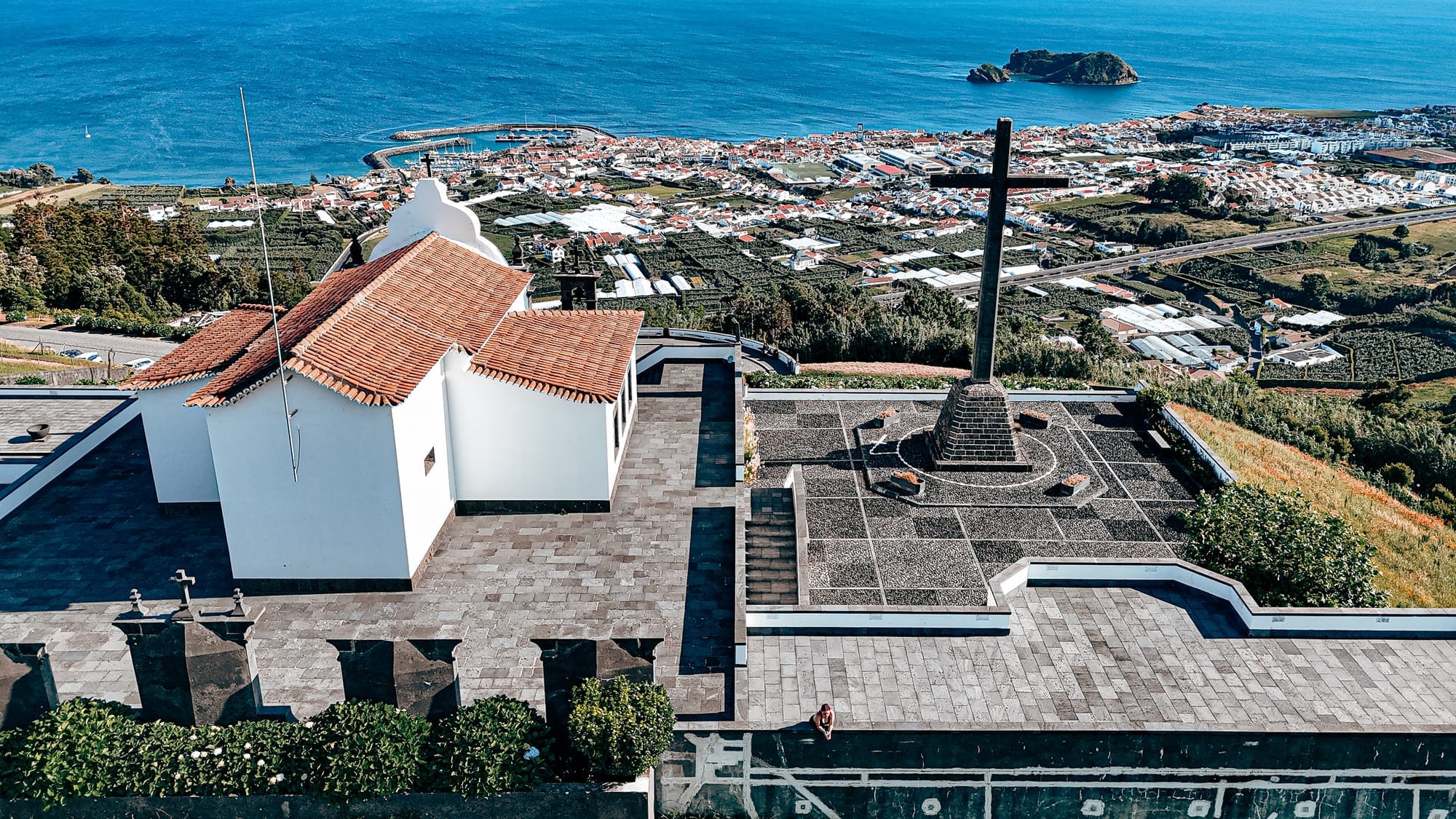
There's a humility to the church: it doesn't dominate the landscape, it makes the landscape look even better.
Why it's our favorite church on São Miguel
The Santuário de Nossa Senhora da Paz may not be the largest or oldest church on São Miguel, but for us, it is easily the most beautiful. That's not because of wealth or grandeur, but because of how it sits in its setting: grounded but reaching up, small but with a huge view, built into the hill but pointing to the sky.
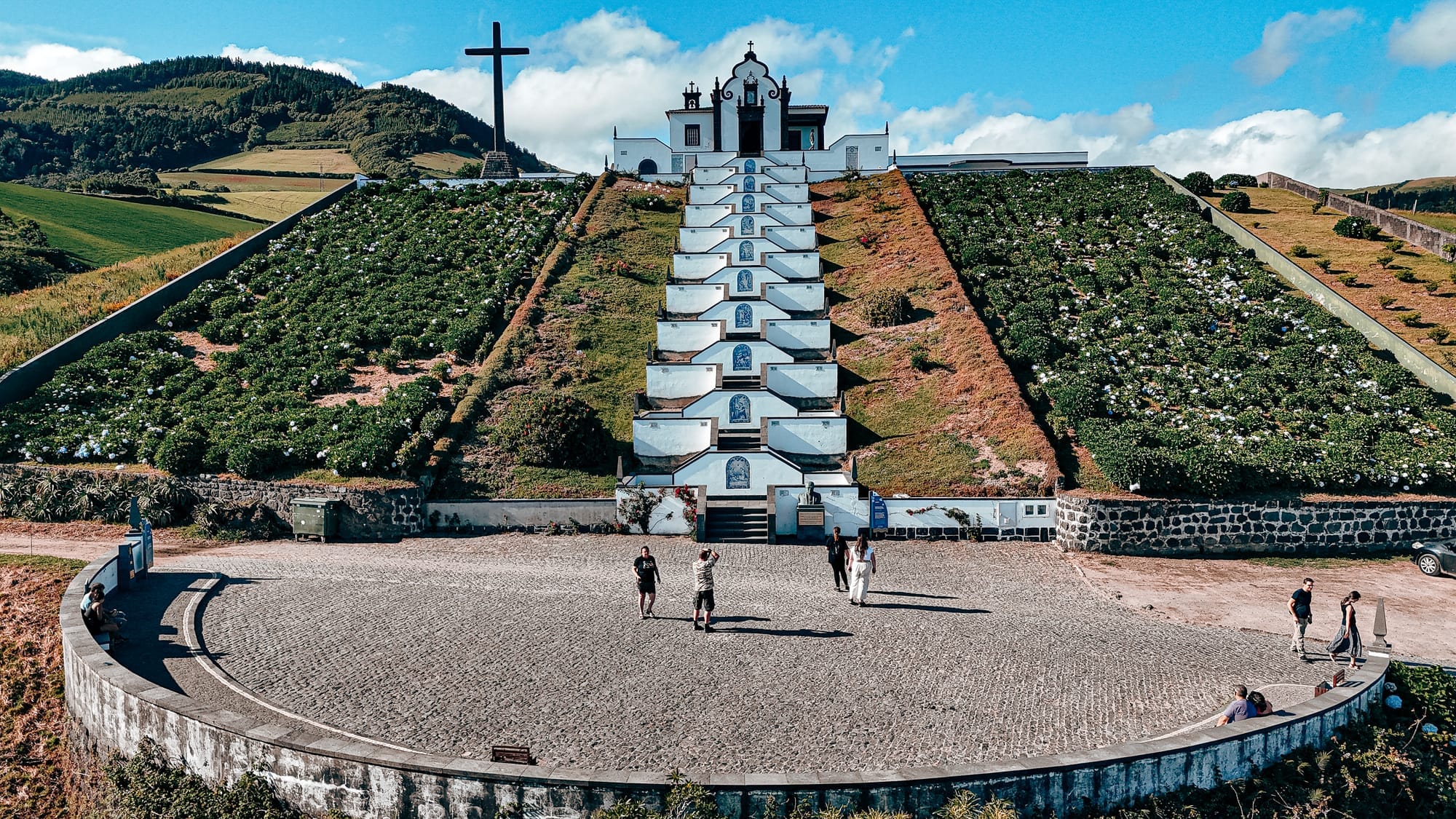
It is, in every sense, a place of peace.
Tips for visiting Nossa Senhora da Paz
A few things worth knowing before you go.
Dress respectfully if you go inside. It's an active church, so cover your shoulders and keep your voice down if a service is on.
Look back from the top. The geometric pattern of the stairs is best seen from the top, and the tile panels read differently on the way down.
Stop at the viewpoint below the church. The Miradouro da Nossa Senhora da Paz is easy to miss and has one of the best views of the town and islet.
Bring water and sun protection in summer. There's little shade on the stairs.
What to see near Nossa Senhora da Paz
The chapel pairs well with a few hours in Vila Franca do Campo. From the top you can pick out the Ilhéu de Vila Franca do Campo, an uninhabited volcanic cone about 1,200 m offshore that has been a nature reserve since 1993. In summer, boats run out to it for swimming in its round lagoon; our islet guide has the details.
Back in town, walk the old streets and the waterfront, then head east to Furnas or west along the coast. For more ideas, see our São Miguel guide and our architecture page.
A half day in Vila Franca do Campo with Nossa Senhora da Paz
The chapel, the town, and the islet fit together well. This is an easy order for a summer day:
Early morning: drive or climb up to Nossa Senhora da Paz while it's cool and the car park still has space. Look down at the islet first, so you know what you're heading to.
Mid-morning: walk down into town for a coffee and a queijada da Vila, the local cheese tart, then stroll along the waterfront. Our Vila Franca do Campo guide has the beaches and the rest of the town.
Late morning to afternoon: take the boat to the islet. In 2026 it ran hourly from 10:00 between 12 June and 11 October, with a cap of 400 visitors a day, so book online ahead. Our islet guide covers tickets, prices, and what to bring.
Out of season, swap the islet for a boat tour around it or a swim at the town beach, and come back up to the chapel for the late-afternoon light.
Nearby, see Vila Franca do Campo.
Whatever your plans, travel with insurance. Stomach bugs, a fall on a cobbled street, or a stolen phone can happen anywhere, and it's much easier to enjoy the trip when you know you're covered. We'd recommend SafetyWing Nomad Insurance. It covers medical emergencies abroad, you can buy it even after you've left home, and it renews every four weeks, so it works for a short trip or months on the road.
Where to stay near Nossa Senhora da Paz
The nearest good base for Nossa Senhora da Paz is Vila Franca do Campo. These are well-reviewed places to stay there, all rated 9 or more on Booking:
- QVA Quinta Velha das Amoreiras: a quinta with garden rooms near the center, rated 9.4.
- Casa do Pescador 14: a simple, good-value stay near the harbor, rated 9.1.
- Convento de São Francisco: a converted convent by the sea, rated 9.4 and a bit more upscale.
Frequently asked questions
How many steps are there at Nossa Senhora da Paz?
There are 100 steps, arranged in ten flights with tiled landings that follow the mysteries of the rosary.
Is Nossa Senhora da Paz free to visit?
Yes. The staircase, gardens, and viewpoint are outdoors and free. The chapel itself isn't always open outside services.
Can you drive to Nossa Senhora da Paz?
Yes. A narrow road climbs from Vila Franca do Campo to a small parking area near the top. It fills up on sunny weekends, so go early.
When was Nossa Senhora da Paz built?
The current chapel dates from 1764, on the site of an older temple. The staircase was added in 1967, and the chapel became a diocesan sanctuary at the start of 2025.
How long do you need at Nossa Senhora da Paz?
About 30 minutes to an hour. Allow more if you climb the full staircase from the bottom or stop at the viewpoint below the church.
What can you see from Nossa Senhora da Paz?
Vila Franca do Campo's red roofs, the Atlantic, and the Ilhéu de Vila Franca do Campo, the round volcanic islet just offshore.
Is Nossa Senhora da Paz worth visiting?
Yes. It's free, it takes under an hour, and it has one of the best views on São Miguel's south coast, over Vila Franca do Campo and its islet. The tiled staircase is the main reason to come.
How high is the Nossa Senhora da Paz viewpoint?
About 215 m above sea level, on the hill directly above Vila Franca do Campo.
What is the legend of Nossa Senhora da Paz?
Shepherds are said to have found an image of the Virgin in a cave on the hill. It kept returning to the cave after being taken away, which was read as a sign that a chapel should be built there.
Can you visit Nossa Senhora da Paz and the Vila Franca islet on the same day?
Yes. The chapel is a short drive from the marina, so go up early, then take the boat to the islet later in the morning. In summer, book the islet ticket online first.
Can you visit Nossa Senhora da Paz if you can't manage stairs?
You can drive to the car park at the viewpoint near the top, which avoids the main staircase. We can't confirm step-free access into the chapel.
What are the opening hours of Nossa Senhora da Paz?
The staircase, gardens, and viewpoint are outdoors with no gate, so you can visit at any time, though daylight is best. The chapel itself isn't always open outside services, so treat a look inside as a bonus.
Is the Miradouro da Nossa Senhora da Paz the same as the chapel?
They're side by side. The Miradouro da Nossa Senhora da Paz is the viewpoint just below the chapel, near the car park, and it looks over Vila Franca do Campo and the islet. You can see both in one stop.
Can you walk to Nossa Senhora da Paz from Vila Franca do Campo?
Yes. Walk up from the town to the bottom of the staircase, then climb the ten flights to the chapel. It's a fair climb on warm days, so wear comfortable shoes and bring water.
Can you get to Nossa Senhora da Paz by bus?
Not directly. Take a bus from Ponta Delgada to Vila Franca do Campo, then walk up the hill or take a taxi. Services are limited, so check the timetable first.
Useful links: Elevation to diocesan sanctuary (RTP, in Portuguese), Vila Franca do Campo (Wikipedia), and Ermida de Nossa Senhora da Paz (GCatholic).


