


Ponta Delgada is the main city of São Miguel, the largest island in the Azores, and it's where almost every visitor lands. The airport is only about 2 km from the center, so you can be in town within minutes. The city itself is easy to walk in a day: the City Gates, the harborfront, churches, gardens, and a lot of street art. Most people stay two to four nights and use it as a base for day trips to Sete Cidades, Furnas, and the hot springs. It works all year, with the driest weather in summer.
Arriving in Ponta Delgada: façades and first impressions
Ponta Delgada is where most visitors to São Miguel arrive. Planes drop through the clouds to land at João Paulo II Airport, just outside the town. Ferries and cargo ships pass in and out of its working port. As the island’s largest city and commercial center, it handles most of what faces the outside world: airport signage, welcome centers, harbor infrastructure, and tourist-friendly street furniture. It plays the role of “main town,” even though its edges turn quickly into farmland and shoreline.
Ponta Delgada at a glance
Here's the quick version before we get into what the city is really like. Hours and prices change, so check official sites before you go.
Where: on the south coast of São Miguel, the biggest and most populated island in the Azores, Portugal.
Size: the municipality had about 67,000 residents in the 2021 census, which makes it the largest in the Azores.
Airport: João Paulo II Airport (PDL), about 2 km west of the center.
Time needed: one full day for the city, plus two or three more days for São Miguel day trips.
Cost: walking the old town, the promenade, and the street art is free. Museums, gardens, and the lava cave tours charge entry.
Weather: mild all year, with summer highs around 25°C and winter highs around 17°C. It rains most in winter.
Top 12 things to do in Ponta Delgada
If you only have a day, here's the list. Each one has more detail further down.
1. Walk through the City Gates (Portas da Cidade), the symbol of the city.
2. Step into the Church of São Sebastião, the main church right behind the gates.
3. Climb the City Hall bell tower for a free view over the rooftops.
4. Walk the harborfront along Avenida Infante Dom Henrique to the Fort of São Brás and its military museum.
5. Visit the Carlos Machado Museum, the regional museum of natural history, art, and ethnography.
6. Rest in the António Borges and José do Canto gardens, two 19th-century gardens in the center.
7. Browse the Mercado da Graça, the covered market, for fruit and pineapples.
8. Go underground at Gruta do Carvão, the largest lava tube on São Miguel.
9. Hunt for street art in the streets uphill from the harbor.
10. Swim at the São Pedro pools by Portas do Mar and the marina.
11. Go whale watching on a boat from the marina.
12. Visit a pineapple plantation on the edge of town.
| Details | |
|---|---|
| Where | South coast of São Miguel, Azores, Portugal |
| Population | About 67,000 (municipality, 2021 census) |
| Airport | João Paulo II (PDL), about 2 km west of the center |
| Time needed | 1 full day for the city, plus 2 or 3 days for day trips |
| Cost | Old town, promenade, and street art are free; museums, gardens, and lava cave tours charge entry |
| Weather | Mild all year: summer highs around 25°C, winter highs around 17°C, wettest in winter |
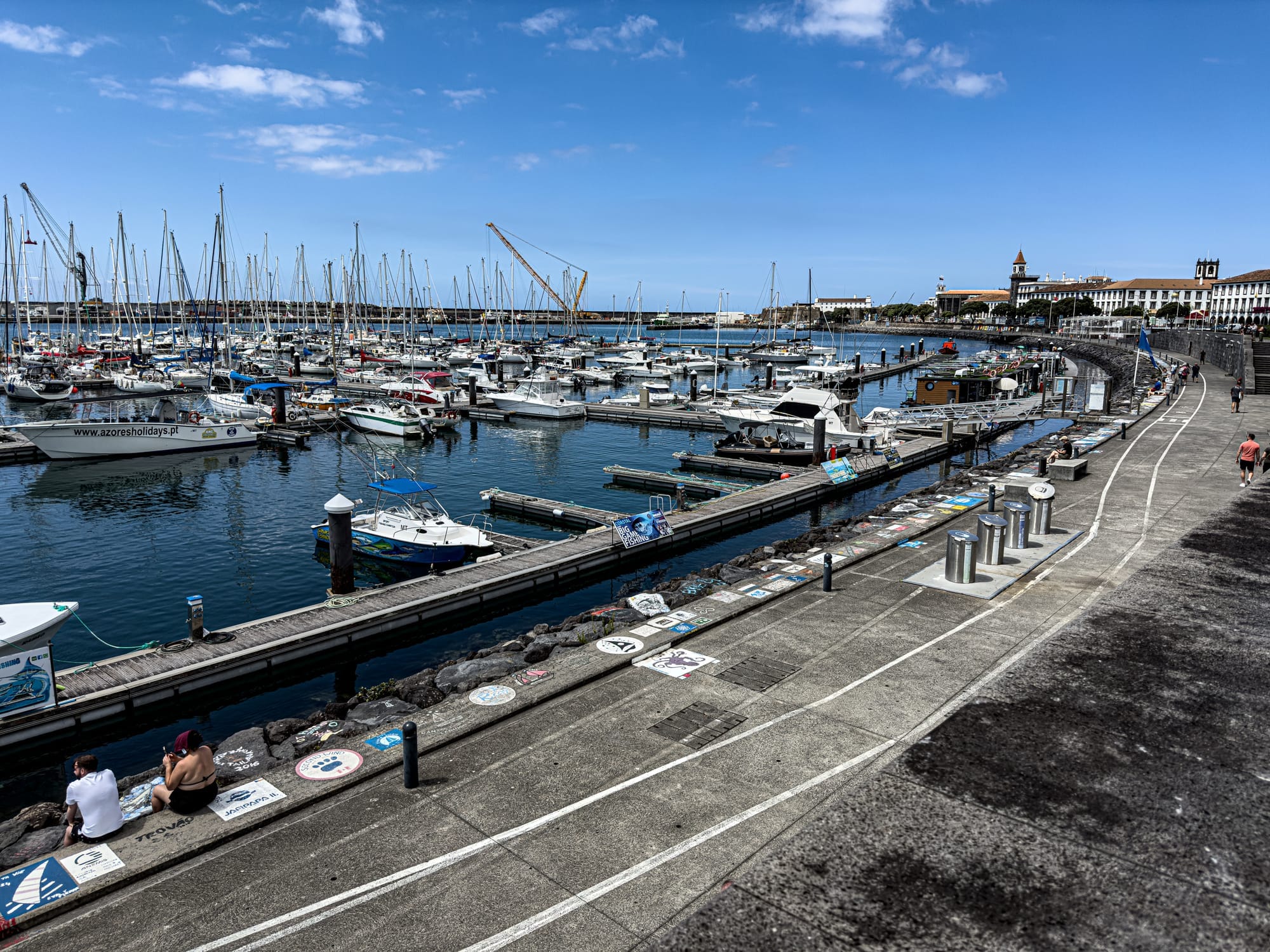
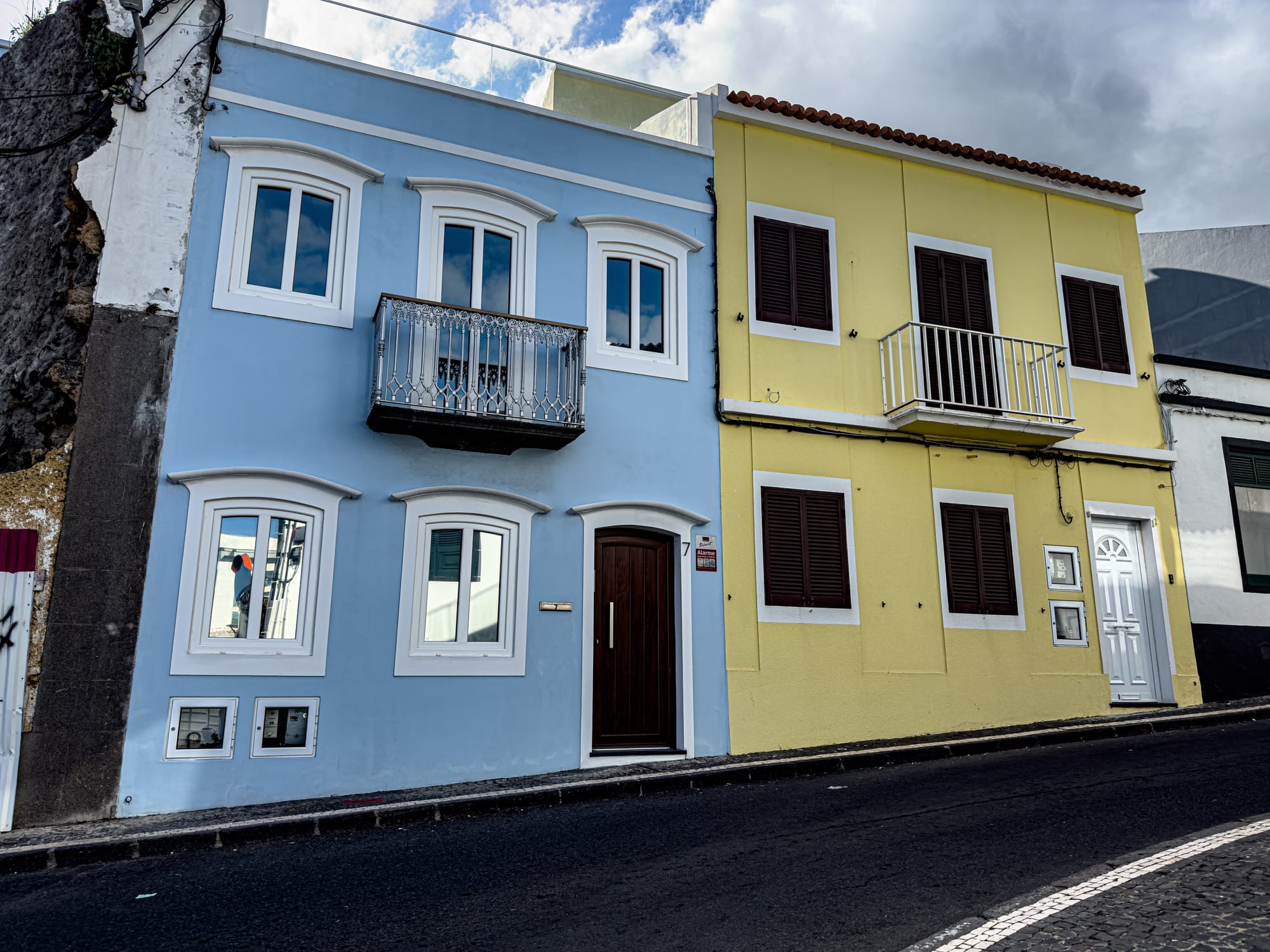
Ponta Delgada’s colorful marina and hillside streets: boats, homes, and local life
First impressions are pretty: tile-trimmed balconies, basalt-and-white façades, botanical gardens and plazas, churches and calçadas. But Ponta Delgada is not a preserved postcard. It's lived-in, worked-in, and clearly changing. The streets tell a less tidy story: of modernization and uneven upkeep, of local life going on alongside tourism, of public works both finished and delayed.
Residential streets and local routes
Behind the harborfront and historic center, Ponta Delgada spreads across low hills in a mix of tight streets, postwar housing blocks, and painted terraces. There are public parks and civic buildings, bakeries and barbers, tire shops and schools. Some roads slope sharply; others look like service lanes. In some neighborhoods, the buildings show their age. You might pass cracked tiles, graffiti, aging signage, or clusters of electrical cables in tangled knots.
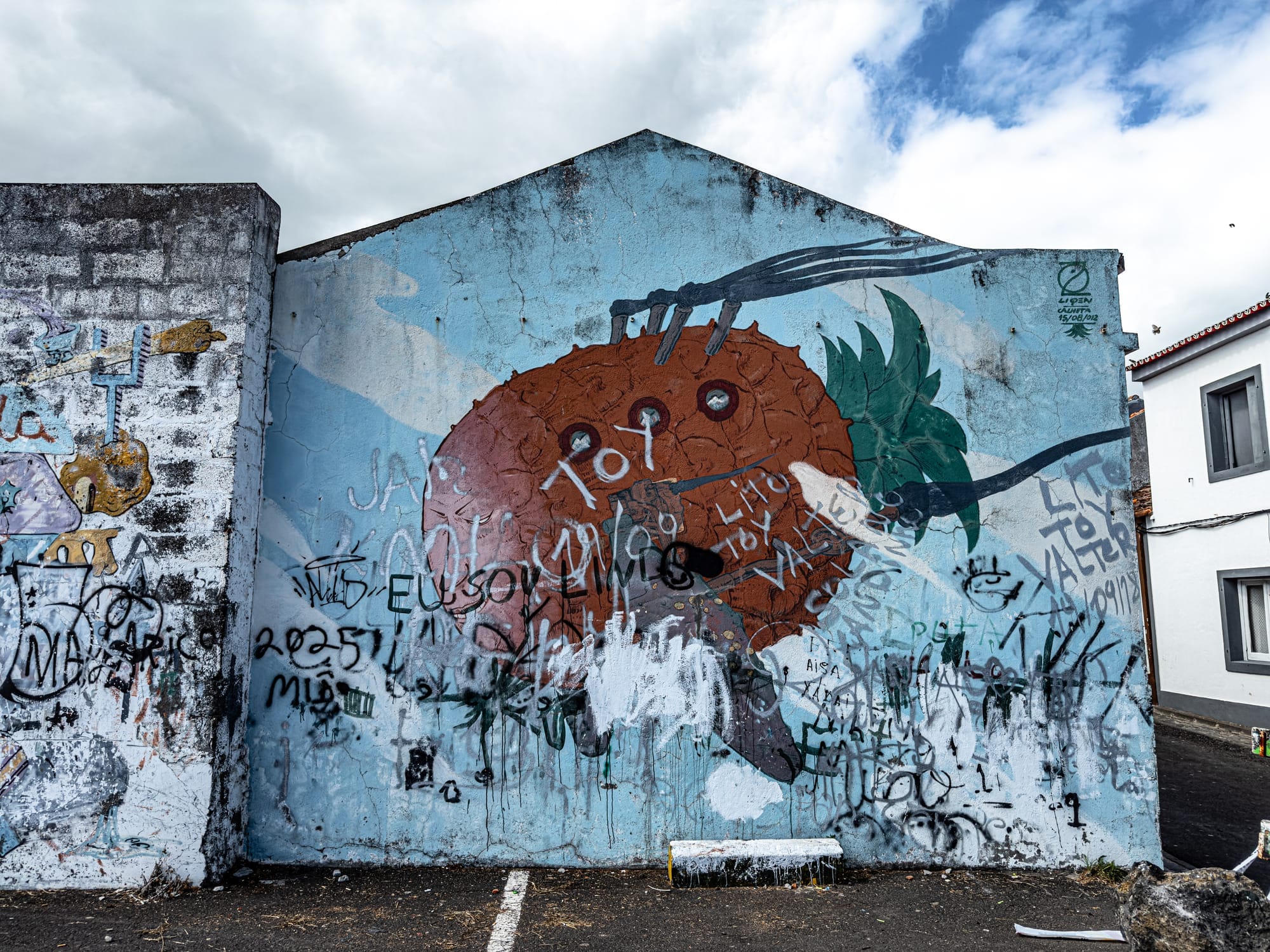
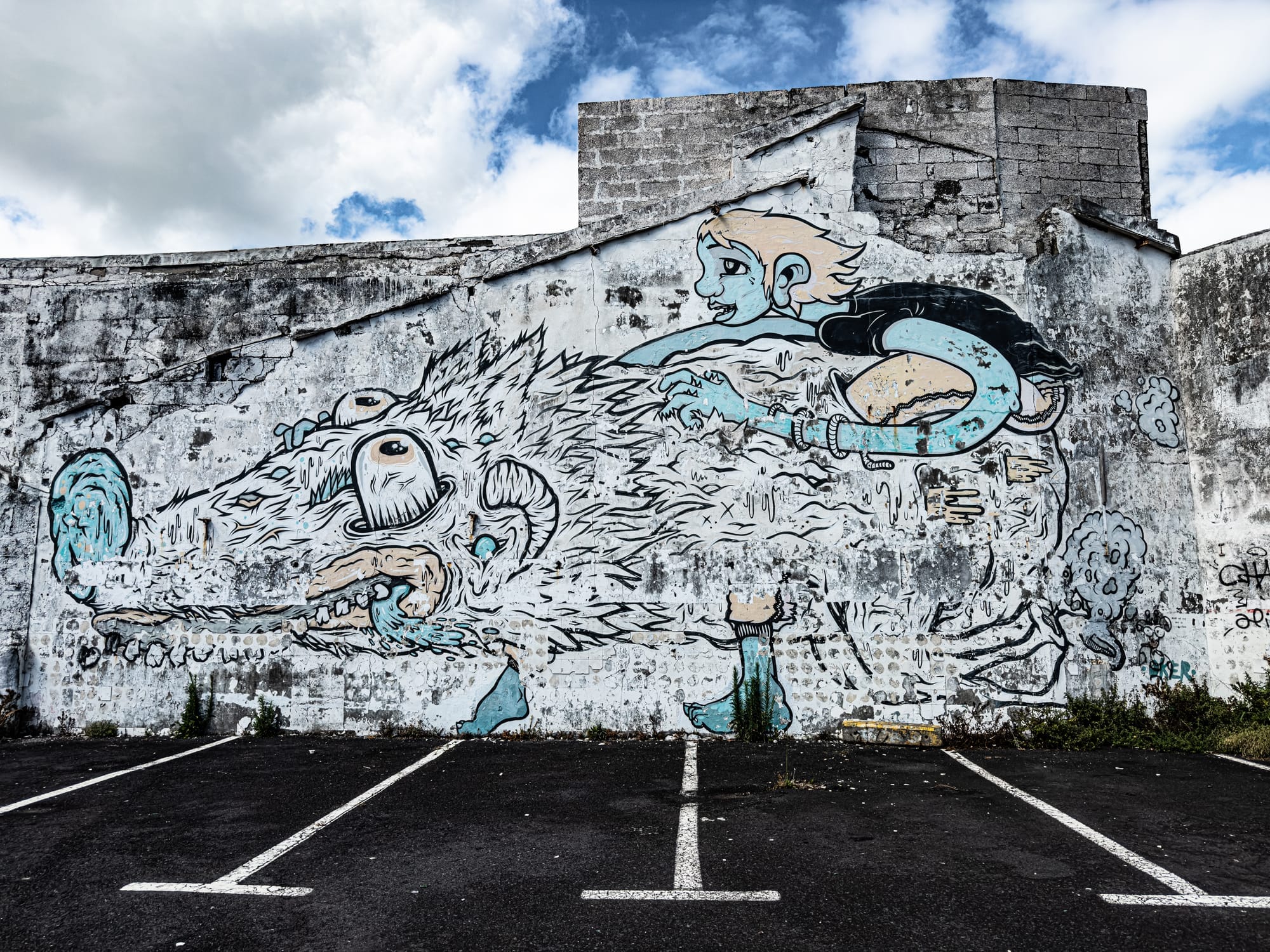
Two sightings on the outskirts of Ponta Delgada, full of humor, critique, and homemade invention
There is dignity in these details. The working parts of the city aren't hidden; they're part of how it's built. You’ll see people hanging out on steps or sitting on walls, waiting for the bus, smoking, unloading trucks, cleaning storefronts, or watching the street. Sidewalk tiles buckle. Cars park tight to the curbs. Municipal signs look hand-painted or retrofitted. And while some homes gleam with fresh coats of pastel paint, others show years of wear from salt air and humidity.
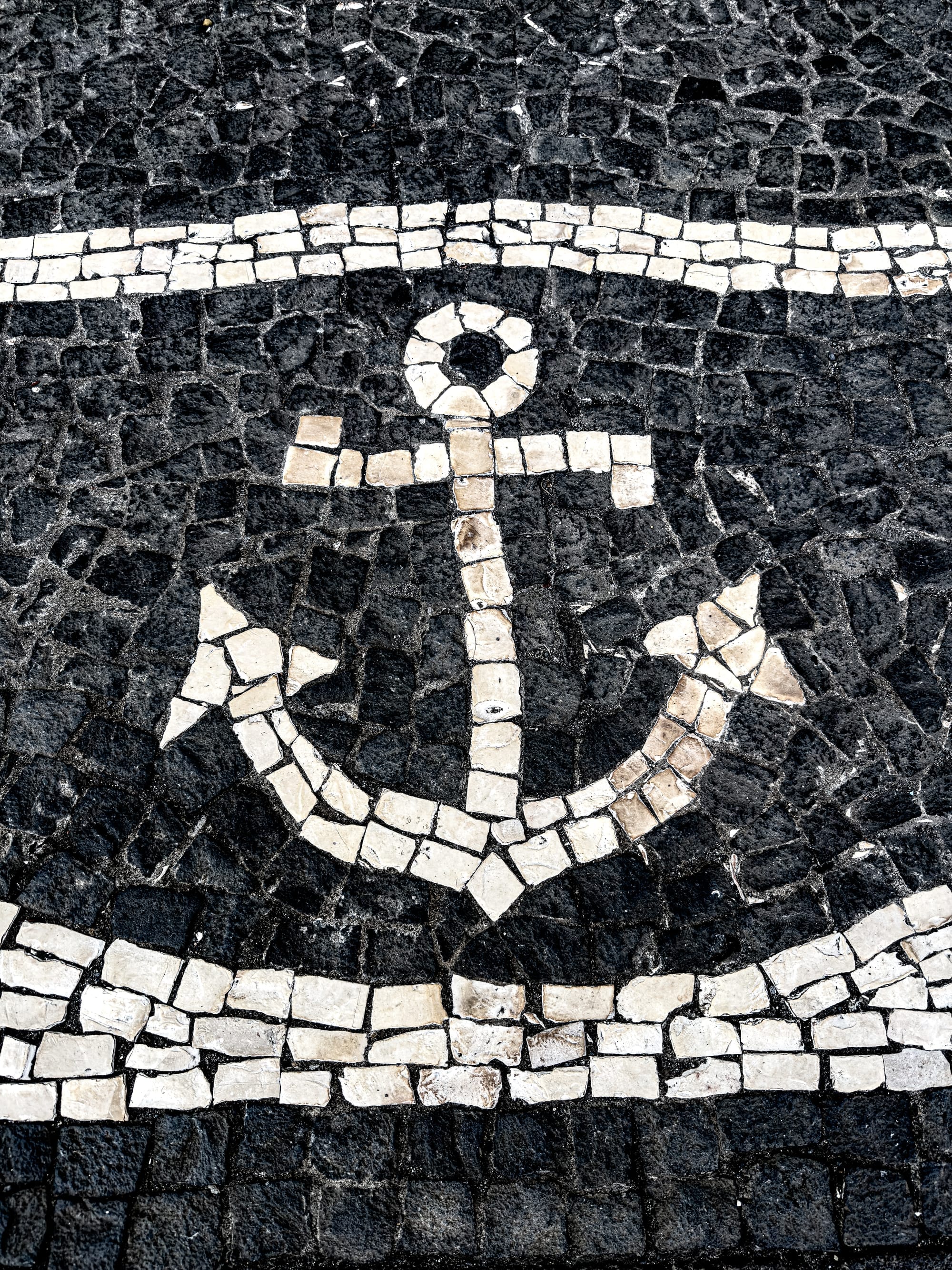
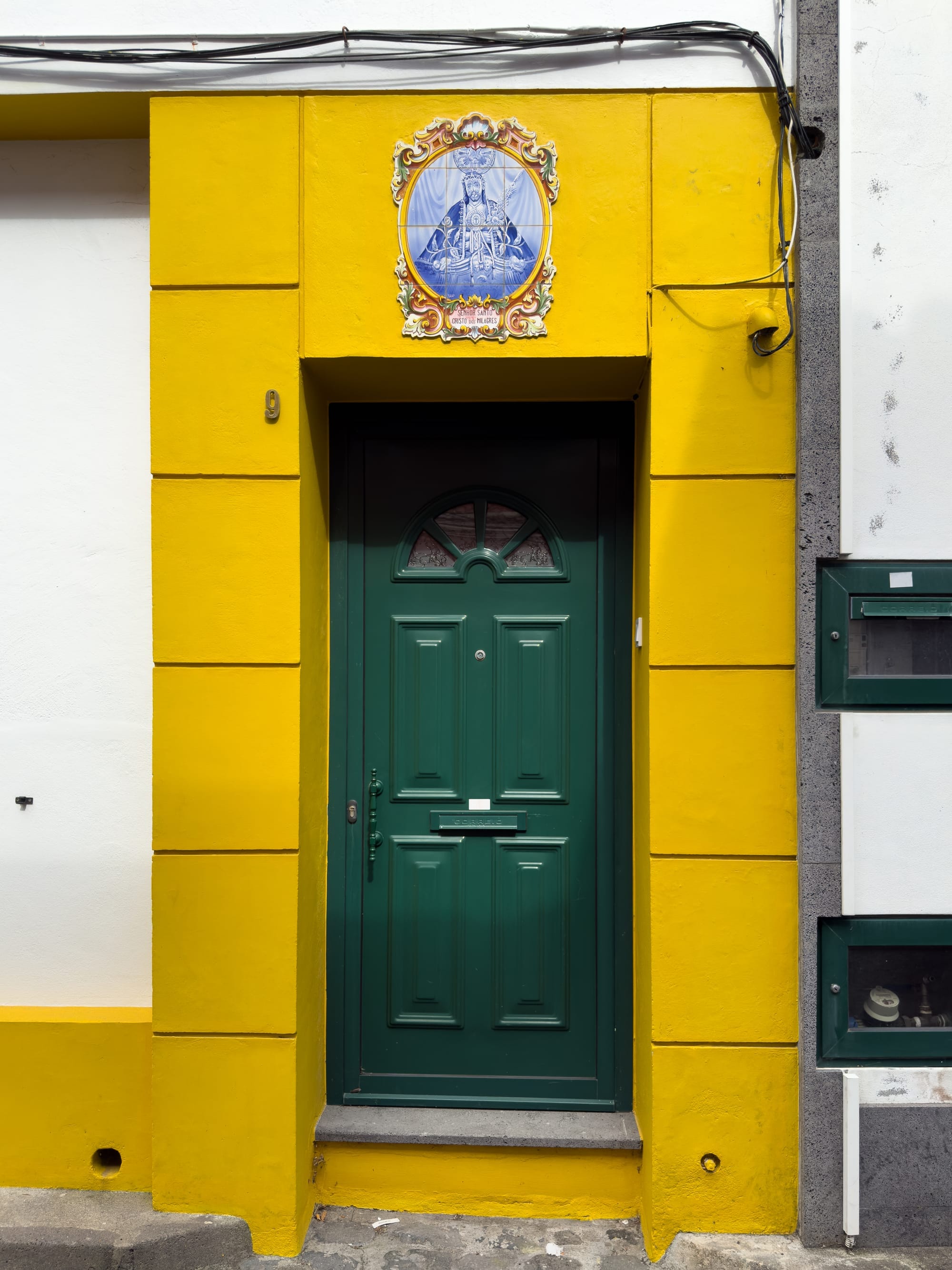
From stone mosaics underfoot to bright doorways, the street details of Ponta Delgada
None of this is exceptional. It’s simply what Azorean life looks like at street level, in a city that is both small and central.
Street art, shops, and repairs
One of the most striking things about Ponta Delgada is its street art. Alongside government-funded murals and heritage azulejos, the town has a varied and expressive mix of paste-ups, wall-sized pieces, and more informal work.

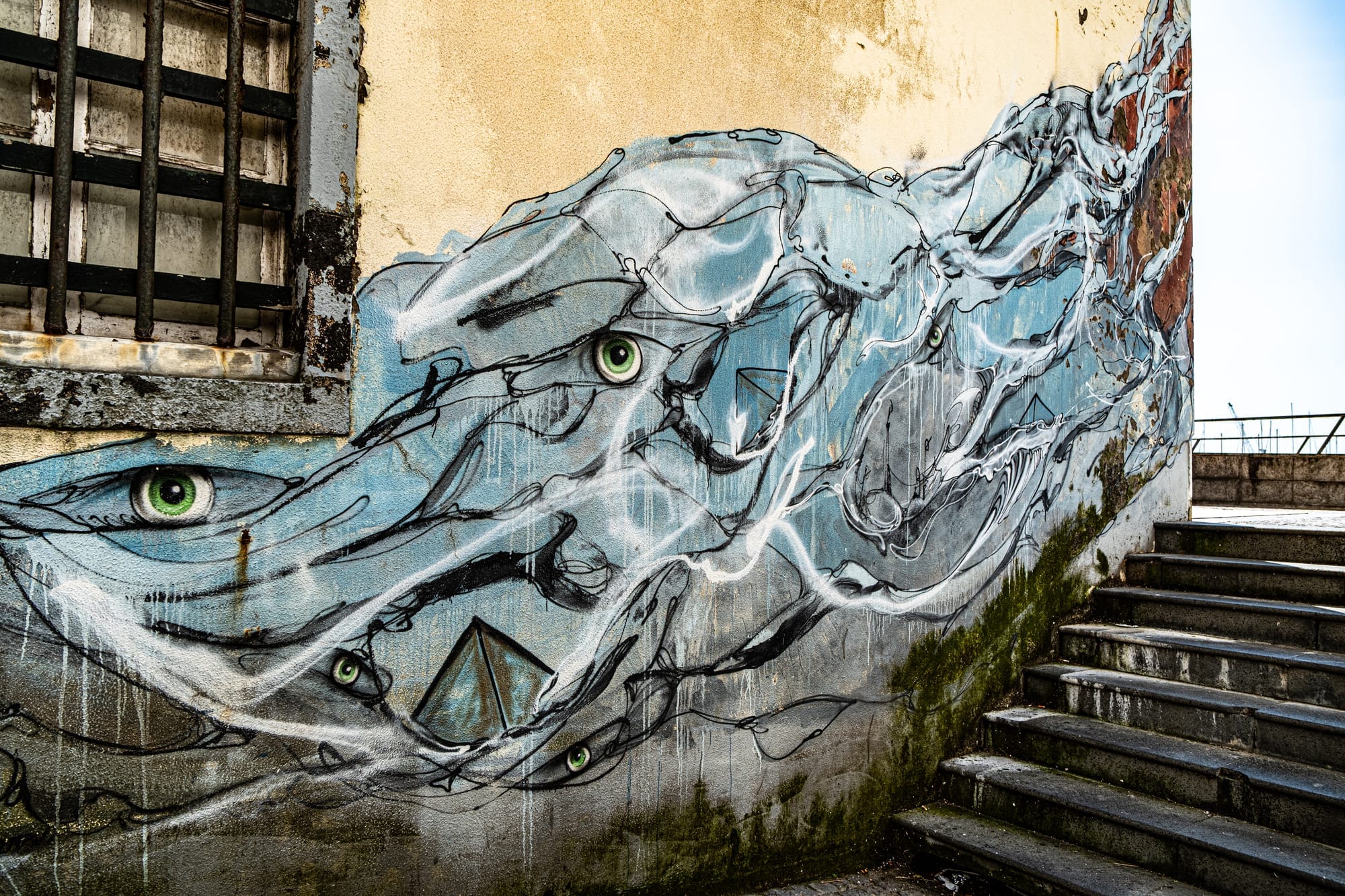
A mural near the waterfront in Ponta Delgada with watchful eyes, paper boats, and a dreamlike current
It isn't a designated art district. Instead, the art is spread across the city's walls: marks made and remade, often in unexpected places.
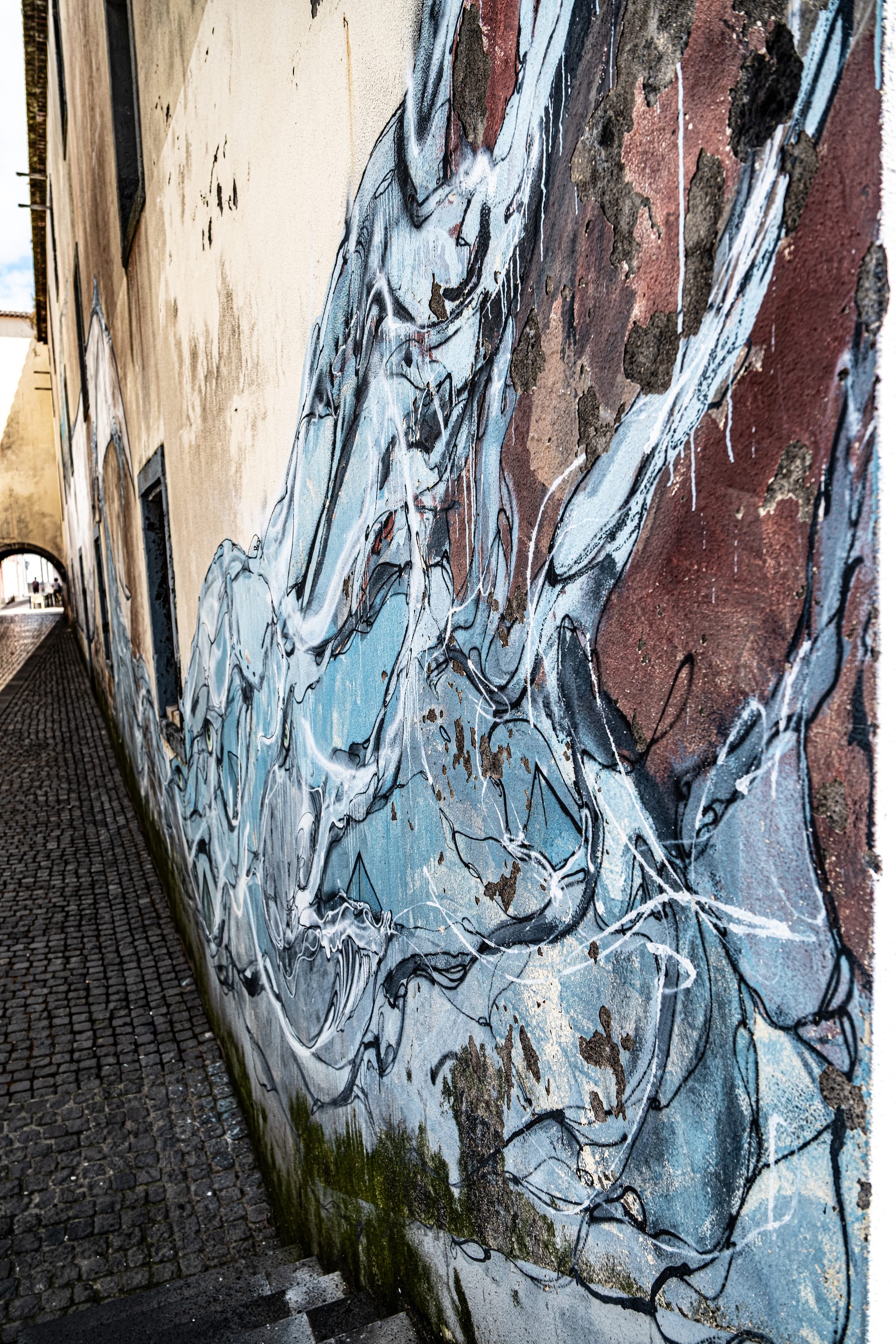
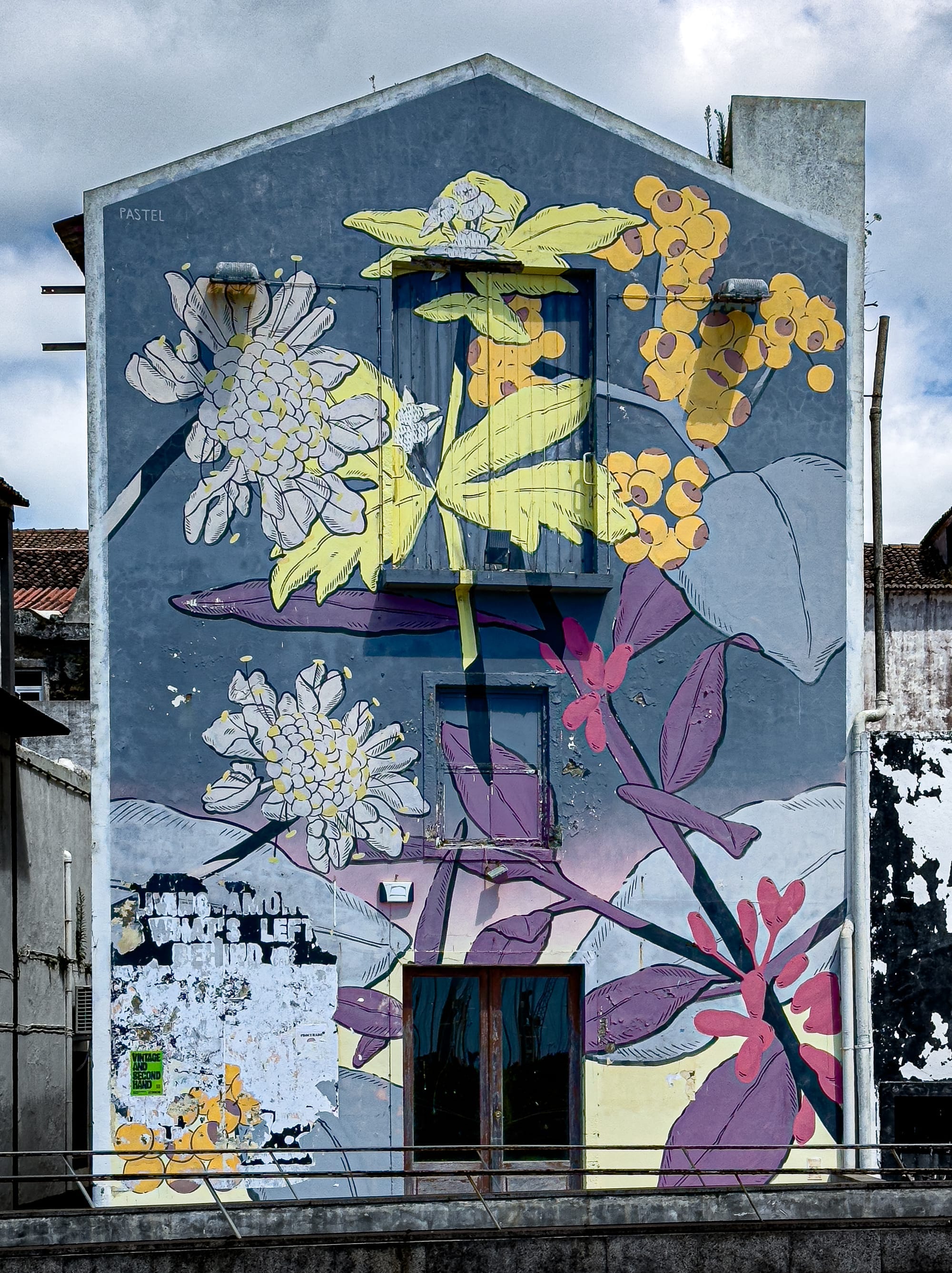
From narrow alleys to building facades, Ponta Delgada’s street art reveals both fluid abstraction and botanical precision
You’ll find finely detailed portraits fading on concrete, fantasy creatures wrapped around corner buildings, or text-based works half-covered by paint or time. Tags and scrawls mix with large commissions. Sometimes it's hard to tell which was sanctioned and which was improvised.
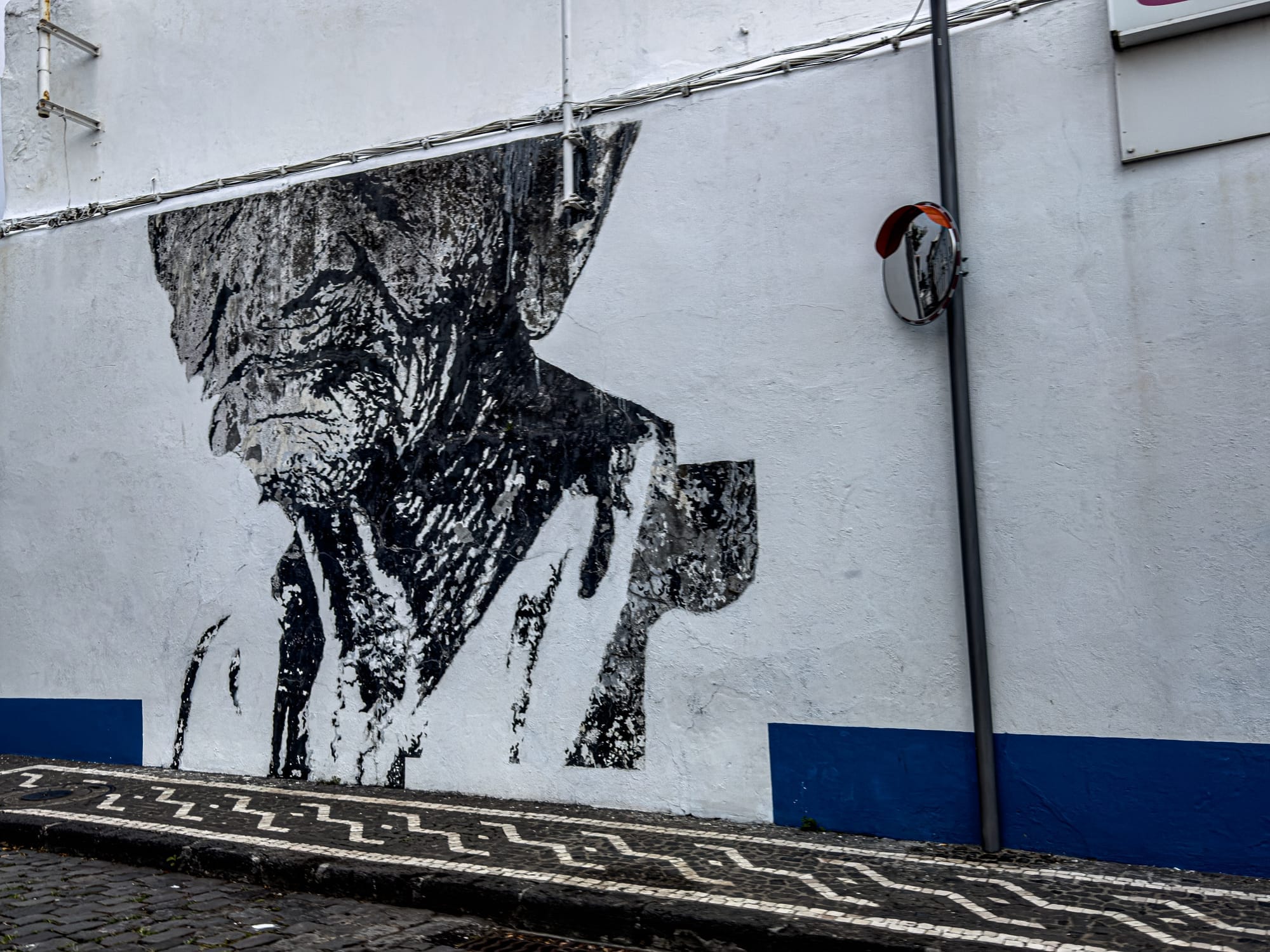
These pieces speak to a younger generation of Azoreans, and to questions of identity, politics, and autonomy. They also sit alongside the visible work of keeping the city going: scaffolding, fresh stucco, plumbing repairs, and the steady effort of making things last.
Prefer to go with a guide? One popular option is a cultural walking tour of Ponta Delgada. You can check dates and prices here:
How Ponta Delgada's economy and streets are changing
Ponta Delgada shows clear signs of economic transition. Tourism is visible in hotels, signage, whale-watching kiosks, and foreign-registered vehicles. But it doesn't fully define the city. Many areas, especially inland or uphill from the harbor, seem shaped more by logistics, schooling, commuting, and local services than by the flow of tourists.
You’ll notice signs for driving schools, dentist offices, and accounting firms. The local market isn’t set up as a show; it’s practical. Municipal posters advertise civic events, blood drives, and community theater. There are abandoned buildings and sleek new builds, construction sites and long-empty lots. Some spaces seem stuck halfway through a change.
The harborfront itself has been reworked in recent decades, with mixed results.
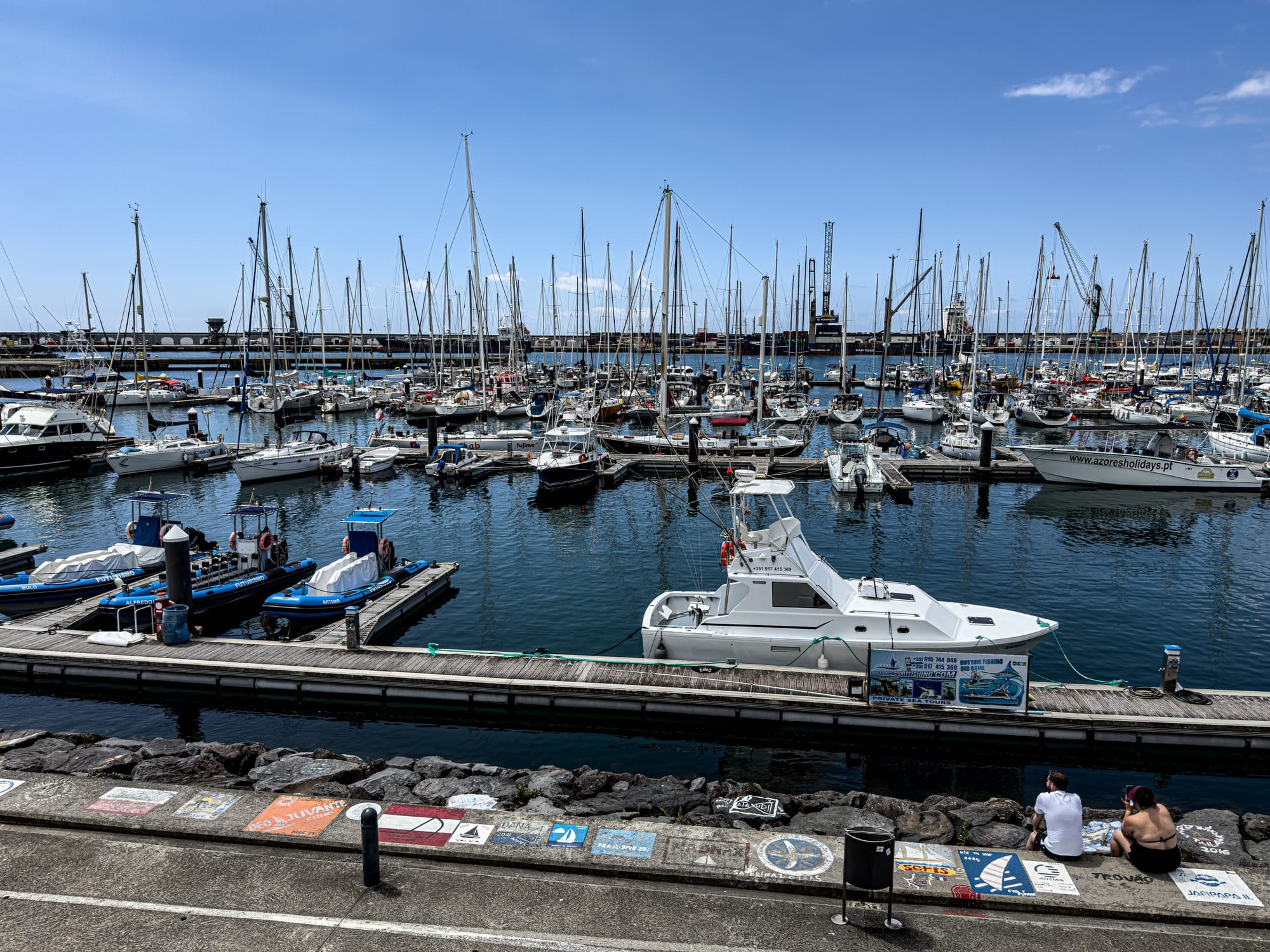
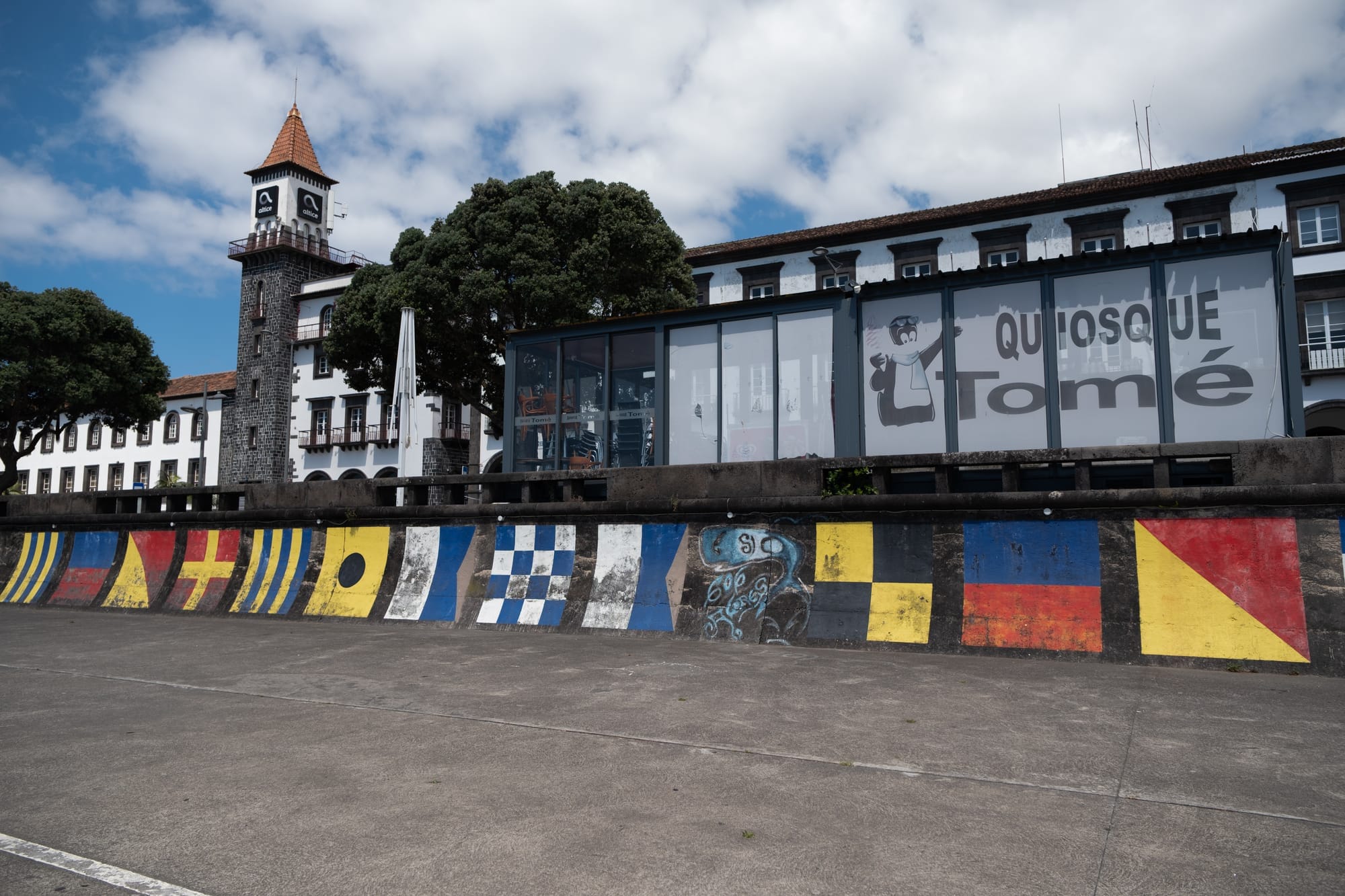
From the colorful codes of the marina wall to the sailboats in Ponta Delgada’s harbor, the waterfront is alive
Decorative tiles, sculpture, and clear wayfinding sit next to uninviting underpasses, shuttered kiosks, and surface parking. The marina is busy, and the port is still a commercial hub, but some areas feel disconnected, the result of several rounds of planning rather than one continuous plan.
Ponta Delgada beyond the postcard
A first visit to Ponta Delgada (a stroll along the promenade, a pastry on a leafy plaza, a glimpse of a mural) doesn’t show you the full city. Talk to residents and you’ll hear different stories: housing pressures, insecure jobs, the rise and strain of seasonal tourism, people moving away, and the balancing act of living in a place that’s often photographed but less often understood.
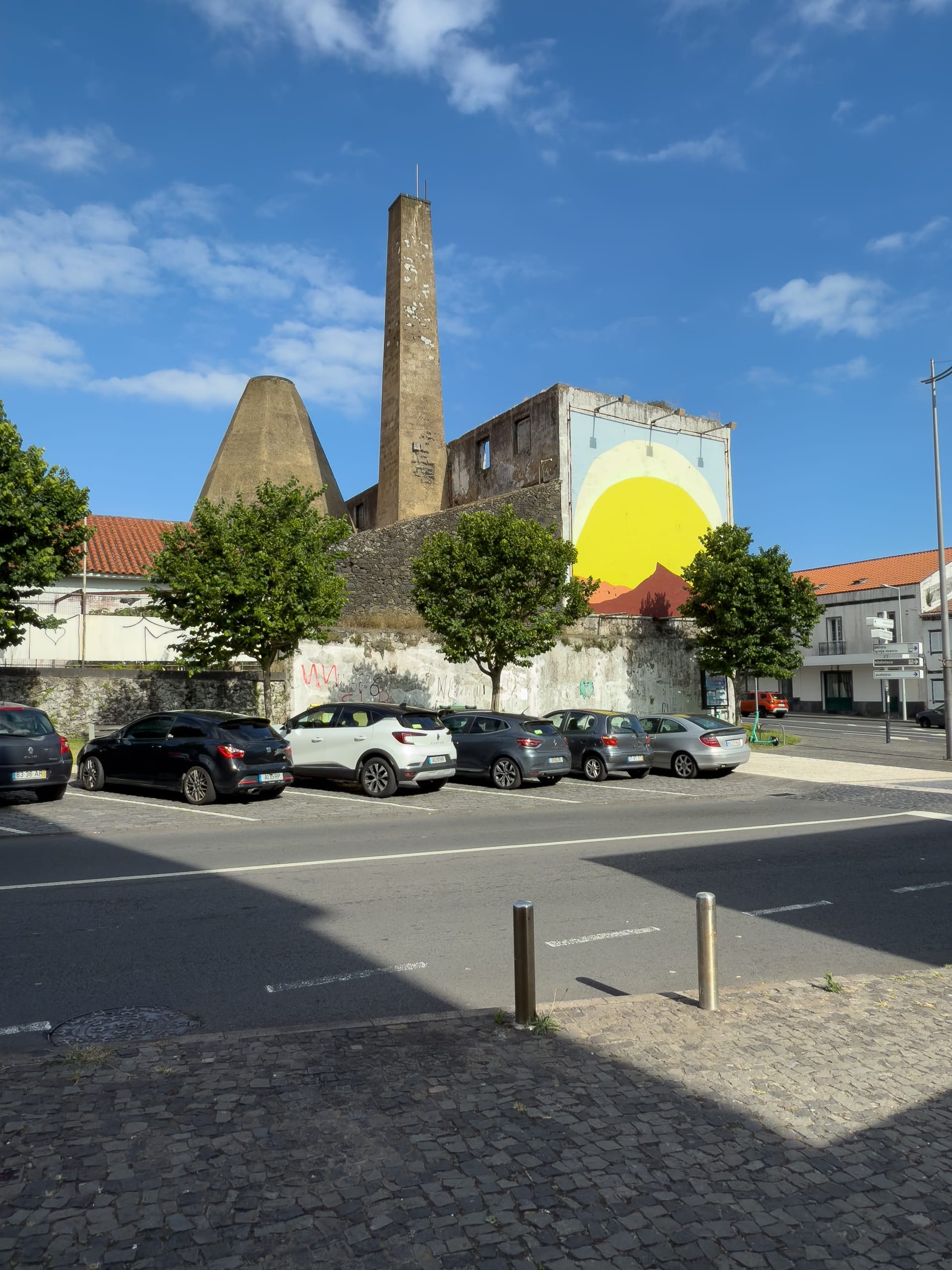
Locals point out areas where maintenance lags, where rents have risen, and where younger people leave for mainland Portugal or abroad. Cruise ship passengers flood certain businesses and leave others untouched. Heritage grants go to high-profile buildings, while basic repairs for ordinary homes are out of reach.
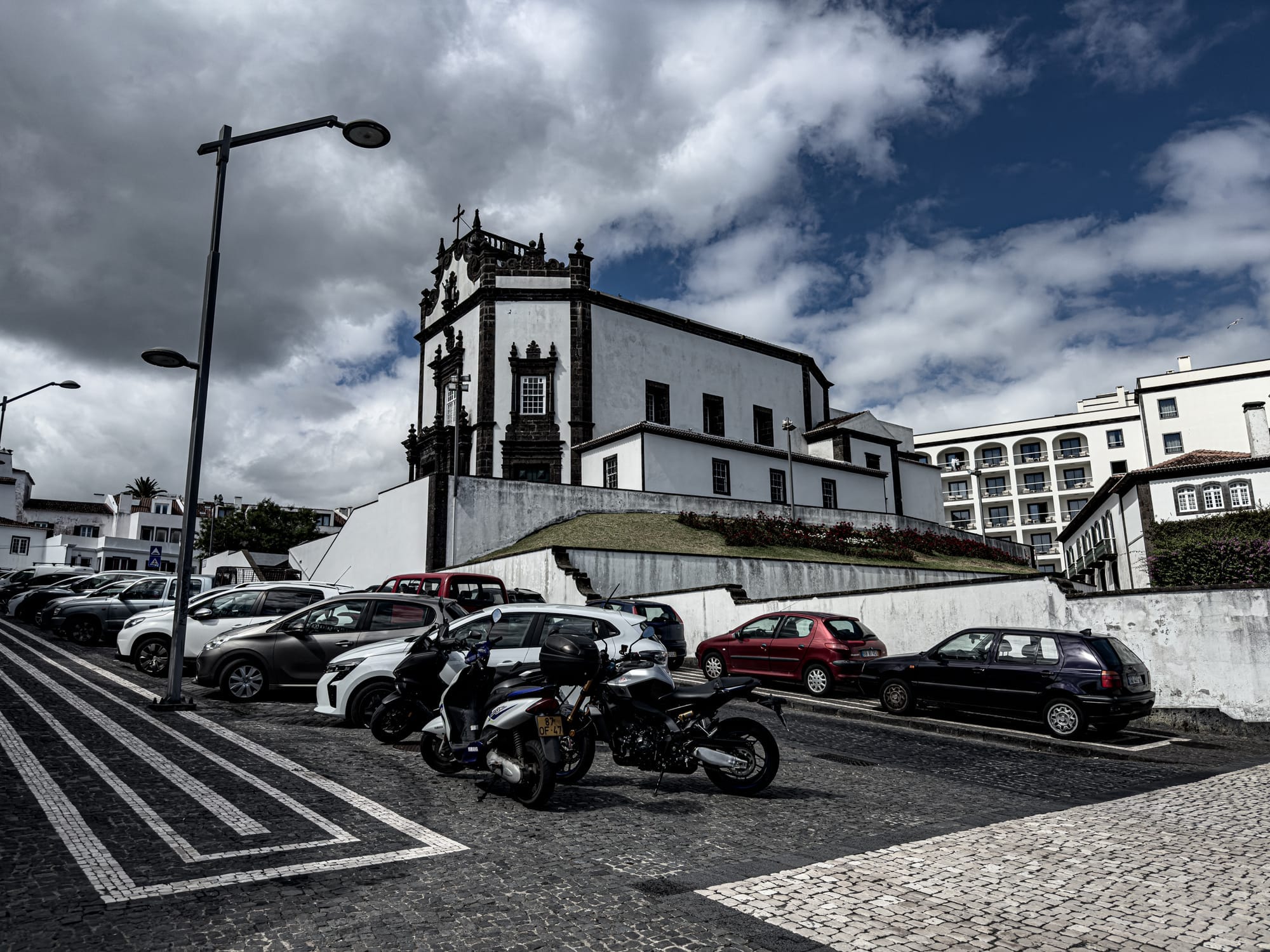
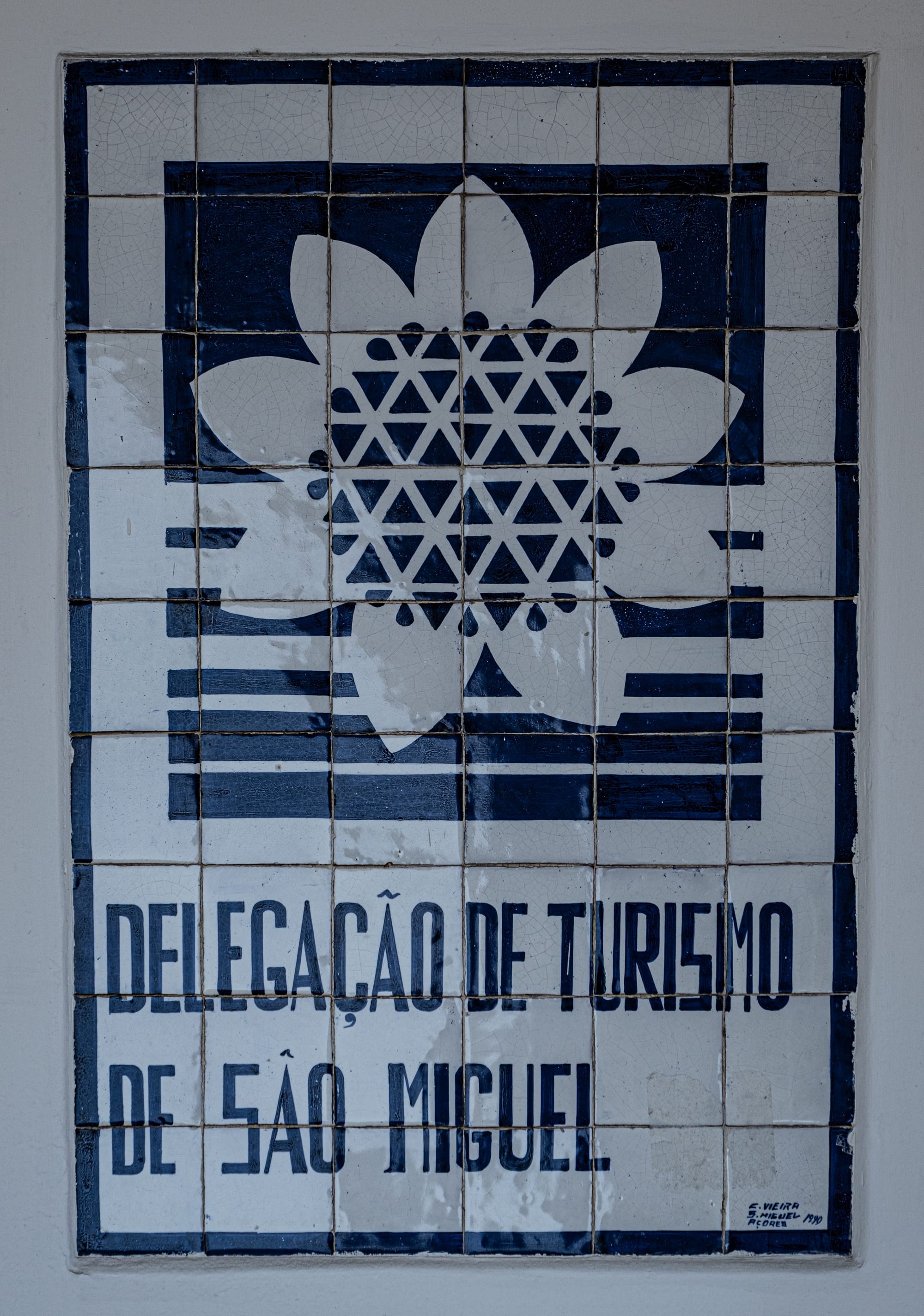
A contrast between local life and curated arrival
Still, this is not a city defined by what's missing or by complaints. It runs on adaptation. People make do, find ways, and keep things running. Cafés fill with conversation. Kids walk to school in uniform. Old men play cards in shaded parks. Groceries are bought, repairs made, appointments kept.
Things to do in Ponta Delgada
The center is compact, so you can see the main sights on foot in a day. These are the ones worth putting on your list.
Walk through the City Gates
The Portas da Cidade are the city's best-known landmark: three basalt-and-white arches with the royal and city coats of arms in the middle. They were built in the 18th century beside the old quay and moved to Gonçalo Velho Cabral Square when the seafront avenue was built. It's the obvious place to start a walk, and the main church and the old streets are right behind them.
Walk the harborfront and the Fort of São Brás
Avenida Infante Dom Henrique runs along the water from the marina to the Fort of São Brás, an old fort at the western end of the seafront. It's a flat, easy walk, and it's where most whale watching companies have their kiosks if you want to book a trip in person.
The fort itself dates from the 16th century and was built to protect the harbor from pirates and privateers. Today it holds the Military Museum of the Azores, run by the Portuguese Army, with weapons, uniforms, maps, and old military vehicles. Entry is a few euros and it closes for lunch on some days, so check the hours before you walk out there. Allow 30 to 45 minutes.
Visit the churches and the old town
The historic center has several churches within a few minutes of each other, including the main church of São Sebastião near the City Gates, the Church of the Jesuit College, and the Convent of Our Lady of Hope. The city has been a city since 1546, so the old town is full of black-and-white calçada pavements and basalt-trimmed buildings. The Carlos Machado Museum, the regional museum of natural history, art, and ethnography, is also in the center, in a former convent. Check its official site for current hours.
Spend an hour in the gardens
Ponta Delgada has several historic gardens, including António Borges and José do Canto, now linked to the University of the Azores. They're a good break from the streets on a hot day. Opening times and fees vary, so check before you go.
Go underground at Gruta do Carvão
Gruta do Carvão is a lava tube on the western edge of the city, about 1,650 m long and the largest on São Miguel. It's a protected natural monument, and visits are by guided tour, usually a short one and a longer one with helmets and headlamps. Spots are limited, so book ahead and check current prices and times with the operator.
Hunt for street art
As we said above, the murals and paste-ups are spread all over town rather than in one district. Walking the streets uphill from the harbor is the best way to find them, and it's free.
Climb the City Hall bell tower
The bell tower beside the City Hall on Praça do Município dates from the early 18th century, and you can usually climb it for free on weekdays. It's around a hundred steps, and the last part is narrow and tight, so skip it if you don't like small spaces. From the top you get a view over the rooftops, the main church, and the harbor.
Browse the Mercado da Graça
The Mercado da Graça is the city's covered market, a few minutes' walk inland from the City Gates. Stalls sell fruit, vegetables, cheese, local liqueurs, and the small, sweet Azorean pineapples. It's the best place in town to stock up on fruit before a day trip.
Swim at Portas do Mar and the São Pedro pools
East of the City Gates, the Portas do Mar complex joins the marina, the cruise ship terminal, and the ferry quay for the other islands. There are cafés, an amphitheater, and the São Pedro natural pools, where you can swim in seawater right in town. The marina has around 640 berths, so it's also a good place to sit and watch the boats come in.
Ponta Delgada sights: cost and time needed
Here's how the main sights compare. Prices and hours change, so treat these as a guide for 2026 and check before you go.
| Sight | Cost | Time needed | Good to know |
|---|---|---|---|
| Portas da Cidade (City Gates) | Free | 10 minutes | The usual start of a walk |
| Church of São Sebastião | Free | 15 minutes | Opening times are irregular |
| City Hall bell tower | Free | 15 minutes | Usually weekdays only, narrow stairs |
| Fort of São Brás and Military Museum | A few euros | 30 to 45 minutes | Run by the army, check lunch closing |
| António Borges Garden | Free | 30 to 60 minutes | Shady paths, ponds, and grottoes |
| José do Canto Garden | Small fee | 45 minutes | Hours change with the season |
| Carlos Machado Museum | Ticket | 1 hour | Usually closed on Mondays |
| Gruta do Carvão lava tube | Guided tour fee | 1 to 2 hours | Book ahead, spots are limited |
| Mercado da Graça | Free to browse | 30 minutes | Fruit, cheese, and pineapples |
| Portas do Mar and São Pedro pools | Free to walk | As long as you like | Seawater pools in summer |
A self-guided walking route of Ponta Delgada
You don't need a tour to see the center. This loop links the main sights in a sensible order, starts and ends on the seafront, and is roughly 3 to 4 km. With stops, it takes two to three hours. Wear shoes with grip, because the black-and-white calçada pavements get slippery in the rain.
- Start at the City Gates on Gonçalo Velho Cabral Square, then walk through to the Church of São Sebastião right behind them.
- Head to the City Hall on Praça do Município, a couple of minutes away, and climb the bell tower if it's open.
- Walk uphill to the Mercado da Graça for fruit or a snack, then on to the António Borges Garden for a shady break.
- Come back down to Campo de São Francisco, the big square with the Convent of Our Lady of Hope, home of the Senhor Santo Cristo statue.
- Cross to the Fort of São Brás at the western end of the seafront and visit the military museum.
- Walk east along Avenida Infante Dom Henrique, past the whale watching kiosks, back to the City Gates.
- Finish at Portas do Mar and the marina for a drink, a swim at the São Pedro pools in summer, or the sunset.
Look out for murals on the side streets as you go: most of the street art is uphill from the harbor, between the market and the gardens.
Ponta Delgada airport: transfers, car hire, and the bus
From the airport to the city center
João Paulo II Airport sits about 2 km west of the center, so it's one of the easiest airport transfers in Europe. A taxi from the rank outside arrivals takes around 10 minutes. There's also an airport bus to the city, which is cheaper but less frequent, so check the current timetable and fare before you land. If you're renting a car, several rental companies have desks at the airport, and you can be in town in minutes.
Ponta Delgada airport (João Paulo II, code PDL) is in the parish of Relva, west of the city, and it's the busiest airport in the Azores, with nearly 3.3 million passengers in 2024. Arrivals is small and easy: bags come out fast, and the taxi rank, the bus desk, and the car hire desks are all a few steps from the exit.
Ponta Delgada airport bus
The ANC Aerobus runs a loop between the airport and the city center about every 40 minutes, stopping along the seafront and near most central hotels. Recent reports put the fare at about €8 one way, paid at the ANC desk in arrivals or to the driver (cash is safest). For two or more people, a taxi often costs about the same or less.
Car hire at Ponta Delgada airport
If you plan day trips, pick up the car at the airport rather than in town: you skip the transfer and drive straight to your hotel. Cars sell out in summer, so book weeks ahead, and ask your hotel about parking before you arrive (see parking below).
| Option | Time | Cost | Good to know |
|---|---|---|---|
| Taxi | About 10 minutes | Around €6 by day, a little more at night | Rank outside arrivals, the easiest choice with luggage |
| ANC Aerobus | About 15 to 20 minutes | About €8 one way | Runs about every 40 minutes, buy at the desk or on board |
| Rental car | About 10 minutes | From the rental price | Desks in arrivals, book early in summer |
Getting around Ponta Delgada and São Miguel
In the city, walking is the easiest way to get around. The center is small, though some streets climb steeply away from the harbor. For the rest of São Miguel, a rental car gives you the most freedom: most of the big sights on the island are within an hour's drive. Book early in summer, as cars can run out.
Parking in Ponta Delgada
Don't try to drive into the old town. The streets are narrow, many are one-way, and spaces are rare. Park on the edge of the center and walk in: it's only a few minutes from any of the car parks to the City Gates.
The city council's parking page lists paid car parks at Castilho, Mercado da Graça, Avenida Infante Dom Henrique (under the seafront), Portas do Mar, and Teatro Micaelense, all close to most hotels. There are also free car parks around the edge of the center. Street spaces with meters need a ticket from the machine, and if you leave the car overnight, remember the meters start again at 8 a.m. If your hotel has parking, book a space when you book the room.
Public buses leave from Ponta Delgada for most towns on the island, but they run less often on weekends and don't always reach viewpoints or trailheads. Taxis and day tours fill the gap if you don't drive. If you plan to hike, the official São Miguel trails site lists the routes, their length, and whether they're open.
How many days to spend in Ponta Delgada
One full day is enough to see the city itself: the City Gates, the harborfront, a church or two, a garden, and some street art. But Ponta Delgada is also the best base on São Miguel, so most people stay longer and do day trips. Three to four nights gives you time for Sete Cidades, Furnas, and a hot spring or two. With a week, you can add hikes, whale watching, and the east of the island without rushing.
To plan those day trips, Our Guide to São Miguel has itineraries for 3, 5, and 7 days and driving times from Ponta Delgada to 12 places around the island.
For how to fit the rest of the island around it, see our São Miguel itinerary.
Best time to visit Ponta Delgada
Ponta Delgada has a mild climate all year, thanks to the Gulf Stream. Summer (June to September) is the warmest and driest, with highs around 25°C, and it's also the busiest and most expensive time. Winter highs sit around 17°C, but it rains a lot more, with December the wettest month. Spring and early autumn are a good middle ground, with fewer crowds and decent hiking weather. Whatever the season, pack a rain jacket, because the weather on São Miguel changes quickly.
For the whole island month by month, see our guide to the best time to visit the Azores.
The Santo Cristo festival in May
The biggest event of the year in Ponta Delgada is the Festas do Senhor Santo Cristo dos Milagres, held around the fifth Sunday after Easter. The city lights up, Campo de São Francisco fills with stalls, and a huge procession carries the Santo Cristo statue through the streets on the Sunday. In 2026, the festivities ran from 8 to 14 May, with the main procession on 10 May, according to the organizers. Many Azoreans living abroad fly home for it, so book flights and rooms early if your dates overlap. The Monday after is a local holiday, and some shops and offices close.
On a normal week, keep in mind that many smaller shops and some sights close on Sundays, so do the market and museums on a weekday.
Day trips and tours from Ponta Delgada
Many visitors use Ponta Delgada as a base. From here, it’s easy to join organized whale watching tours, most of which leave from the marina. The city is also close to the well-known pineapple plantations, a short drive or bike ride inland, where you can see São Miguel’s unusual method of growing pineapples in greenhouses up close.
Buses and tours head in all directions from the central terminal, while rental cars follow the island’s curves outward. But Ponta Delgada is worth more than a launchpad. It is a place to stay, watch, learn, walk, and come back to.
It doesn’t dress itself up for tourists. It doesn’t hold back for locals. It's a city with its own needs, histories, and futures, handling change with a steady mix of adaptation, visibility, and self-determination.
That makes it a gateway to São Miguel and also a good introduction to the Azores on its own terms.
Nearby, see Vila Franca do Campo and Poça da Dona Beija hot springs.
More day trips from Ponta Delgada
Most of São Miguel is within an hour of the city, so it's easy to do a different area each day. These are the ones we've written about:
Sete Cidades lakes: the twin crater lakes in the west, about 30 to 40 minutes by car.
Furnas: the crater village in the east with fumaroles, hot springs, and cozido, about 45 minutes to an hour away. Our list of things to do in Furnas covers the hot springs, the lake, and the cozido.
Caldeira Velha: warm pools in the forest above Ribeira Grande, about half an hour north.
Whale watching from Ponta Delgada: boats leave straight from the marina.
São Miguel's best viewpoints: including Boca do Inferno above Sete Cidades.
For the full list, see our guide to things to do on São Miguel.
Day trips from Ponta Delgada at a glance
Most of these work as a half day or a full day by car. Drive times are rough and depend on the route and traffic.
| Day trip | Drive from Ponta Delgada | Why go |
|---|---|---|
| Sete Cidades lakes | 30 to 40 minutes | The twin crater lakes and the Boca do Inferno viewpoint |
| Lagoa do Fogo | 35 to 45 minutes | A crater lake in a nature reserve, with a summer shuttle |
| Caldeira Velha | About 30 minutes | Warm pools and a waterfall in the forest |
| Gorreana tea plantation | About 40 minutes | Europe's oldest tea plantation, free to visit |
| Furnas | 45 minutes to an hour | Fumaroles, hot springs, the lake, and cozido pots |
| Ribeira Quente | About 15 minutes past Furnas | A beach warmed by hot springs |
| Whale watching | At the marina | Boats leave from the seafront |
For more detail, see our guides to Lagoa do Fogo, the Gorreana tea plantation, and Ribeira Quente.
Nearby, see living in the Azores and the pineapple plantations.
Whatever your plans, travel with insurance. Stomach bugs, a fall on a cobbled street, or a stolen phone can happen anywhere, and it's much easier to enjoy the trip when you know you're covered. We'd recommend SafetyWing Nomad Insurance. It covers medical emergencies abroad, you can buy it even after you've left home, and it renews every four weeks, so it works for a short trip or months on the road.
Vegan food in Ponta Delgada
Ponta Delgada has the most choice for vegans on São Miguel. Once you leave the city, menus are built around fish, meat, and the Furnas cozido, so it's worth eating well here and stocking up before day trips. Our Furnas guide has tips for eating vegan in the east of the island.
- Shop at the Mercado da Graça for fruit, vegetables, bread, and local pineapples for a picnic.
- Ask about bolo lêvedo. The flat, slightly sweet Azorean bread is usually made with milk, eggs, and butter.
- Read the labels on pineapple products. Fresh fruit and juice are fine, but cakes, ice cream, and some liqueurs may contain dairy or eggs.
- Check vegetable soup. It's on most menus, but it's often made with meat stock, so ask.
Where to stay near Ponta Delgada
Ponta Delgada is the easiest base for Ponta Delgada, with the most places to eat and the airport nearby. All of these are rated 9 or more on Booking:
- Island Bliss: a well-priced guest house in the city, rated 9.4 from over 700 reviews.
- Santa Clara 1828: a restored 19th-century house turned boutique stay, rated 9.6.
- Ilha Hostel & Suites: private suites and dorms with a social feel, rated 9.2 from nearly 1,000 reviews.
Best areas for Ponta Delgada hotels
Ponta Delgada hotels fall into a few areas, and having a car makes the biggest difference to which one suits you.
- Old town: the best pick without a car. You can walk to the City Gates, the market, and most restaurants, but parking is hard, so ask before you book.
- The seafront (Avenida Infante Dom Henrique): the easiest base with a car. The paid car park under the avenue is right there, the marina and whale watching kiosks are close, and many rooms face the sea.
- São Roque and Pópulo, east of the center: near Praia do Pópulo, the closest sandy beach. You'll need a car or the bus to get into town.
- The hills behind the center: guest houses and apartments are often cheaper here, but the streets are steep, so a car helps.
Frequently asked questions
Is Ponta Delgada worth visiting?
Yes. It's the easiest base on São Miguel, with the most places to stay and eat, and the city has enough sights, gardens, and street art for a full day on its own.
How far is Ponta Delgada airport from the city center?
About 2 km. A taxi takes around 10 minutes, and there's also an airport bus. Check the current fare and timetable before you travel.
How many days do you need in Ponta Delgada?
One day covers the city. Three to four nights lets you add day trips to Sete Cidades, Furnas, and the hot springs.
Do you need a car in Ponta Delgada?
Not in the city, which is easy to walk. For the rest of São Miguel, a rental car is the most flexible option, since buses are infrequent and don't reach every viewpoint or trailhead.
What is the best time to visit Ponta Delgada?
Summer is the warmest and driest, but also the busiest. Spring and early autumn have fewer crowds and are still good for hiking. Expect rain at any time of year.
Is Ponta Delgada the capital of the Azores?
It's the largest city and the seat of the regional government. The Azores split some capital functions, with the judiciary and the bishop based in Angra do Heroísmo on Terceira.
What are the best day trips from Ponta Delgada?
Sete Cidades in the west, Furnas and Poça da Dona Beija in the east, Caldeira Velha in the north, and whale watching from the marina are the most popular.
Where is Ponta Delgada?
On the south coast of São Miguel, the largest island of the Azores, an autonomous region of Portugal in the middle of the Atlantic.
What is Ponta Delgada known for?
The City Gates (Portas da Cidade), the harborfront, its churches and black-and-white pavements, historic gardens, and street art. It's also the main base for day trips to Sete Cidades, Furnas, and the hot springs.
What is the airport in Ponta Delgada called?
João Paulo II Airport (PDL). It's about 2 km west of the city center, around 10 minutes by taxi.
What is the weather like in Ponta Delgada?
Mild all year. Summer highs are around 25°C and winter highs around 17°C. It rains most in winter, and December is the wettest month, so pack a rain jacket in any season.
Is Ponta Delgada walkable?
Yes. The center is small and easy to cover on foot in a day, though some streets climb steeply away from the harbor.
What are the best things to do in Ponta Delgada?
Walk through the City Gates, follow the harborfront to the Fort of São Brás, visit the churches and the Carlos Machado Museum, rest in the gardens, tour the Gruta do Carvão lava tube, and look for street art.
Can you go whale watching from Ponta Delgada?
Yes. Most whale watching trips on São Miguel leave from the marina in Ponta Delgada.
Is Ponta Delgada a good base for São Miguel?
Yes. It has the airport, the most places to stay and eat, and most of the island's big sights are within an hour's drive.
How big is Ponta Delgada?
The municipality had about 67,000 residents in the 2021 census, which makes it the largest in the Azores.
Where can I park in Ponta Delgada?
Use one of the paid car parks on the edge of the center, such as the one under Avenida Infante Dom Henrique on the seafront, Portas do Mar, or Mercado da Graça, and walk in. Avoid driving in the old town, where the streets are narrow and one-way.
How much is the airport bus in Ponta Delgada?
The ANC Aerobus costs about €8 one way, according to recent reports, and runs about every 40 minutes. A taxi to the center costs around €6 by day, so it's often cheaper for two or more people. Check current fares before you travel.
Can you swim in Ponta Delgada?
Yes. The São Pedro natural pools by the marina at Portas do Mar have seawater swimming in summer, and Praia do Pópulo, a few kilometers east of the center, is the nearest sandy beach.
When is the Santo Cristo festival in Ponta Delgada?
Around the fifth Sunday after Easter, usually in May. In 2026 it ran from 8 to 14 May, with the main procession on Sunday 10 May. It's the busiest week of the year in the city.
Is it easy to eat vegan in Ponta Delgada?
It's the easiest place on São Miguel. Stock up on fruit and bread at the Mercado da Graça, and ask about meat stock in soups and dairy in bolo lêvedo and pineapple desserts.
Can you do a walking tour of Ponta Delgada on your own?
Yes. A loop from the City Gates to the City Hall, the market, the António Borges Garden, Campo de São Francisco, the Fort of São Brás, and back along the seafront is about 3 to 4 km and takes two to three hours with stops.
Useful links: Ponta Delgada on Wikipedia, Portas da Cidade on Visit Azores, Gruta do Carvão on Wikipedia, and São Miguel hiking trails.


