


Povoação is a small port town on the southeast coast of São Miguel in the Azores, and the place where the island's first settlers landed in the 15th century. It's about 60 km from Ponta Delgada, roughly an hour by car. There's nothing to pay: you walk the port, swim in the sea-side pool, see the 19th-century parish church, and try fofas, the local cream pastry. Half a day is plenty, or a full day if you add a hike. Summer is best for swimming, but the town works year-round as a stop on an east-coast drive.
Povoação sits in a curve of São Miguel’s southeast coast, where steep cliffs meet the Atlantic. This was the first place settled on the island: early 15th-century arrivals came for the rivers, fertile slopes, and the shelter of a natural amphitheater of hills.
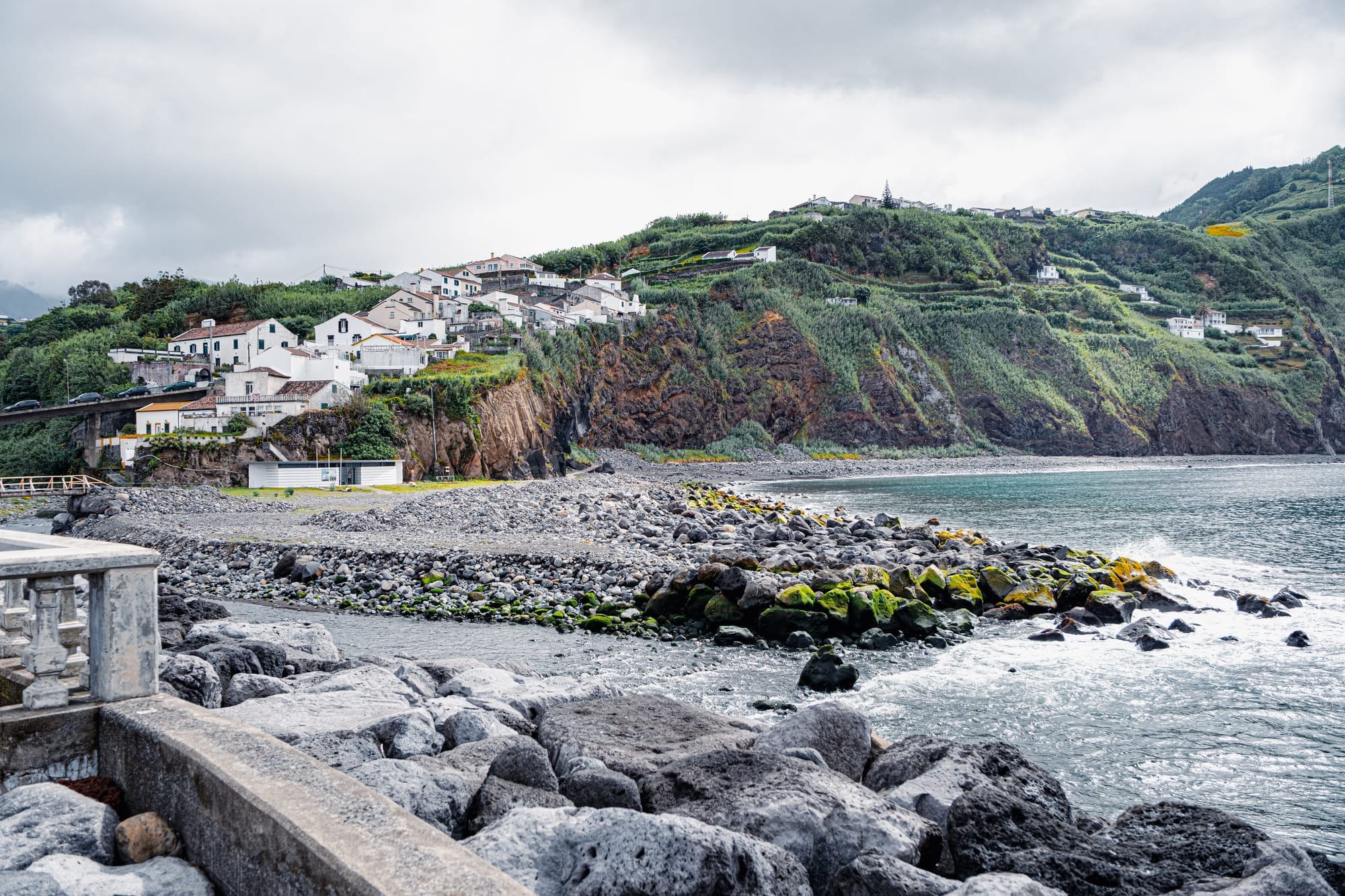
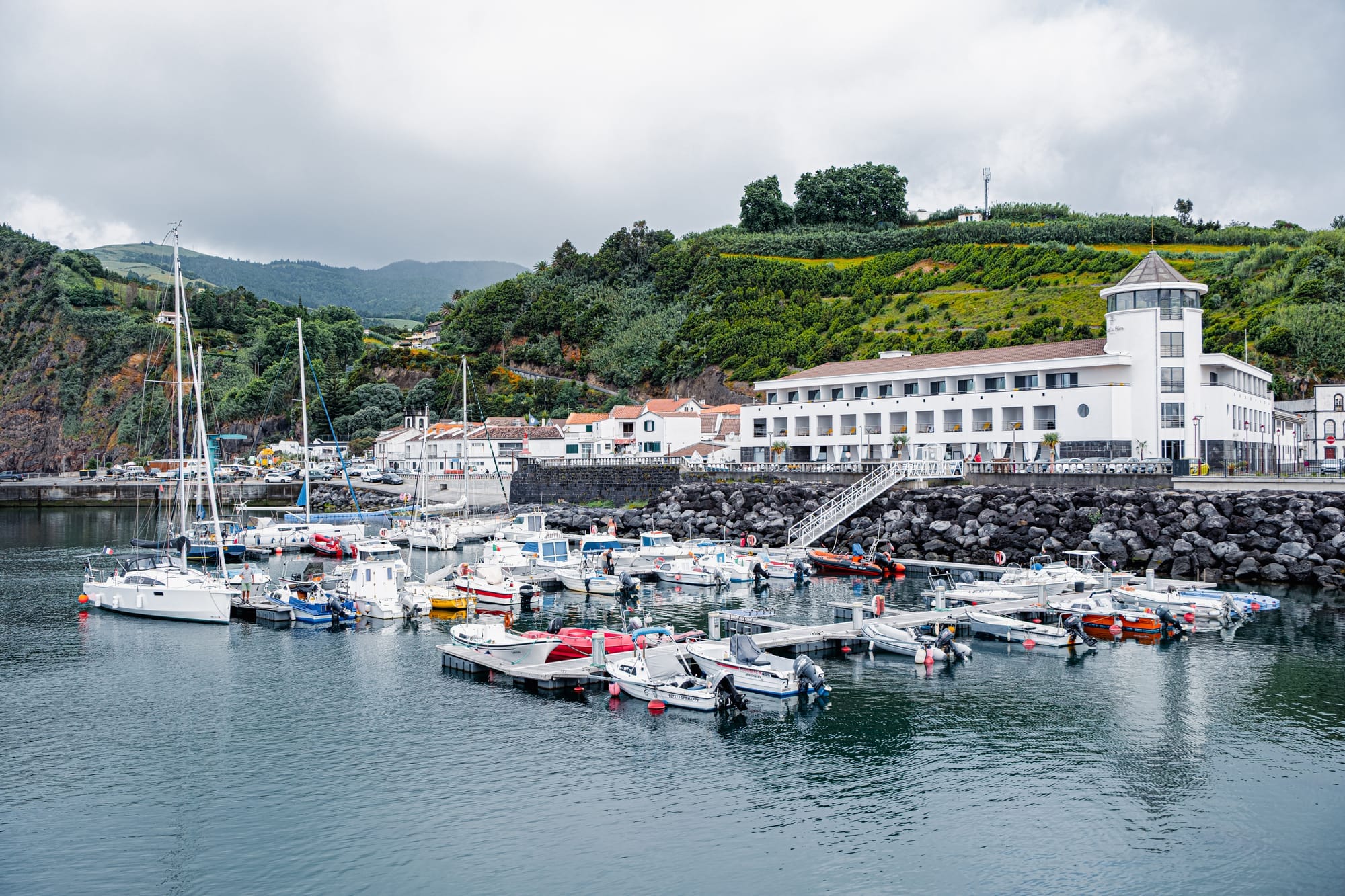
From basalt shorelines to a working marina, Povoação traces the edge of São Miguel
It's still shaped by that first arrival: practical rather than showy, unhurried rather than rushed. If you're looking for a different kind of destination in the Azores, Povoação gives you a low-key and very local perspective.
Povoação at a glance
The practical facts first, so you know how Povoação fits into your São Miguel plans.
Where: southeast coast of São Miguel, in a wide valley between Furnas and Faial da Terra.
From Ponta Delgada: about 60 km, roughly an hour's drive.
Cost: free to walk around. Check locally for any fees at the pool or the museum.
Time needed: two to four hours for the town, a full day with a hike.
Best time: June to September for swimming, any dry day for walking.
Don't miss: the port and breakwater, the parish church, the Discoverers' Gate, and a fofa with coffee.
| Details | |
|---|---|
| Where | Southeast coast, in a valley between Furnas and Faial da Terra |
| From Ponta Delgada | About 60 km, roughly an hour by car |
| Cost | Free to walk around; check pool or museum fees locally |
| Time needed | Two to four hours, a full day with a hike |
| Best time | June to September for swimming, any dry day for walking |
| Don't miss | The port and breakwater, the parish church, the Discoverers' Gate, and a fofa |
| Nearby hike | PR18 SMI Vigia da Baleia, about 7 km, 3 hours, medium, linear |
History of Povoação: the first settlement on São Miguel
Povoação's name simply means "settlement", and that's the point: this is where colonisation of São Miguel began. According to Wikipedia's history of Povoação, Gonçalo Velho Cabral chose the spot for the island's first settlement around 1432, though sources give different years from the 1420s to the 1440s. The early settlers found fertile land inside the Povoação crater and brought cattle, wheat seed, and farm tools. For a long time the valley was the island's cereal centre, which is why a wheat museum makes sense here.
The town became the seat of its own municipality in 1839, when it split from Vila Franca do Campo. Today the municipality has six parishes, including Furnas and Ribeira Quente, so a lot of São Miguel's best-known sights are technically in Povoação. The 18th century brought a boom in shipbuilding using local timber, and a 1935 earthquake did serious damage to the town. You can find current local news and events on the Câmara Municipal da Povoação website.
Povoação municipality: parishes and size
Povoação is both a town and a municipality, which confuses a lot of people planning a trip. The municipality covers about 110 km² of the island's southeast and has around 7,000 residents, according to the Câmara Municipal's geography page. Its six parishes are Povoação, Furnas, Nossa Senhora dos Remédios, Ribeira Quente, Água Retorta, and Faial da Terra. So if you've soaked in Furnas or swum at Ribeira Quente, you've already been in Povoação municipality without knowing it.
The town itself sits inside the Povoação caldera, a wide, eroded volcanic crater that is one of the oldest volcanic areas on São Miguel. Over time, streams cut the crater floor into long ridges that run down to the sea. Locals call them lombas, and the town is often described as the place of seven lombas. Neighbourhoods such as Lomba do Cavaleiro, Lomba do Loução, and Lomba do Alcaide take their names from them.
If you want to ask for directions, the name is said roughly "poo-voo-ah-SOWN", with a nasal ending.
A town shaped by sea and slope
The town spreads across seven hills, with whitewashed homes climbing up and around the terrain. Down by the water, the port is the town’s anchor: practical, worn, and in use. There are rusted ship propellers and anchors tucked into the basalt, not placed for effect but because that’s where they’ve landed.
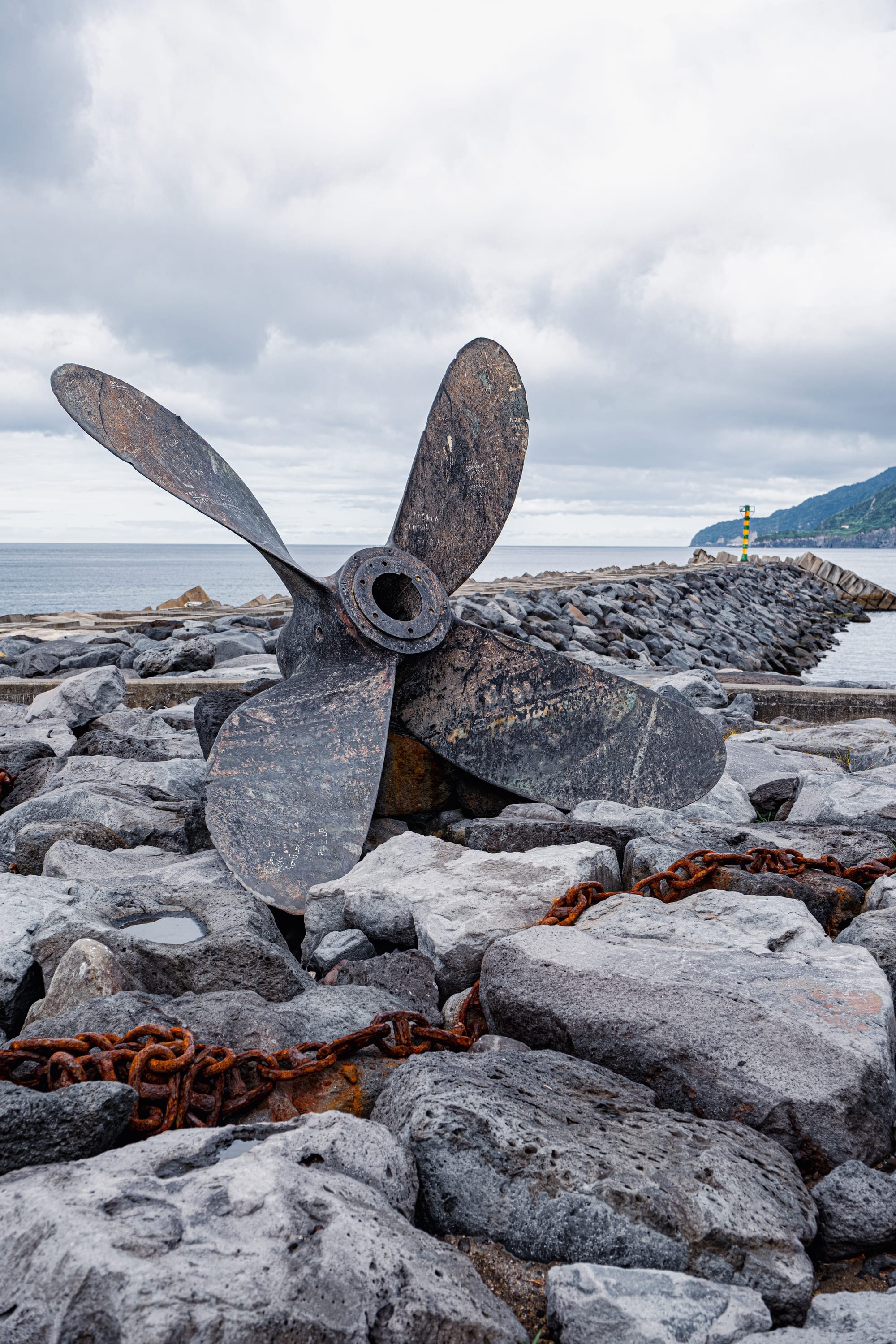
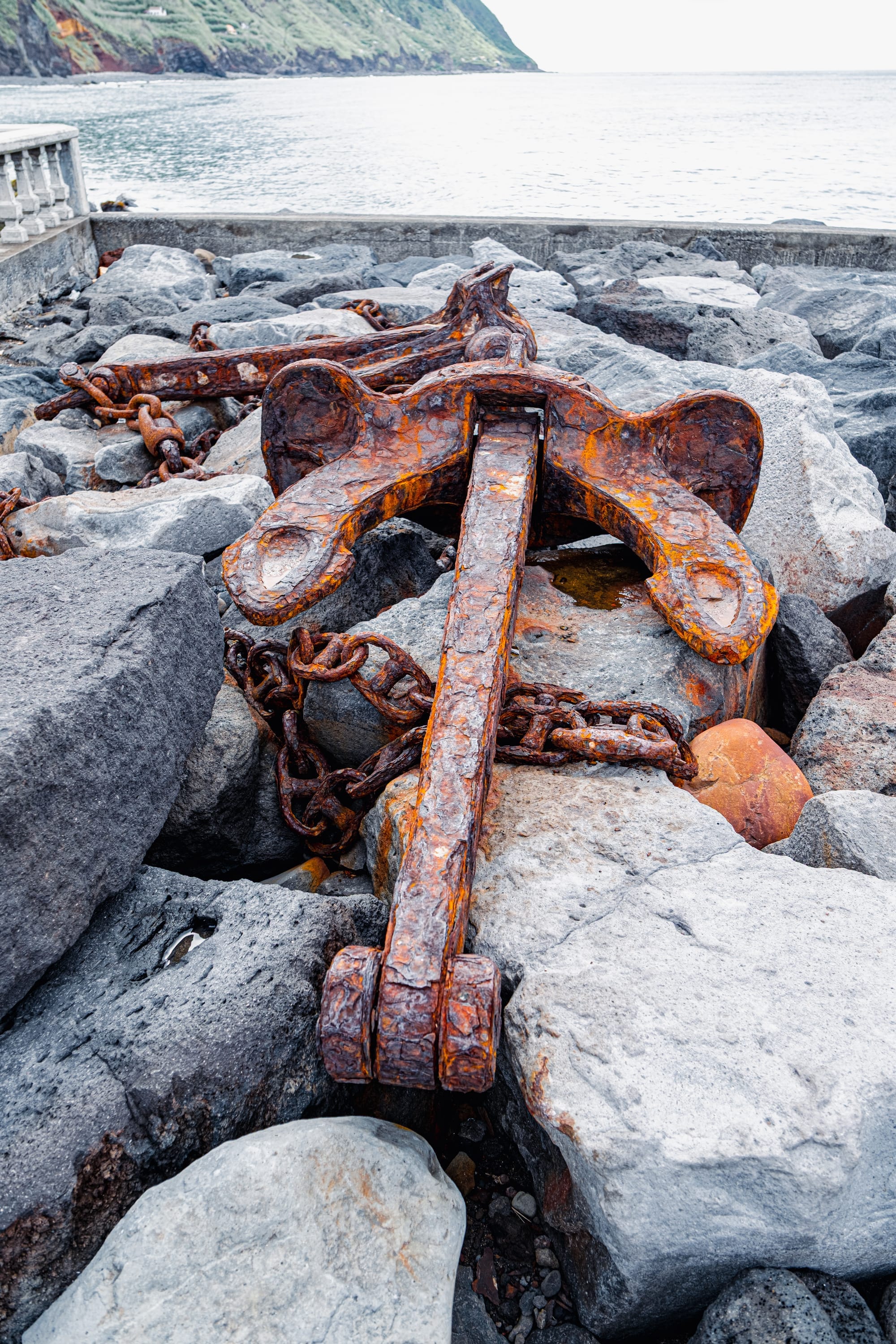
Maritime remnants rest where they landed: rusted anchors and propellers on Povoação’s working shore
A wooden footbridge crosses a stone-littered outflow toward the ocean. You walk over rounded volcanic rocks, past seawalls and concrete breakers designed to hold the Atlantic back just enough.
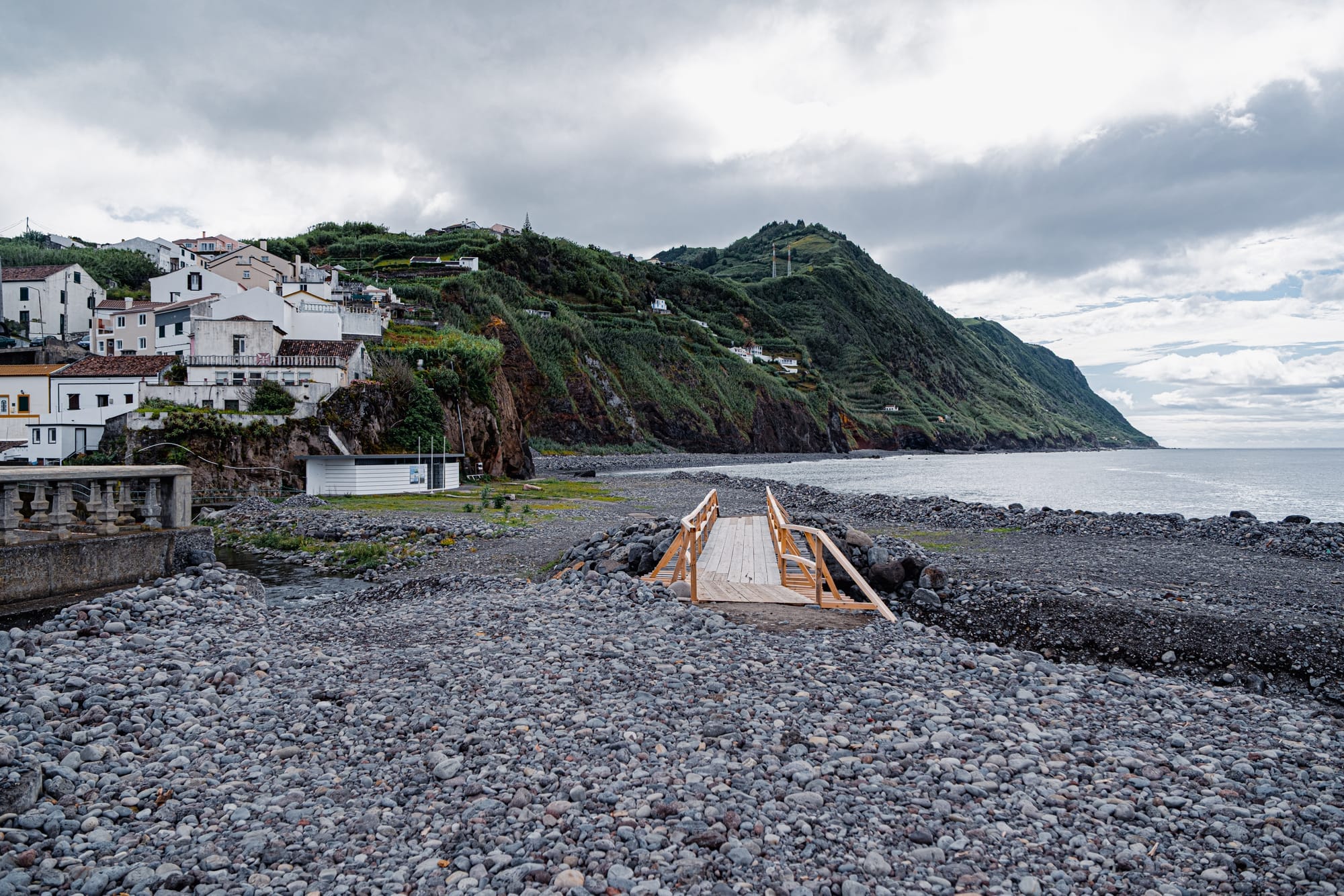
This is a town where people live and work. It's not curated for tourism. It’s a port town with ship hardware on the rocks, residential streets that curve with the hillside, and a pace set by weather, errands, church bells, and tide.
Swimming beside the Atlantic
A public pool edges against the sea, built from poured concrete and lined with simple fencing. It’s used daily, mostly by locals: kids splashing at the shallow end, older swimmers swimming steady laps.
The water in the pool is clear and still; the ocean just beyond is not. Even in overcast weather, you’ll find people swimming. The contrast between pool and sea is subtle but real: calm water and saltwater surge, separated by a single wall.
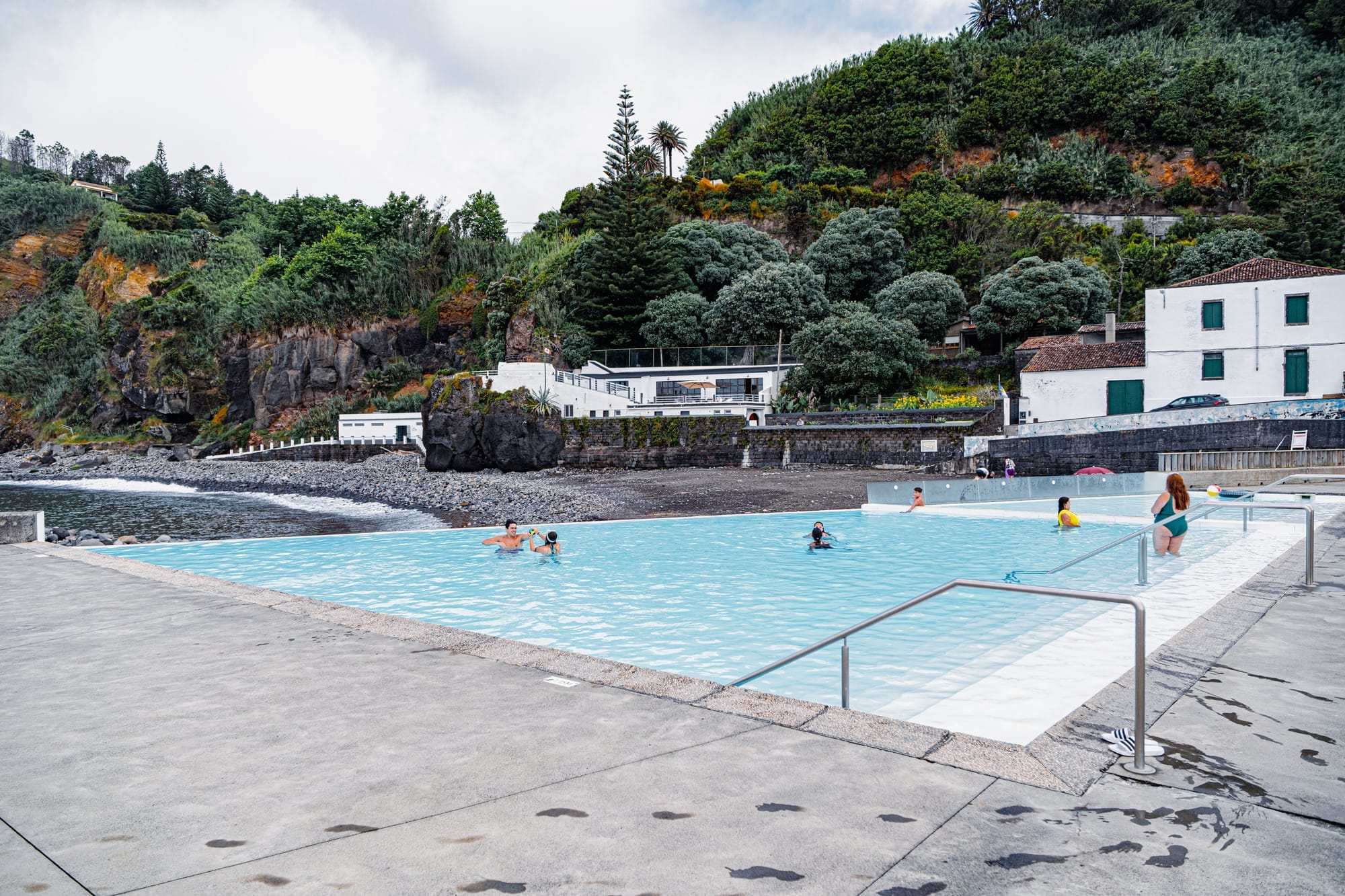
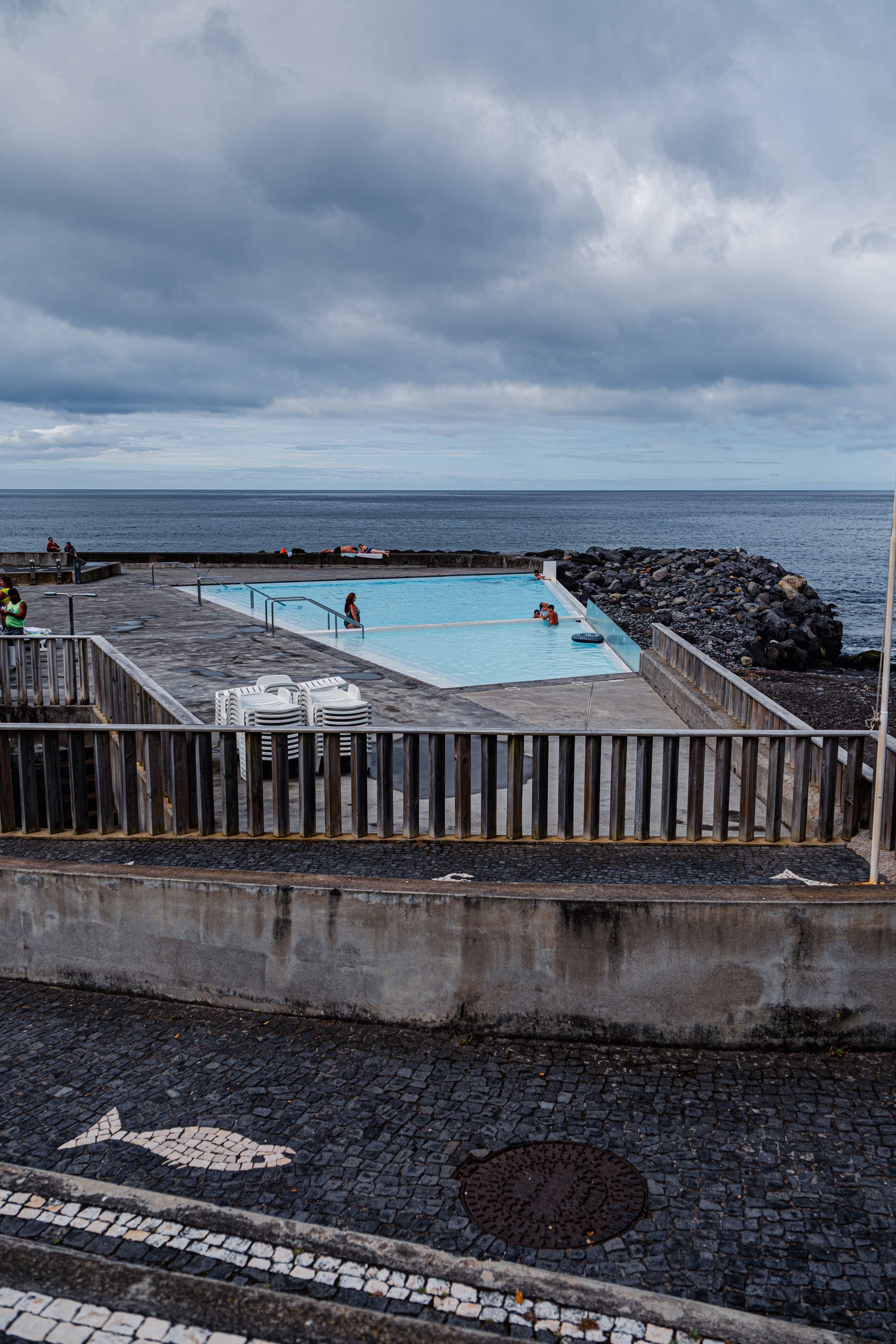
Povoação’s ocean-facing public pool blends into the coastline: plain, well used, and open to weather and tide
Nearby, the jetty holds steady against the Atlantic. The stone breakwater extends out with puzzle-cut concrete blocks, almost Brutalist in form. Their scale and repetition catch the light differently as the day shifts.
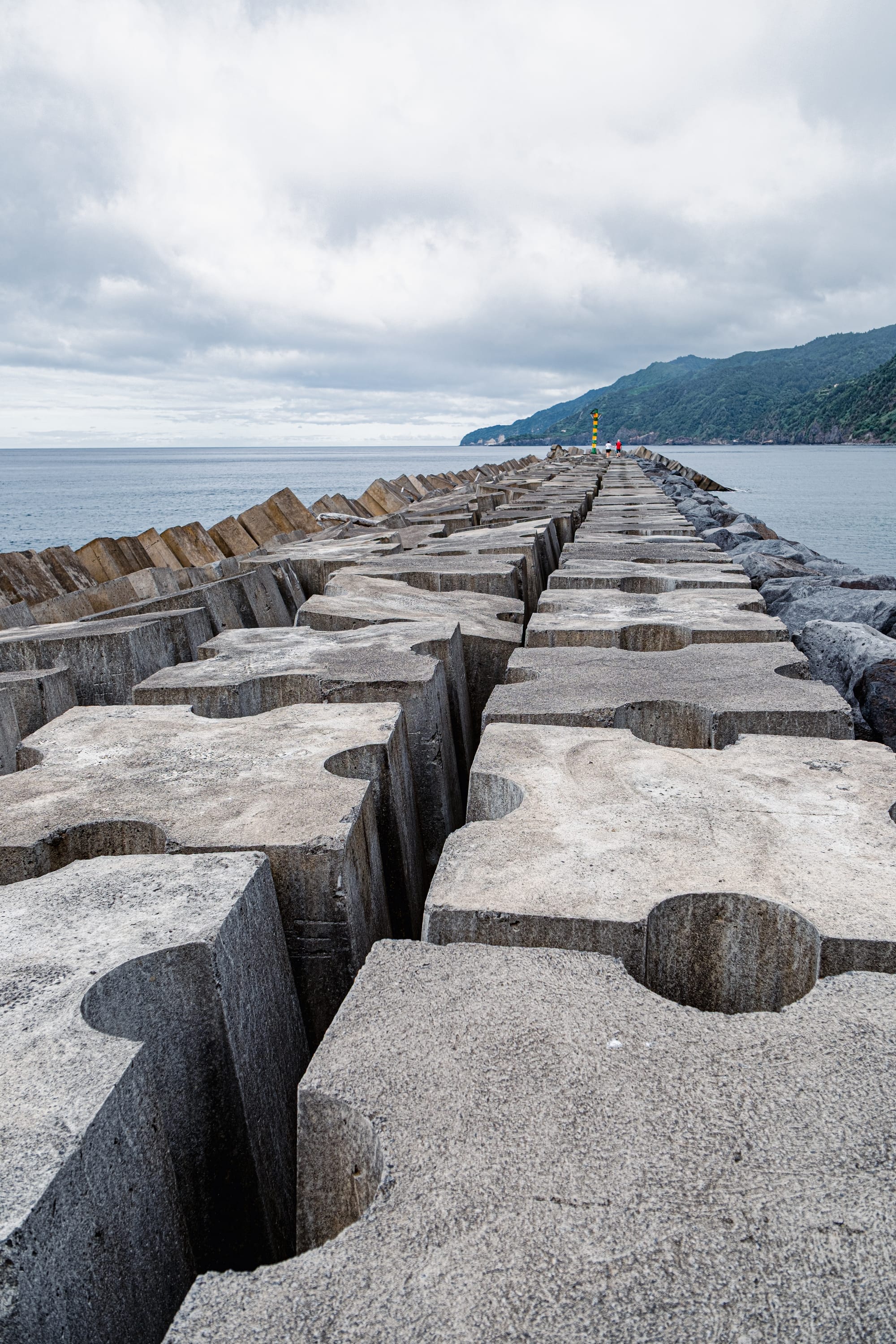
Walking out along this line of stone and poured concrete shows how the town has always faced the sea, with an eye on its force. If you're looking for a unique place to swim in São Miguel, this ocean-facing public pool in Povoação is one of the most distinctive and locally used spots on the island.
Beaches near Povoação
Praia da Povoação is the town's sandy beach, right next to the port. For more facilities, the municipality's two Blue Flag bathing areas are close by, as listed on the council's Blue Flag page:
- Praia do Fogo, Ribeira Quente: a sandy beach where hot springs under the sea warm the water in places. See our Ribeira Quente guide.
- Portinho do Faial da Terra: a sheltered cove with a swimming area, east of town. The Porto Novo picnic park beside it has grills, tables, and benches.
- Praia do Morro, Ribeira Quente: a smaller alternative when Praia do Fogo is busy in July and August.
A walk through Povoação: streets, tiles, and churches
Further inland, a mix of restored and weathered buildings give shape to the center. A tiled pastoral sign outside a community building. A crimson door, slightly chipped at the base.
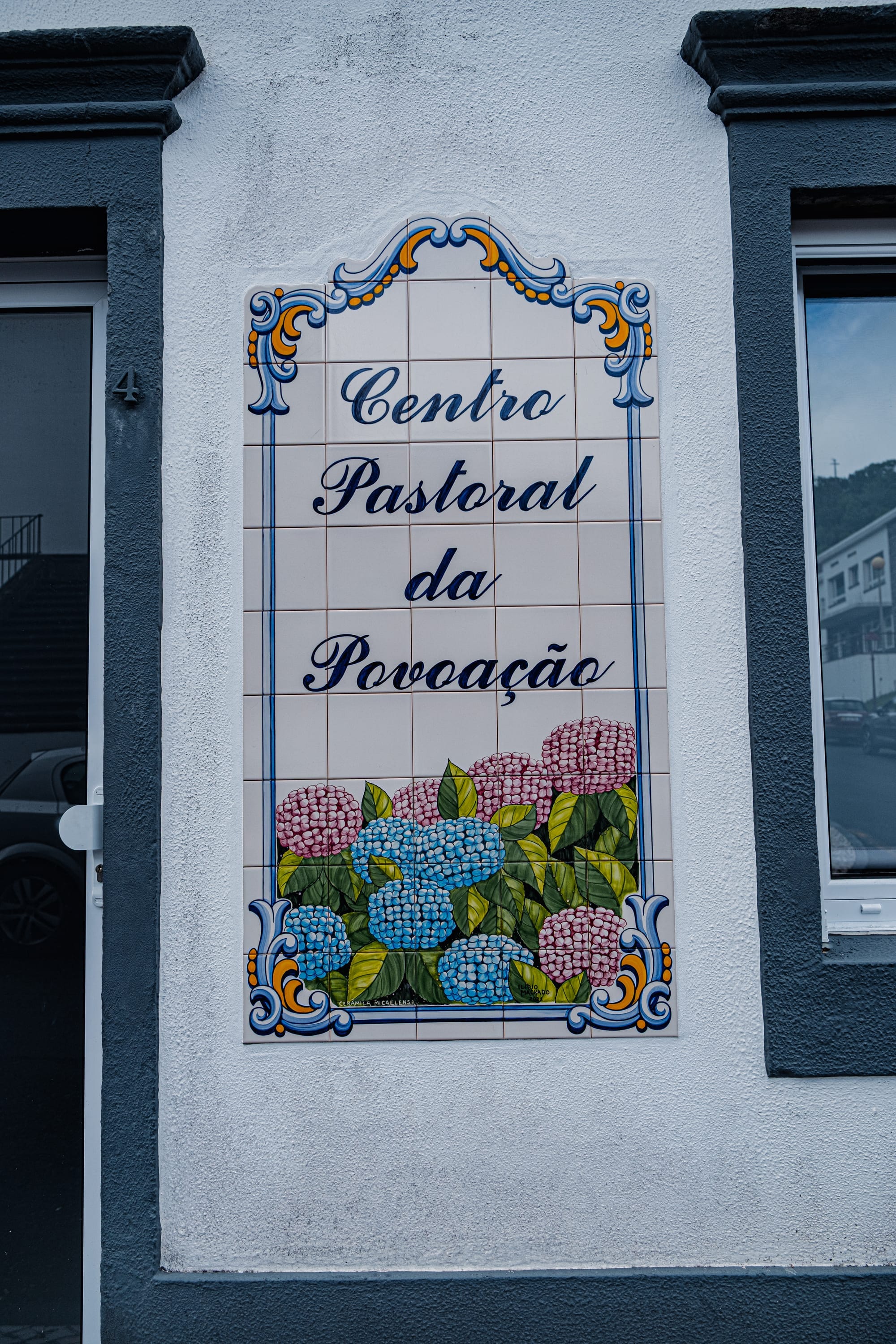
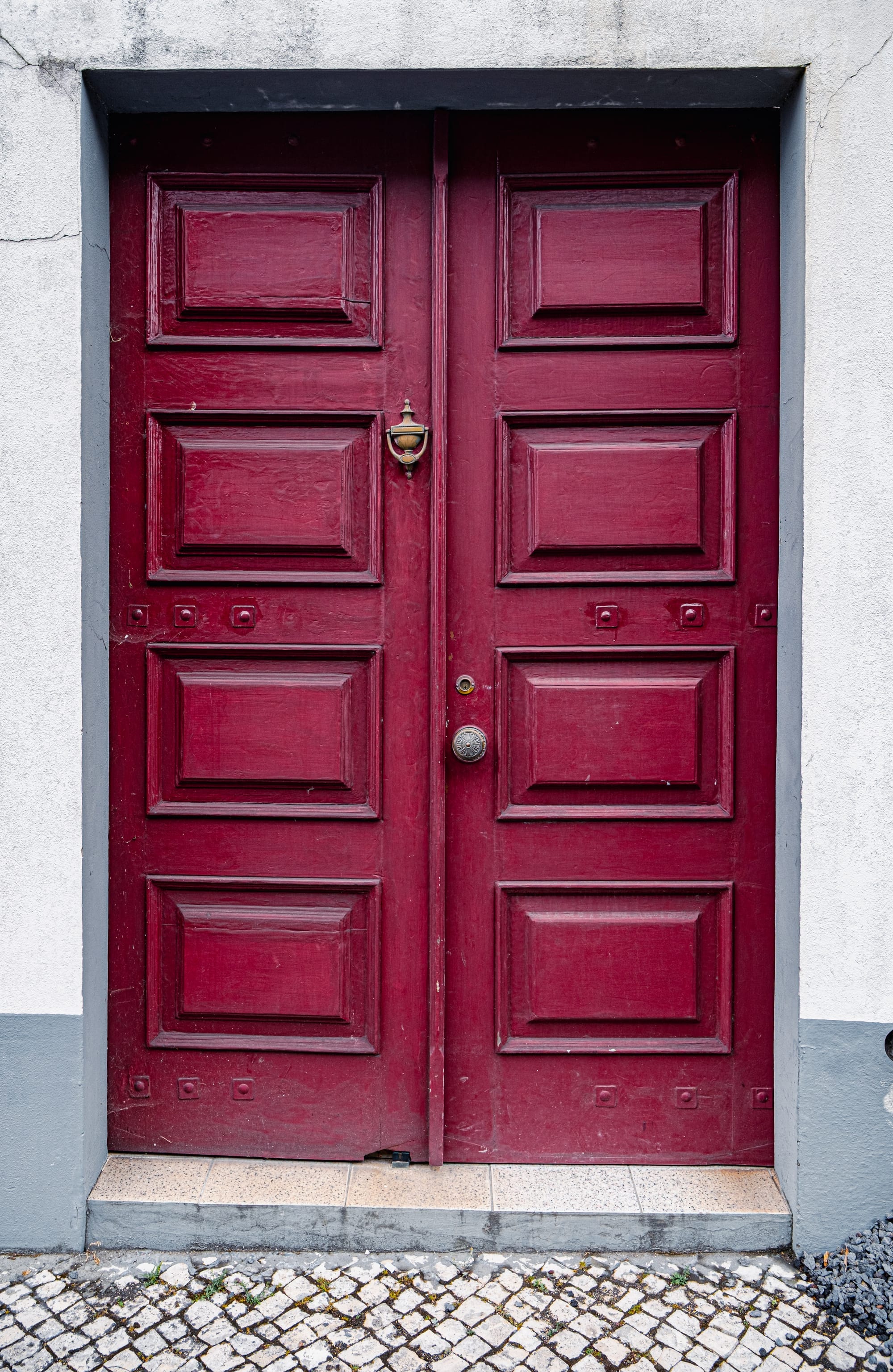
Signs of faith and small details: Povoação’s streets are lined with tiled signs, painted doors, and lived-in color
A church, Igreja Matriz de Nossa Senhora da Mãe de Deus, built in the 19th century, with its black basalt framing, baroque geometry, and crisp white walls.
That church is the Igreja Matriz, inaugurated on 24 July 1848 and known for its gilded woodwork inside, according to the Povoação parish page on Wikipedia). The older Igreja Velha (Church of Nossa Senhora do Rosário) dates from 1745 and was built on the site of an earlier hermitage. Down on the coast, the Discoverers' Gate (Porta dos Descobrimentos) marks the spot where the first settlers are thought to have landed, which is a nice stop to tie the town's story together.
Two more religious buildings are worth a short detour. The Ermida de Santa Bárbara stands on Morro de Santa Bárbara, the small hill above the landing site, so it pairs well with the Discoverers' Gate. Inland, the Igreja de Nossa Senhora dos Remédios is the main church of the parish of the same name, up the valley from the town centre.
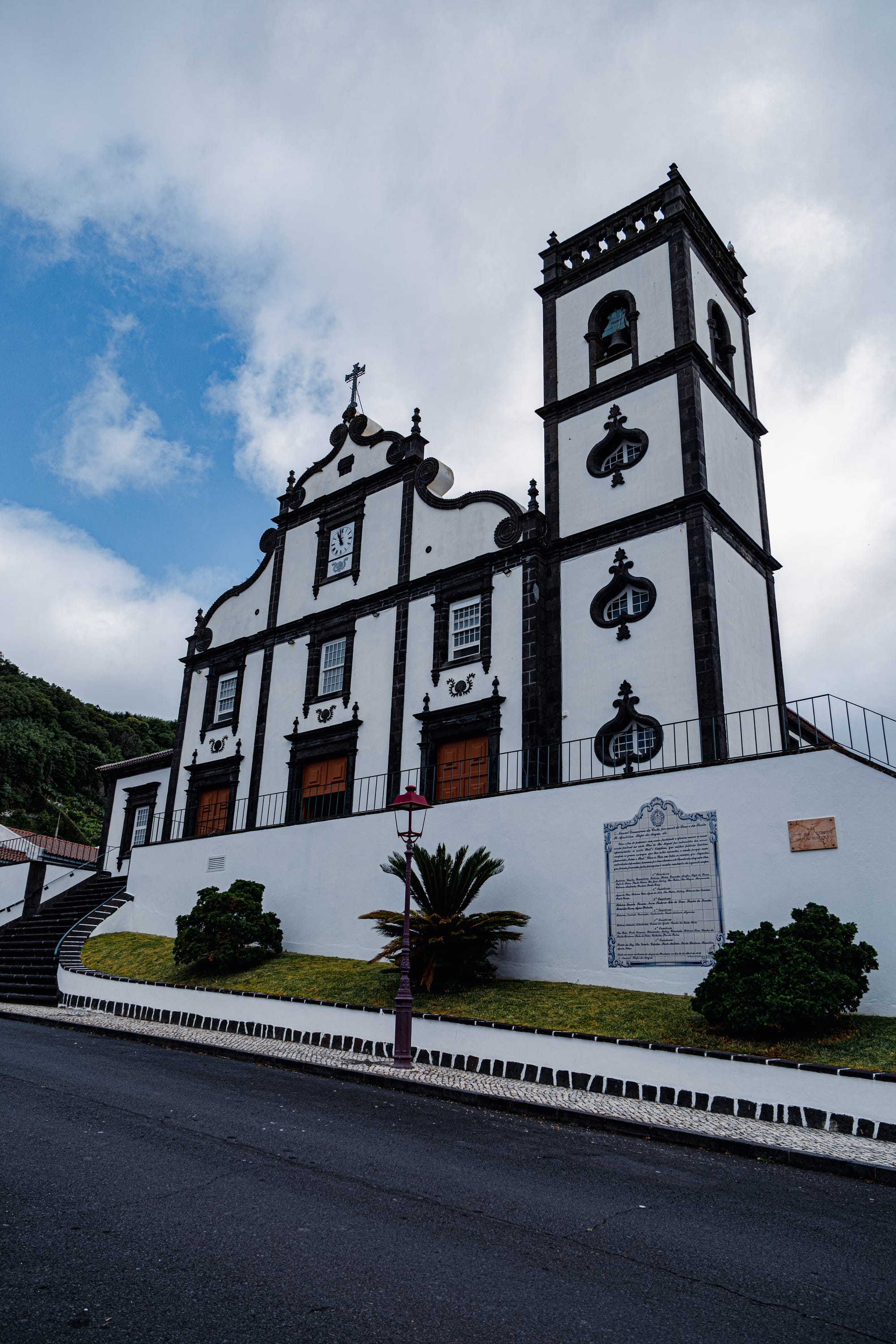
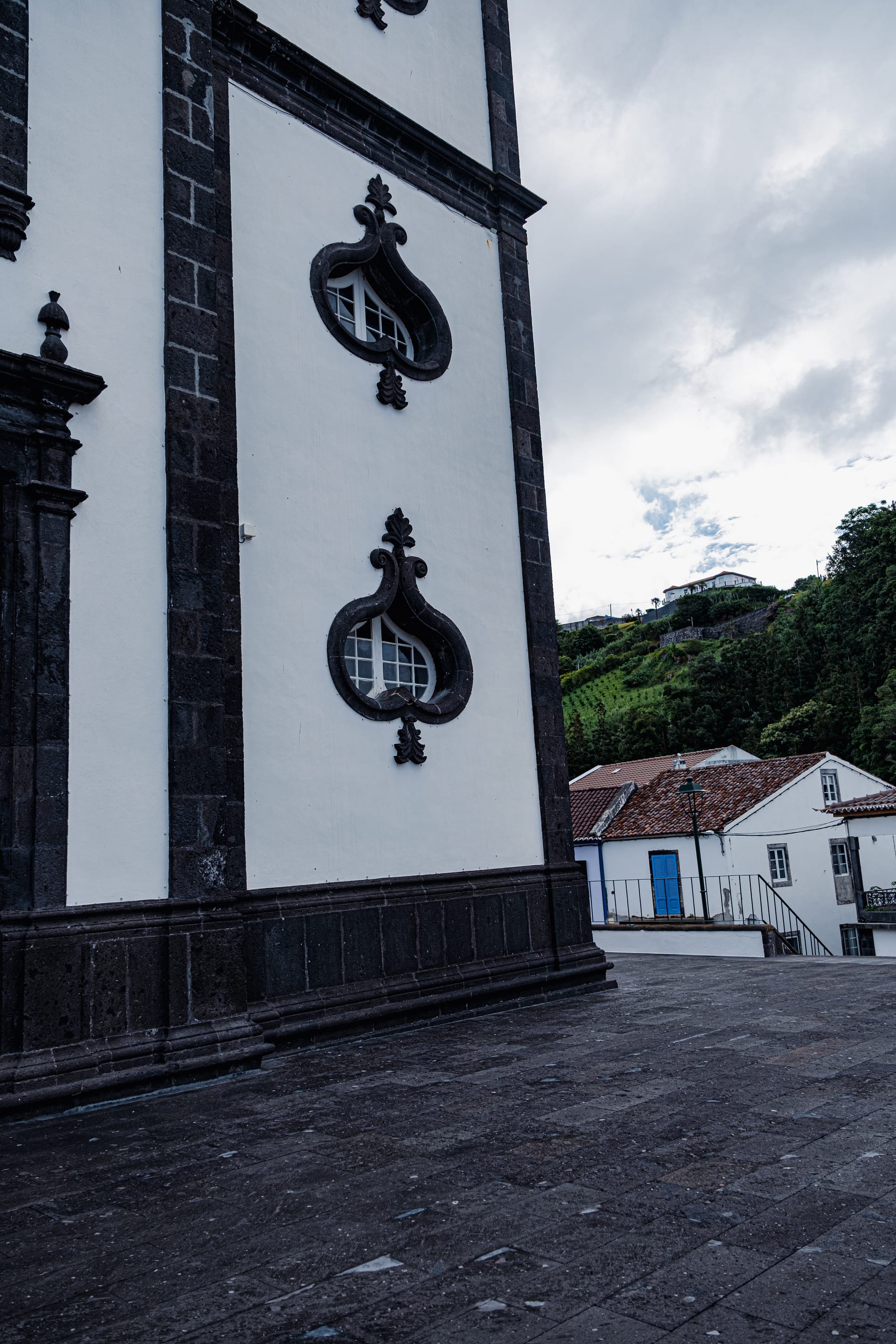
The church at the heart of Povoação: baroque lines and basalt framing
Walking through the center of town, the streets are narrow and lined with low buildings in white and pale blue. Occasionally a bright yellow facade breaks through. Sidewalks are tiled in black and white mosaic, sometimes inlaid with small fish or geometric bands.
One tiled alcove shrine is patterned in deep blue, its niche discolored by rain and time, the lower tiles streaked with ochre.
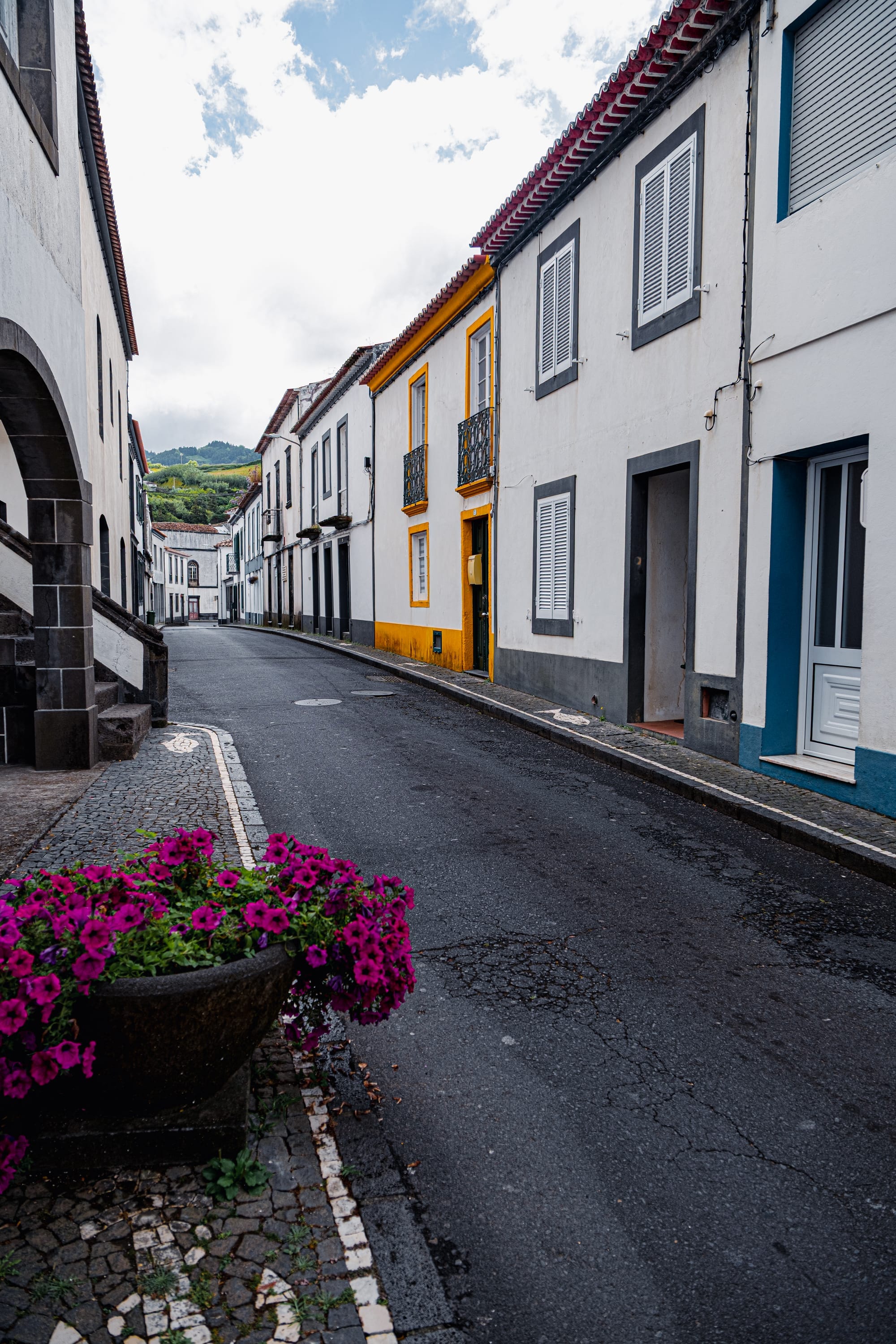
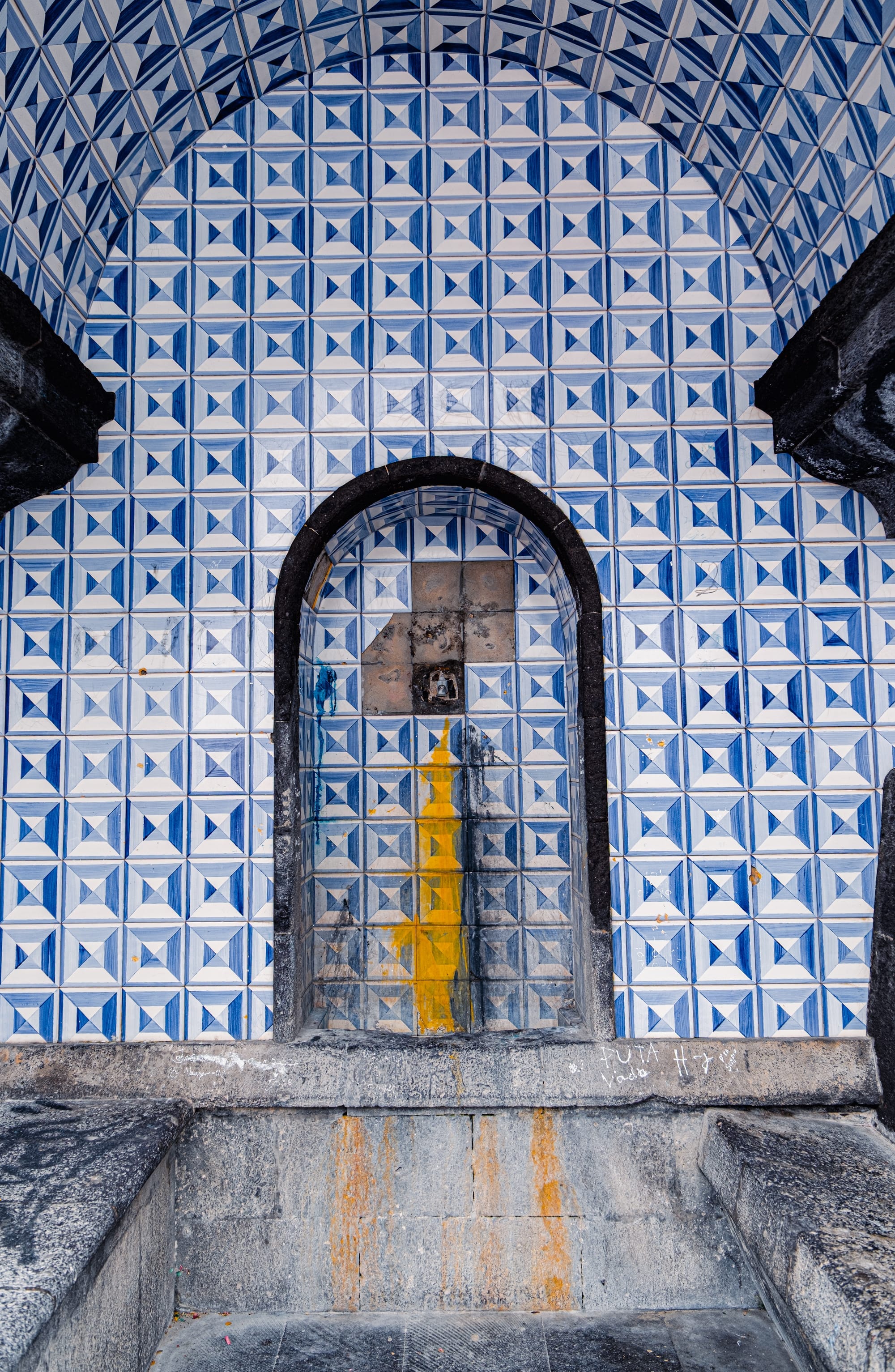
From residential streets to stained azulejo shrines, Povoação’s worn surfaces and bright color
These details aren’t isolated. They’re everywhere, part of the street rather than set apart from it. Walking around Povoação is a good way to see ordinary Azorean life up close, with nothing staged for visitors.
Prefer to go with a guide? One popular option is a full-day tour of the east of the island. You can check dates and prices here:
Where work meets worship
You can spend a morning at the small Wheat Museum, tucked just off the main road, where farming tools, threshing methods, and crop histories are recorded with care.
The building is modest, but the context is rich: Povoação’s early economy depended heavily on grain and its movement through the port. The museum is one of several small cultural attractions in Povoação worth visiting if you’re interested in the island’s agricultural history.
Povoação Wheat Museum: what to know before you go
The Museu do Trigo is in an old water-powered grain mill on the Ribeira dos Bispos, between Lomba do Loução and Lomba do Alcaide, a short drive up from the port. The Câmara Municipal's museum page gives its story: the mill was built around 1854, ran until 1973, sat empty for over 20 years, and was bought by the council in 1995. It opened as an ethnographic museum on 31 July 2004 and is the only one of its kind on São Miguel.
Inside you'll see the water wheels, the threshing machine that separated grain from straw, and the winnowing machine that cleaned it. In July and August the mill used to run day and night, and the room where workers slept between shifts is now a tea room with local crafts and products. Follow the signs from either Lomba, then a cobbled path leads to the door.
| Wheat Museum | Details (2026, check before you go) |
|---|---|
| Location | Ribeira dos Bispos, between Lomba do Loução and Lomba do Alcaide |
| Hours, weekdays | 9:00 to 17:00 |
| Hours, weekends and holidays | 11:00 to 16:00 |
| Phone | 967 932 096 |
Churches and shrines appear all over town. Some are intact and active. Others have half-collapsed roofs but still feature hand-painted saints in tile.
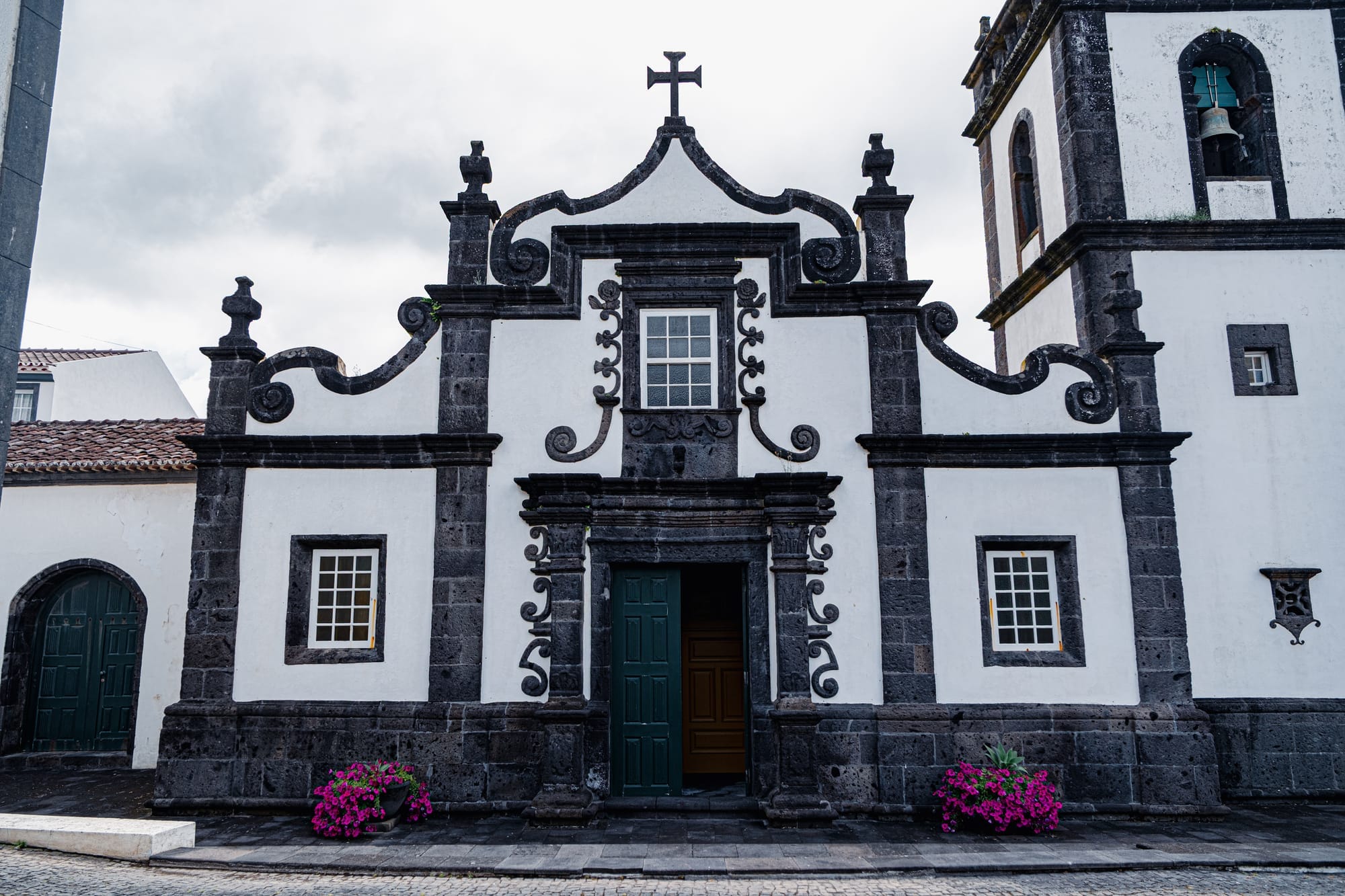
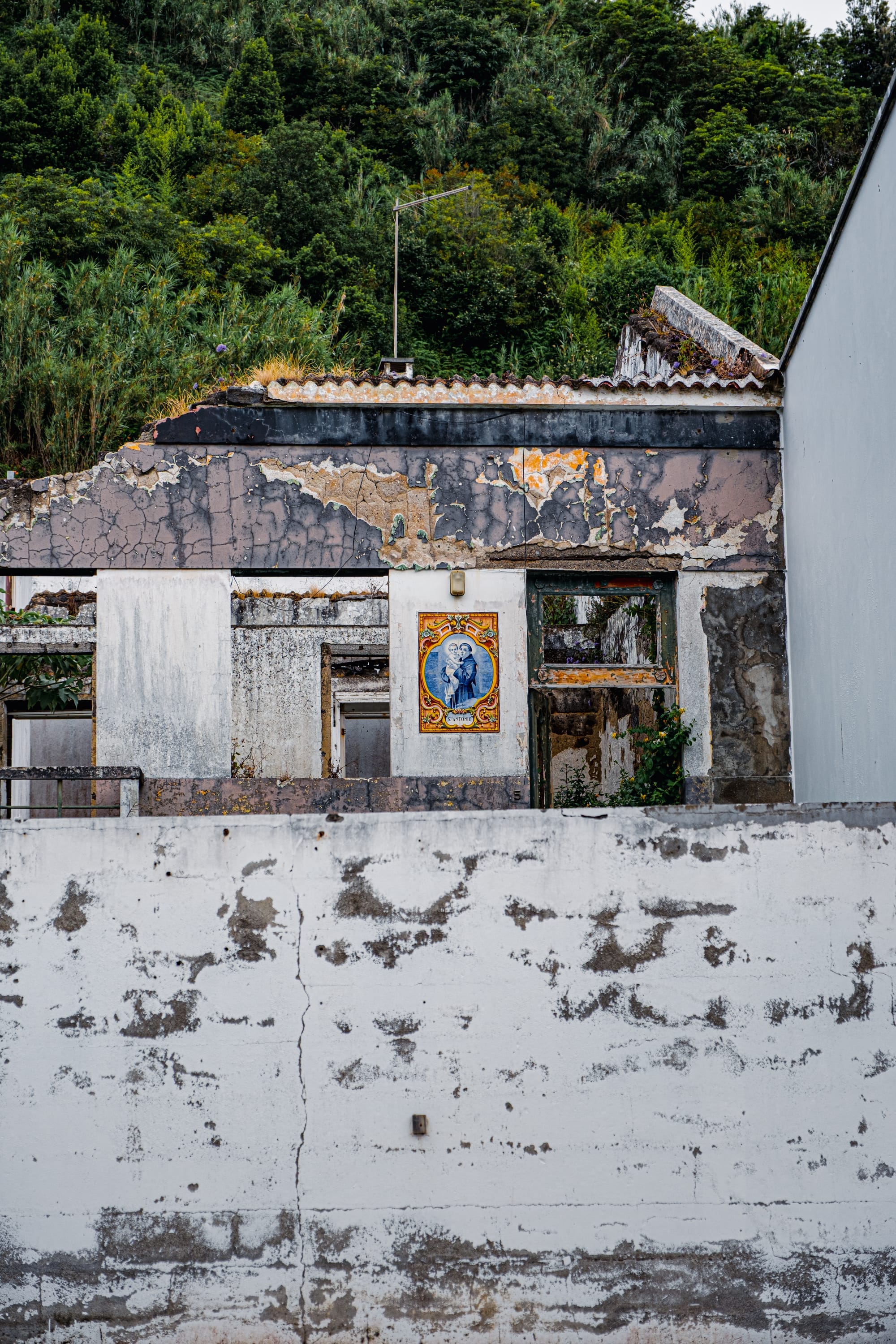
In Povoação, places of devotion range from well-kept churches to roofless walls still bearing painted saints
These shrines aren’t destinations; they’re part of the ordinary route.
What to taste, what to notice
At Pastelaria Guida, fofas de Povoação (cream-filled choux pastries) are made fresh and served plain, with sugar dusting. The pastry itself is light and airy, often filled with either vanilla or lemon custard. They are a local specialty, typically eaten with coffee or enjoyed as an afternoon treat.
It’s important to note that fofas de Povoação are not vegan, as they are made with eggs, milk, and often butter. For those curious about local culinary culture, they remain an emblematic example of regional confectionery, and may still be of interest to travelers exploring the island’s food history.
Recipes vary by bakery. Many fofas have a hint of fennel in the dough, a lemon or vanilla filling, and a line of chocolate on top rather than plain sugar. The shop's full name is Pastelaria Pizzaria Guida, which helps if you're searching for it on a map. Cafés around the centre sell them too, and they're best eaten the same day.
They’re best eaten sitting on a bench by the port wall, watching the sweep of the cove or the movement of a single fisherman checking nets by hand.
The town’s flavor is in the details: a rusted chain half-submerged in grass, the sound of a hose on cobblestone, the tap of a walking stick. Small gardens in front of homes often contain both flowers and tools.
There’s no boundary between beauty and utility here. That’s part of the character.
How to spend a day in Povoação
There’s no obligation to do anything in particular. You can swim, walk, watch boats come and go. You can follow the slope of a street, find a shrine, or sit beside a rusted chain.
This is what ordinary life looks like in a small port town: calm, busy, and local.
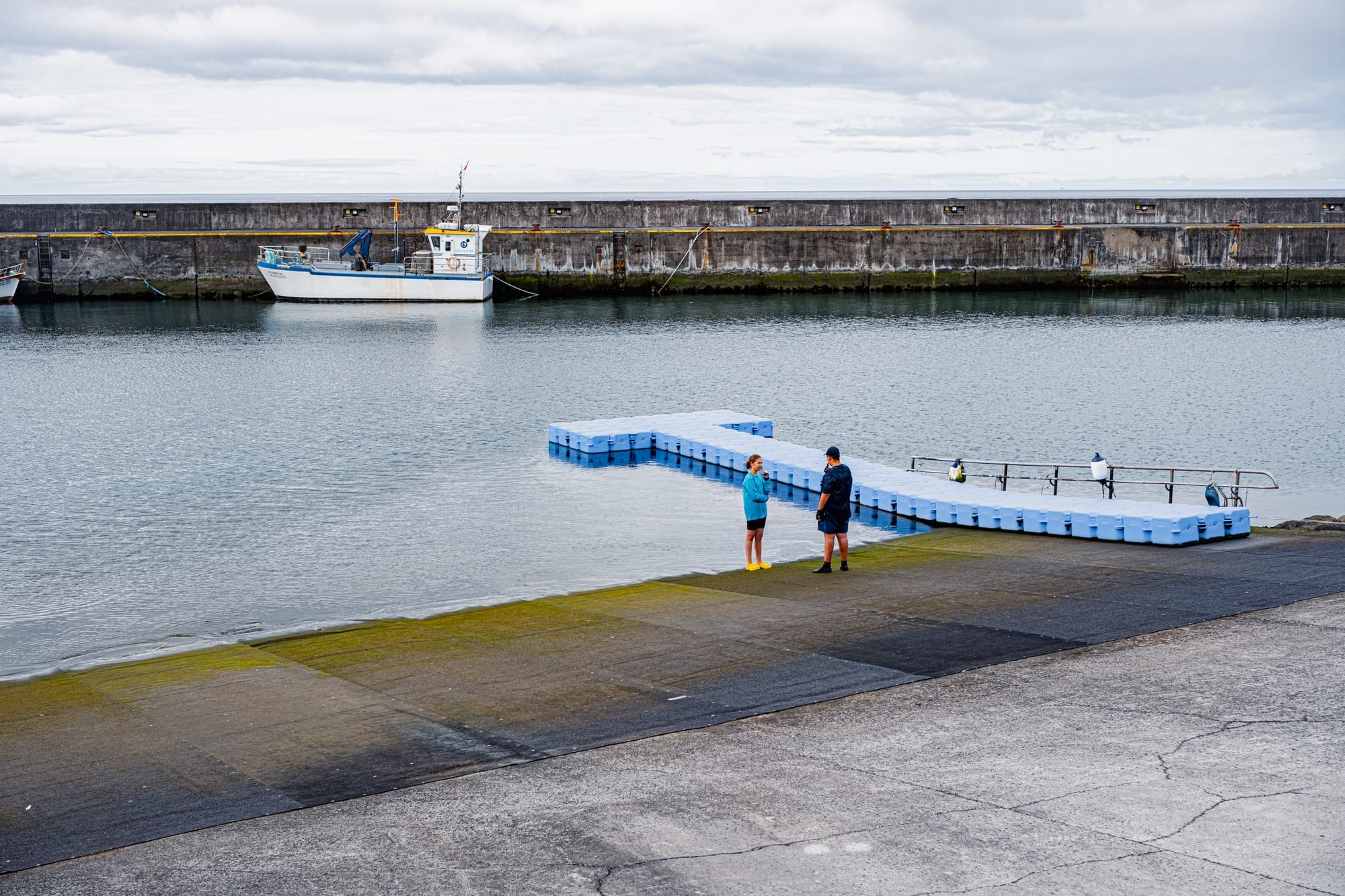
If you want to understand how a lived-in place works, somewhere not designed for visitors, this is a good place to start. Povoação is a destination for those interested in experiencing authentic Azorean life along the coast of São Miguel.
How to get to Povoação from Ponta Delgada
The easiest way is by car. Povoação is about 60 km east of Ponta Delgada along the regional road, and the drive takes roughly an hour, depending on traffic and how many viewpoints you stop at. Public buses run between Ponta Delgada and Povoação, but services are limited and take longer, so check the current timetable before you rely on them. With a car, you can combine Povoação with Furnas and Ribeira Quente in one day, since all three are in the same municipality.
Povoação sits on the southeast route in our São Miguel guide (PDF), which lists driving times from Ponta Delgada and covers the coast below Furnas.
Povoação viewpoints
The best way to understand the town's layout is from above. On the drive in from Furnas, the regional road passes a few lookouts:
- Miradouro da Lomba do Cavaleiro: on the regional road just above town, with a view over the rooftops, the lombas, and the coast.
- Miradouro do Salto do Cavalo: high on the rim of the Furnas caldera, looking down over the Povoação valley on one side and Furnas on the other. Cloud often covers it, so go on a clear day.
- Pico dos Bodes: a lookout at about 460 m on the Vigia da Baleia trail, with a 180 degree view of the south coast from Faial da Terra to Vila Franca do Campo.
In town, the municipality runs a Centro de Informação, Turismo e Artesanato (tourism information and crafts centre), and the council website keeps a list of contacts for local restaurants and bars, which is handy outside summer when opening hours are shorter.
Hikes near Povoação
If you want to stretch your legs, two official trails start in or near town. The PR18 SMI Vigia da Baleia trail is a linear walk of about 7 km and 3 hours, rated medium, from Povoação over to Faial da Terra. It passes Pico dos Bodes and an old whale lookout with a wide view of the south coast, as the official Vigia da Baleia trail leaflet explains. From Faial da Terra you can carry on to the Sanguinho trail and Salto do Prego waterfall.
The other option is the PR12 SMI coastal trail between Povoação and Ribeira Quente. Details are on the official Povoação to Ribeira Quente trail leaflet. Both trails are linear, so plan a taxi or a second car back, and bring rain gear: the weather on this side of the island changes fast.
The PR12 SMI is also called the Agrião trail. The official Visit Azores trail sheet gives it as about 7.6 km and 3 hours, rated medium, running along the coast and past Lomba do Cavaleiro, with pastures and an old mill on the way. At least one regional guide has reported it as temporarily closed, so check its status on Visit Azores before you set off.
If you walk to Salto do Prego, you'll pass Aldeia do Sanguinho, a hamlet that was abandoned in the 1970s and is being restored, with a handful of stone houses rented to visitors.
Best time to visit Povoação
Summer, from June to September, is the best time if you want to use the sea-side pool or the beach. The water is warmest and the days are longest. Spring and autumn are good for walking the town and the trails, with fewer people around. Winter brings more rain and rough seas, which can make the breakwater dramatic to watch but not a place to stand too close. Whatever the season, it's worth checking the forecast, because the southeast valleys catch cloud easily.
Festivals in Povoação
The biggest event is the festival of Nossa Senhora Mãe de Deus, the town's patron, held on the first weekend of September with processions, music, and food stalls. Corpo de Deus (Corpus Christi) is also celebrated in town, and many emigrant families come home in summer for the festivities. Dates move each year, so check the agenda on the Câmara Municipal da Povoação website before planning around them.
Is Povoação worth visiting?
Yes, if you like real working towns more than big sights. Povoação doesn't have a headline attraction like Sete Cidades or Lagoa do Fogo. What it has is a port in use, a sea pool locals swim in, good pastries, and a lot of history for a small place. If you only have two or three days on São Miguel and want the big views, you could skip it. If you're driving the east coast anyway, it's an easy and worthwhile stop. For more ideas, see our list of things to do on São Miguel.
Nearby, see Vila Franca do Campo and Poça da Dona Beija hot springs.
Nearby, see the Ilhéu de Vila Franca islet.
Whatever your plans, travel with insurance. Stomach bugs, a fall on a cobbled street, or a stolen phone can happen anywhere, and it's much easier to enjoy the trip when you know you're covered. We'd recommend SafetyWing Nomad Insurance. It covers medical emergencies abroad, you can buy it even after you've left home, and it renews every four weeks, so it works for a short trip or months on the road.
Where to stay near Povoação
The nearest good base for Povoação is Povoação. These are well-reviewed places to stay there, all rated 9 or more on Booking:
- Casa da Cisaltina: a guest house in Povoação rated 9.7 from over 300 reviews.
- Casa da Lomba do Cavaleiro: a rural guest house above Povoação, rated 9.3.
Frequently asked questions
What is Povoação known for?
Povoação is known as the site of the first settlement on São Miguel, in the 15th century. Locally, it's also known for fofas de Povoação, a cream-filled pastry, and for its port and sea-side swimming pool.
How far is Povoação from Ponta Delgada?
About 60 km, which is roughly an hour by car. Buses also run, but they're less frequent, so a rental car is the easier choice.
Can you swim in Povoação?
Yes. There's a public pool right beside the sea, used mostly by locals, and Praia da Povoação is one of the few sandy beaches on that stretch of coast. Check for lifeguards and sea conditions before swimming in the ocean.
Is Povoação worth visiting?
It's worth a few hours if you're exploring the east of São Miguel. It suits travellers who like local life, history, and food more than big viewpoints.
What is near Povoação?
Furnas, Ribeira Quente, and Faial da Terra, the starting point of the Sanguinho trail, are all close by. Vila Franca do Campo is further west along the south coast.
What are fofas de Povoação?
They're light choux-style pastries filled with custard and dusted with sugar, a specialty of the town. They contain eggs, milk, and butter, so they aren't vegan.
How do you pronounce Povoação?
Roughly "poo-voo-ah-SOWN", with a nasal sound at the end. The name means "settlement" in Portuguese.
Which parishes are in Povoação municipality?
Six: Povoação, Furnas, Nossa Senhora dos Remédios, Ribeira Quente, Água Retorta, and Faial da Terra. That's why Furnas and Ribeira Quente count as part of Povoação.
What is the Wheat Museum in Povoação?
The Museu do Trigo is a restored 19th-century water mill that shows how wheat was threshed and cleaned. It opened as a museum in 2004. In 2026 the council lists weekday hours of 9:00 to 17:00, and shorter hours at weekends.
When is the Povoação festival?
The festival of Nossa Senhora Mãe de Deus, the town's patron, takes place on the first weekend of September. Check the council's agenda for the exact dates.
Are there Blue Flag beaches near Povoação?
Yes. Praia do Fogo in Ribeira Quente and Portinho do Faial da Terra both hold the Blue Flag, according to the municipality.
Useful links: Câmara Municipal da Povoação, Visit Azores: PR18 SMI Vigia da Baleia trail leaflet, Visit Azores: PR12 SMI Povoação to Ribeira Quente leaflet, and Povoação on Wikipedia.


