


Ribeira dos Caldeirões is a small natural park in Achada, in the Nordeste municipality of northeast São Miguel, Azores. It has a tall waterfall right by the car park, historic water mills, hydrangea-lined paths, a café, and toilets. Entry and parking are free. An hour is enough for a walk around, or plan half a day if you book canyoning. It's roughly an hour and a quarter by car from Ponta Delgada. Summer is best for the hydrangeas, which usually flower from about June to August, and early in the day is usually calmer.
On the green, rain-fed northern side of São Miguel Island in the Azores, Parque Natural da Ribeira dos Caldeirões is a lot more than a waterfall stop on an island tour. It mixes geology, plants, history, and adventure in one small park. Hydrangeas bloom everywhere. Centuries-old water mills still stand by the stream. And if you’re up for it, you can jump into a canyon beneath a waterfall, into cold volcanic spring water that will wake you right up.
Ribeira dos Caldeirões at a glance
The essentials, so you can fit the park into a day in the east of the island.
Where: Achada, Nordeste municipality, on the regional road along the north coast of São Miguel.
Entrance fee: free, with free parking on site.
Opening hours: it's an open-access park, so there are no gates or fixed hours. The café, craft shop, and mill museum keep their own hours, so check locally.
Service hours: local guides list the café, shop, and museum area as open from about 9:00 to 17:00, while the paths stay open all day. Treat that as a guide for 2026, since times can shift in winter.
Time needed: 45 minutes to an hour for the waterfall and mills, half a day with canyoning.
Facilities: café, toilets, a picnic area with tables and barbecues, a craft centre, and a children's play area.
Parking: free, but the car park is small and fills quickly on summer days, especially when tour minivans arrive. Come before 10:00 or after 16:00 between June and September.
Best for: easy walks, photos, families, and anyone driving the Nordeste coast.
| Details | |
|---|---|
| Where | Achada, Nordeste, off the north coast regional road |
| From Ponta Delgada | About an hour and a quarter by car |
| Entrance fee | Free, with free parking |
| Opening hours | Open access, no gates or fixed hours; café, shop, and museum vary |
| Time needed | 45 minutes to an hour, half a day with canyoning |
| Facilities | Café, toilets, picnic area with barbecues, craft centre, and play area |
| Best time | Summer for hydrangeas (about June to August), early or late in the day |
| Best for | Easy walks, photos, families, and Nordeste coast drives |
The official Visit Azores page for Ribeira dos Caldeirões Park describes it as a landscape project that turned a set of water mills and old footpaths into an open-air museum. The Azores government's tourism portal also lists the Parque Natural da Ribeira dos Caldeirões among Nordeste's main sights.
Arriving at Ribeira dos Caldeirões
You arrive by car, along the forested bends of Nordeste. A rustic wooden railing guides you down. Then you see it: the green valley opens up below you, and a waterfall splits a basalt wall in the distance. Everything smells of earth and flowers.
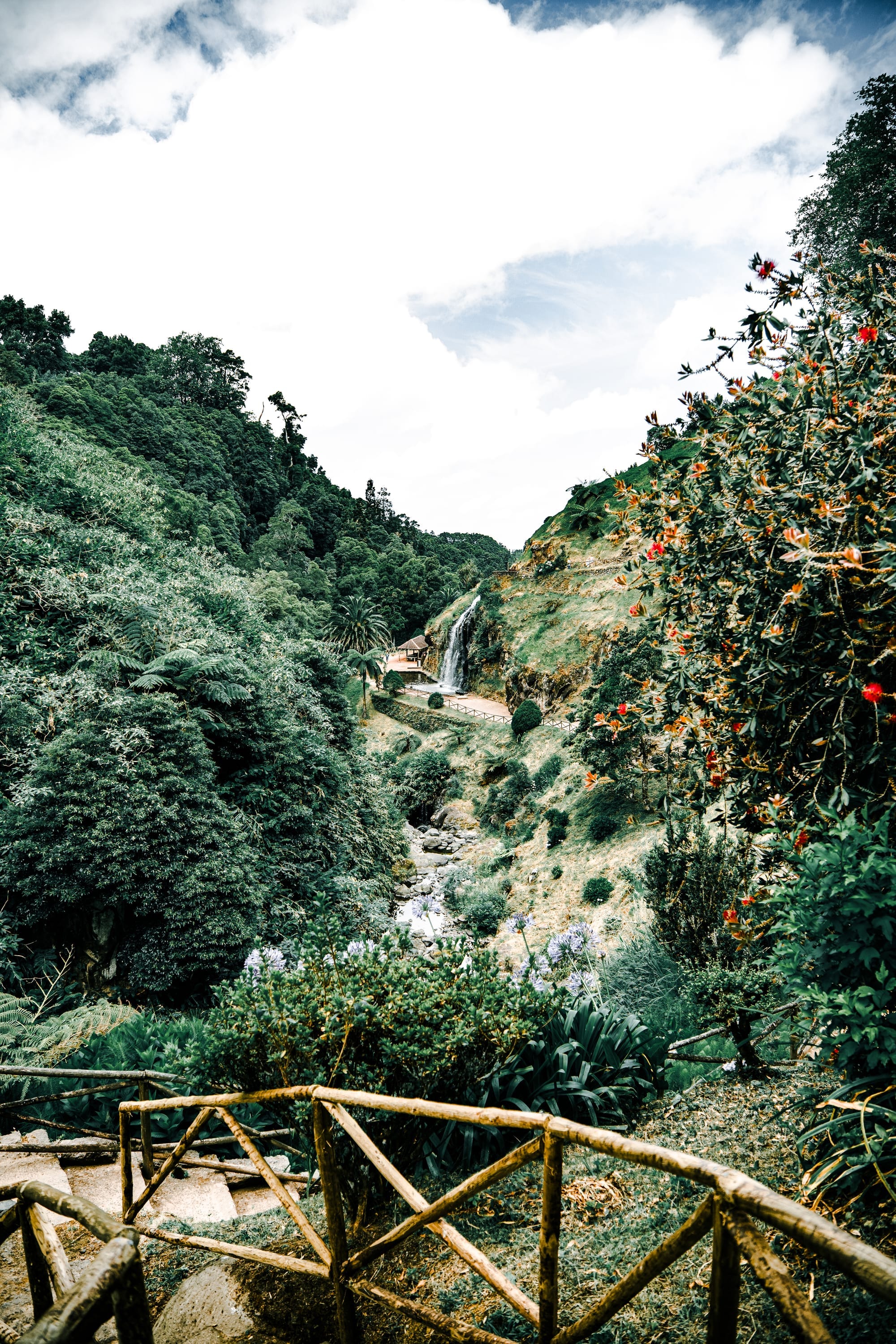
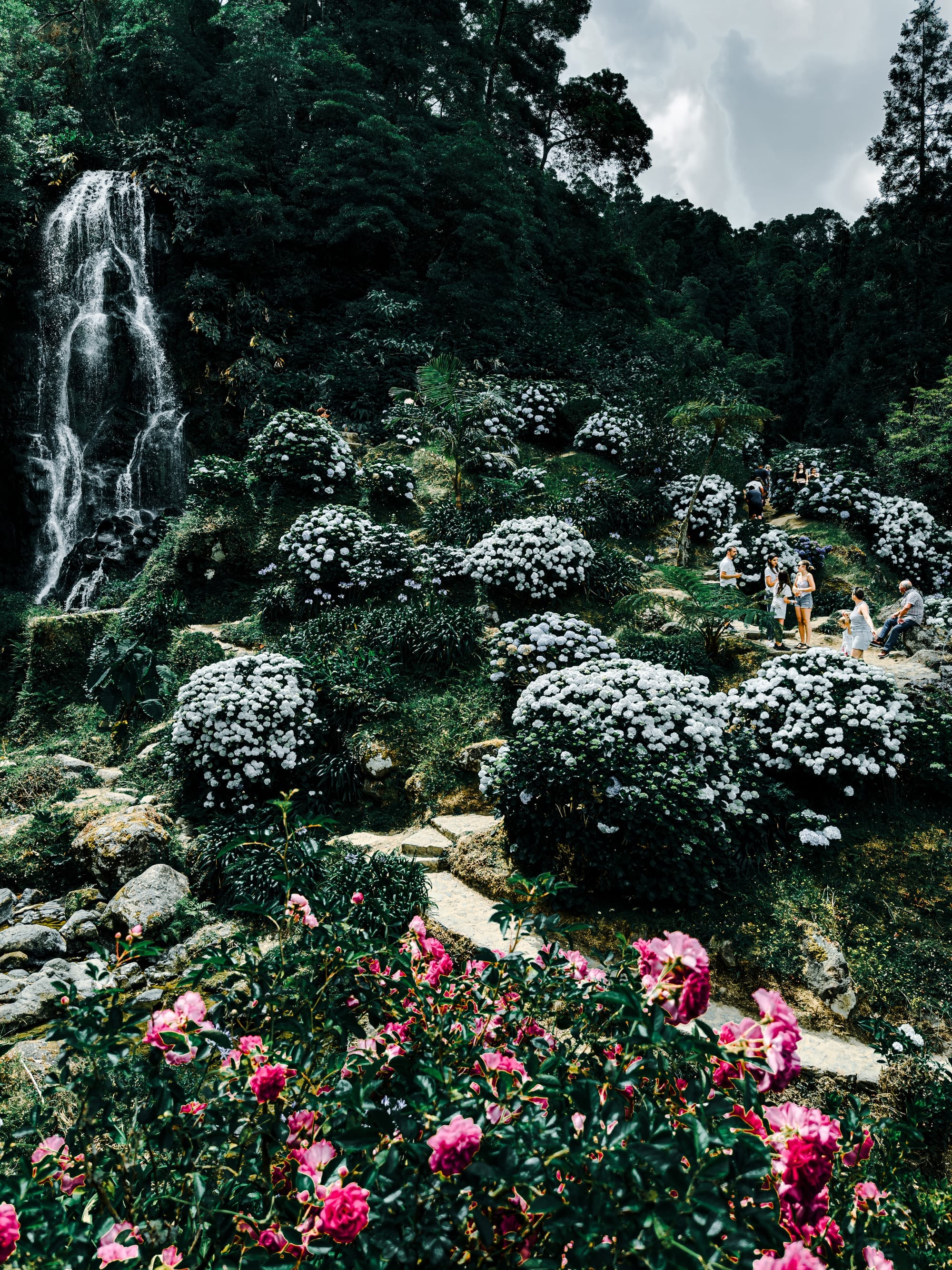
The descent: stone railings, forest shadow, and the roar of distant water
The park is laid out so you discover it bit by bit. Trails curve out of view, you hear water before the stream appears, and the flower borders look different at each hour. You never see everything at once, so take your time, stay curious, and enjoy the surprises along the way.
This is the entrance to Ribeira dos Caldeirões, a protected park of ravines and ridges. It was once crucial to the island’s farming systems and is still home to working water mills. Their walls are dark with age, but they still do their job.
The main waterfall, often called Véu da Noiva (the Bridal Veil), drops down the rock face across the road from the car park, and a short path takes you to the best spots for photos. Many visitors stop there and leave, but the main part of the park lies on the car park side of the road. Follow the path down toward the stream and you'll find several smaller falls, the mills, and far fewer people.
History of the Ribeira dos Caldeirões water mills
There are five water mills in the park. According to byAçores, they date back to the 16th century, and for generations they were a key source of income for local families, grinding corn into flour with the stream's steady flow. Three of the mills are classified as Public Interest Properties and belong to the Municipality of Nordeste.
One mill has been restored and still works, and another holds a small ethnographic museum about corn and cornmeal. The old millers' houses now contain a craft shop, rural accommodation, and the café. It's worth stepping inside the museum mill, even for five minutes, because it explains what you're looking at on the rest of the walk.
The three listed mills were protected by a regional resolution in 1997 (Resolution No. 79/97), according to byAçores, and a miller still works the restored mill most days, so you may see corn being ground into meal. The museum mill is free to enter. If you're offered cornmeal cakes or other snacks inside the mills, they're for sale, not free tastings, so ask the price first.
The park sits on the slopes of the Serra da Tronqueira, in one of the wettest and greenest corners of the island. Nordeste is the least populated municipality on São Miguel, and much of its interior is forest, mountain peaks, and river valleys, including Pico da Vara, the island's highest point at 1,103 m. That rain is why the waterfalls run all year.
The stream running through the park is the Ribeira do Guilherme, and the slopes around it are covered in laurel forest (laurissilva), the native Macaronesian woodland, with giant tree ferns and plantations of Japanese cedar mixed in. Upstream is the Ribeira do Guilherme botanical garden.
The priolo and the Pico da Vara protected area
The park sits inside the Pico da Vara and Ribeira do Guilherme Special Protection Area, part of the EU's Natura 2000 network. It was set up to protect the priolo, or Azores bullfinch, a small grey-brown finch that lives only in this patch of native forest in eastern São Miguel. It was thought to be extinct between 1932 and 1967, and Wikipedia's Azores bullfinch page notes it was once considered one of Europe's rarest birds, with a 2008 estimate of about 775 birds.
You'd be lucky to see one in the park, as they keep to the higher forest. To learn more, stop at the Priolo Environmental Centre (Centro Ambiental do Priolo), a short drive up into the Serra da Tronqueira, which has a small exhibition on the bird and the work to replant native trees.
Hydrangeas and other flowers
Hydrangeas are everywhere: white, periwinkle, violet, and deep indigo. Planted along trails and growing out of rocky ledges, they thrive in the acidic volcanic soil and near-constant mist. Their summer bloom frames every photo and lines every stone stair.
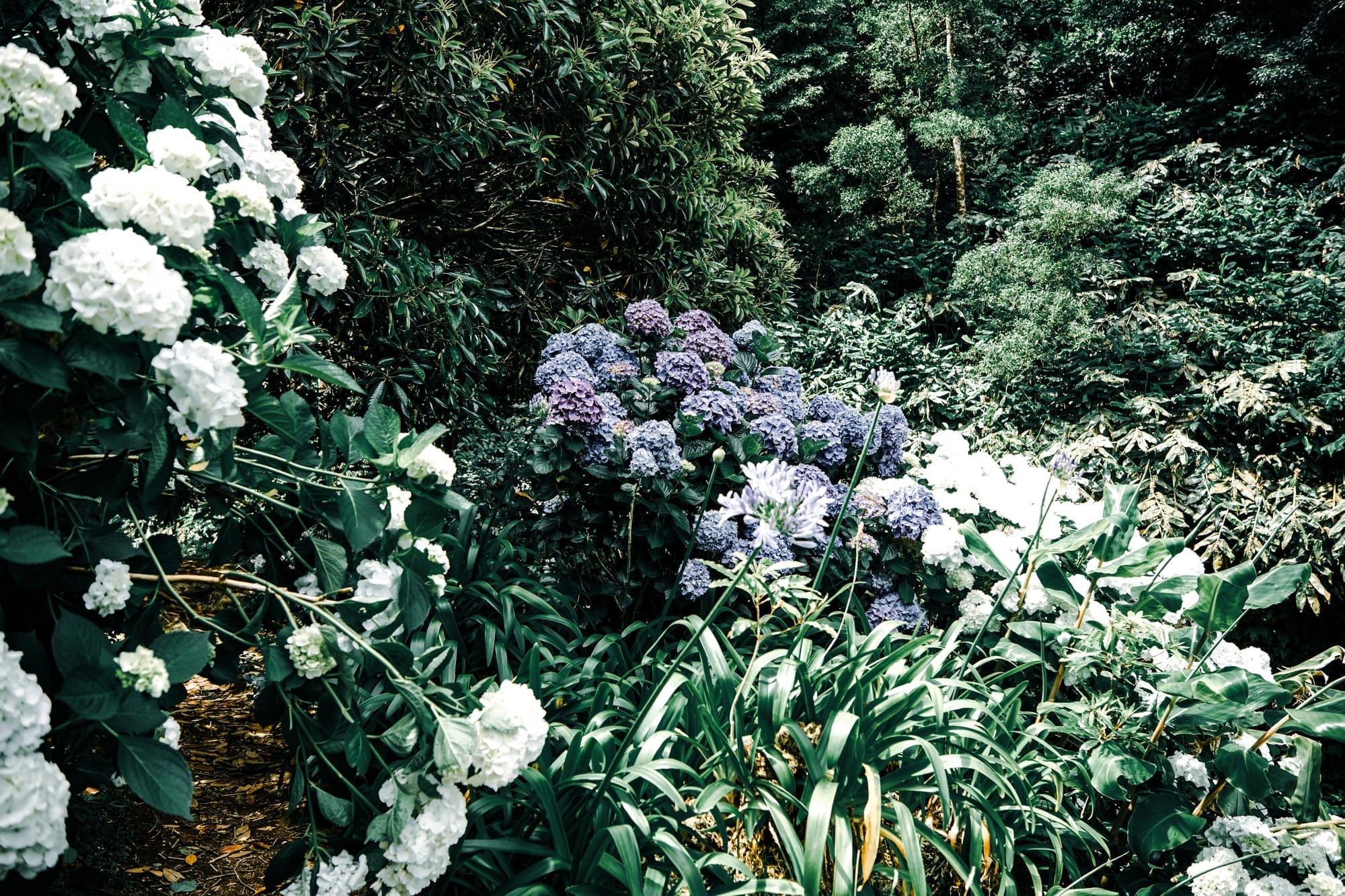
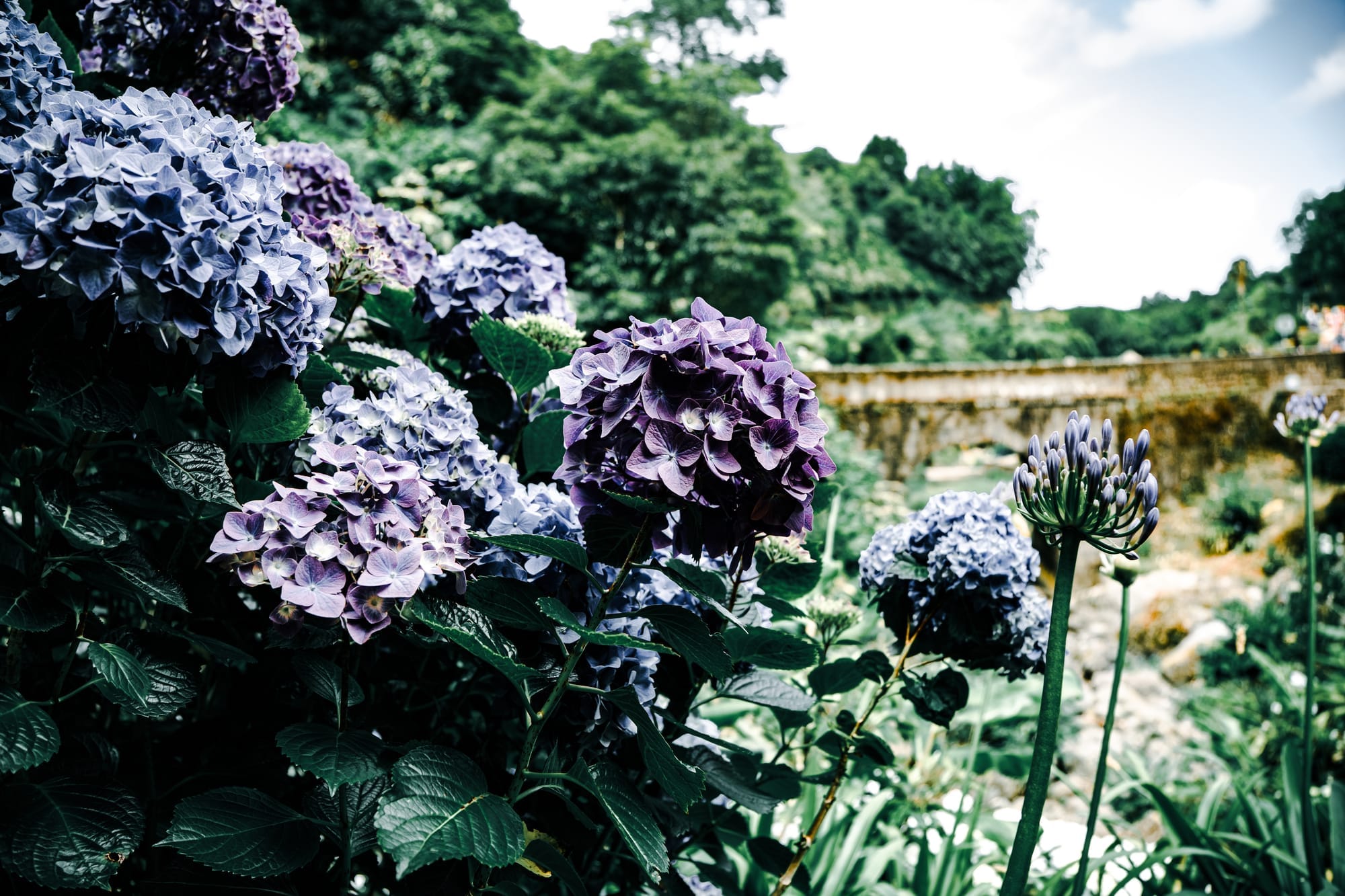
Dense clusters of blue, violet, and white hydrangeas spill over stone and slope, shifting hue in the Azorean light
The flowers take over the park’s edges. They cluster against the wooden guardrails and grow like shrubs along the stairs. Their color is a bit wild, even as they soften the landscape. You’ll keep stopping for photos.
But they’re just the start. The deeper you go, the more varied the plants get. Orange cannas and red hibiscus stand out on the slopes, while broad-leafed lilies and bird-of-paradise palms stretch upward.
Even in shaded corners, flowers keep blooming.
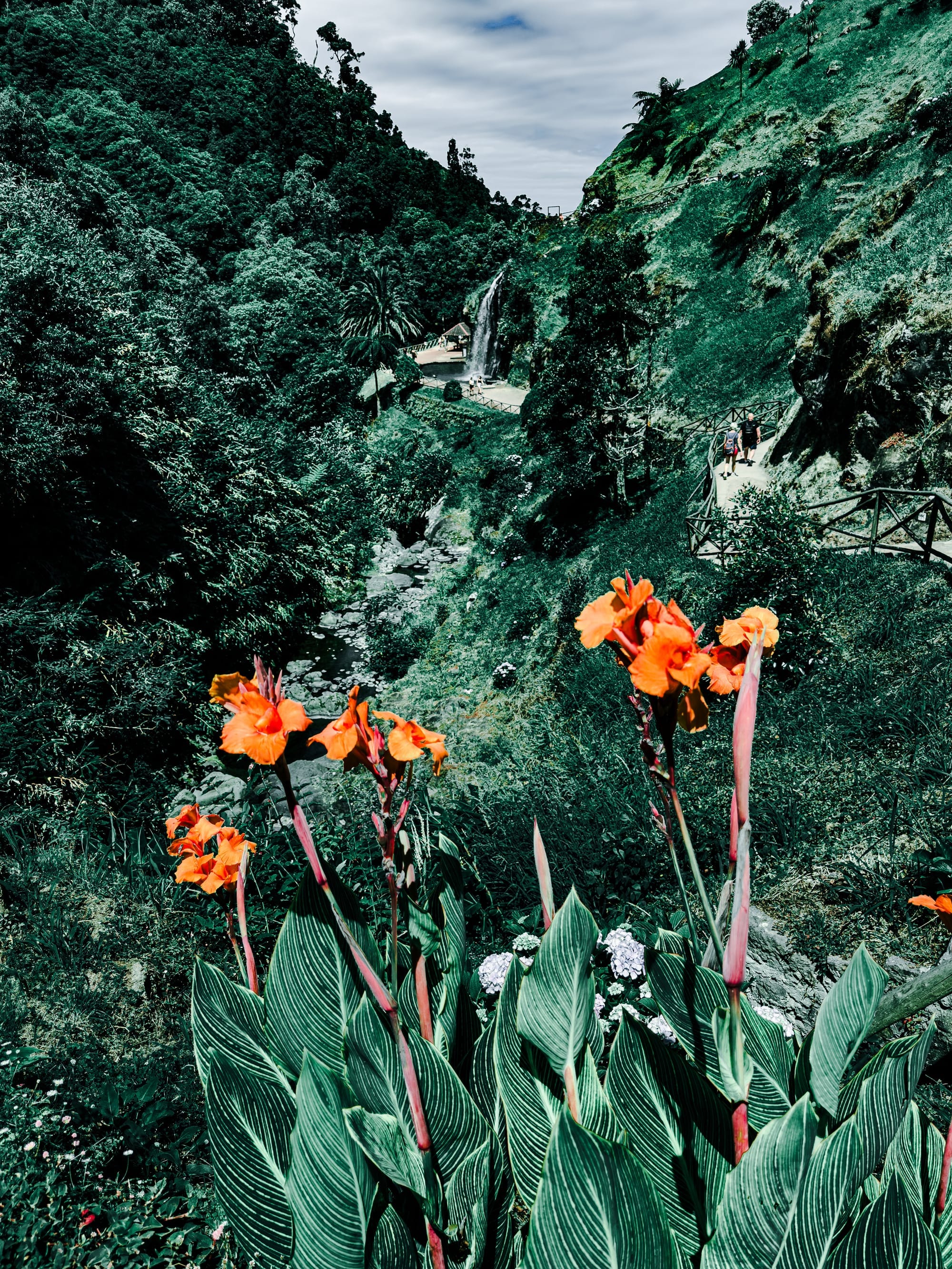
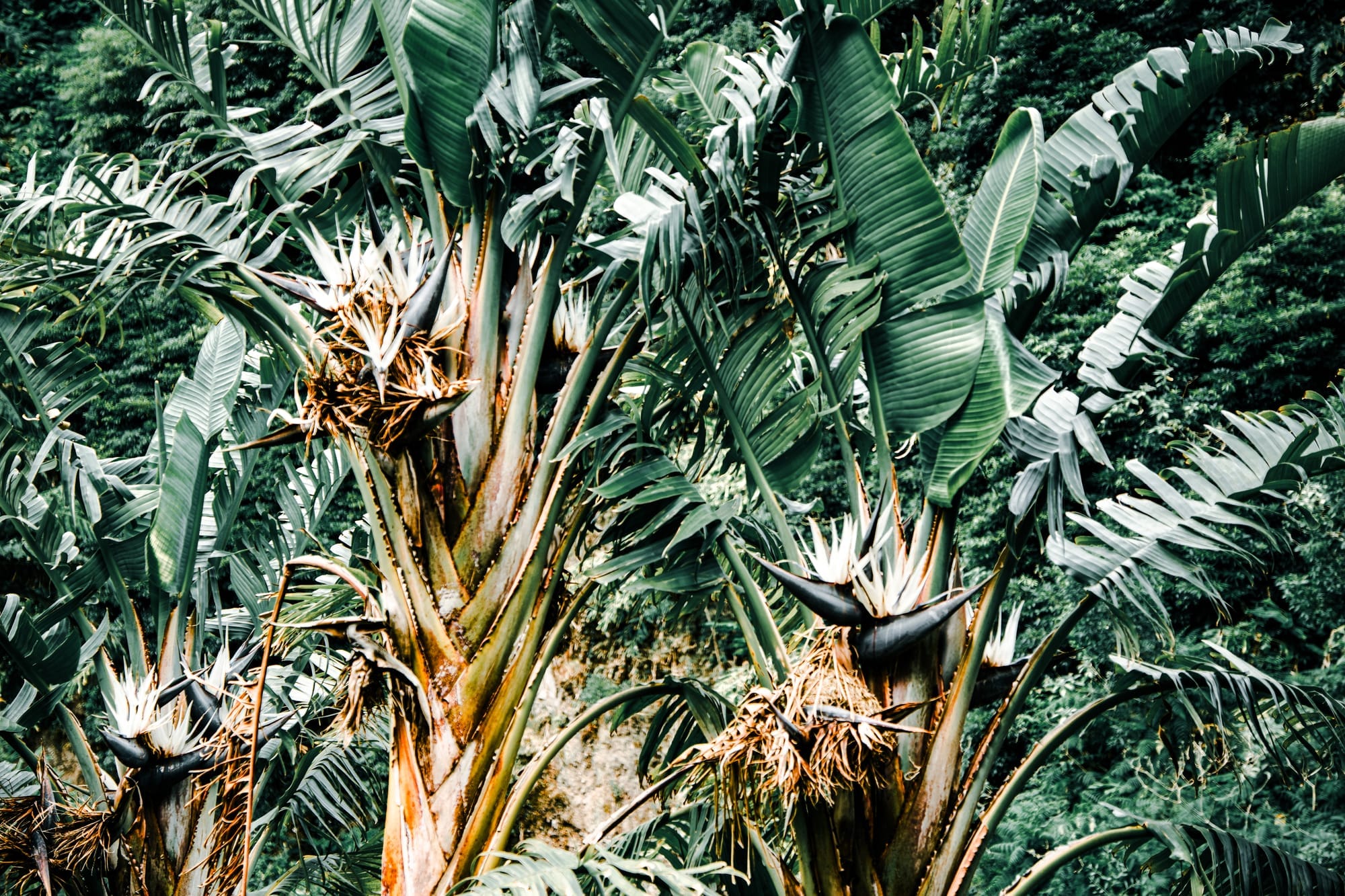
Cannas flare and bird-of-paradise shoots rise between switchbacks
By the time you reach the middle trail, it’s like walking through a botanical garden.
The canyoning option
For the brave: canyoning. This isn’t a touristy paddle. In a wetsuit, helmet, and harness, you’ll go down a series of waterfalls, often by jumping straight into emerald plunge pools. One moment you’re standing at the top, heart pounding; the next, you’re in the air, tucked and dropping into cold, clear water.
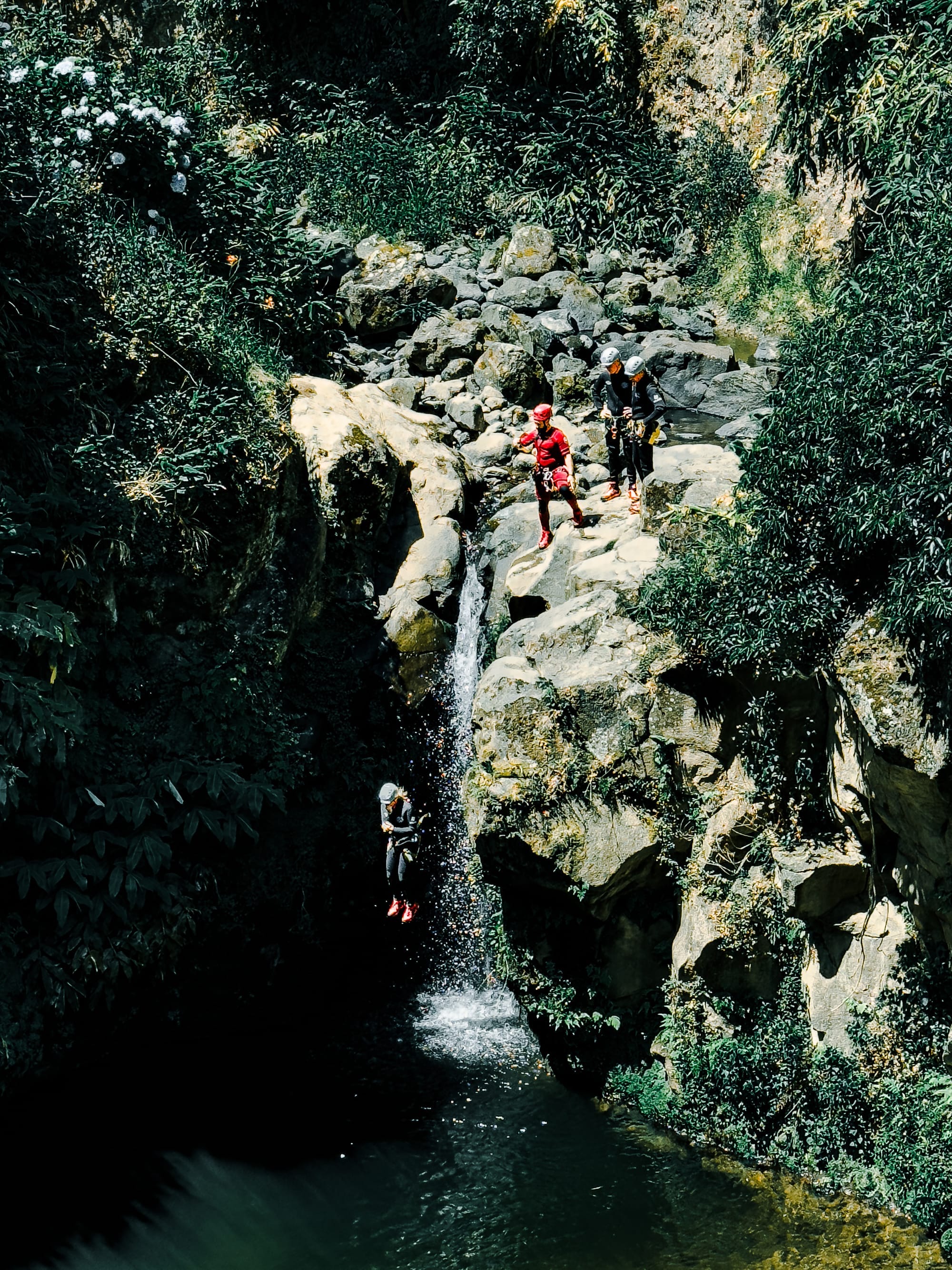
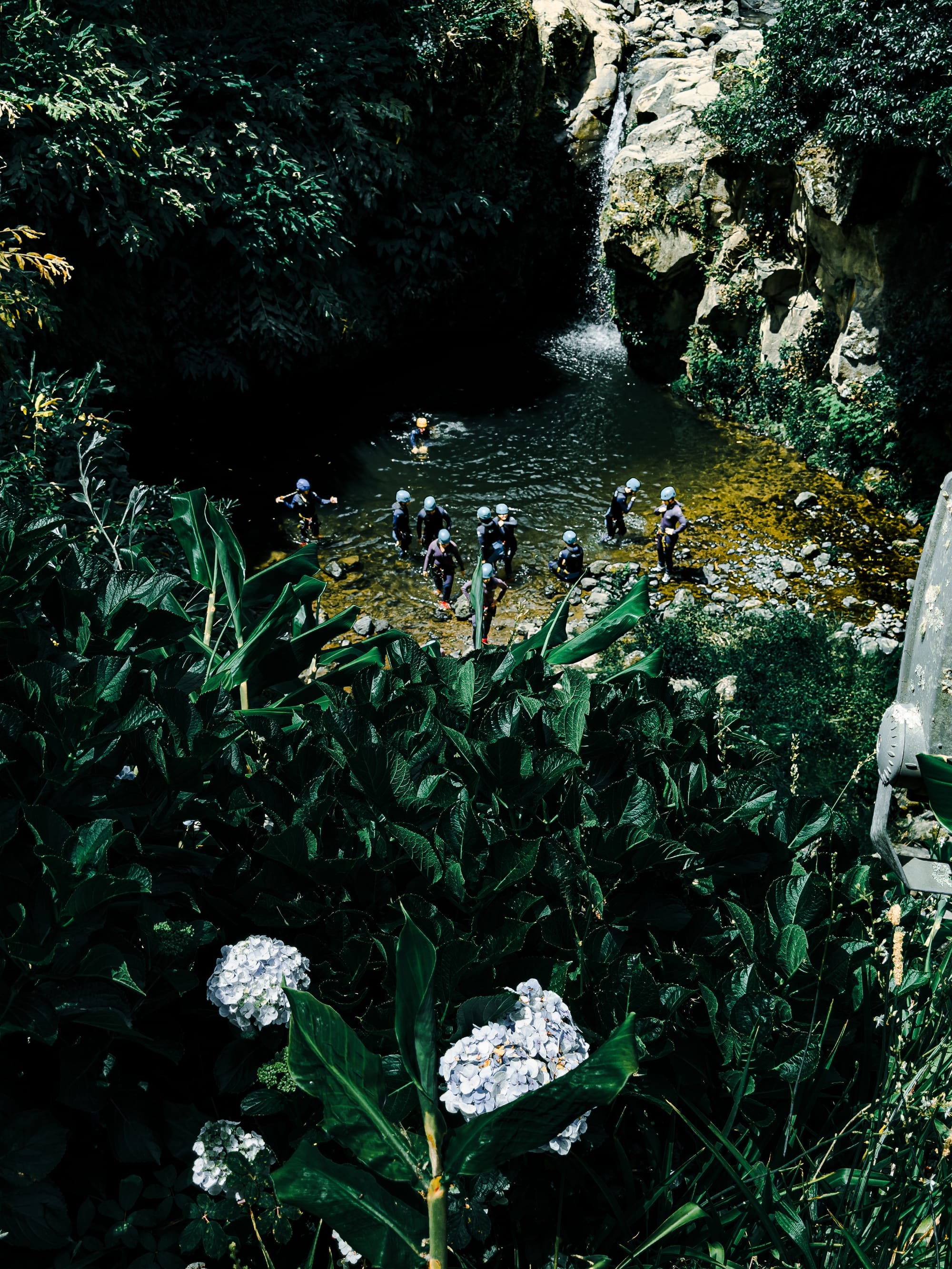
A leap into cold water: canyoning through Ribeira dos Caldeirões drops you into pools carved by time and volcanic flow
We watched a group drop one by one into the canyon. You could hear the impact echo off the rocks before the splash reached the air. Then it went silent for a moment, until the next jump.
Once they disappear downstream, the pool goes still again. Watching from the edge, it's easy to see why people sign up: it looks like a proper thrill.
A typical trip mixes jumps into pools, abseils down the falls, natural rock slides, and some scrambling through the gorge, with all the gear and a licensed guide included. It's physical and the water is cold all year, so it isn't suited to anyone with a heart condition or who isn't comfortable in water.
Want to try it? Book a professionally guided canyoning tour here. No experience needed, just a bit of nerve.
The easy walking trail
If you want a calm walk, the park has that too. Follow a looping trail through terraced gardens, stone bridges, and rippling streams. You hear water the whole way. Ferns unroll in the shade, while levadas carry spring water along moss-lined walls.
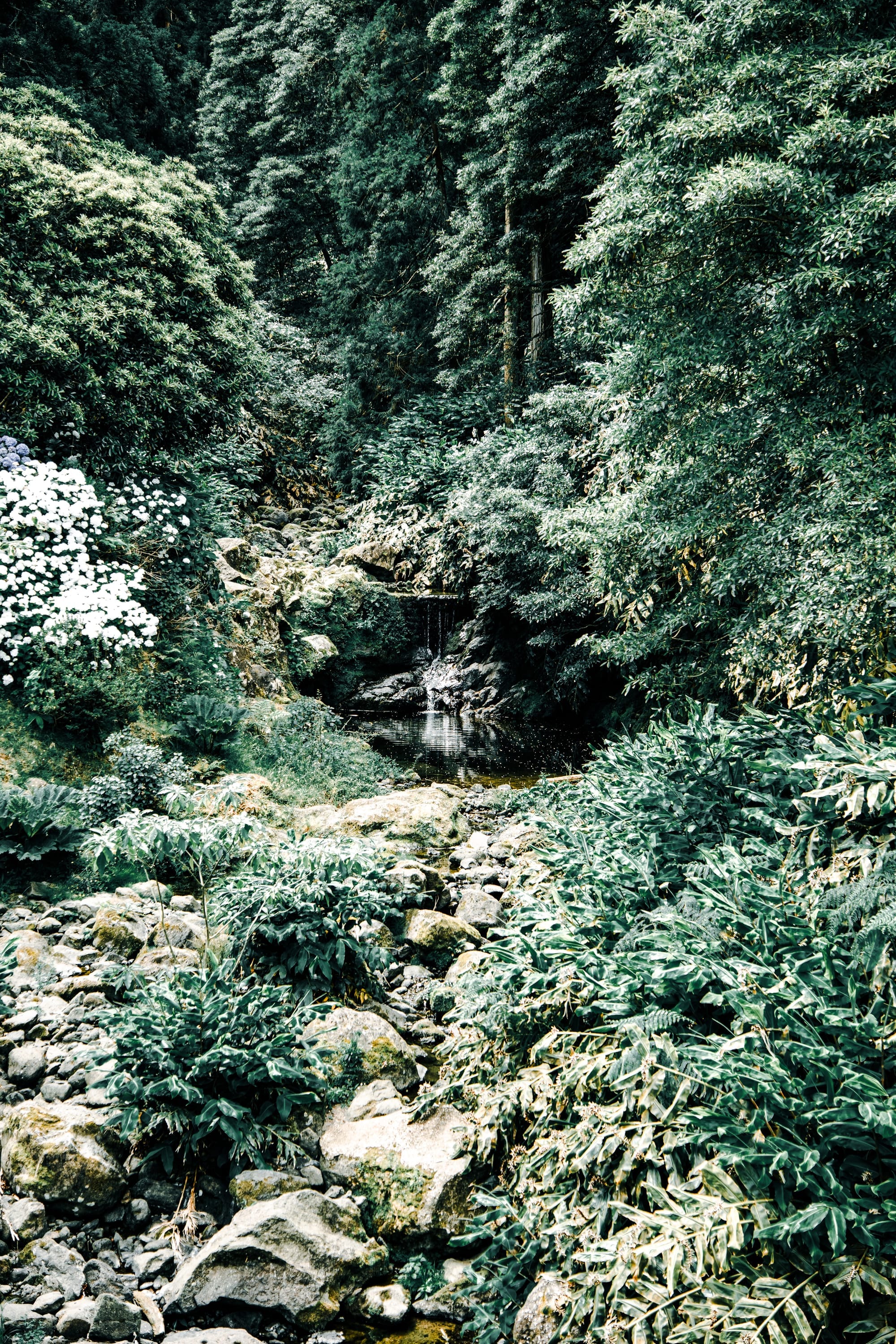
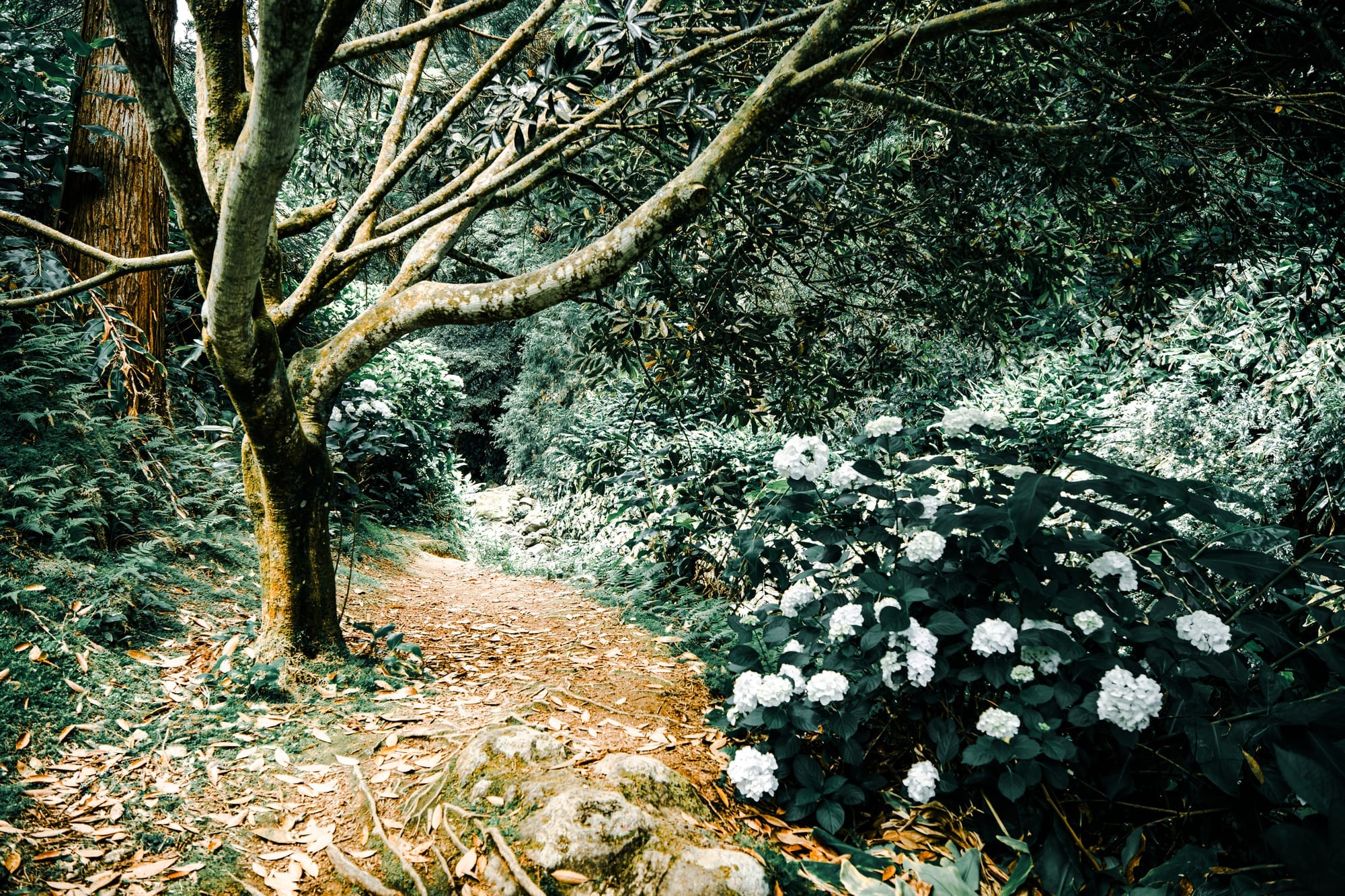
Paths cut across flower banks and under leafy canopies, shifting light with every step
Even the railings and steps look hand-built: rough-cut wood, basalt, and aged mortar.
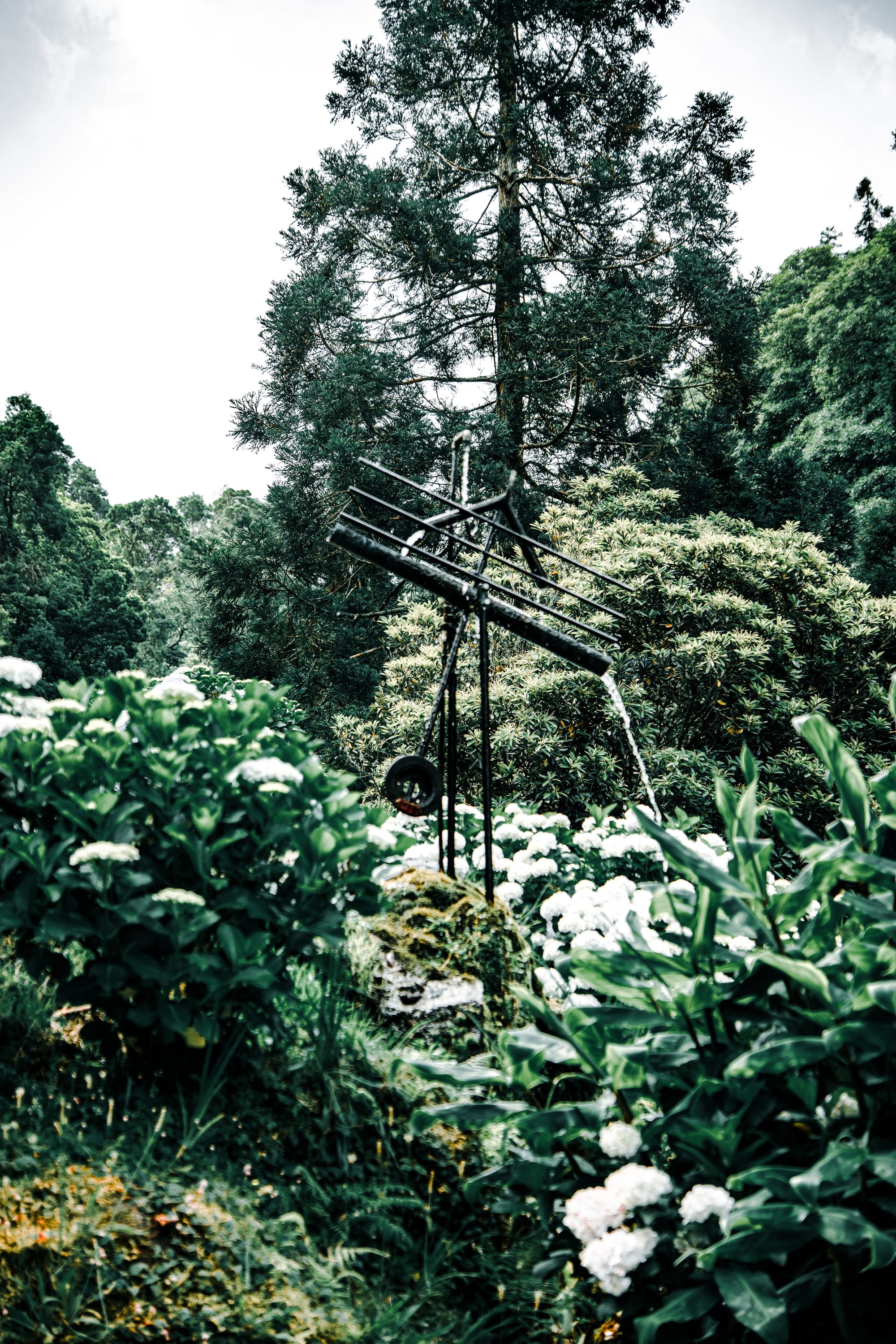
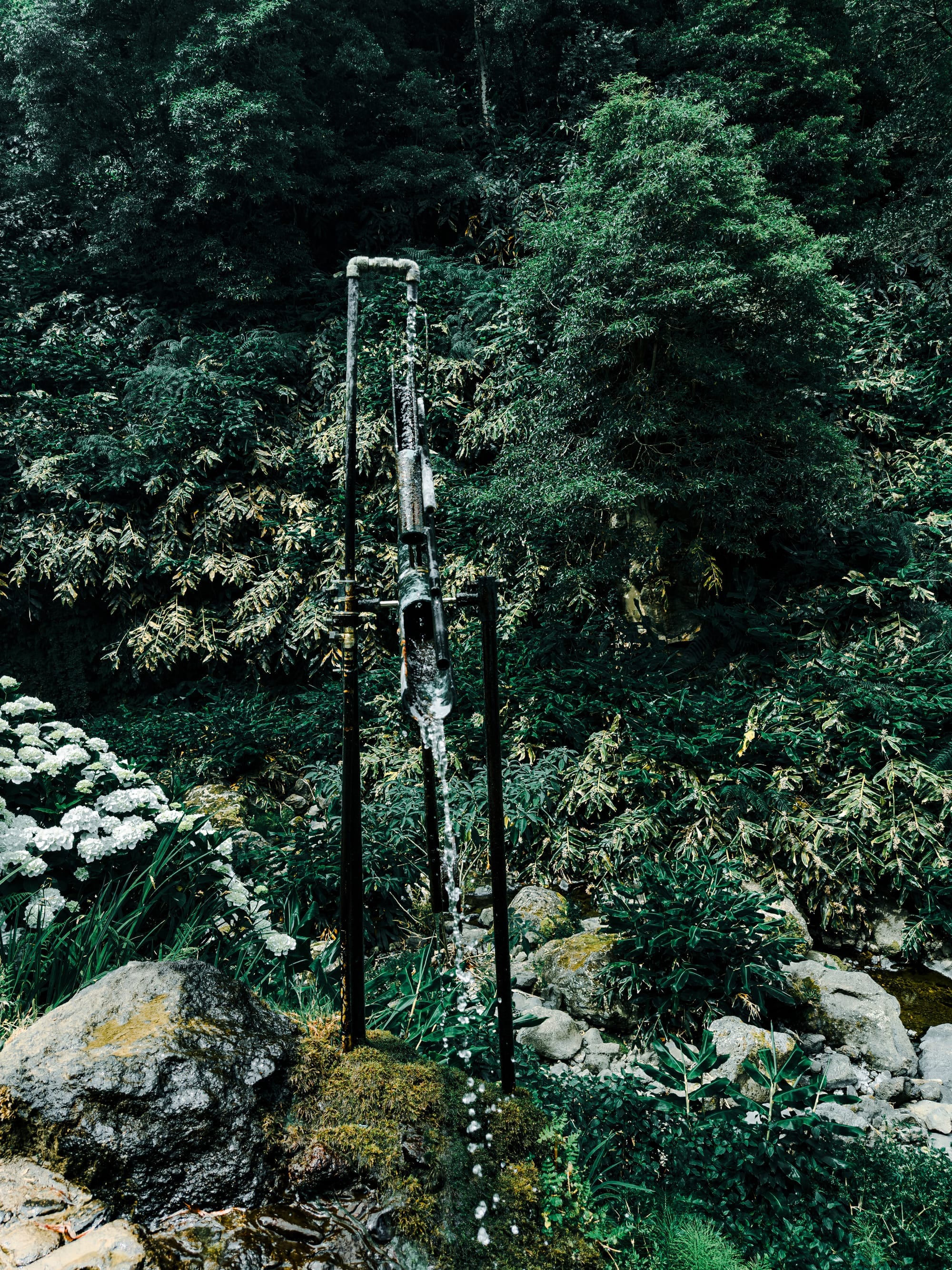
A patterned sculpture tucked among ferns and stone
Farther in, the path narrows and gets softer underfoot, lined with moss and very peaceful.
Prefer to go with a guide? One popular option is canyoning at Ribeira dos Caldeirões. You can check dates and prices here:
Waterfalls and water mills
The waterfalls here vary in size and style. Some are tall and dramatic, framed by volcanic stone.
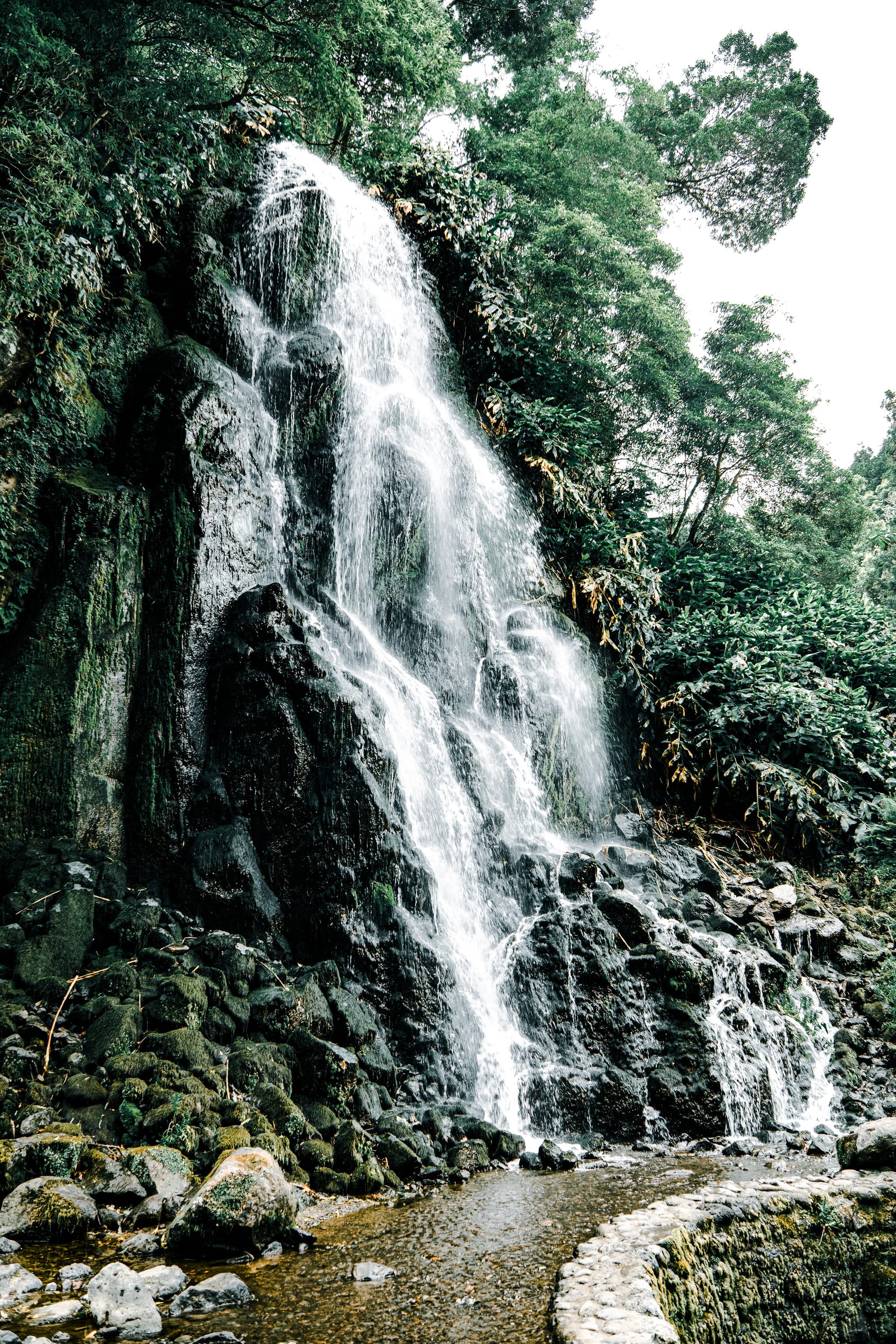
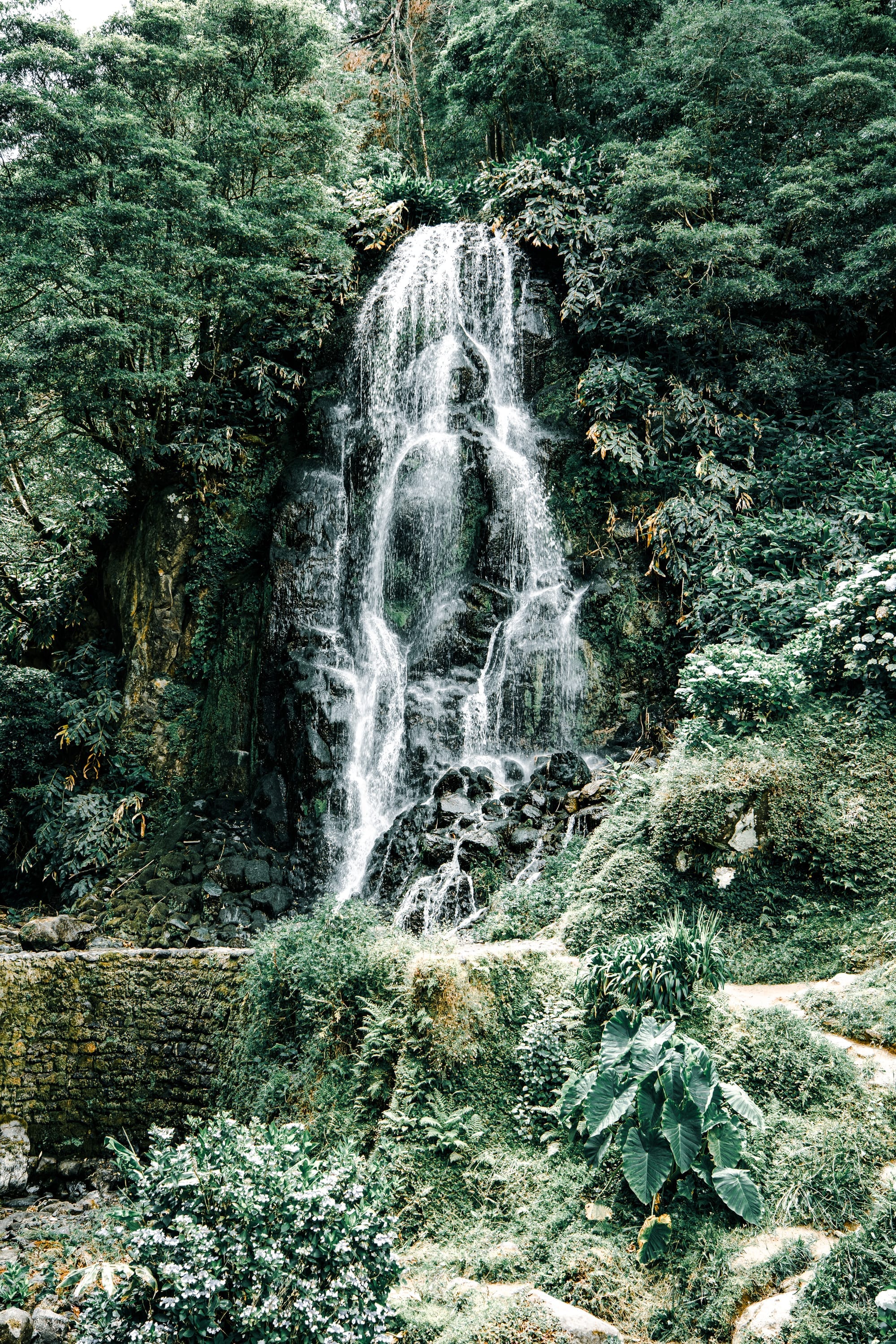
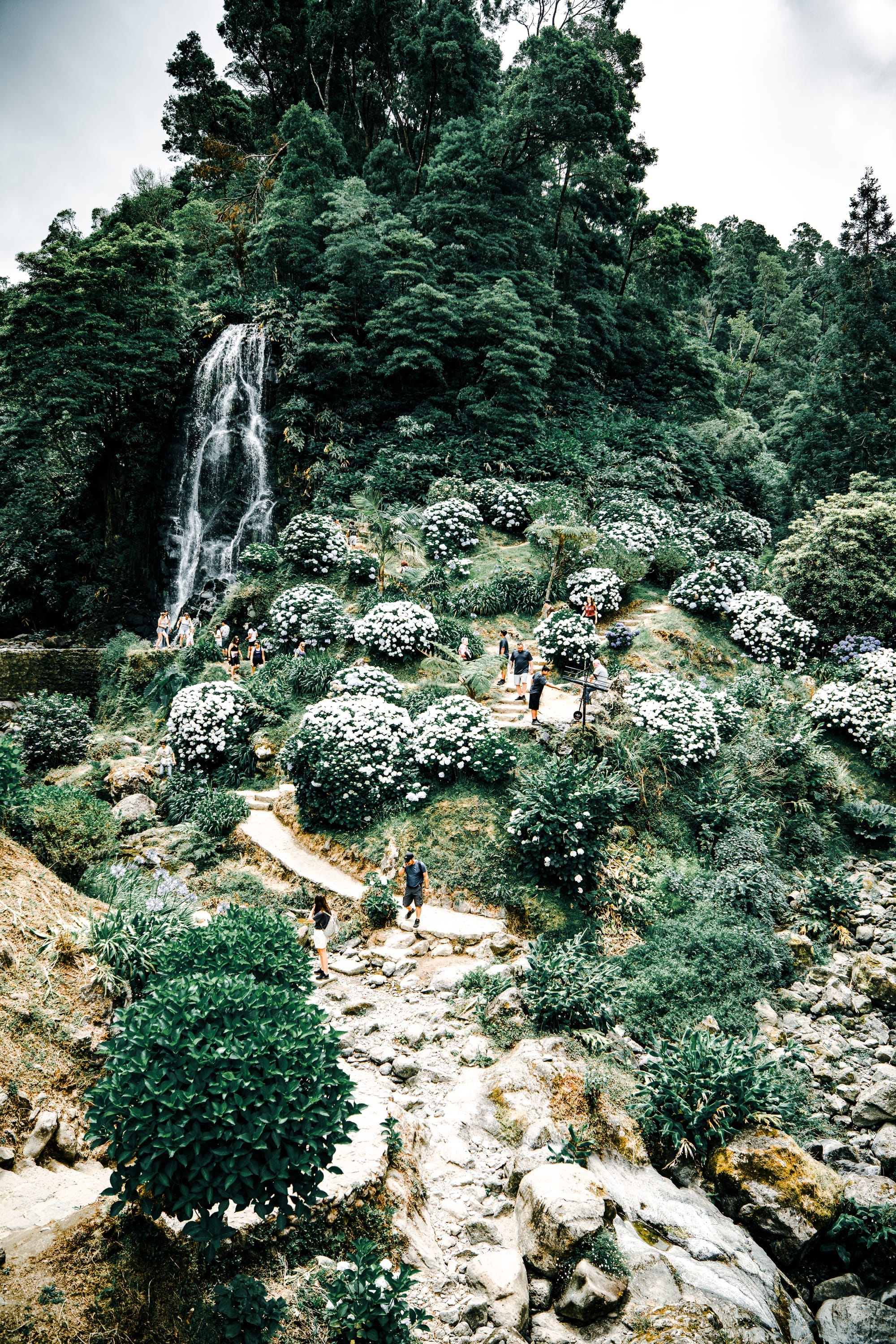
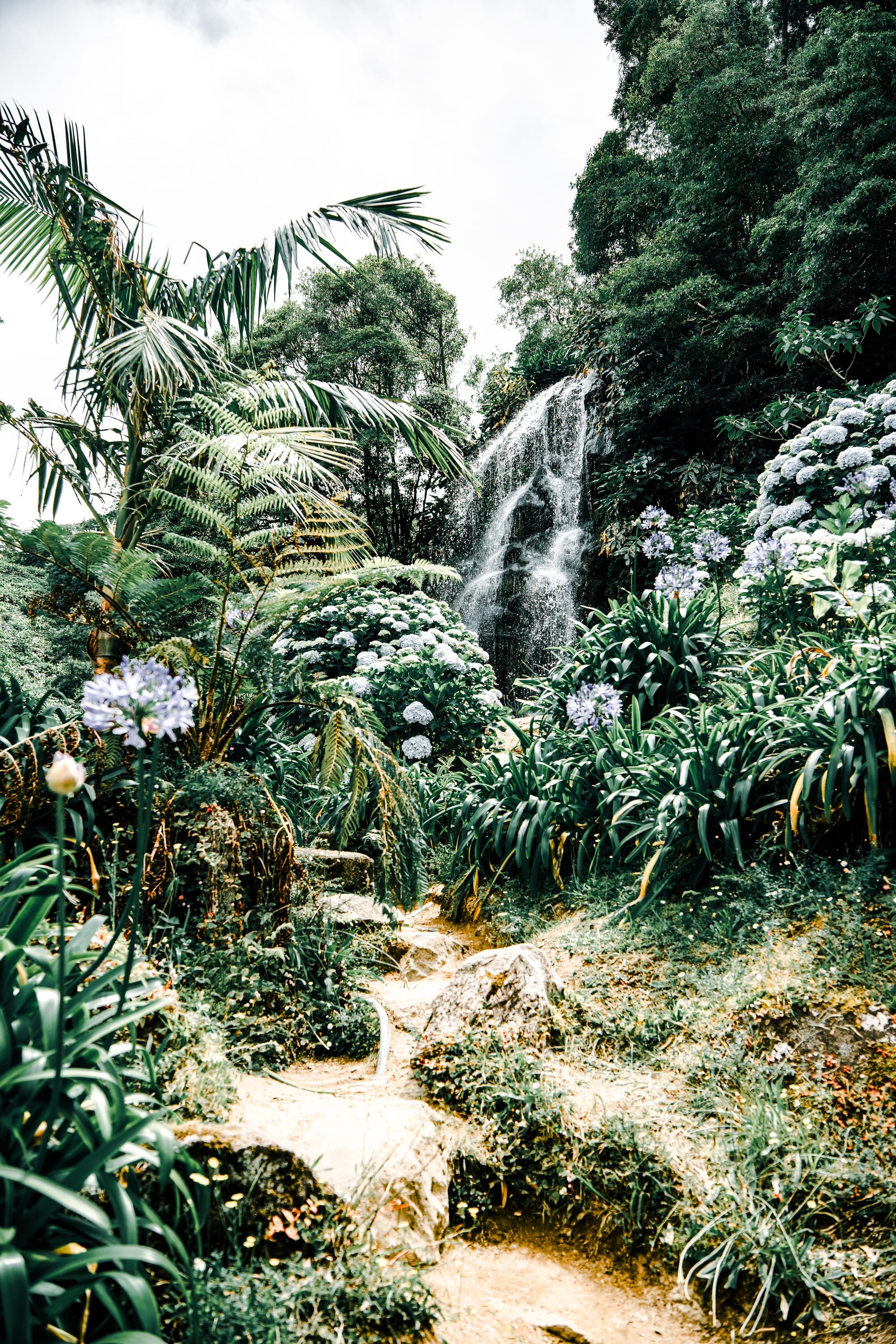
The main cascade is the showpiece: fierce, photogenic, and full of mist
Others are smaller, tucked into crevices where water drips more than it falls.
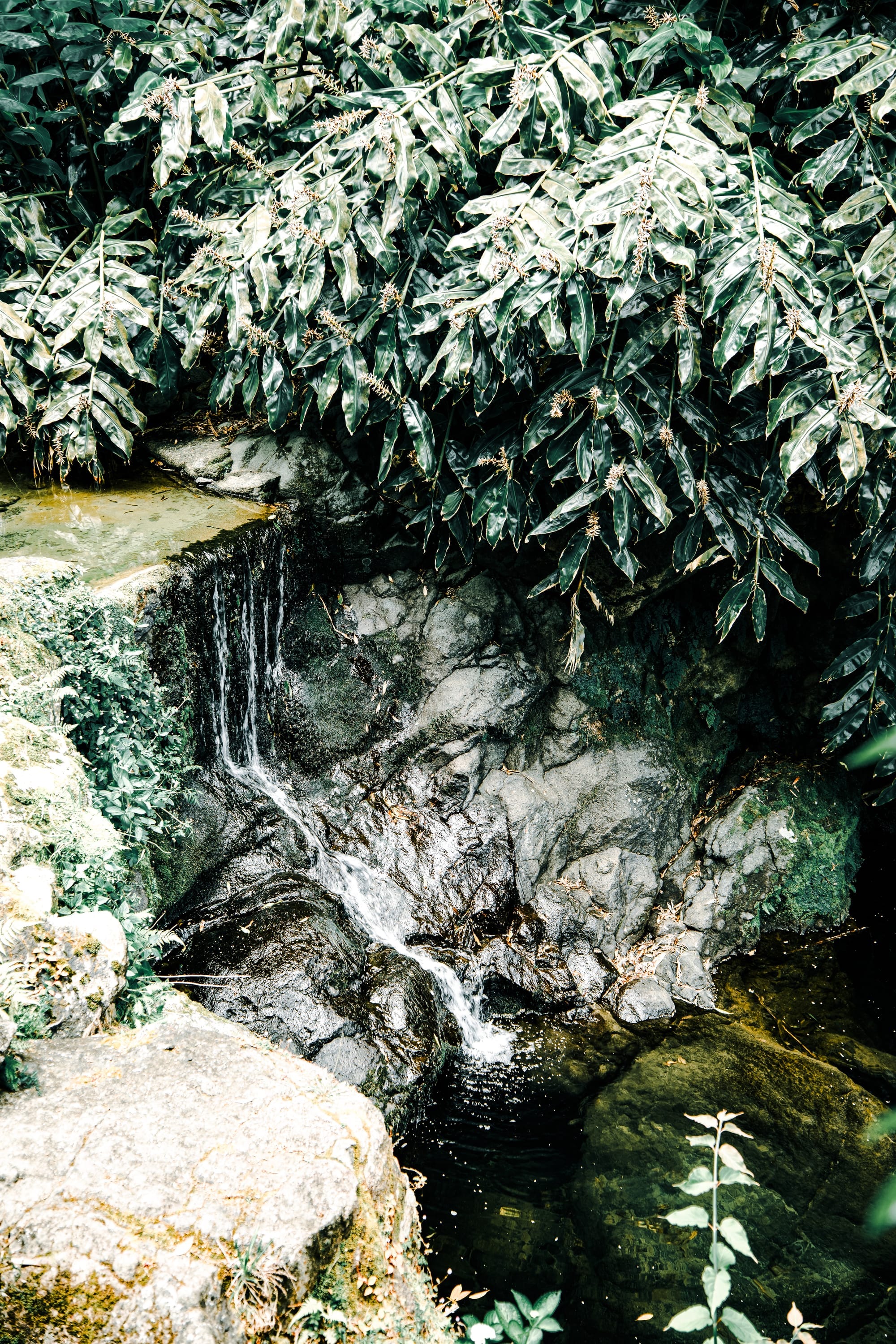
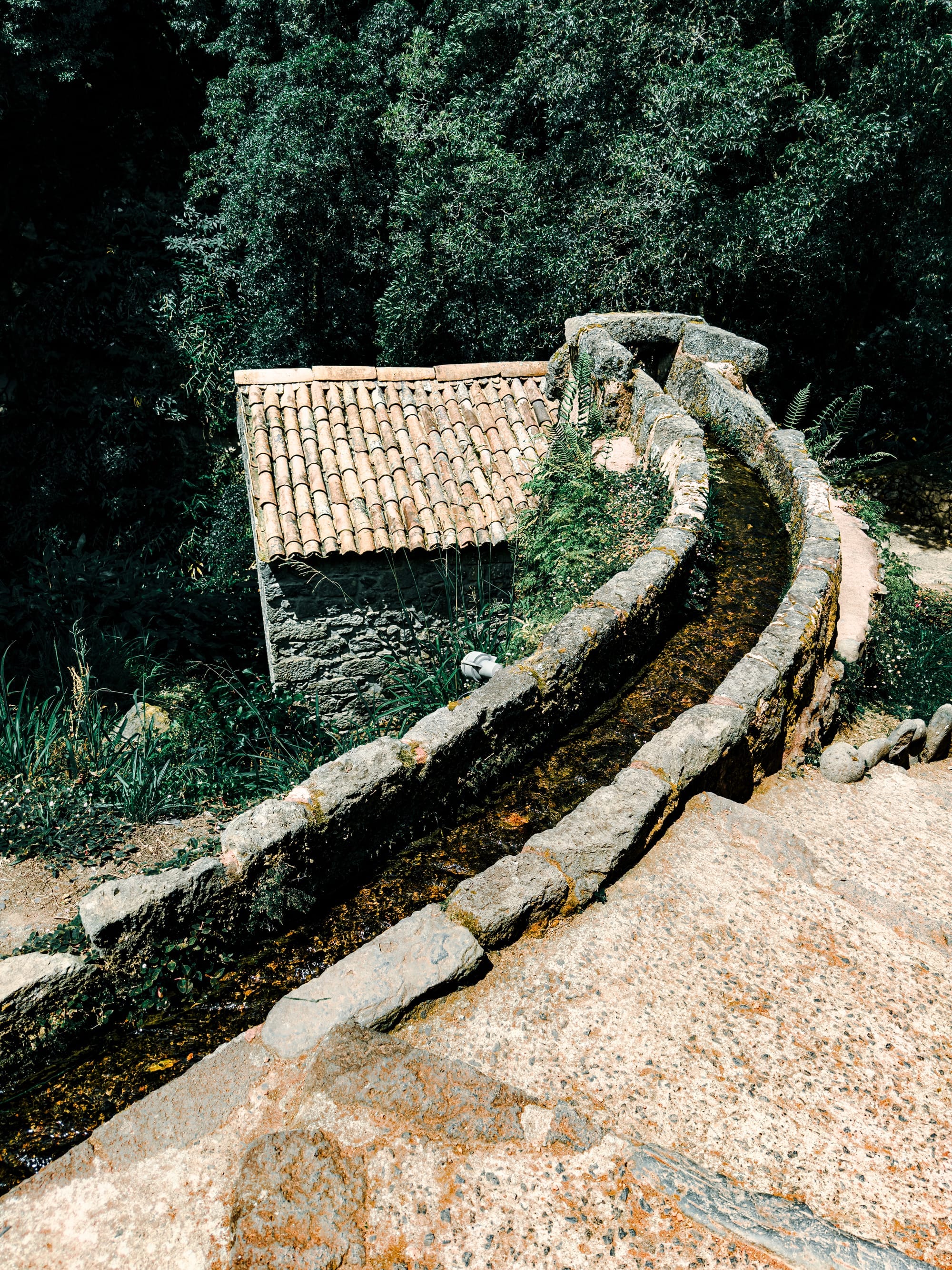
Behind a stone stairway is one of Ribeira’s last working water mills. Step inside and you’re surrounded by basalt, wood, and water that’s still churning.
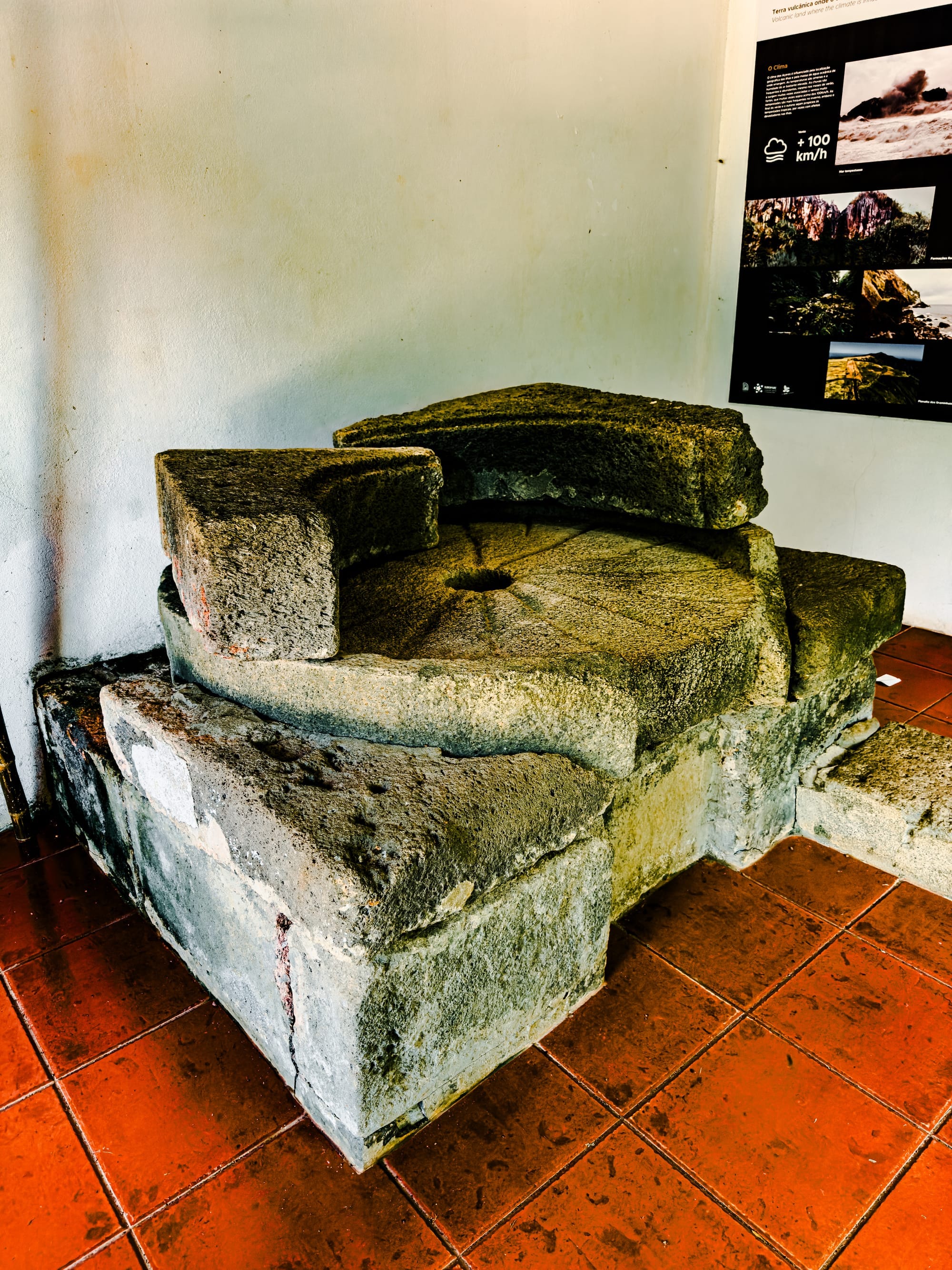
Inside the historic mill: heavy millstones and hand-carved beams
You can walk through it and hear the trickle powering the millstone below your feet.
Most of the old mills no longer grind, but the water still runs, and one of them is still kept working.
If you have time, walk the whole path down to the stream rather than only the two biggest falls. A full loop with stops at the mills and the museum takes about 1.5 to 2 hours.
Make it a day trip
You don’t need a rugged itinerary to enjoy Ribeira dos Caldeirões. It’s an easy inclusion on a full-day loop through São Miguel’s east.
This guided east São Miguel tour includes Ribeira, volcanic viewpoints, tea plantations, and lunch stops. Ideal if you like to take your time or would rather let someone else drive.
How to get to Ribeira dos Caldeirões from Ponta Delgada
Driving is by far the easiest option. From Ponta Delgada, take the fast road along the north coast towards Nordeste, and the park is signed off the regional road in Achada. Allow roughly an hour and a quarter each way. The car park is right next to the main waterfall, so you don't need to walk far to see the highlight. Public buses to Nordeste exist but are infrequent, which makes a car or a tour much more practical for this corner of the island.
The waterfall trails of the northeast are mapped in Our Guide to São Miguel, together with the Nordeste viewpoints worth stopping at on the drive.
Coming from the west along the north coast, the brown signs for the park start just after you pass the village of Achadinha. The address is Estrada Regional, Achada, 9630-024 Nordeste.
If you're driving, it's easy to combine the park with the viewpoints along the Nordeste coast. See our guide to São Miguel's viewpoints and our full list of things to do on São Miguel for stops nearby.
Best time to visit Ribeira dos Caldeirões
Summer is the most colourful time, when the hydrangeas along the paths are in flower. Spring brings fresh green and fewer people, and the waterfall runs strongest after rain in autumn and winter. Island tours stop here too, so arriving early in the day, or later in the afternoon, usually gives you more space for photos. Bring a light rain jacket whatever the season: this is the wet side of the island.
One thing to know: in a dry late summer, the waterfalls can be much thinner than in the photos you've seen. If the falls are your priority, winter and spring give you the most water. Before you drive out, the live webcams on SpotAzores are a handy way to check whether the northeast is under cloud.
Tips for visiting Ribeira dos Caldeirões
A few simple things make the visit easier.
Wear shoes with grip. Stone steps and paths near the water are often wet and mossy.
Don't swim on your own in the canyon. Jumping and abseiling are done with licensed canyoning guides and proper gear.
Bring a picnic if you like. There are tables and barbecues, but leave no litter behind.
Visit the working mill and the craft shop, which help keep the place running.
Pair it with the east coast, including Furnas and the Gorreana tea plantation, on the drive back.
Other stops near Ribeira dos Caldeirões
The park is a good anchor for a day in the Nordeste area. These are all within a short drive.
| Stop | Why go |
|---|---|
| Nordeste village | Small town known for its flower-lined streets, best in spring and summer |
| Ponte dos Sete Arcos | Seven-arch stone bridge into Nordeste, built in 1882 and 1883 |
| Farol do Arnel | Late 19th-century lighthouse at Ponta do Arnel, still in use |
| Praia do Lombo Gordo | Dark sand beach below the cliffs, best in the morning before the sun drops behind the hills |
| Ponta da Madrugada and Ponta do Sossego | Two garden viewpoints on the east coast, good at sunrise |
| Pico da Vara | The island's highest peak, inside a natural reserve; best done with a guide on a clear day |
Is Ribeira dos Caldeirões worth visiting?
Even if you don’t jump into a waterfall, this place is worth the visit. What stays with you is the sound: the constant falling water, leaves brushing against each other, and the stream carving its way through the stone.
Nearby, see the Moinhos da Ribeira Funda hike and the Moinho do Félix waterfall trail.
Whatever your plans, travel with insurance. Stomach bugs, a fall on a cobbled street, or a stolen phone can happen anywhere, and it's much easier to enjoy the trip when you know you're covered. We'd recommend SafetyWing Nomad Insurance. It covers medical emergencies abroad, you can buy it even after you've left home, and it renews every four weeks, so it works for a short trip or months on the road.
Where to stay near Ribeira dos Caldeirões
The nearest good base for Ribeira dos Caldeirões is Nordeste. These are well-reviewed places to stay there, all rated 9 or more on Booking:
- Tradicampo Eco Country Houses: stone country houses in the green northeast, rated 9.5.
- Casa das Courelas: a good-value rural house in Nordeste, rated 9.2.
Frequently asked questions
Is there an entrance fee for Ribeira dos Caldeirões?
No. Entry to the Ribeira dos Caldeirões natural park is free, and so is parking. You only pay for the café, the shop, or a canyoning tour.
What are the opening hours of Ribeira dos Caldeirões?
The park is open access, with no fixed hours. The café, shop, and mill museum have their own hours, which can change by season, so check locally.
How long do you need at Ribeira dos Caldeirões?
About an hour is enough to see the main waterfall, walk the paths, and look inside the mills. Canyoning takes half a day.
Can you swim at Ribeira dos Caldeirões?
The park isn't set up as a swimming spot. People get into the water during guided canyoning trips, with wetsuits, helmets, and guides.
How far is Ribeira dos Caldeirões from Ponta Delgada?
It's in Achada, in the Nordeste municipality, roughly an hour and a quarter by car from Ponta Delgada.
Is Ribeira dos Caldeirões worth visiting?
Yes, especially if you're exploring the east of São Miguel. The main waterfall is right by the car park, the mills add some real history, and it's free.
What is the waterfall at Ribeira dos Caldeirões called?
The main fall across the road from the car park is often called Véu da Noiva, or Bridal Veil. There are several smaller falls along the stream inside the park.
Can you see the priolo at Ribeira dos Caldeirões?
It's possible but rare. The park is inside the protected area for the Azores bullfinch, which mostly lives in the higher laurel forest around Pico da Vara.
Is there food at Ribeira dos Caldeirões?
Yes, there's a café and a snack bar, plus picnic tables and barbecues. Snacks offered in the mills are paid.
Can you stay overnight at Ribeira dos Caldeirões?
Some of the old millers' houses are now rural accommodation inside the park, and there are more country houses around Nordeste.
Useful links: Visit Azores: Ribeira dos Caldeirões Park, Azores Tourism Portal: Parque Natural da Ribeira dos Caldeirões, byAçores: Natural Park of Ribeira dos Caldeirões, and Nordeste on Wikipedia.


