


San Cristóbal de las Casas has dozens of churches, and you can see the best ones in a morning on foot. Start with the yellow cathedral on the main plaza and Templo de Santo Domingo, whose carved Baroque facade is the most ornate in the city. Then climb to the hilltop churches of Guadalupe and San Cristóbal (El Cerrito) for the views, and fit in La Merced, El Carmen's arch, and San Francisco on the way. Entry is free, most churches open from morning until early evening, and covered shoulders are a good idea. Below are the ones we found most worth visiting.
Mexican church architecture is often highly ornate and visually distinct, and San Cristóbal de las Casas offers a concentrated view of how that ornamentation shifts across time and place. Elaborate Baroque façades sit alongside later neo-Gothic structures, and heavily decorated exteriors contrast with churches whose impact comes less from detail than from position and visibility. Color, carved detail, symmetry, and surface decoration play a strong role, but so does setting: a church fronting a market feels very different from one reached by climbing a long staircase.
For anyone staying in San Cris for more than a day or two, we highly recommend spending a morning walking through town and visiting a handful of its churches. Below are the ones we found most notable, each offering a different perspective on the city’s layout, history, and how locals use these spaces today.
Churches in San Cristóbal de las Casas at a glance
INAH counts 19 religious buildings inside the city's historic zone alone, which was declared a Zone of Historic Monuments in 1986 (INAH). These are the ones most worth your time, with dates from INAH and Wikipedia:
Catedral de San Cristóbal Mártir: begun 1528, Baroque facade finished 1721. Yellow, on the main plaza.
Templo de Santo Domingo de Guzmán: begun 1547, carved stucco Baroque facade from the 17th century. The most ornate church in town.
Templo de la Caridad: built 1712, right next to Santo Domingo.
Templo de Guadalupe: 1834, on Cerro de Guadalupe, 79 steps up. Best for views over the city.
Templo de San Cristóbal (El Cerrito): 19th century, on Cerro de San Cristóbal, up a long zigzag staircase with murals.
Templo de la Merced: the city's first monastery, founded 1537. The ex-convent is now the Amber Museum.
Templo y Arco del Carmen: convent founded 1597, Mudéjar arch and tower from 1680.
Templo de San Francisco: Franciscan monastery founded 1577; the church you see is mostly 18th century.
Templo de Nuestra Señora de la Asunción: 1904, our personal favorite.
San Cristóbal churches compared
Here are the seven churches most visitors ask about, side by side. Dates come from INAH and Wikipedia in Spanish. None of them post official visiting hours, so the hours below are a rough guide (2026, check locally).
| Church | Founded | Style | Hours (approx.) | Highlight |
|---|---|---|---|---|
| Templo de Santo Domingo | 1547 (facade 17th century) | Baroque, carved stucco | Daily, morning to evening | The facade, the gilded altarpieces, and candlelight inside in the evening |
| Catedral de San Cristóbal Mártir | 1528 (cathedral from 1538, facade 1721) | Baroque with Oaxacan and Guatemalan influence | Daily, may close at midday | Twisted Solomonic columns on the yellow facade and the gilded pulpit |
| Templo de Guadalupe | 1834 | 19th-century hilltop church | Most reliable around Mass times | 79 steps up for a view over the city; huge fiesta on December 12 |
| Templo de San Cristóbal (San Cristóbalito, El Cerrito) | 19th century | Plain hilltop church | Often locked outside Mass | The zigzag staircase with murals and the view; feast on July 25 |
| Templo y Arco del Carmen | Convent 1597, arch and tower 1680 | Mudéjar arch, plain rebuilt church | The arch is on a public street, so any time | One of the few Mudéjar buildings in the Americas |
| Templo de la Merced | Convent 1537 (church rebuilt in the 19th century) | Neoclassical interior | Daytime; museum has its own hours | The Amber Museum in the old convent next door |
| Templo de la Caridad | 1712 | Baroque altarpiece facade with Tuscan columns | Daytime, next to Santo Domingo | Carving tied to Guatemalan sculptors; faces La Alameda park |
If you only have an hour, see Santo Domingo, La Caridad, and the cathedral, which are all a few minutes apart on the same pedestrian street. Add the two hill churches if you want views, and El Carmen and La Merced if you like old convents.
| Church | Built | Highlight |
|---|---|---|
| Catedral de San Cristóbal Mártir | Begun 1528; facade 1721 | Yellow Baroque facade on the main plaza |
| Santo Domingo de Guzmán | Begun 1547; facade 17th century | Carved stucco facade, the most ornate in town |
| Templo de la Caridad | 1712 | Right next to Santo Domingo |
| Templo de Guadalupe | 1834 | 79 steps up, views over the city |
| San Cristóbal (El Cerrito) | 19th century | Zigzag staircase with murals |
| Templo de la Merced | Founded 1537 | First monastery; ex-convent is the Amber Museum |
| Templo y Arco del Carmen | Convent 1597; arch and tower 1680 | Mudéjar arch |
| Templo de San Francisco | Founded 1577; church mostly 18th century | Franciscan monastery |
| Nuestra Señora de la Asunción | 1904 | Our personal favorite |
Iglesia de San Cristóbalito
Iglesia de San Cristóbalito sits at the top of Cerro de San Cristóbal, but the church itself is only part of the experience. What most people remember is the zigzagging staircase that leads up to it, cutting back and forth through a residential hillside neighborhood just southwest of the historic center.
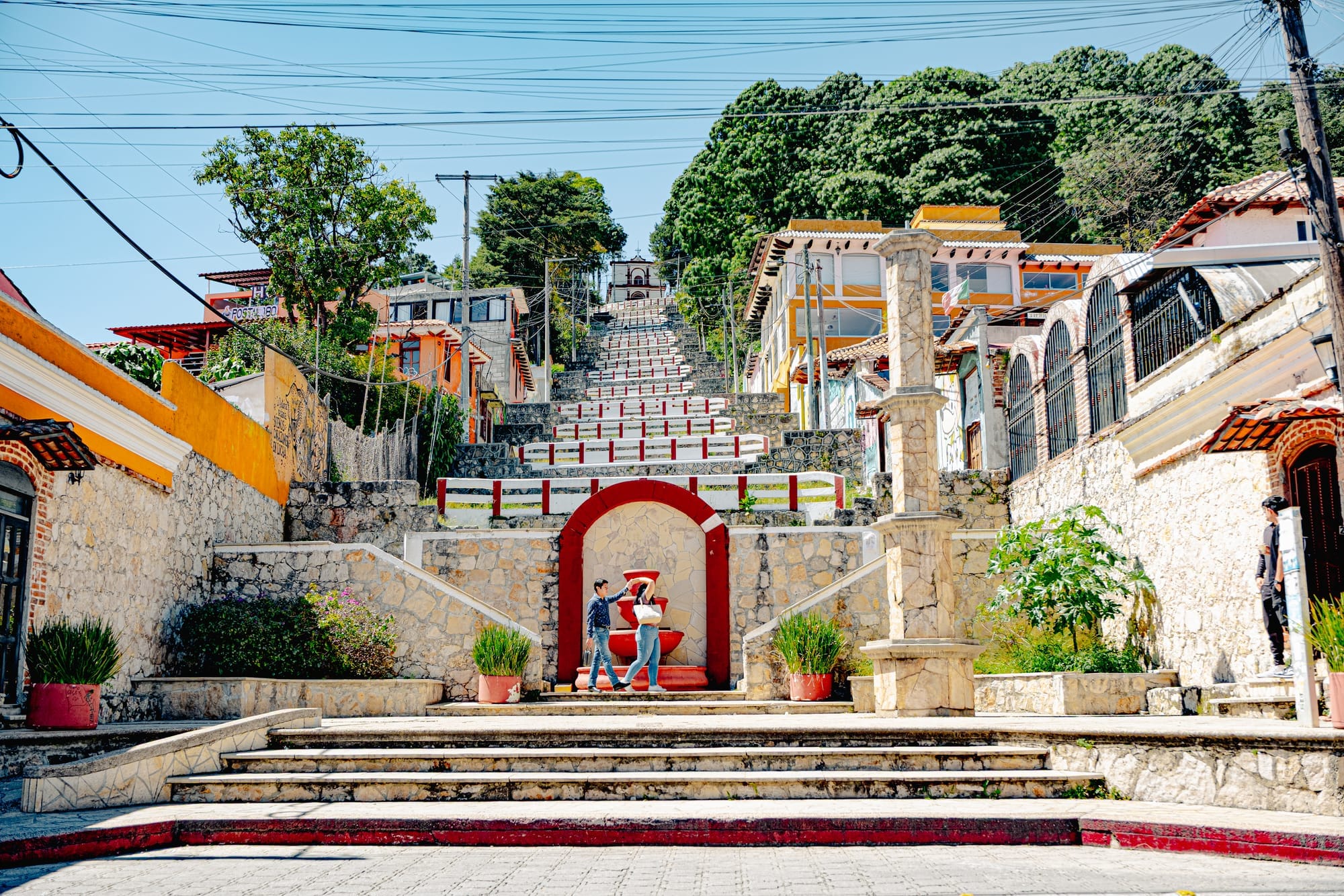
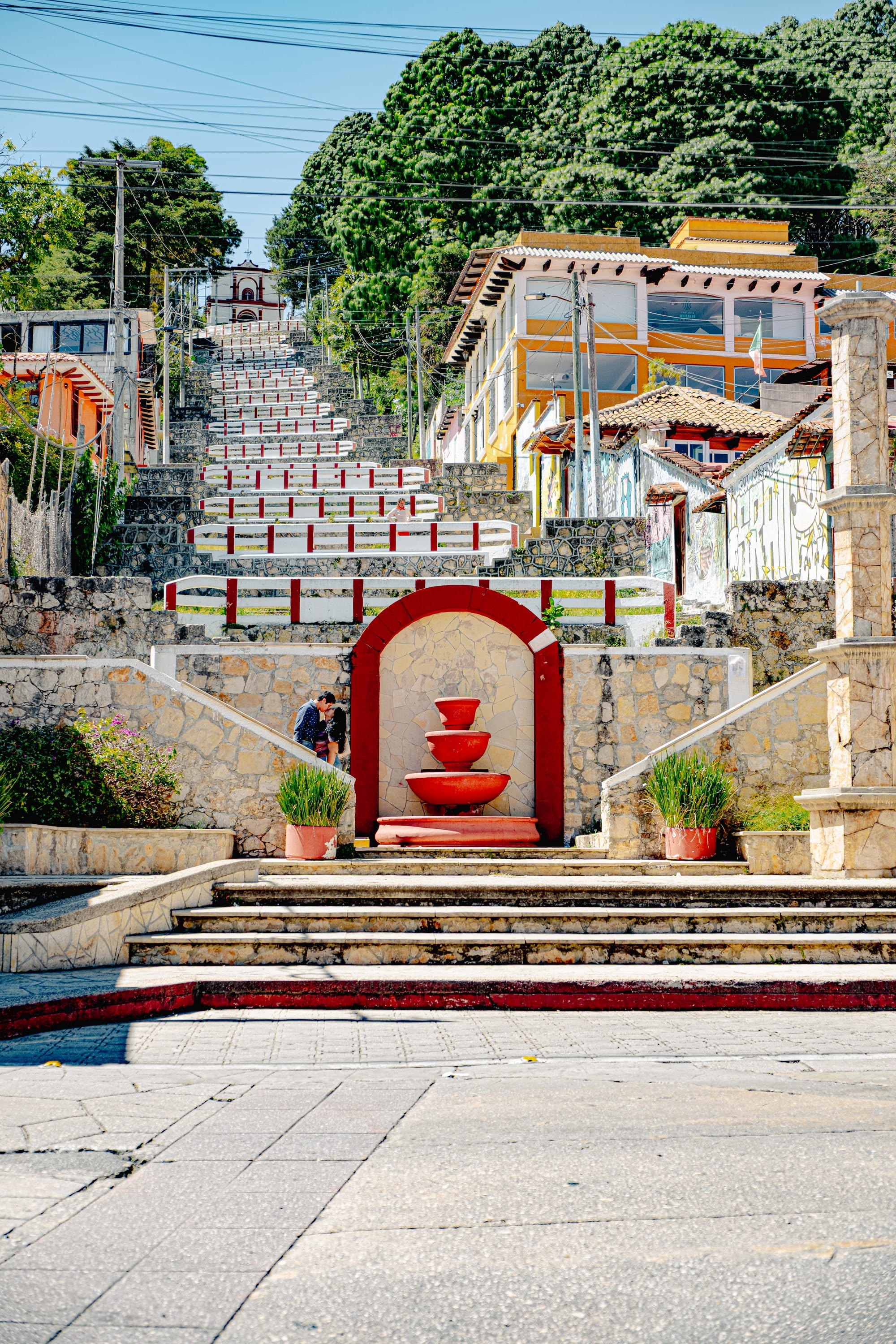
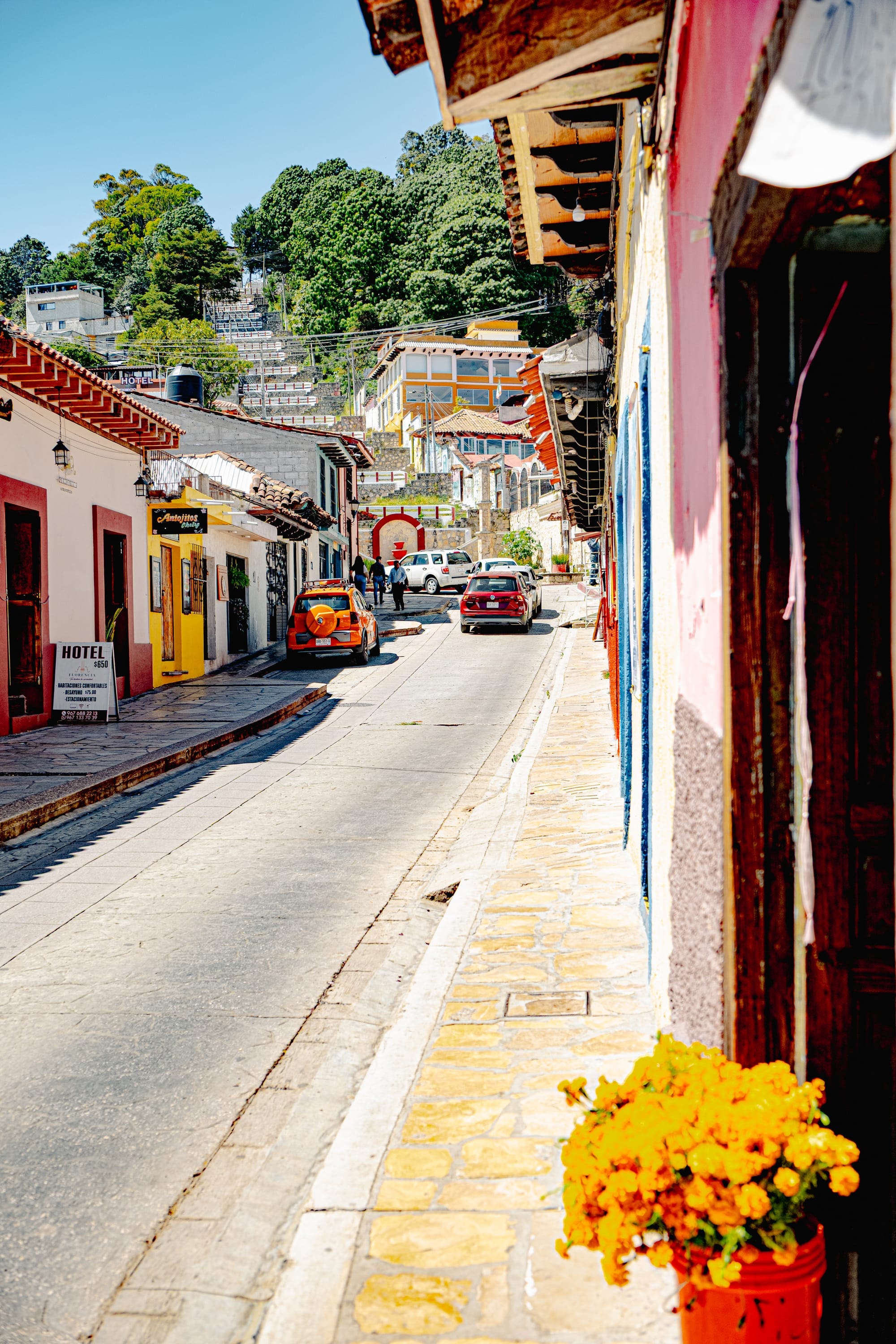
The zigzagging staircase leading up to Iglesia de San Cristóbalito
The climb begins at street level and unfolds gradually rather than in a single straight ascent. The staircase is wide and segmented, with landings that shift direction as it moves uphill. These turns break the climb into manageable sections and make it easy to track your progress. From the lower steps, the church is barely visible; it comes into view only toward the final stretch.
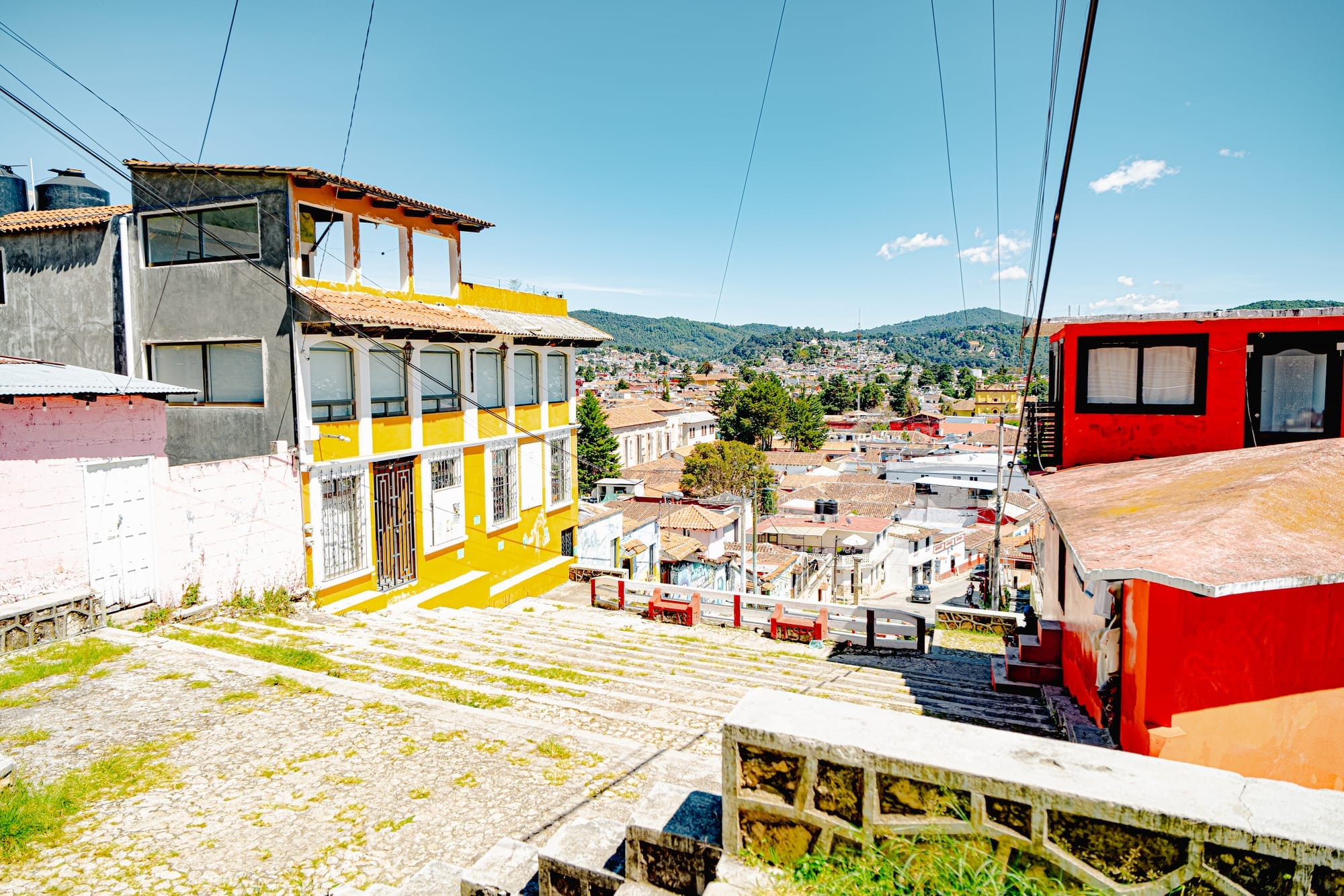
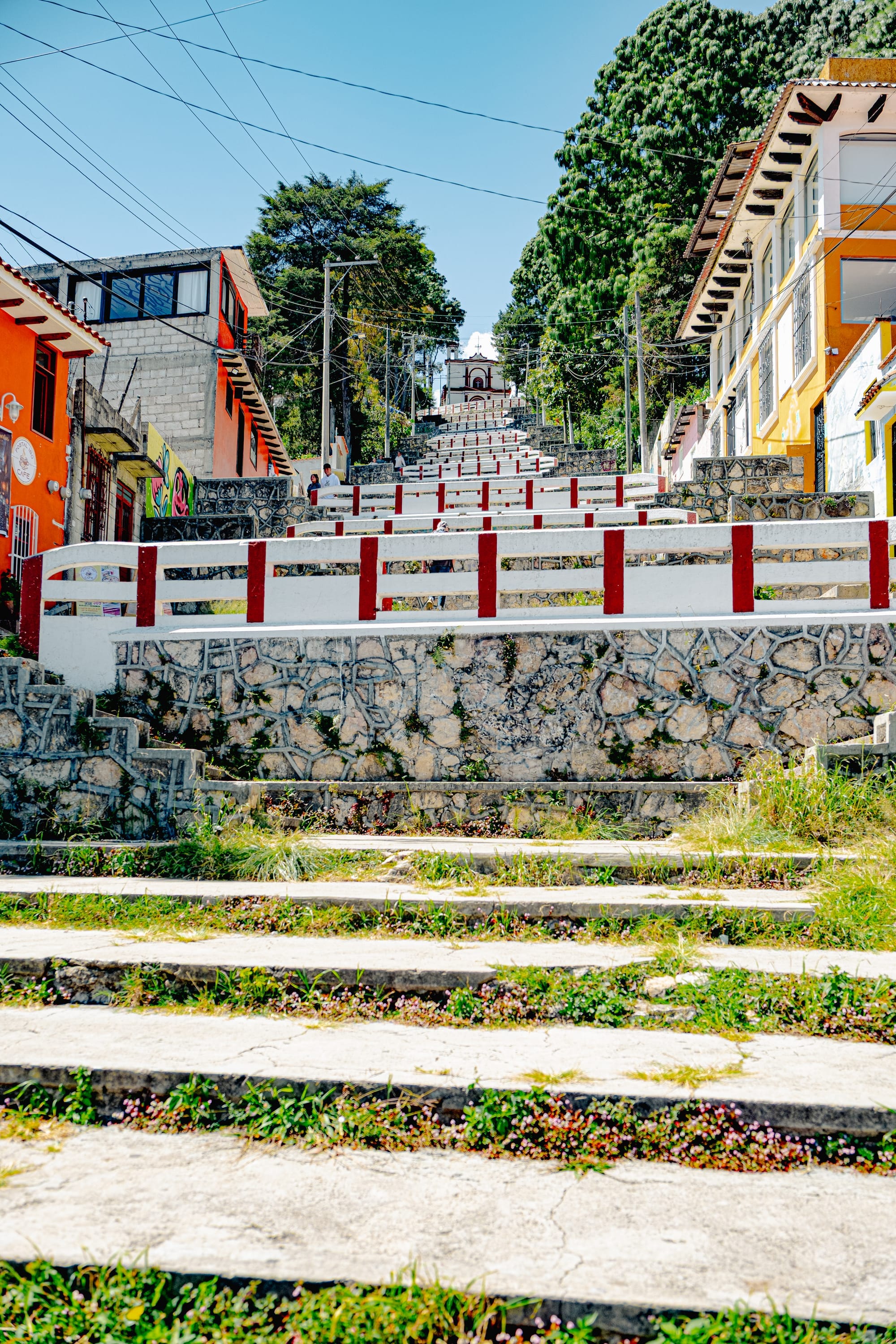
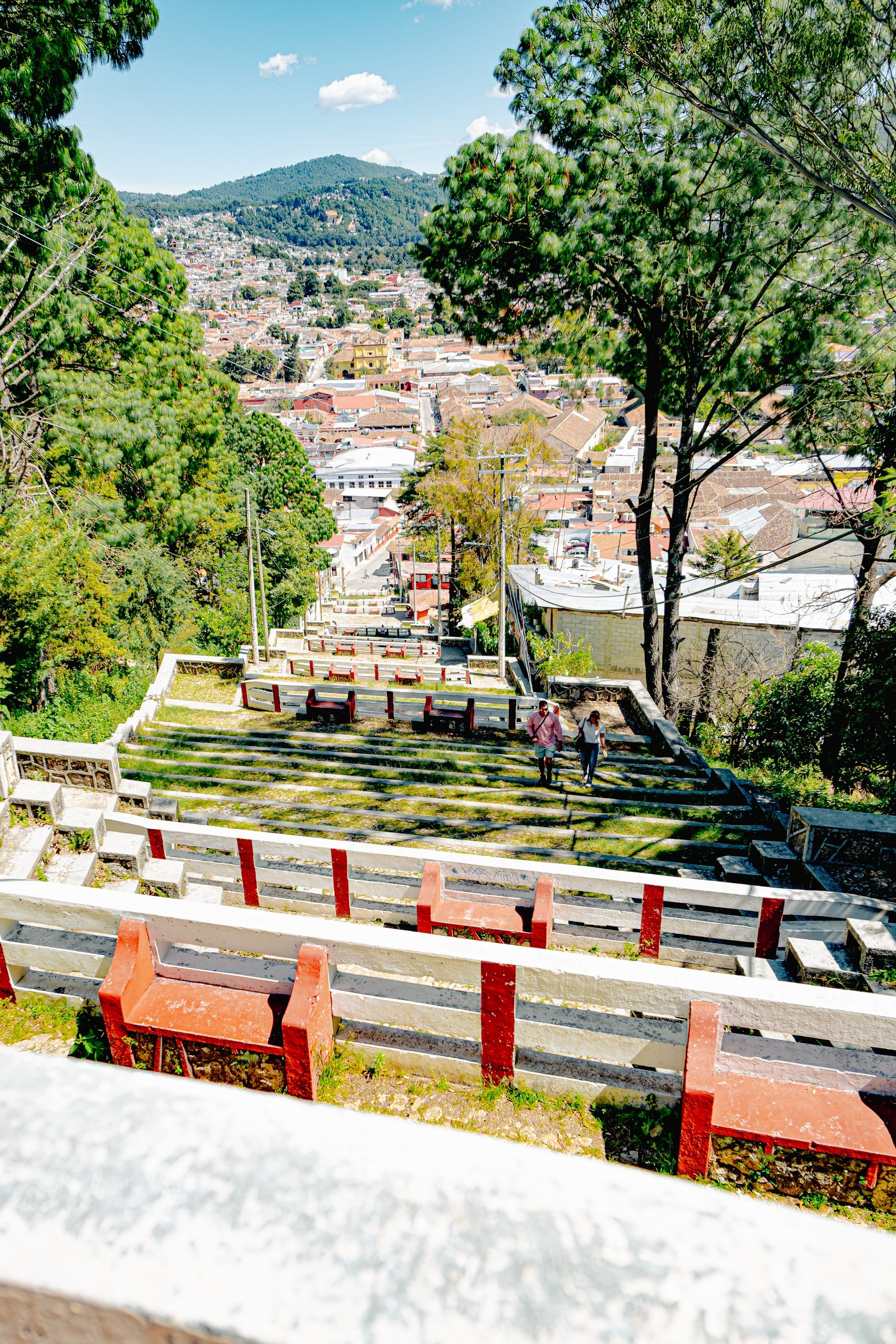
Looking up and back down the zigzagging staircase to Iglesia de San Cristóbalito
As you move upward, the surroundings change. Houses sit close to the steps, walls rise and fall alongside the path, and the city begins to open up behind you. The staircase functions as a pedestrian corridor through the neighborhood, used daily by residents heading up and down rather than only by visitors walking to the church.
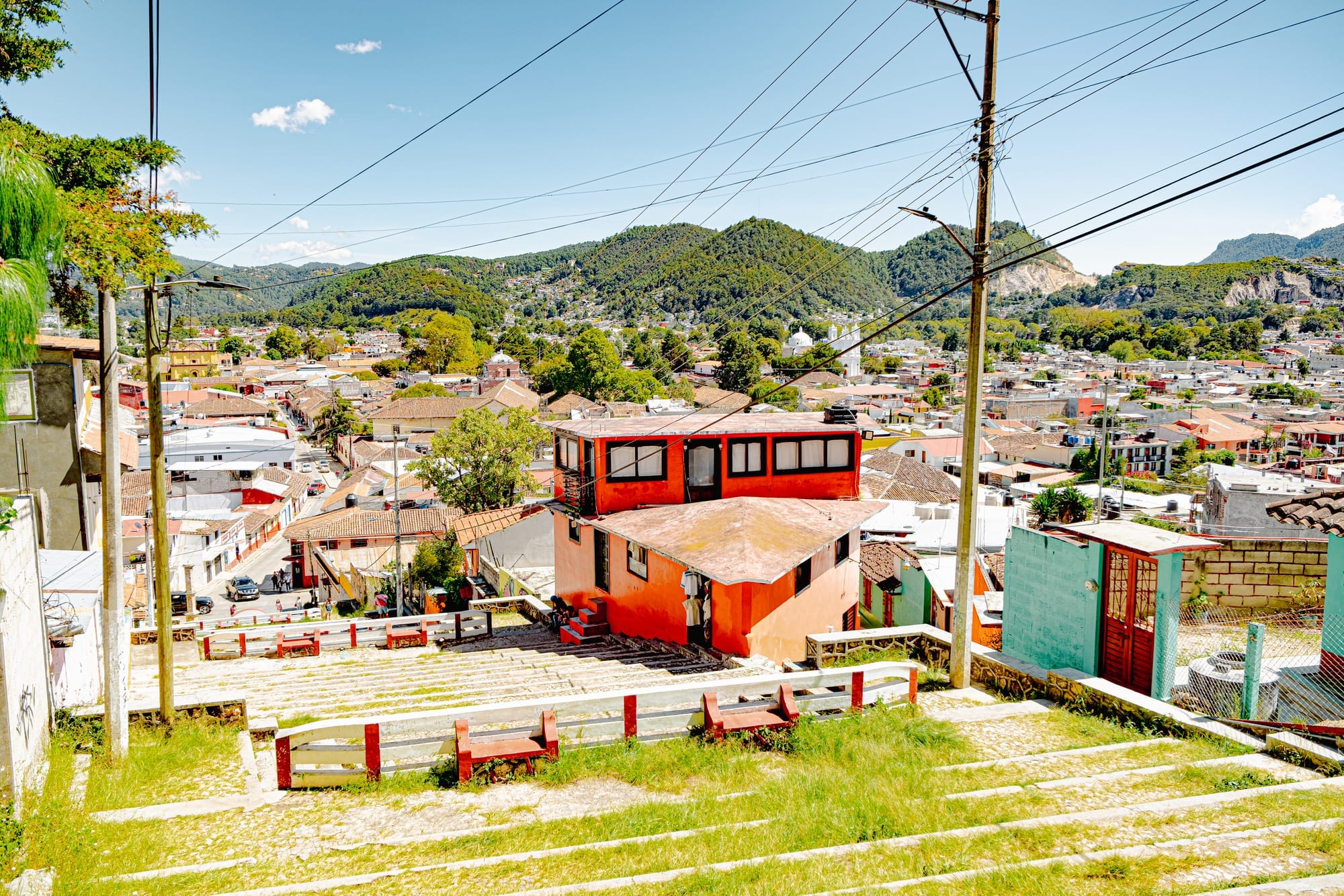
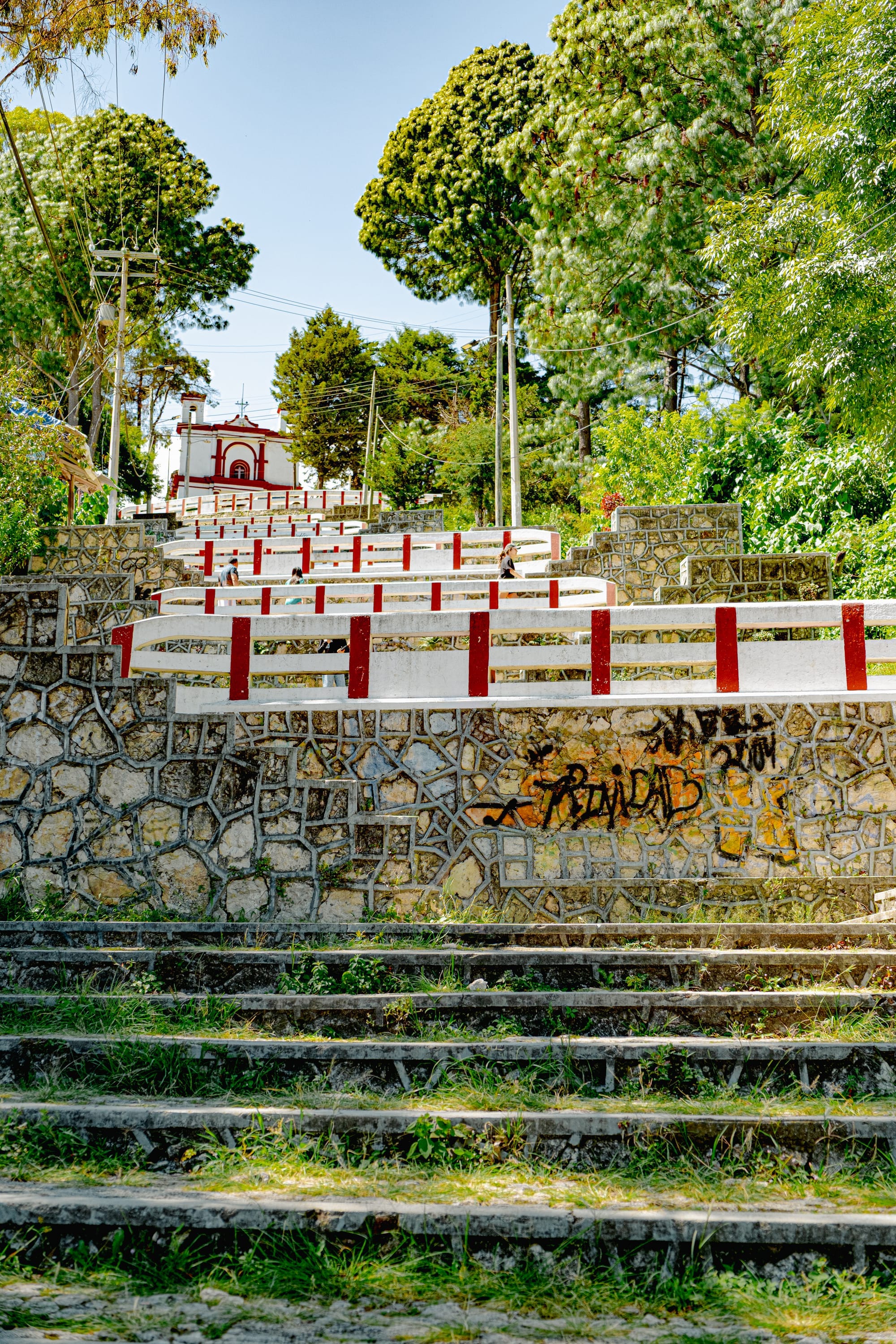
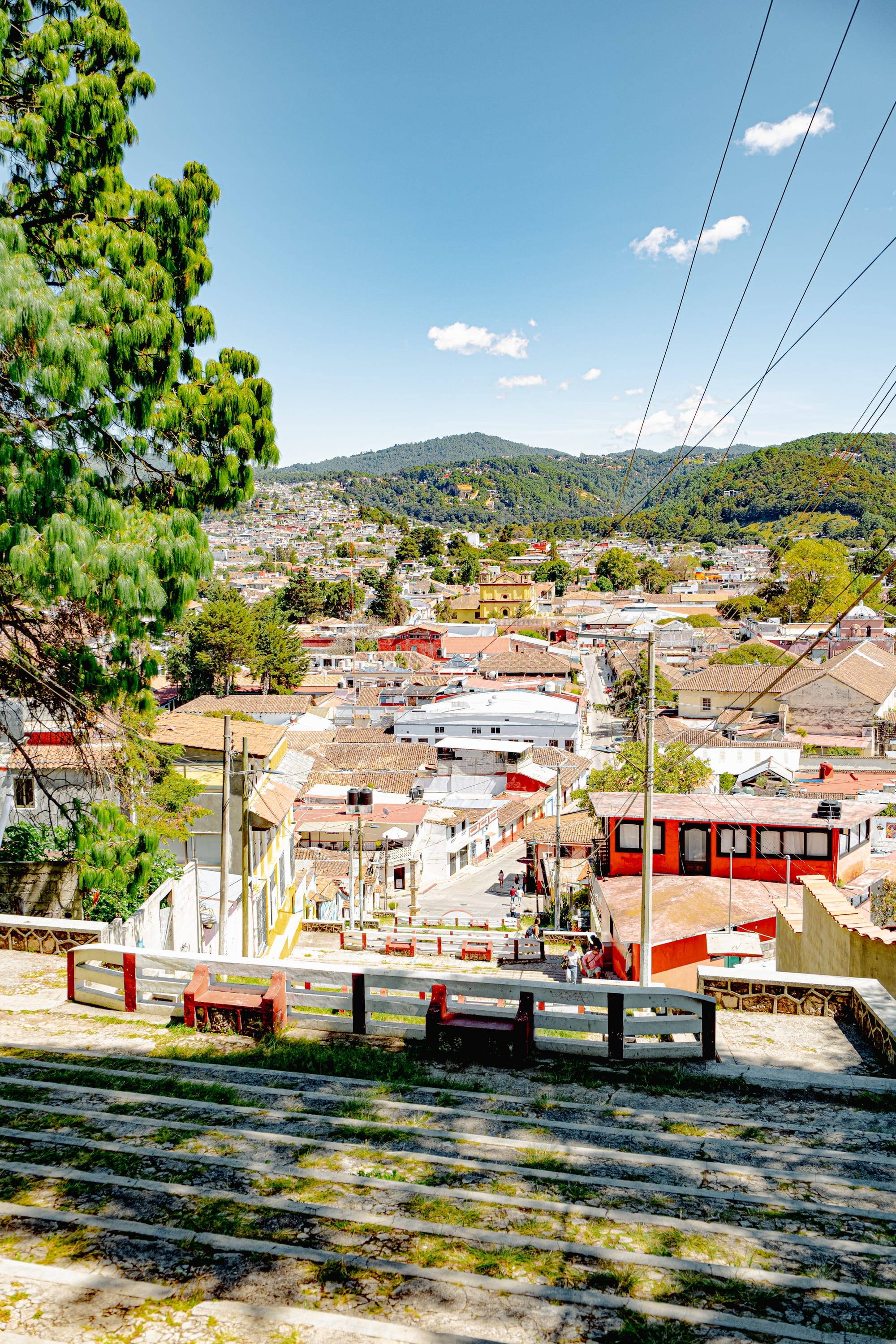
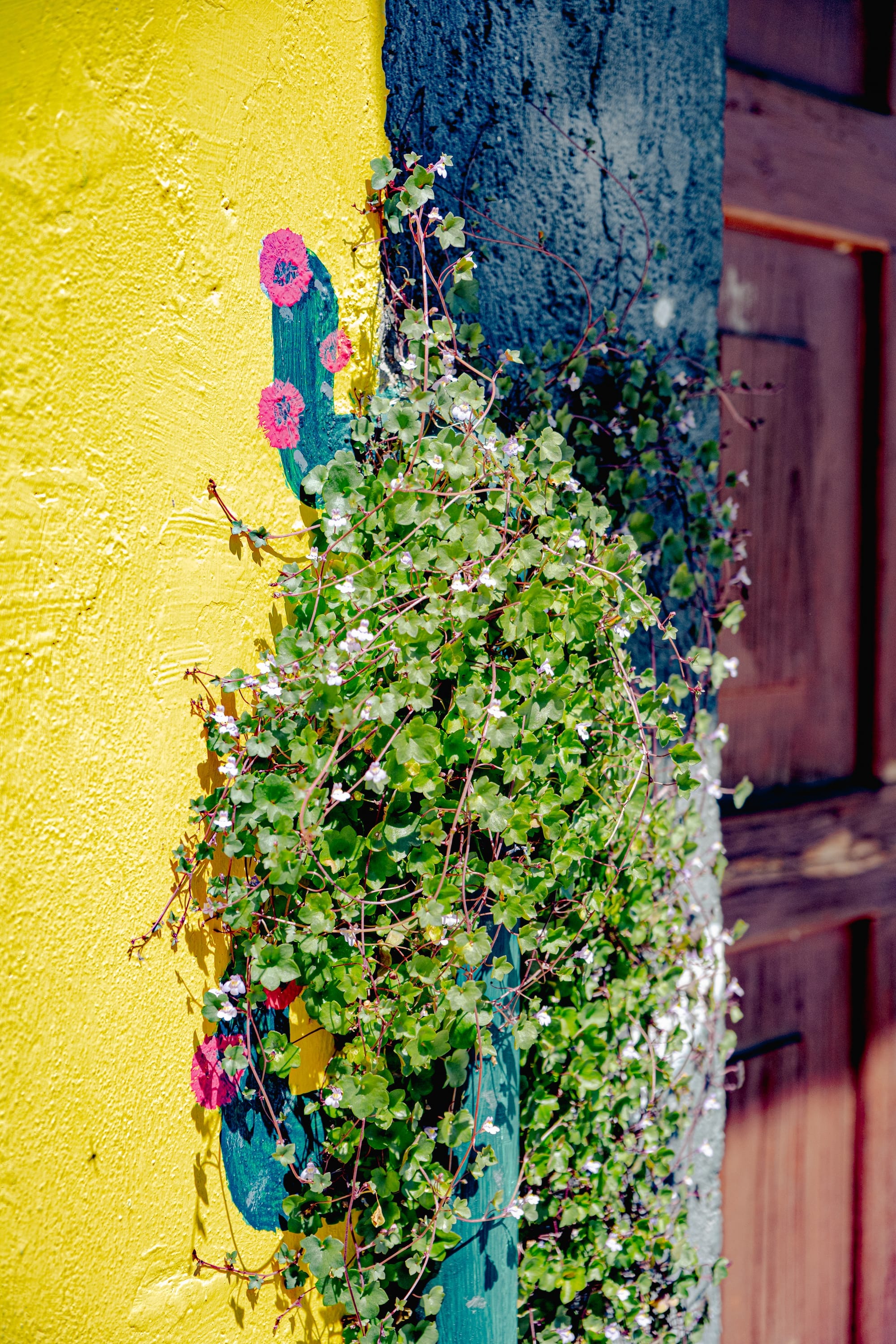
Details along the staircase climb
One of the most distinctive features of this route is the street art that lines the ascent. Murals appear on retaining walls, house façades, and small corner surfaces along the steps. The artwork ranges from political imagery and references to Indigenous identity to abstract figures, animals, and symbolic scenes. Some murals are carefully maintained; others show signs of age, paint over older work, or partial repainting. Together, they give you plenty to look at on the way up and make the approach interesting rather than purely functional.
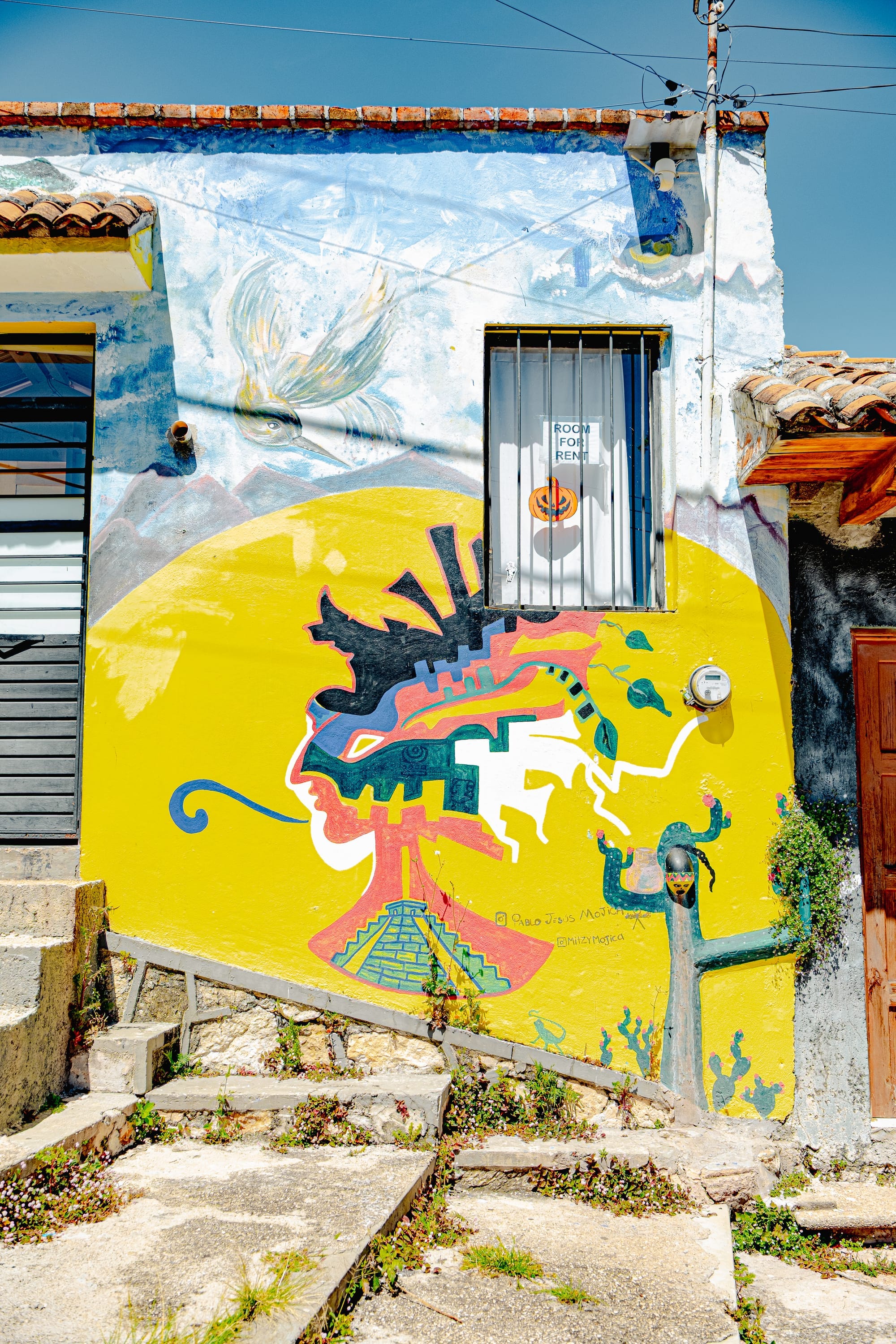
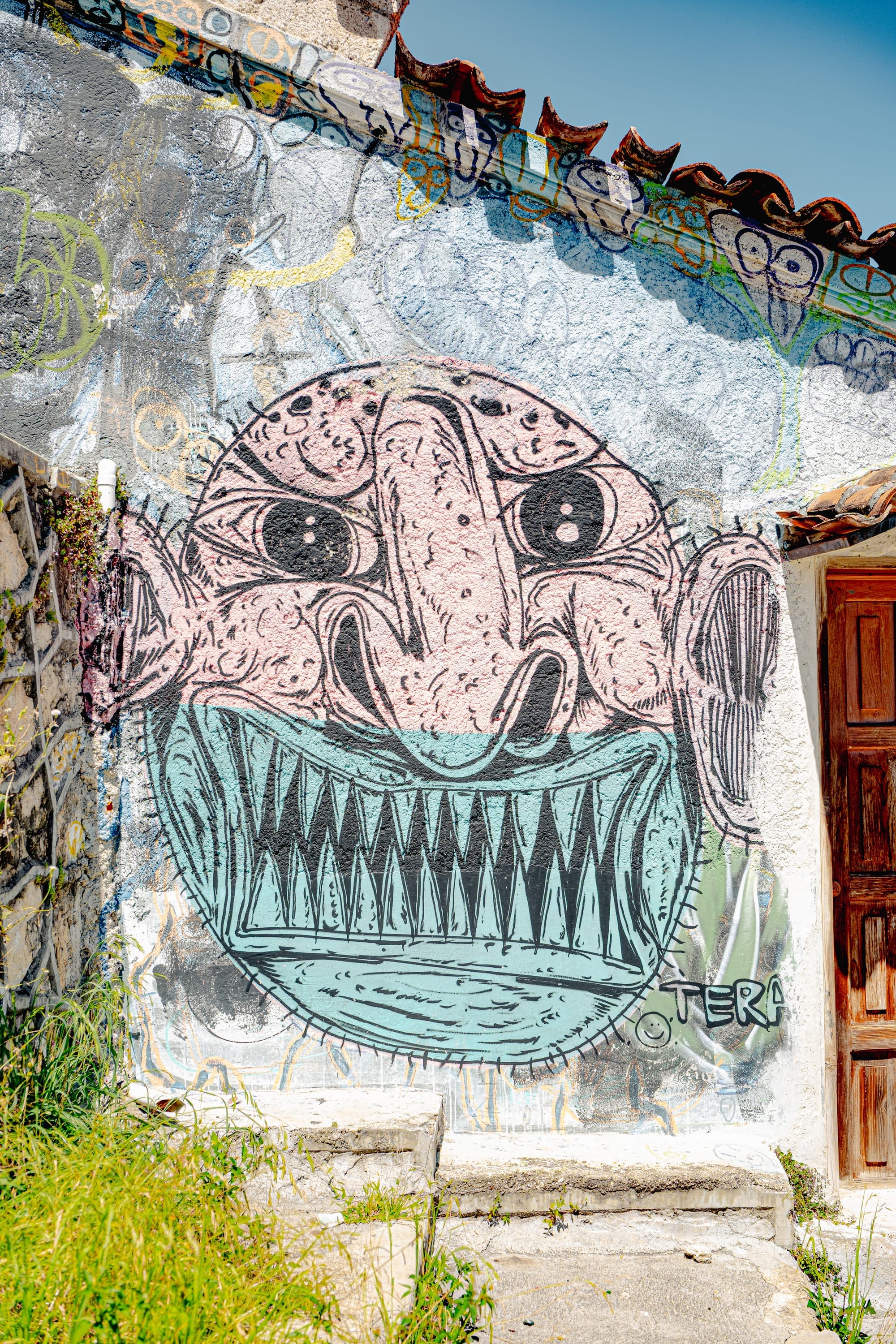
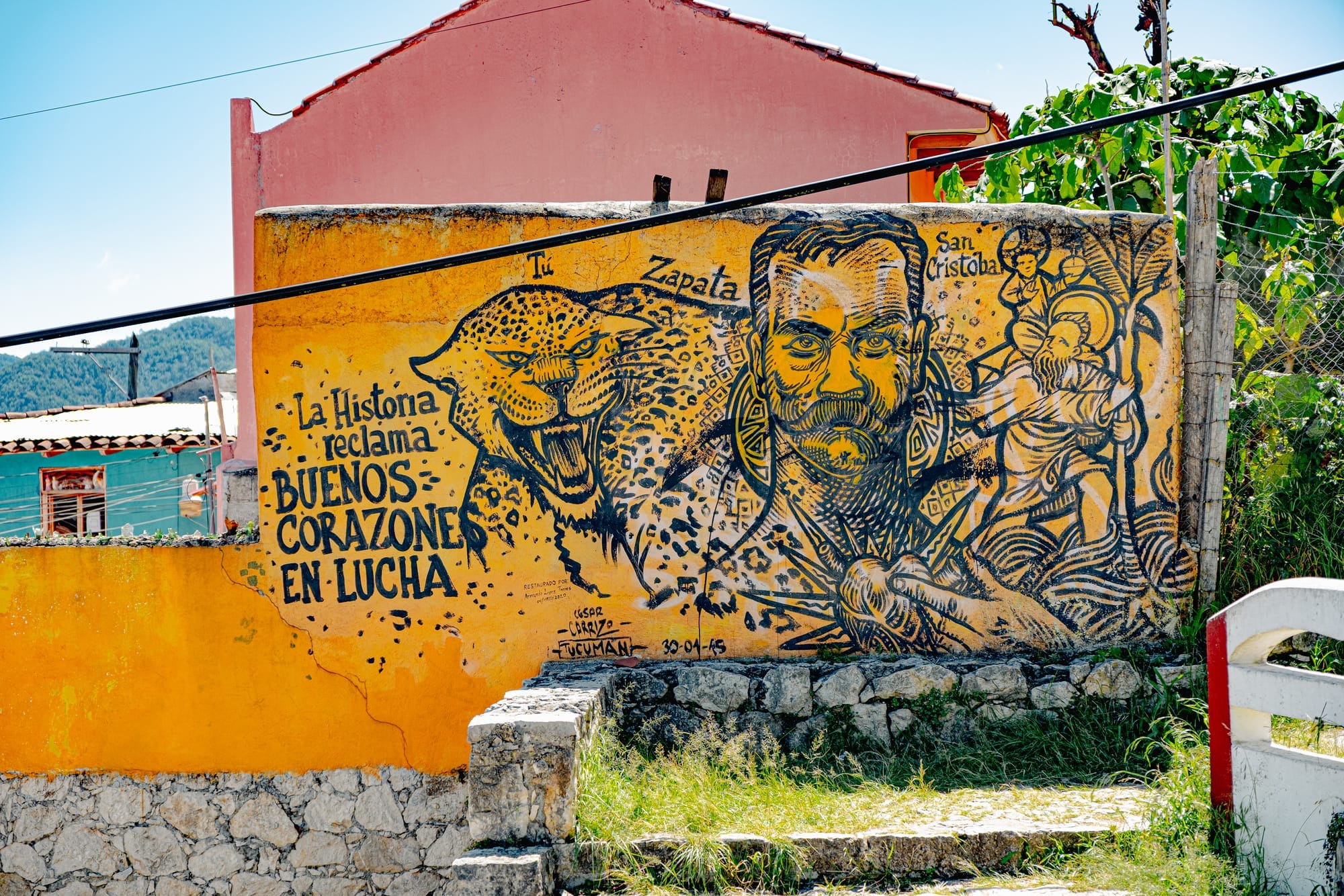
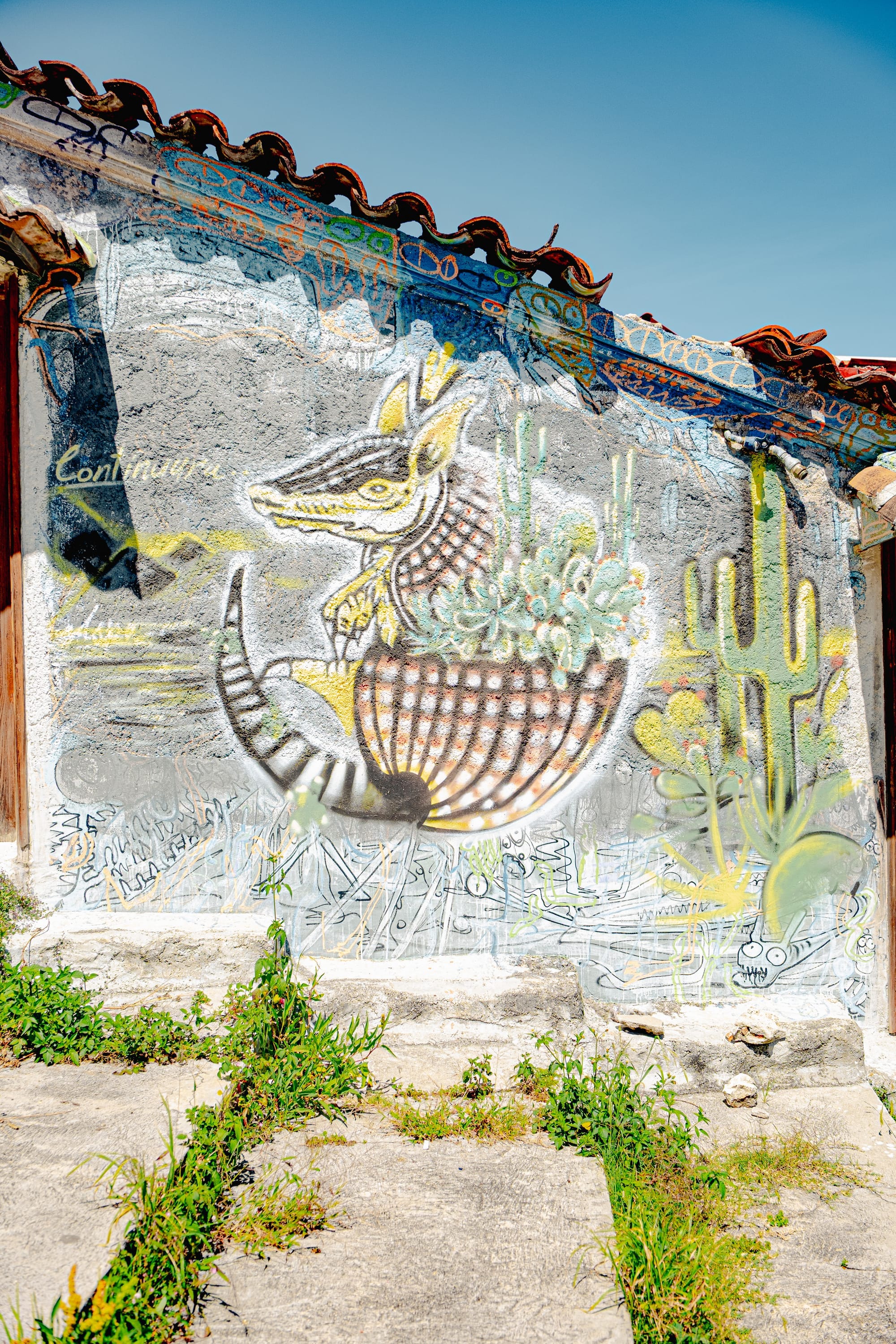
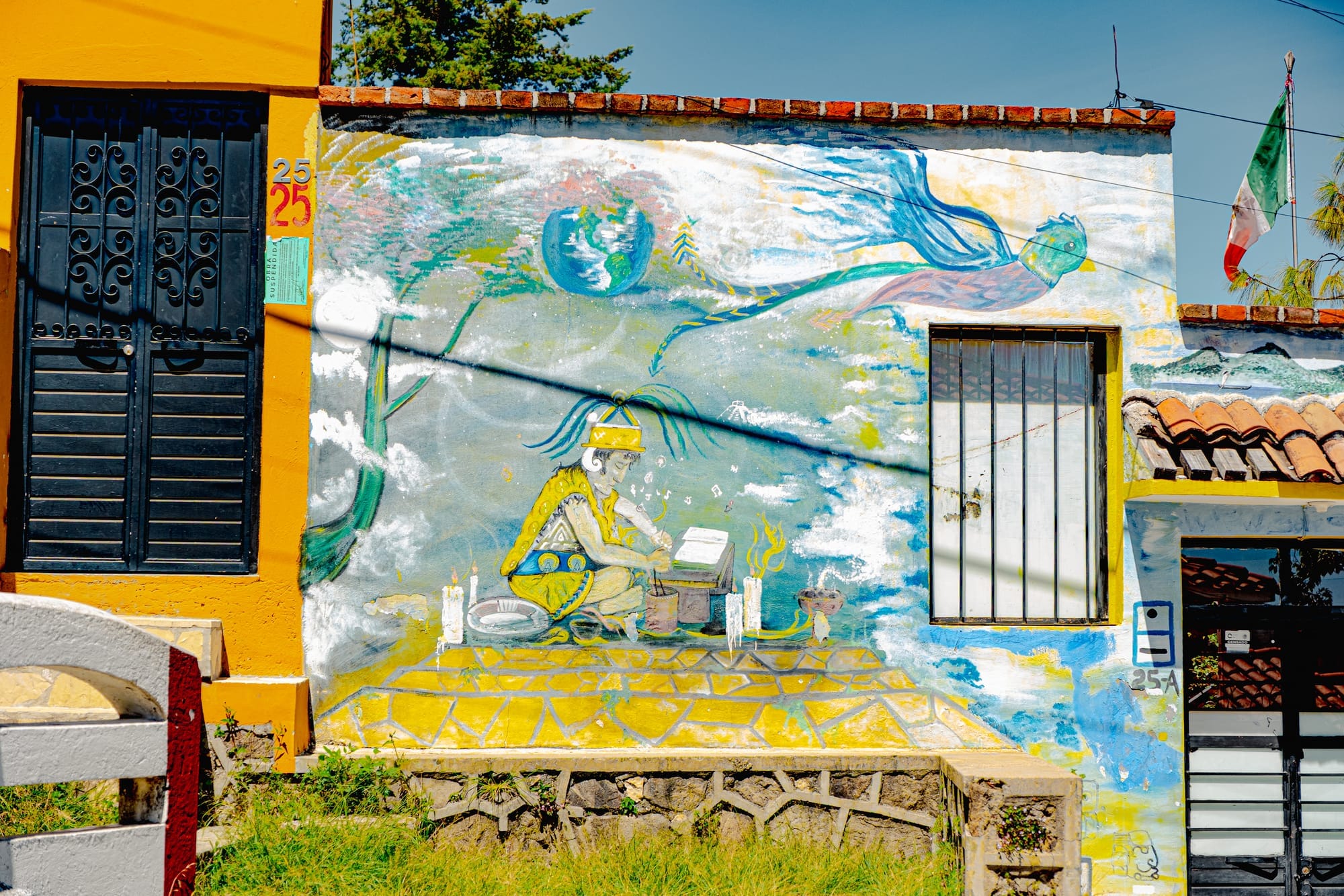
Interspersed with the murals are small details: potted plants, hand-painted steps, low walls where people stop to rest, and occasional views back toward the city. These pauses offer natural stopping points, both for catching your breath and for taking in the surroundings. The staircase is not hidden or enclosed; it remains open to the neighborhood at every stage.
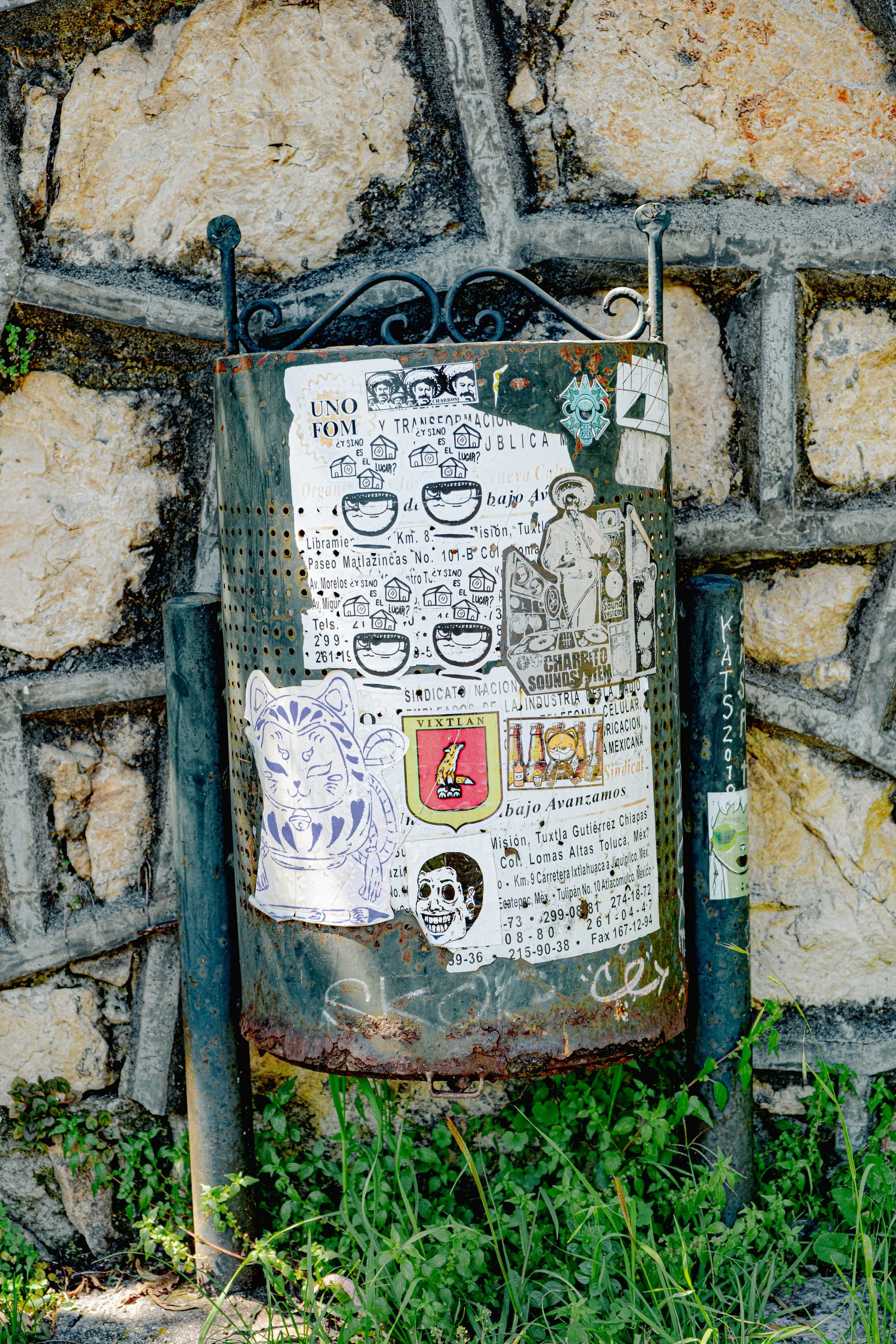
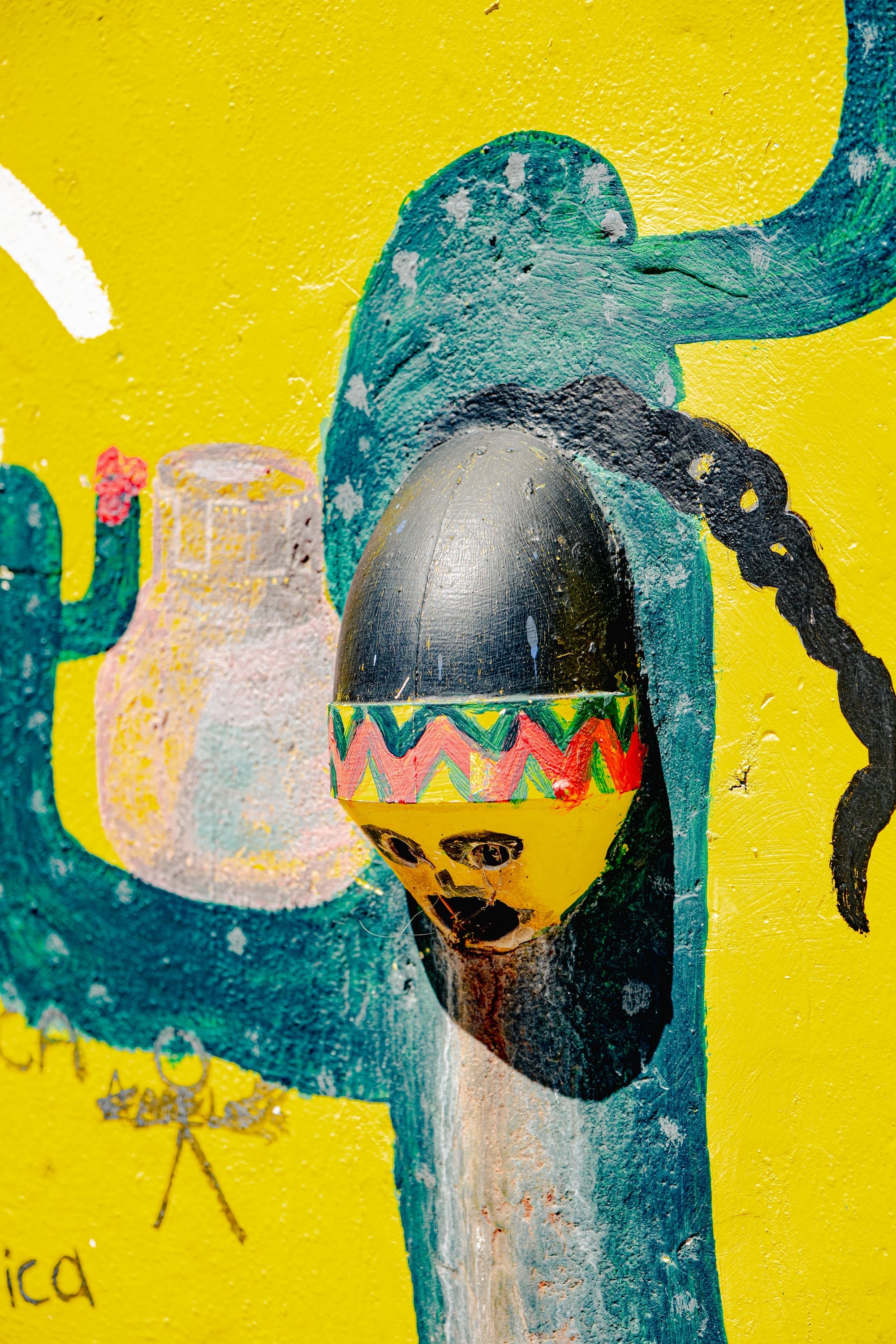
Posters, stickers, and painted figures line the route up to Iglesia de San Cristóbalito
At the top, the steps level out into a small open area in front of the church. From here, San Cristóbal de las Casas spreads out below, with rooftops, streets, and distant hills visible in multiple directions. This viewpoint is one of the main reasons people make the climb, often lingering longer here than inside the church itself.
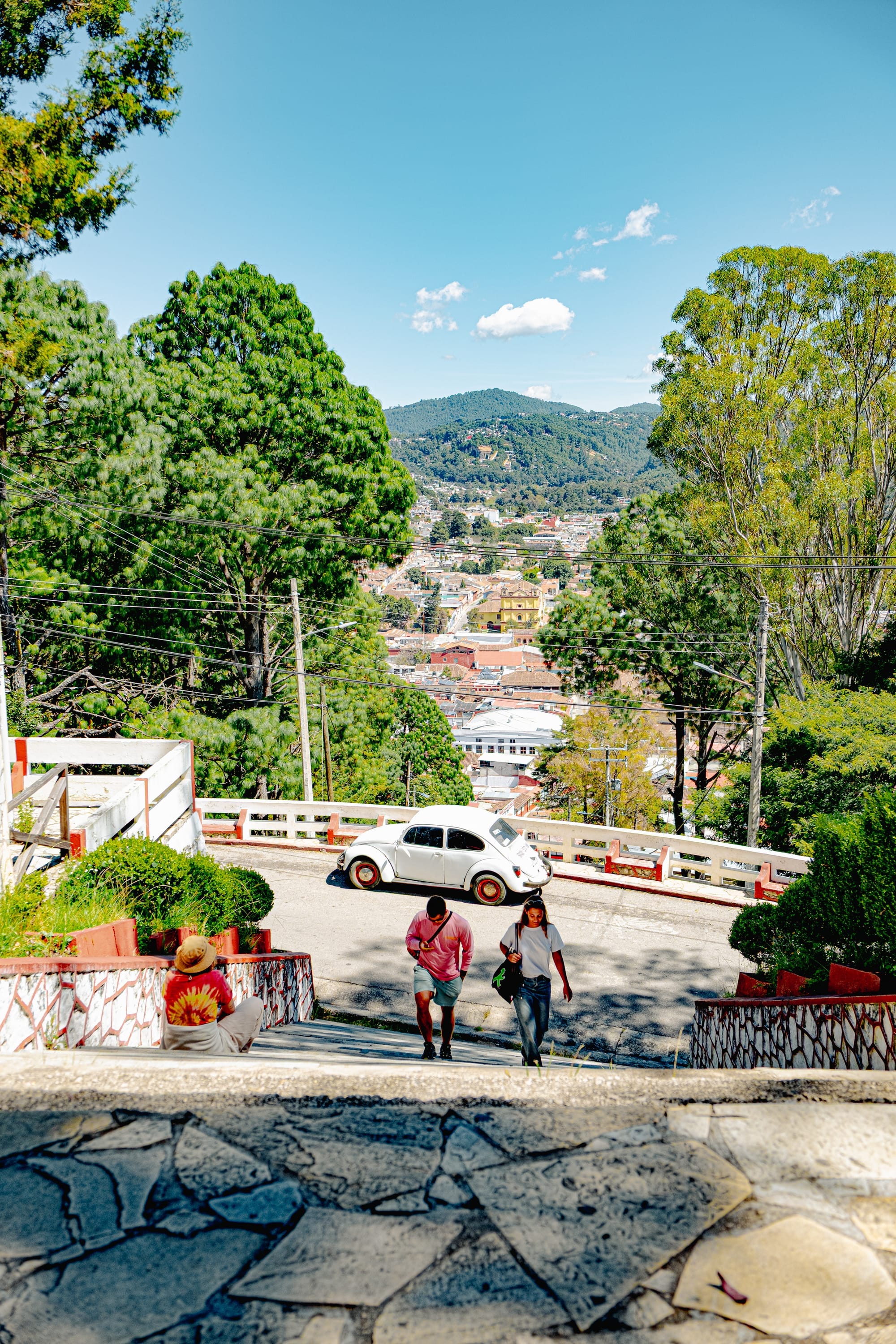
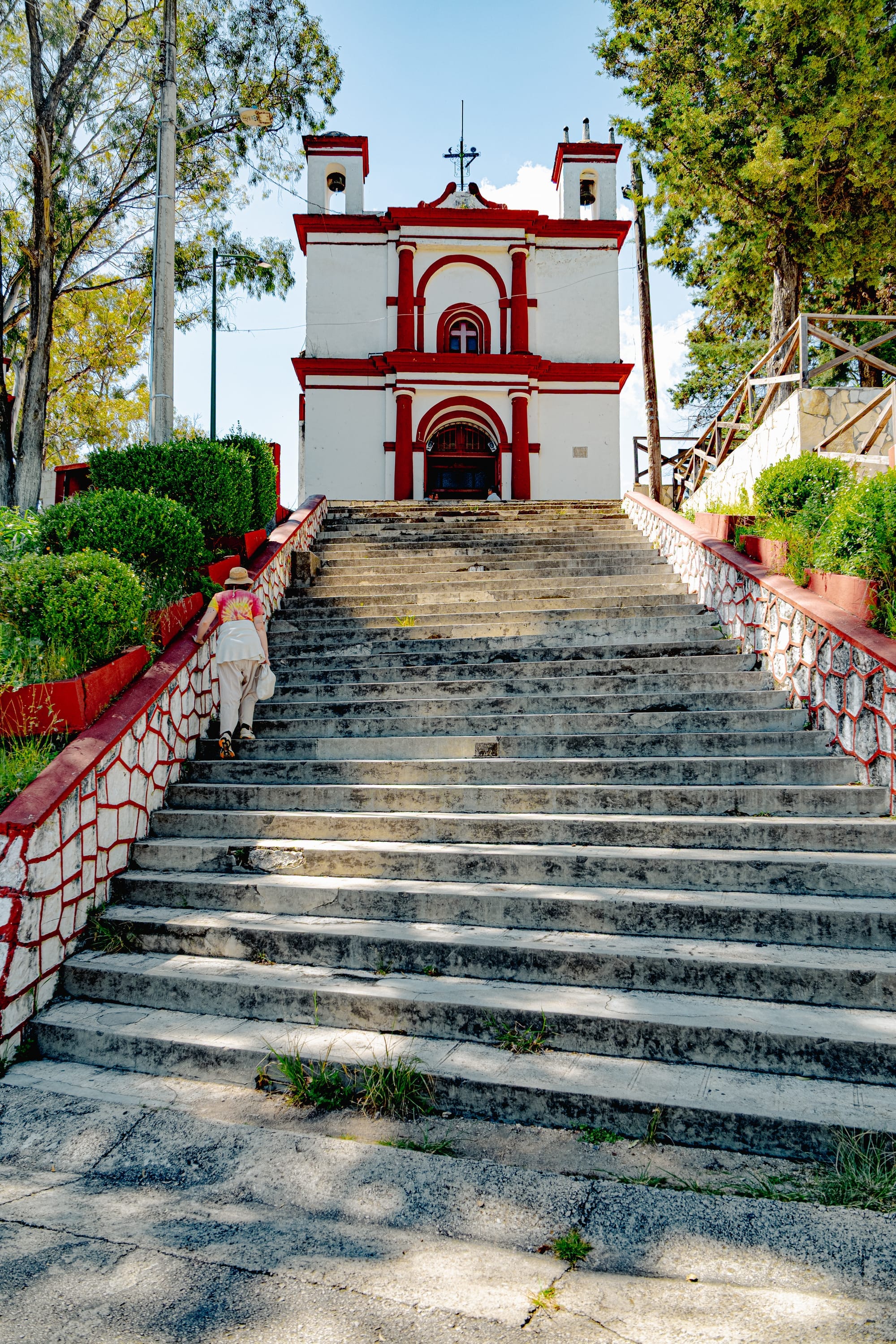
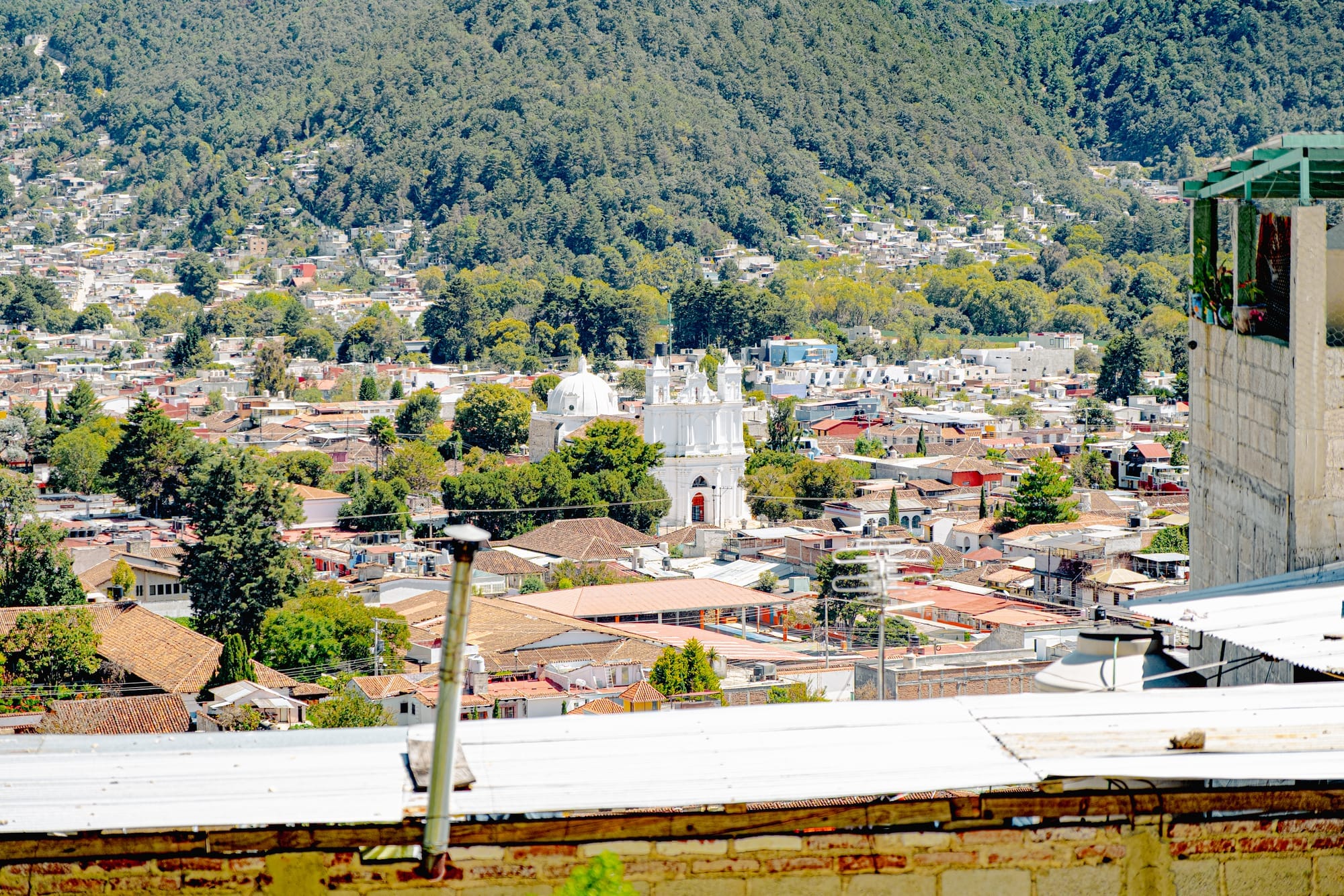
The church building is modest in scale and design. Its façade is simple, typically painted in yellow or ochre tones, with minimal decorative elements. The interior is equally restrained, consisting of a single nave and basic religious imagery, serving a local congregation rather than functioning as a major architectural landmark.
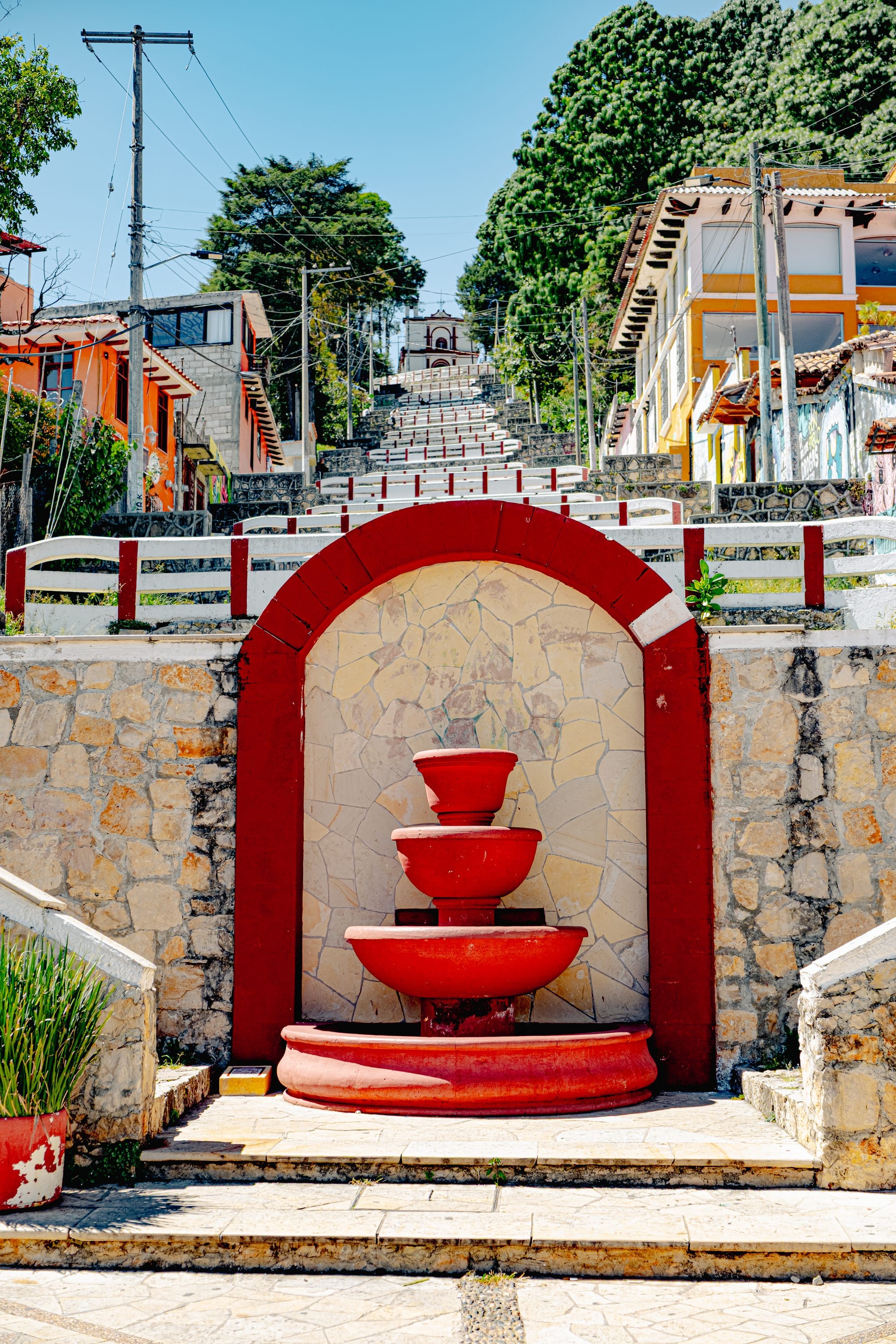
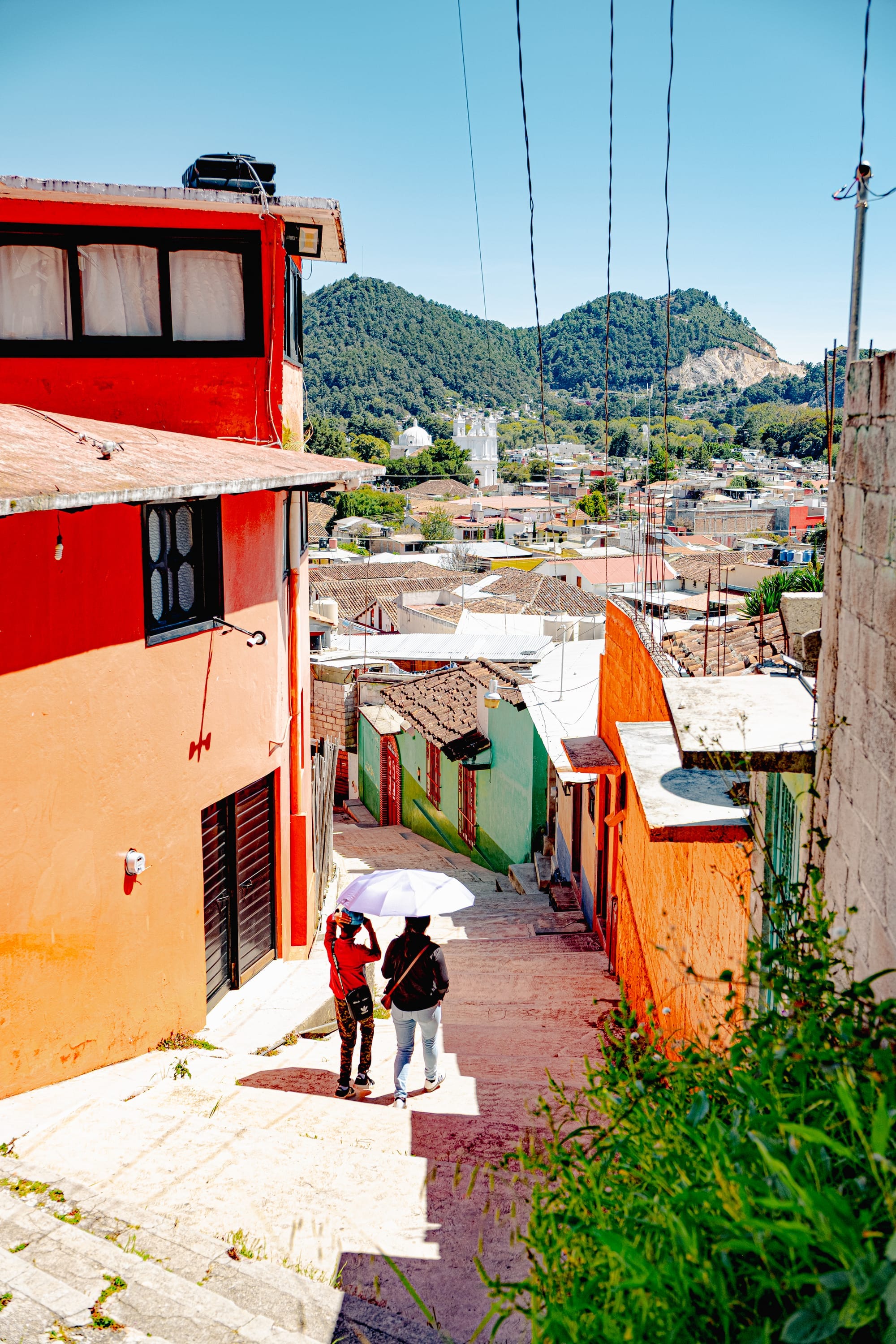
Along the zigzagging staircase to Iglesia de San Cristóbalito
At San Cristóbalito, the emphasis is less on the structure and more on the route that leads to it. The staircase, murals, and shifting views shape how the church is experienced, turning the climb into a gradual transition from the dense streets below to a calmer, elevated vantage point above the city.
Locals often call this hill and church El Cerrito, and INAH lists the church as Templo de San Cristóbal, dating from the 19th century. It's frequently locked, so come for the stairs and the view rather than the interior. The church's big day is the feast of Saint Christopher on July 25. Wikivoyage advises against climbing either hill staircase after dark, so go in the morning or early afternoon.
Catedral de San Cristóbal Mártir
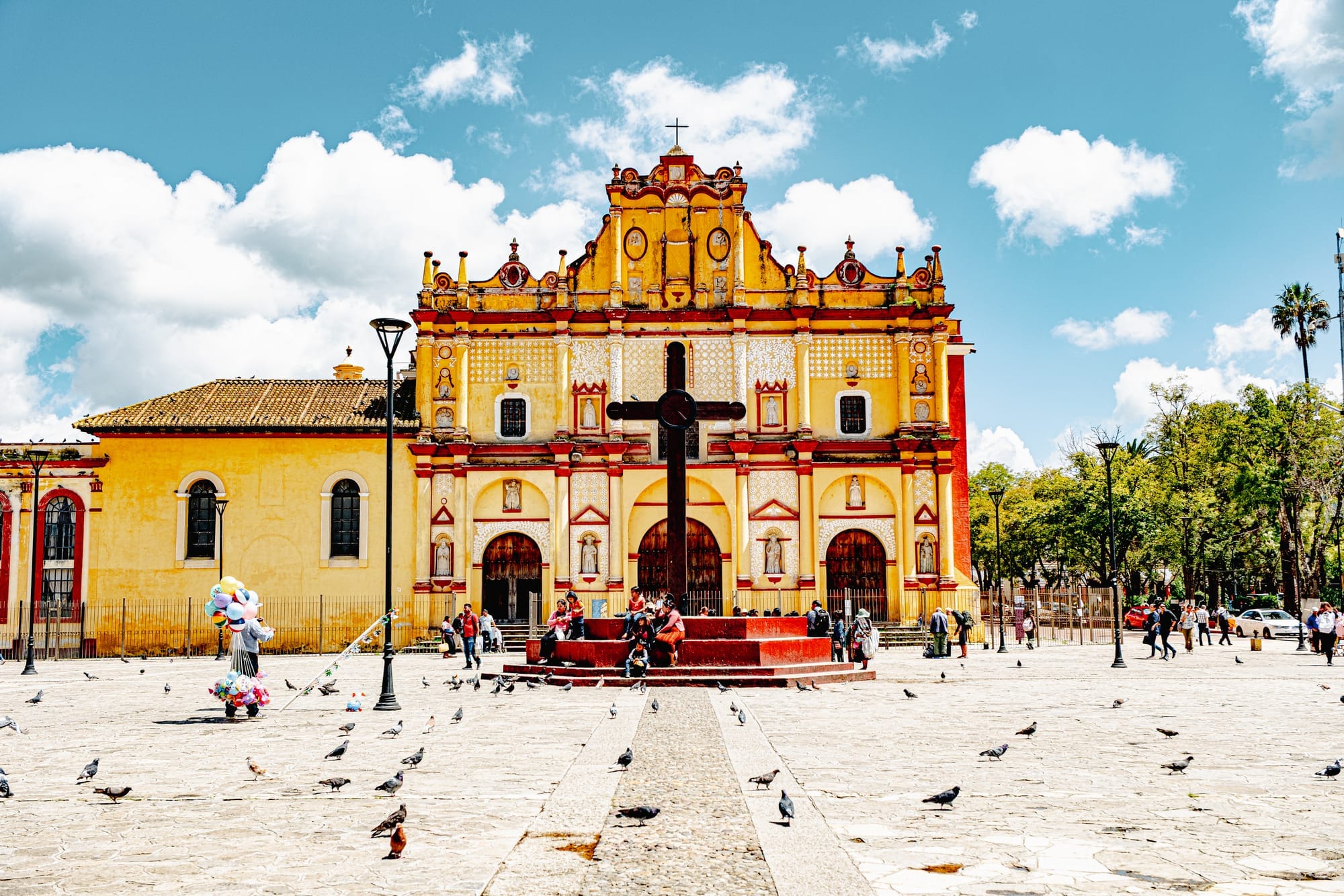
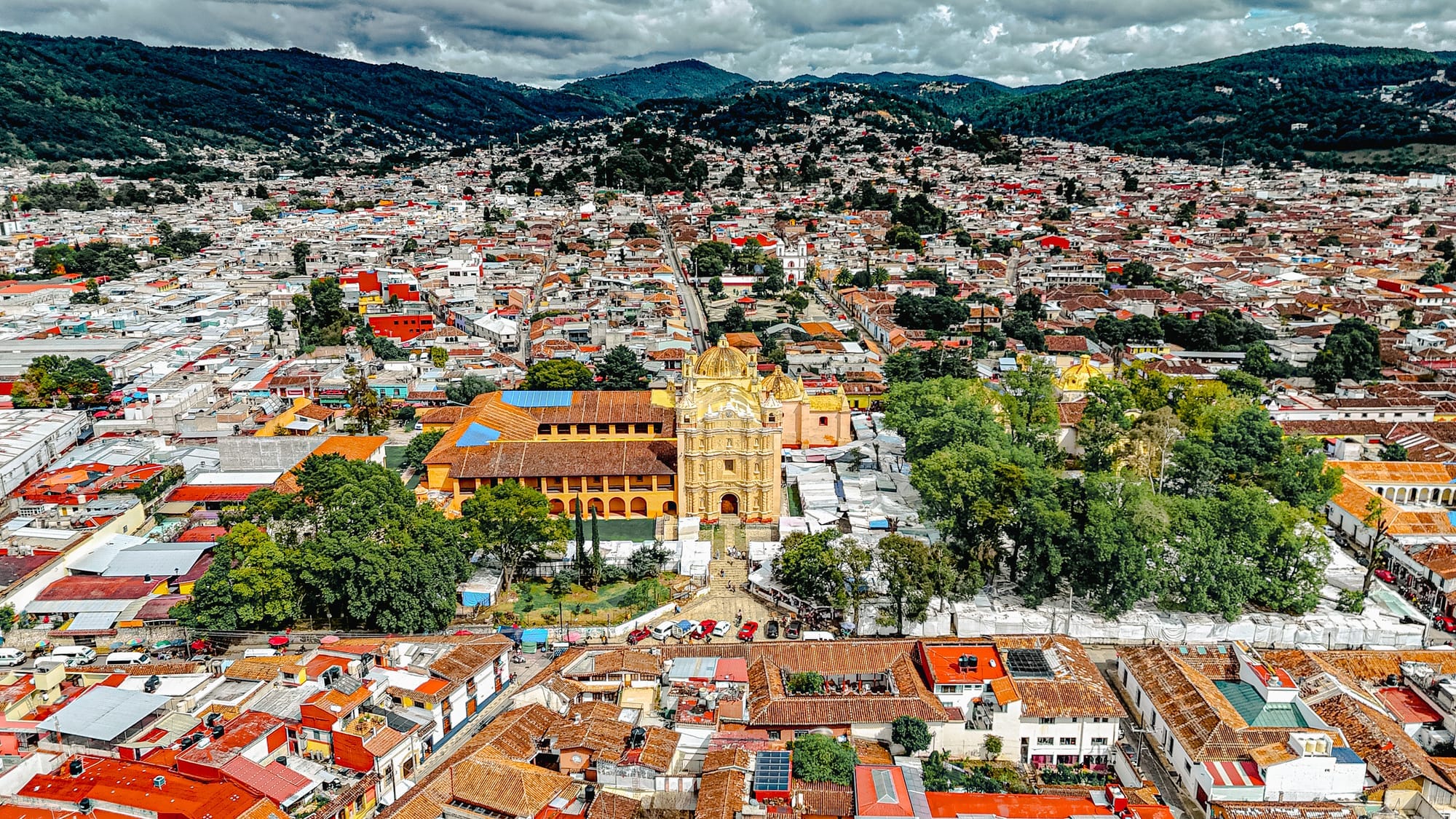
Catedral de San Cristóbal Mártir sits on the north side of Plaza 31 de Marzo, directly facing the city’s main square. Painted in a warm yellow with red detailing, it is one of the most recognizable buildings in San Cristóbal de las Casas and functions as a central reference point for both locals and visitors moving through the historic center.
The cathedral was originally founded in the early 16th century, shortly after the Spanish establishment of the city. While elements of the original structure remain, the building as it appears today largely dates to the 17th century, with multiple restorations following damage caused by earthquakes, most notably in 1902 and 1975. As a result, the cathedral reflects an architectural history built up in stages, shaped as much by repair and adaptation as by initial design.
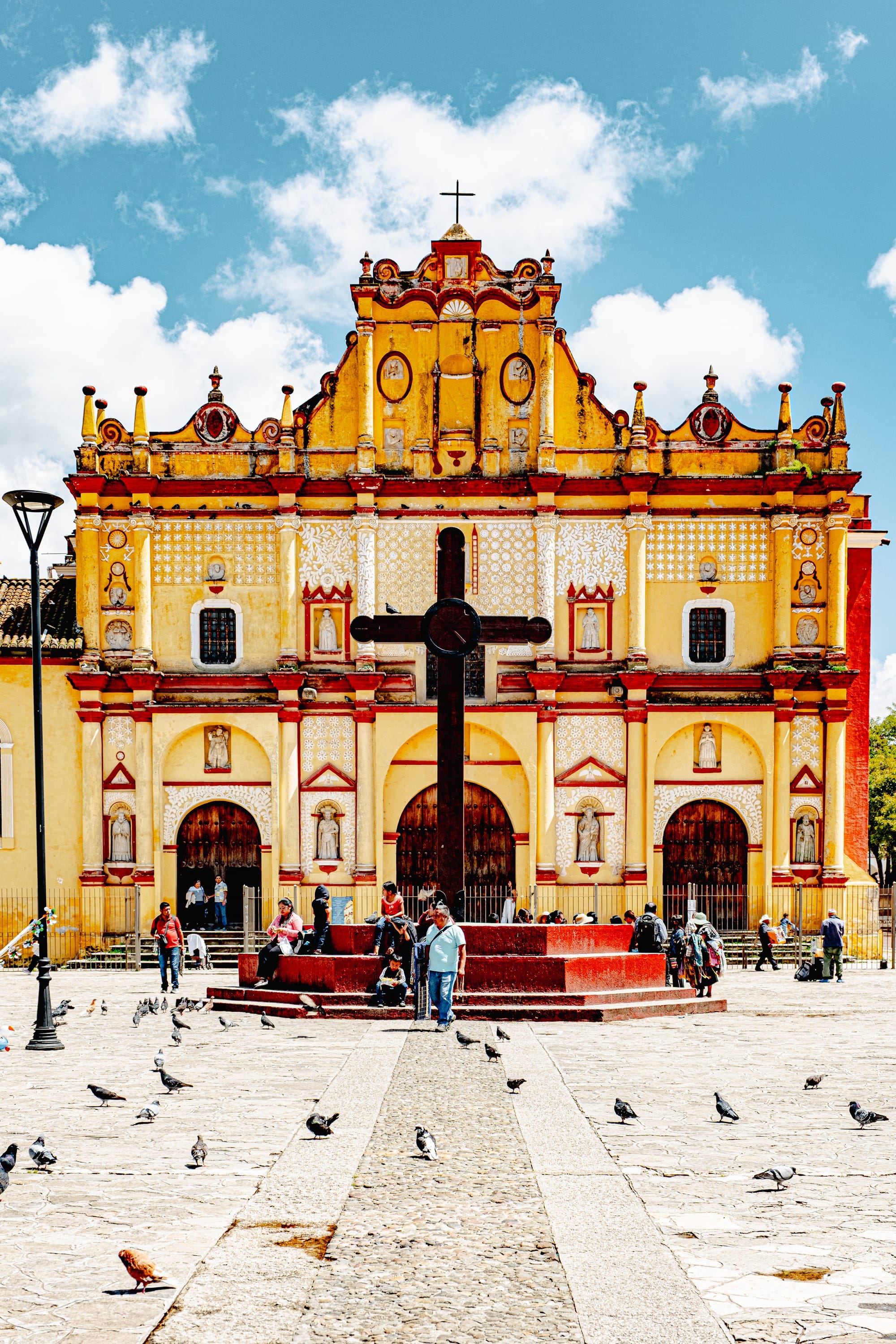
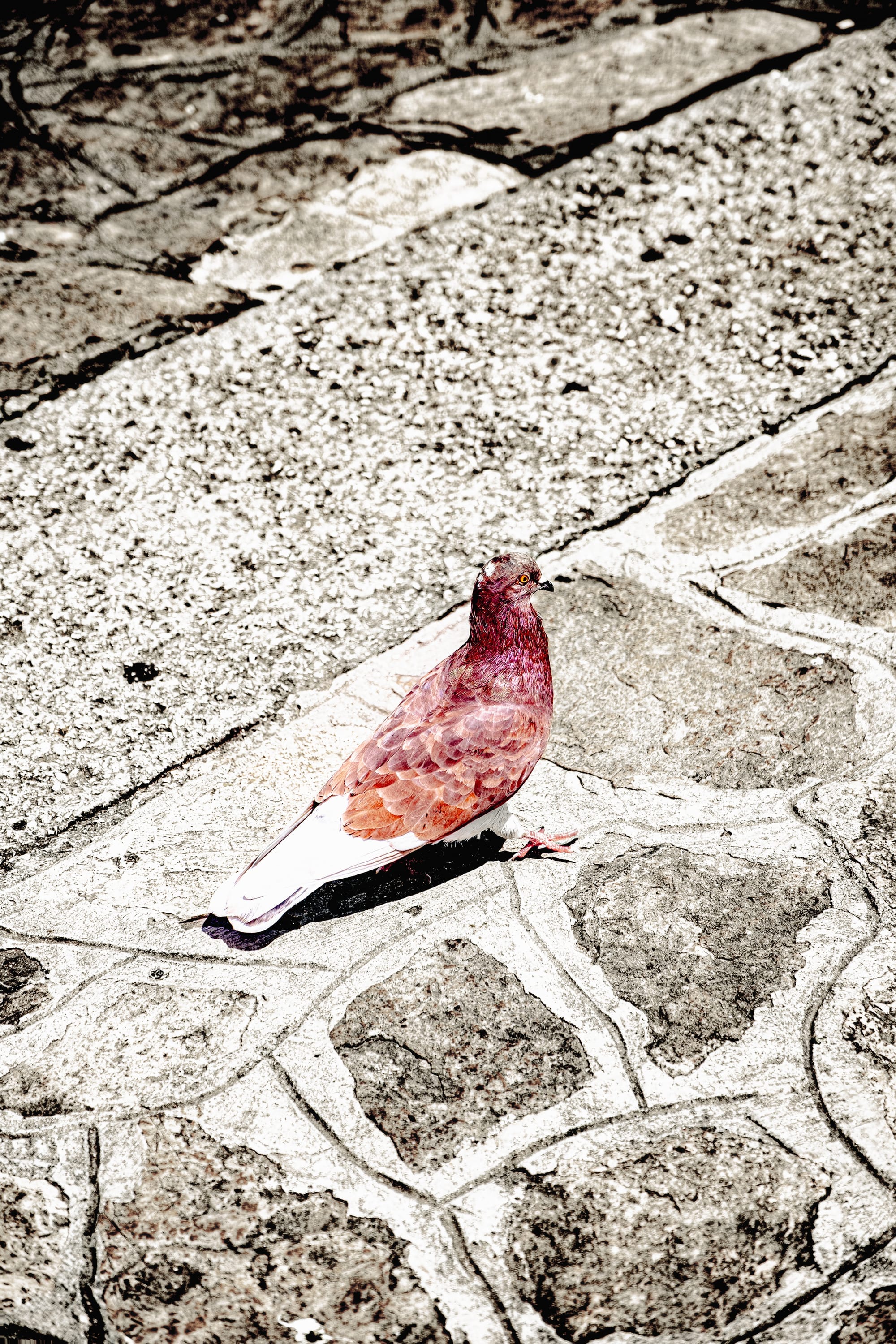
Pigeons dot the plaza outside Catedral de San Cristóbal Mártir
Architecturally, the cathedral is an example of Chiapas Baroque, a regional interpretation of Baroque style that tends to be more restrained than what is found in central Mexico. The façade is symmetrical and divided into horizontal sections, with niches containing saint figures, arched doorways, and decorative plasterwork. The ornamentation is present but not excessive, and the overall effect is solid and orderly rather than elaborate. The red trim outlining architectural elements contrasts with the yellow walls, making the structure visually prominent in the open plaza.
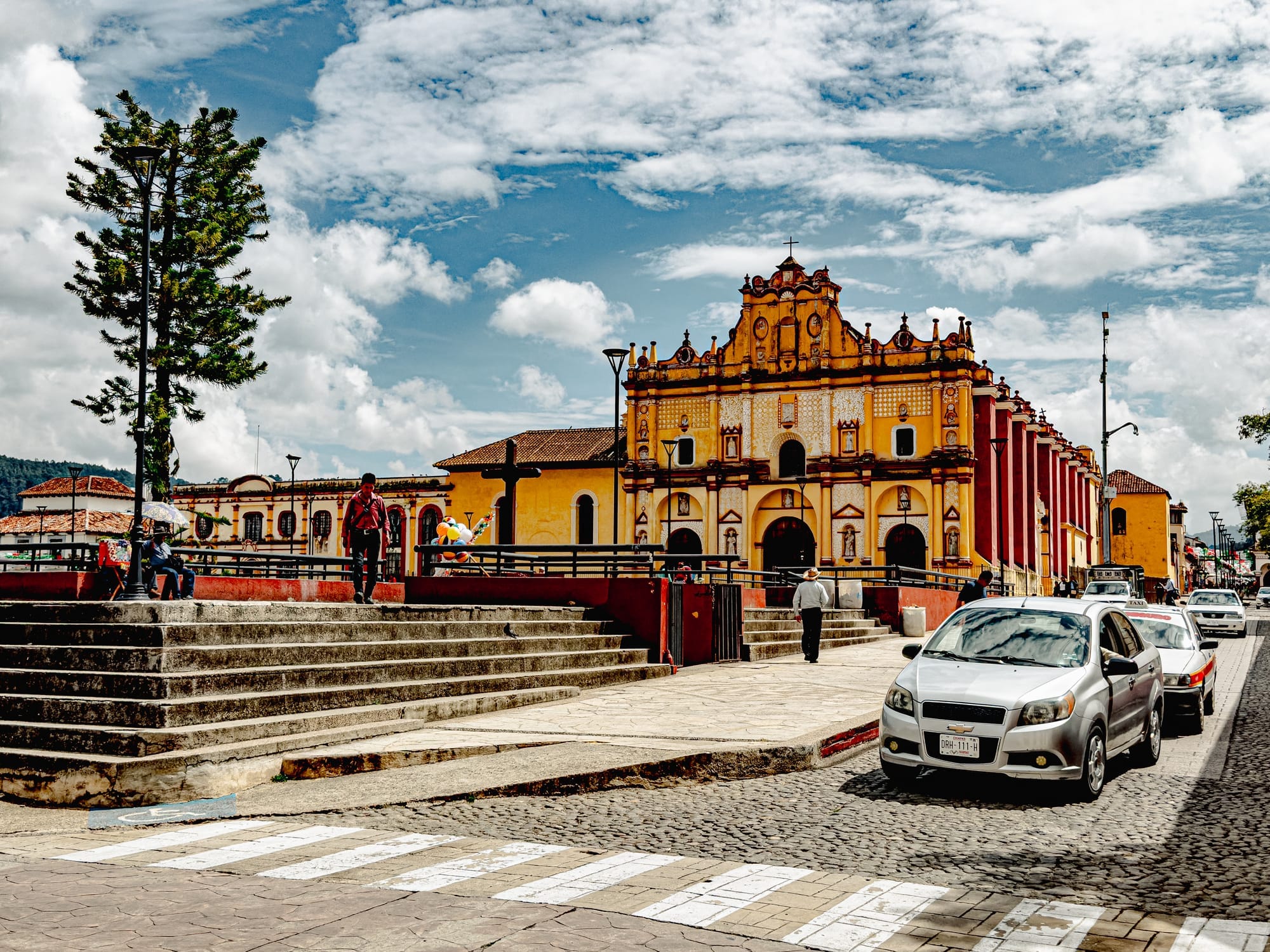
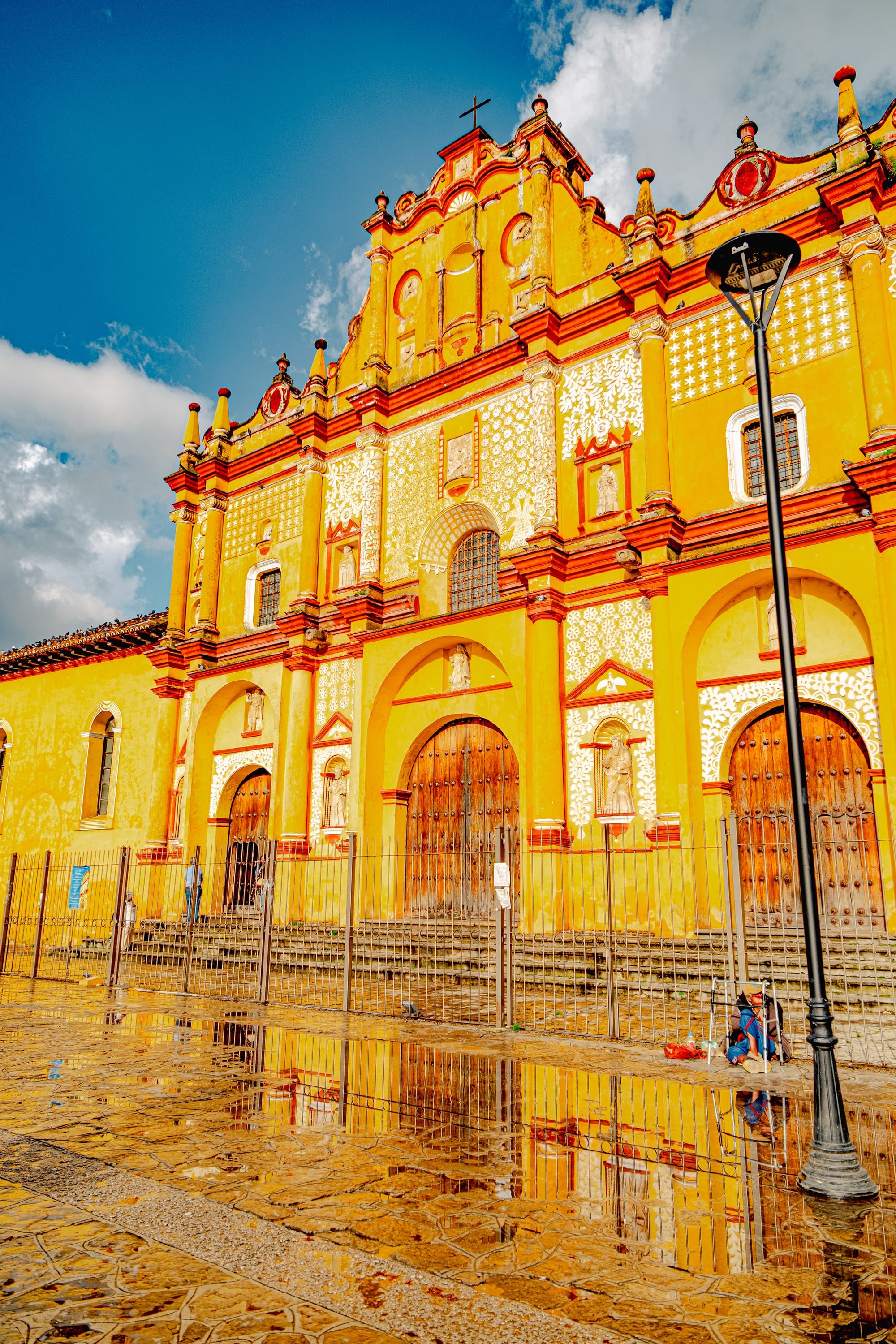
Catedral de San Cristóbal Mártir seen from street level and the plaza
In front of the cathedral stands a large wooden cross set in the plaza itself, separate from the building. This cross is a common gathering point and often appears in photographs of the square. The surrounding space is active throughout the day, with people resting on the low walls, street vendors selling balloons or snacks, and pigeons moving across the stone paving. The cathedral is not fenced off or elevated; it opens directly onto this public space and is closely tied into the life of the city.
The cathedral is dedicated to Saint Christopher, the patron saint of travelers. This dedication is historically significant given San Cristóbal’s role as a regional hub and its long history of movement (religious, commercial, and political) through the Chiapas highlands. Today, the cathedral serves as the seat of the local diocese and remains an active place of worship.
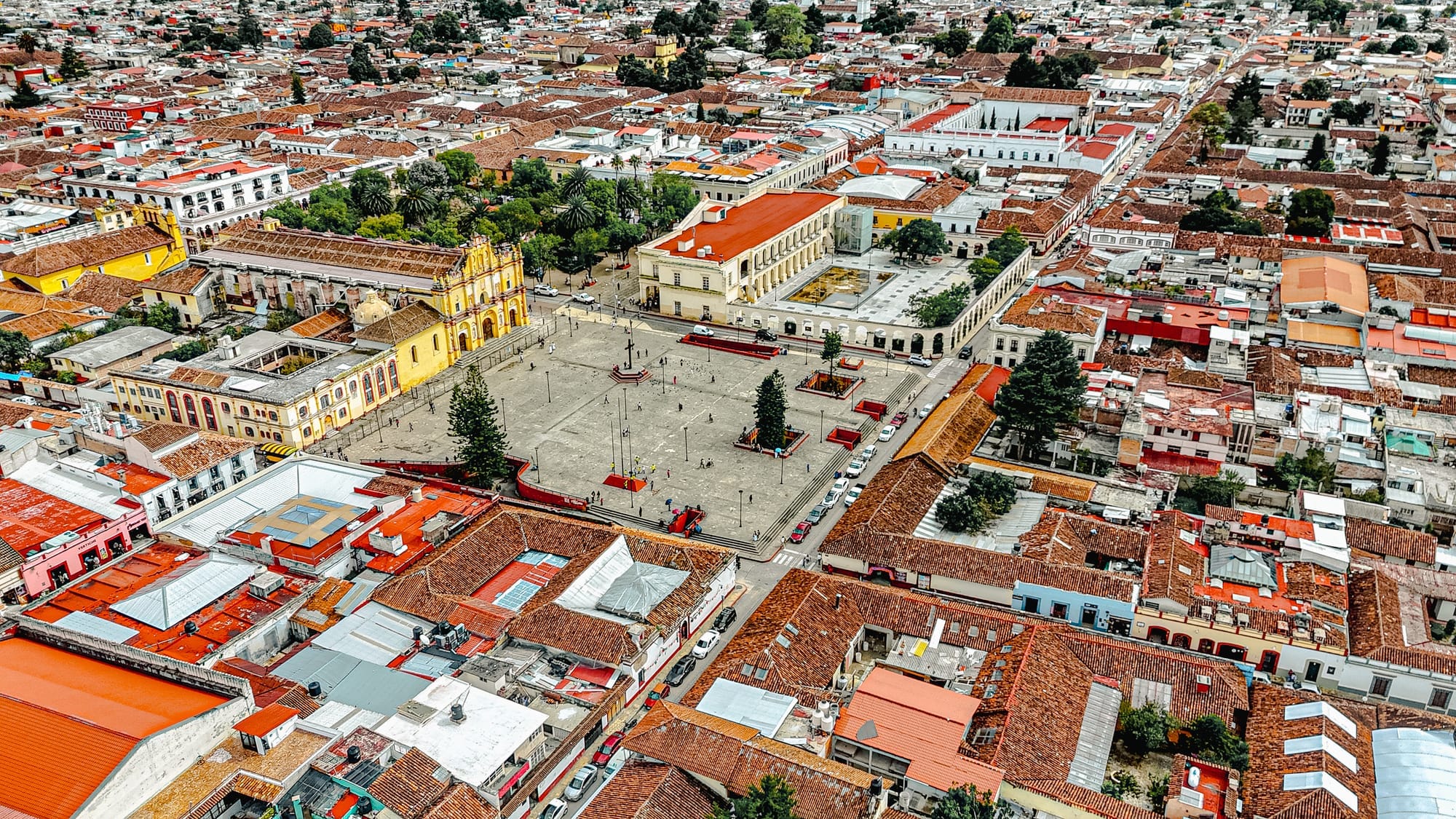
An aerial view and a close-up view
More than any single architectural feature, the cathedral’s significance comes from its position within the city. It is a place people pass by repeatedly: on the way to markets, cafes, protests, celebrations, and errands. While there are many churches in San Cristóbal de las Casas, Catedral de San Cristóbal Mártir remains the most central, both geographically and functionally, serving as a steady presence in a city shaped by constant change.
San Cristóbal de las Casas cathedral: dates and architecture
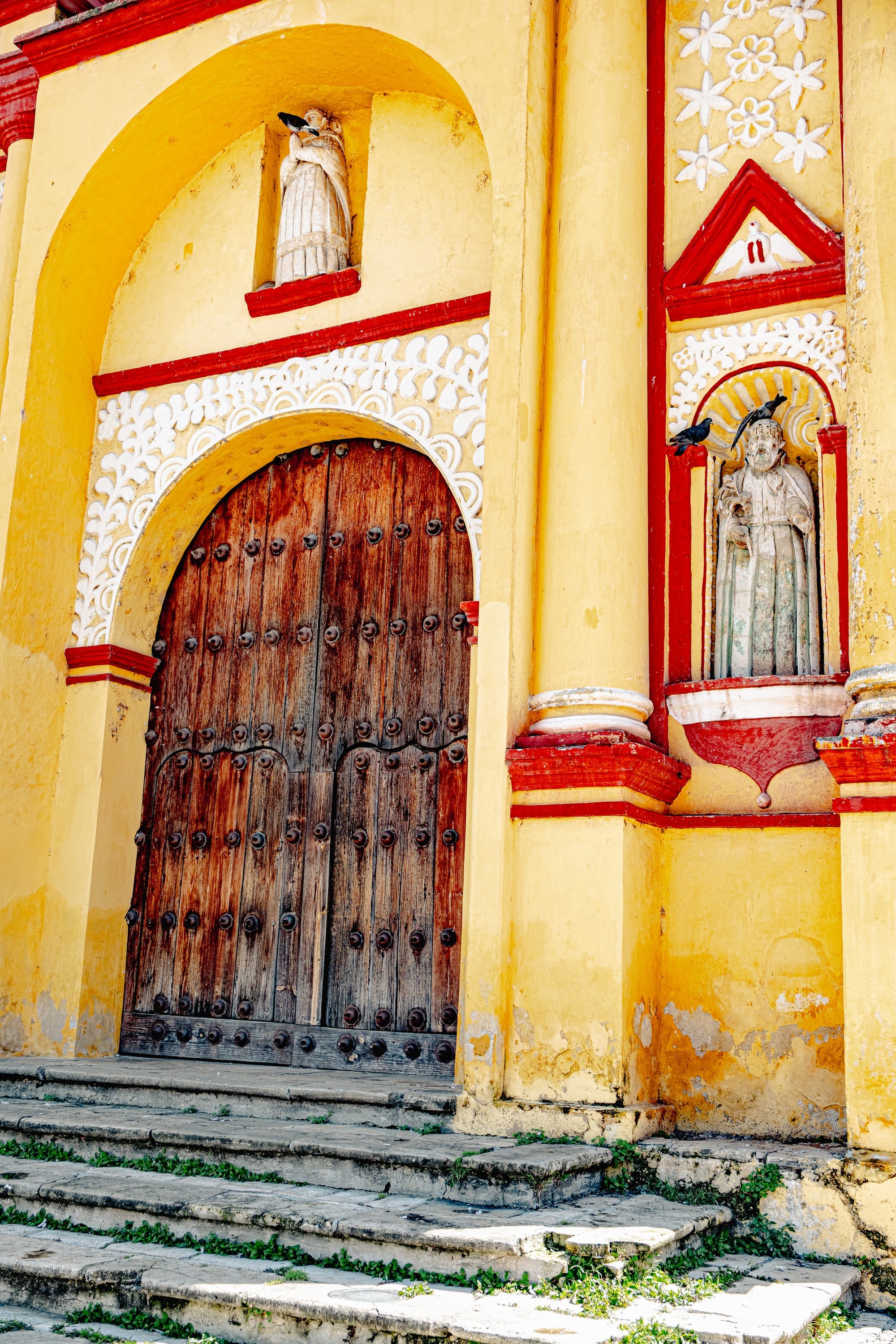
According to INAH, the first church on this site went up in 1528, the year the city was founded, and was dedicated to the Virgin Mary. It became a cathedral in 1538 and was rededicated to Saint Christopher. The building you see replaced that first church, and its main facade was finished in 1721. Look for the three levels of paired Solomonic (twisted) columns and the white stucco decoration on the yellow wall, which mixes Oaxacan and Guatemalan Baroque styles. Inside, the gilded wooden pulpit is the piece to find.
Walk around the back to see Templo de San Nicolás, built by Augustinian monks between 1613 and 1621 in Mudéjar (Moorish-influenced) style. It's the only church in the city that hasn't been significantly altered since it was built.
Templo de Santo Domingo de Guzmán
Templo de Santo Domingo de Guzmán is located a few blocks north of the main plaza, at the edge of what is now one of San Cristóbal de las Casas’ busiest public areas. Unlike the cathedral, which opens onto a broad civic square, Santo Domingo is approached through constant movement: vendors, parked cars, foot traffic, and the open-air market that fills the surrounding space throughout the day.
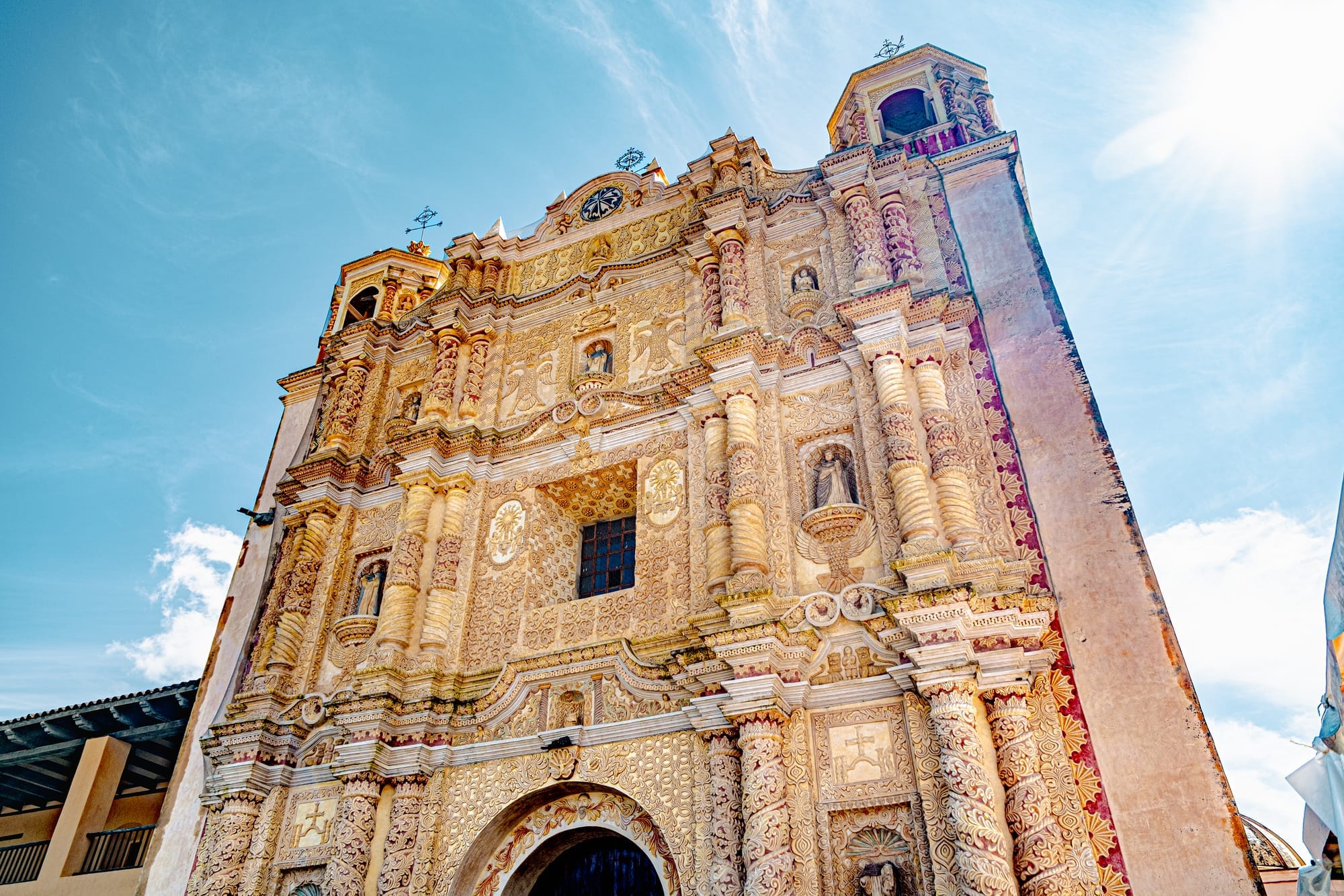
Construction of the church began in 1547 under the Dominican order, though the structure most visible today dates primarily to the late 17th century, when the elaborate façade was completed. The church is widely considered one of the most important examples of Baroque architecture in Chiapas, and it stands out immediately for the density and intricacy of its exterior decoration.
The façade is carved almost entirely in stucco, creating a deeply worked surface filled with religious imagery. Saints stand in niches stacked across multiple levels, framed by twisted columns, floral patterns, and symbolic reliefs. Unlike the restrained design of the cathedral, Santo Domingo’s exterior is highly detailed and visually demanding, drawing attention to individual figures and motifs rather than to the building as a single form. The overall color palette (earthy cream and pale stone tones) lets the carvings themselves dominate.
Two bell towers flank the façade, and a central clock sits above the main entrance. Electrical wires crossing the upper portion of the building are unavoidable and visible, and they make it clear that this is a working church in the middle of a busy city, not a preserved monument set apart from it. The church rises directly from uneven cobblestone streets, with steps leading up from an area often crowded with stalls selling textiles, handicrafts, and local goods.
The market in front of Santo Domingo is one of the most active in San Cristóbal and is closely associated with Indigenous vendors from surrounding highland communities. This proximity creates a sharp visual and cultural contrast: the highly ornate colonial façade on one side, and ordinary local buying and selling going on directly in front of it. The church’s entrance is often partially obscured by stalls and people moving through the space, which changes how it is experienced compared to churches set back from daily activity.
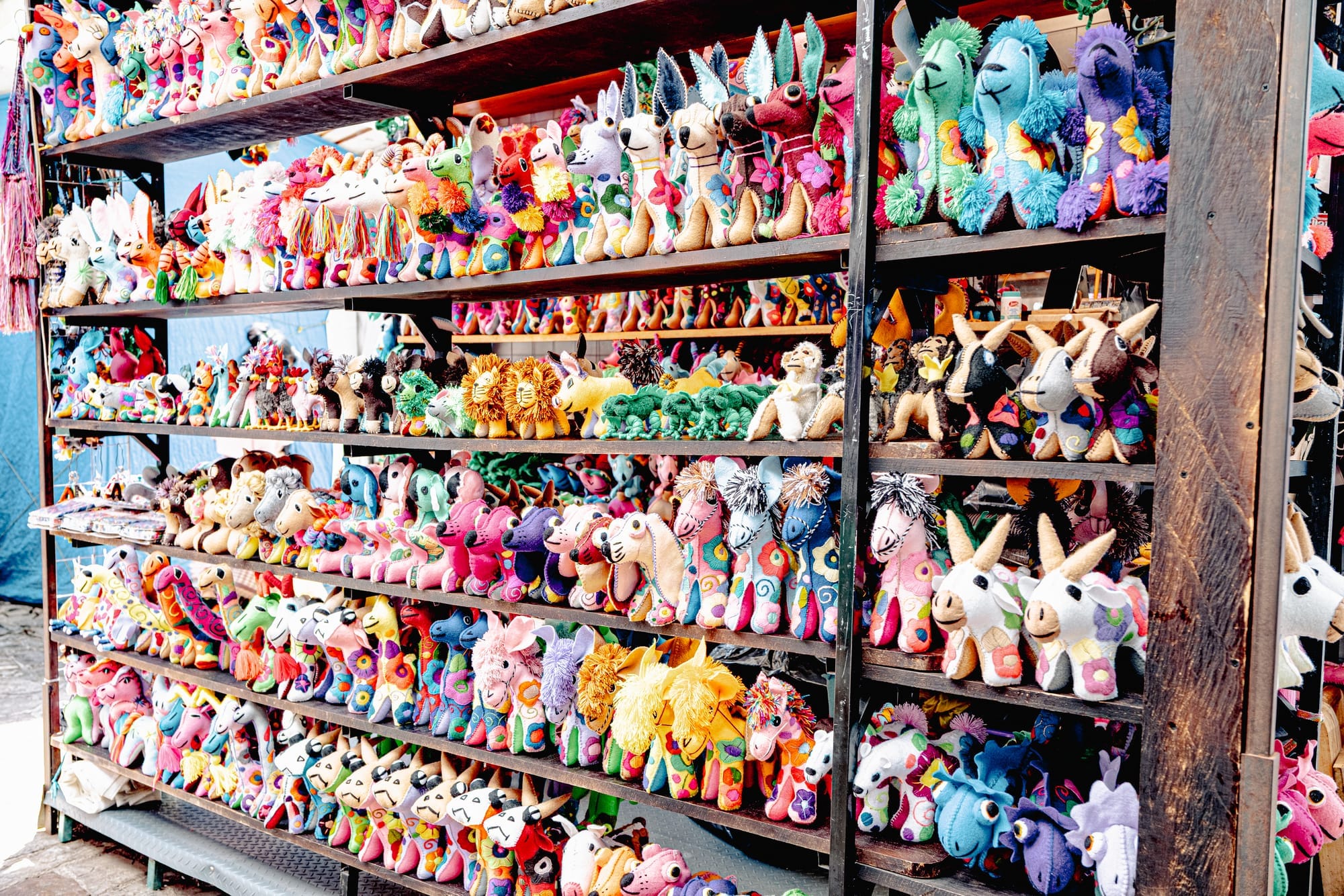
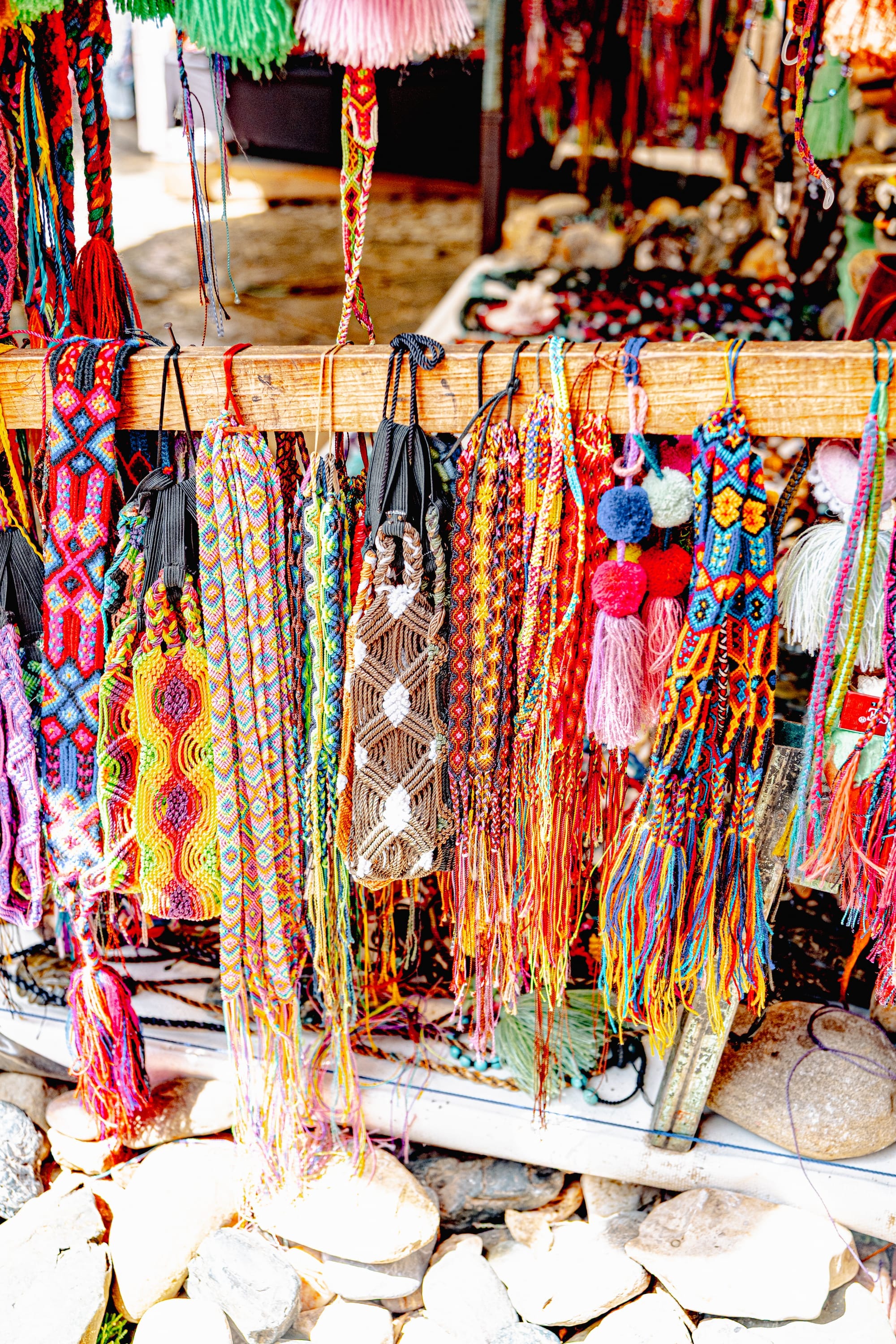
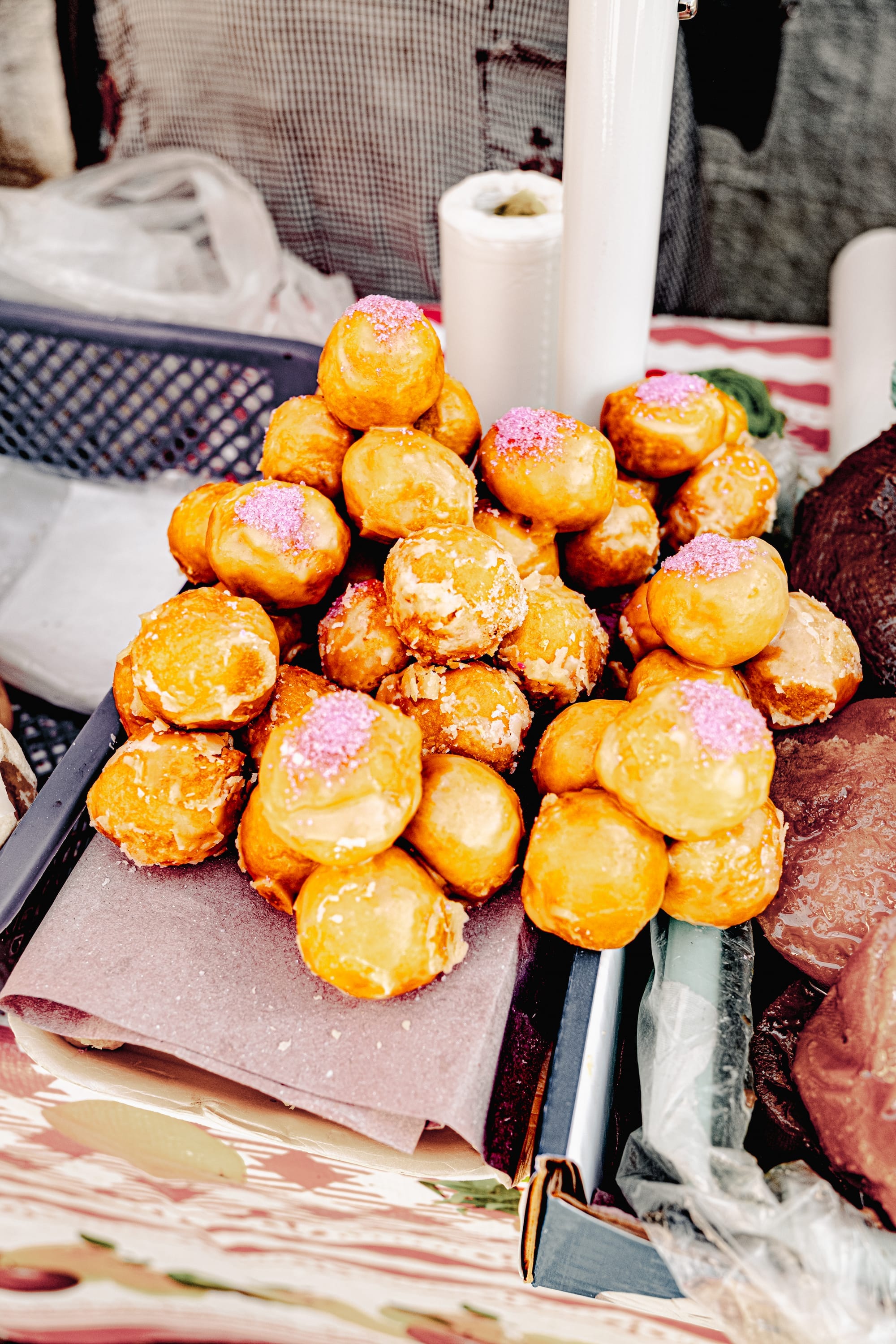
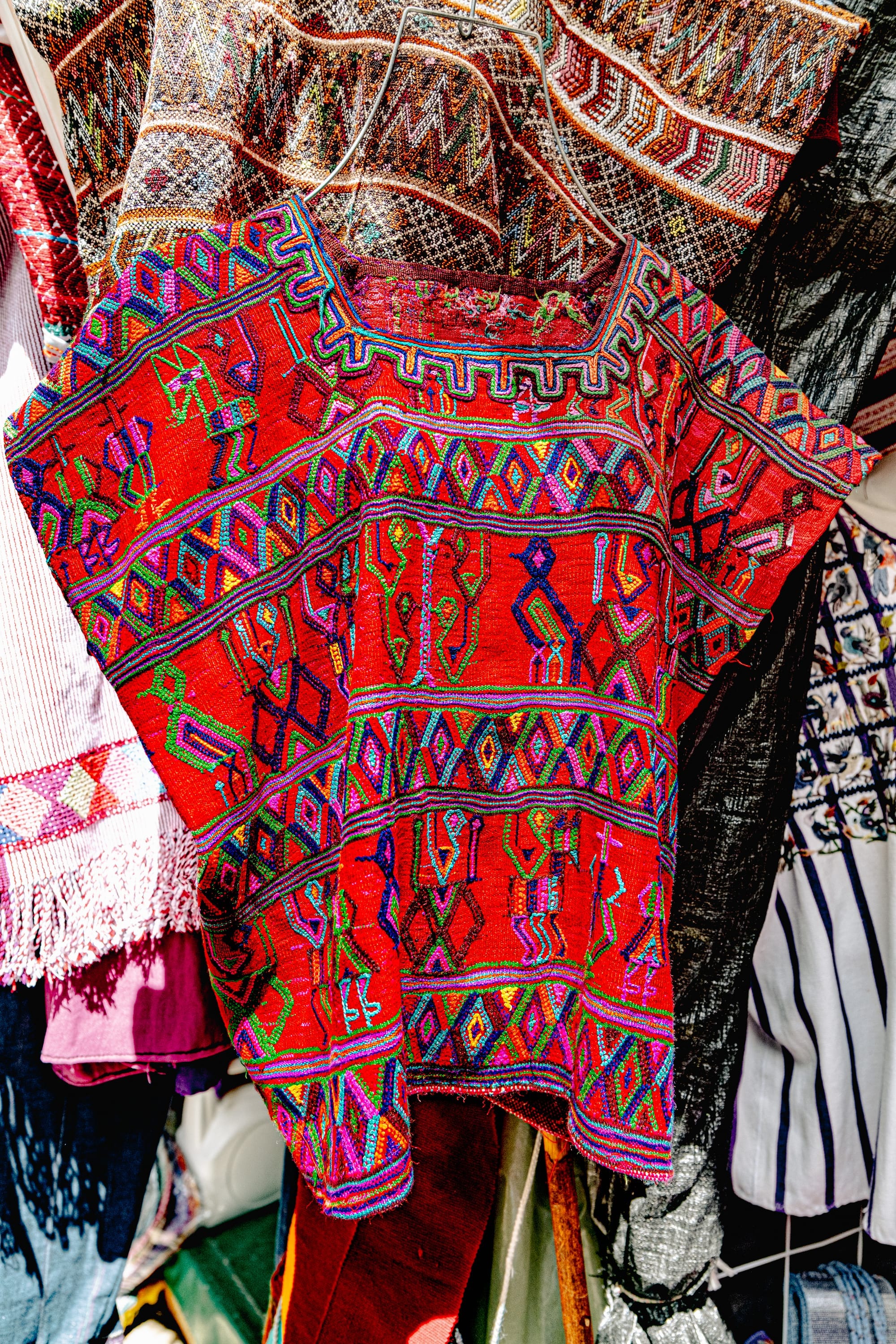
Scenes from the market surrounding Templo de Santo Domingo de Guzmán
Adjacent to Templo de Santo Domingo de Guzmán is the former Dominican convent, which today functions as a cultural and archaeological museum complex. Entered through a side access near the church, the space opens into a calm interior courtyard surrounded by thick stone walls and covered walkways. The museum focuses on regional history and archaeology, offering context on Chiapas before and during the colonial period. The courtyard itself is one of the most appealing parts of the visit: calm, shaded, and noticeably removed from the noise of the market outside. Benches line the perimeter, plants fill the central space, and the contrast between the highly ornate church façade and the restrained, inward-facing convent architecture is clear. It’s an easy place to pause after visiting the church, and well worth stepping into even if only for a short walk through the courtyard.
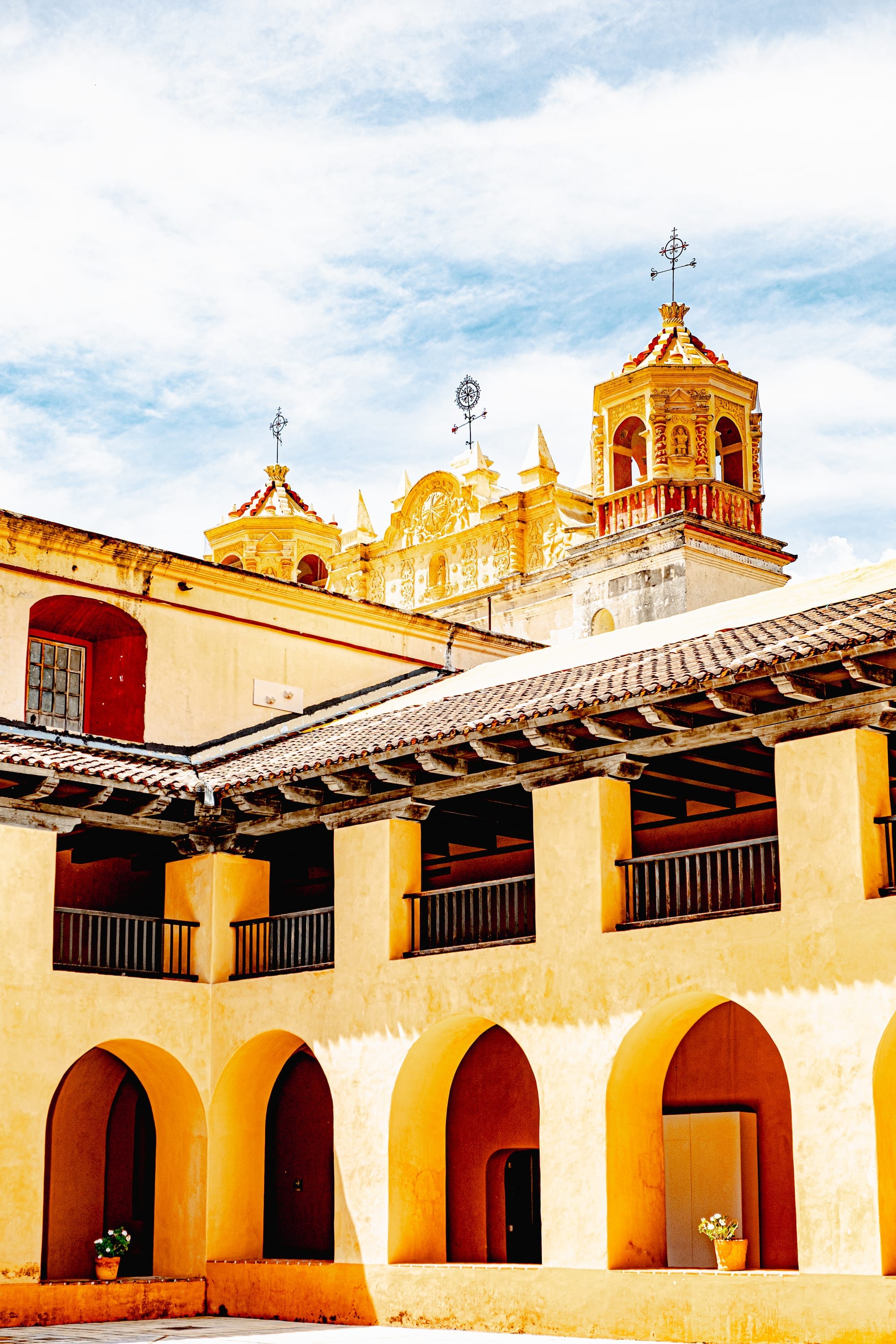
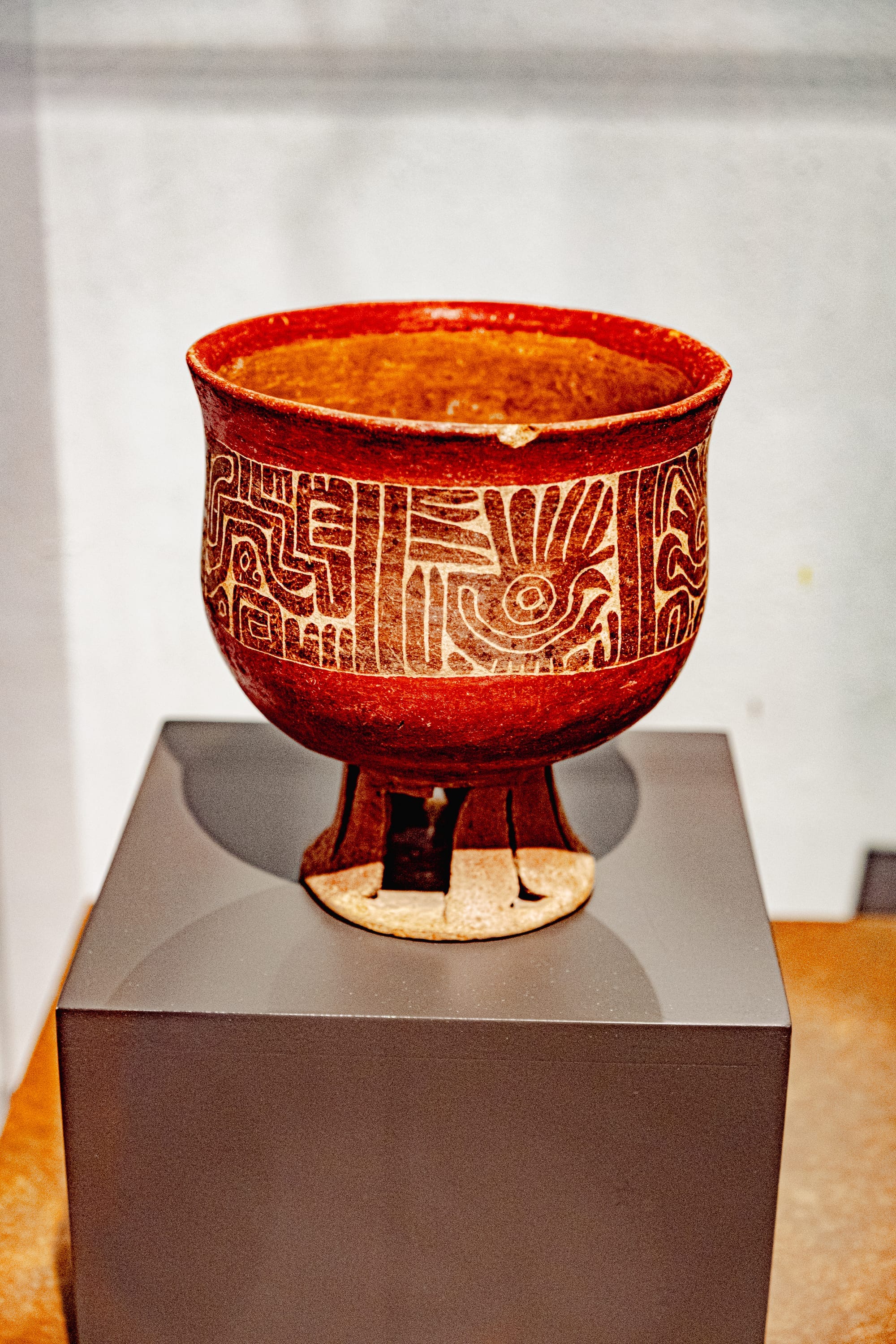
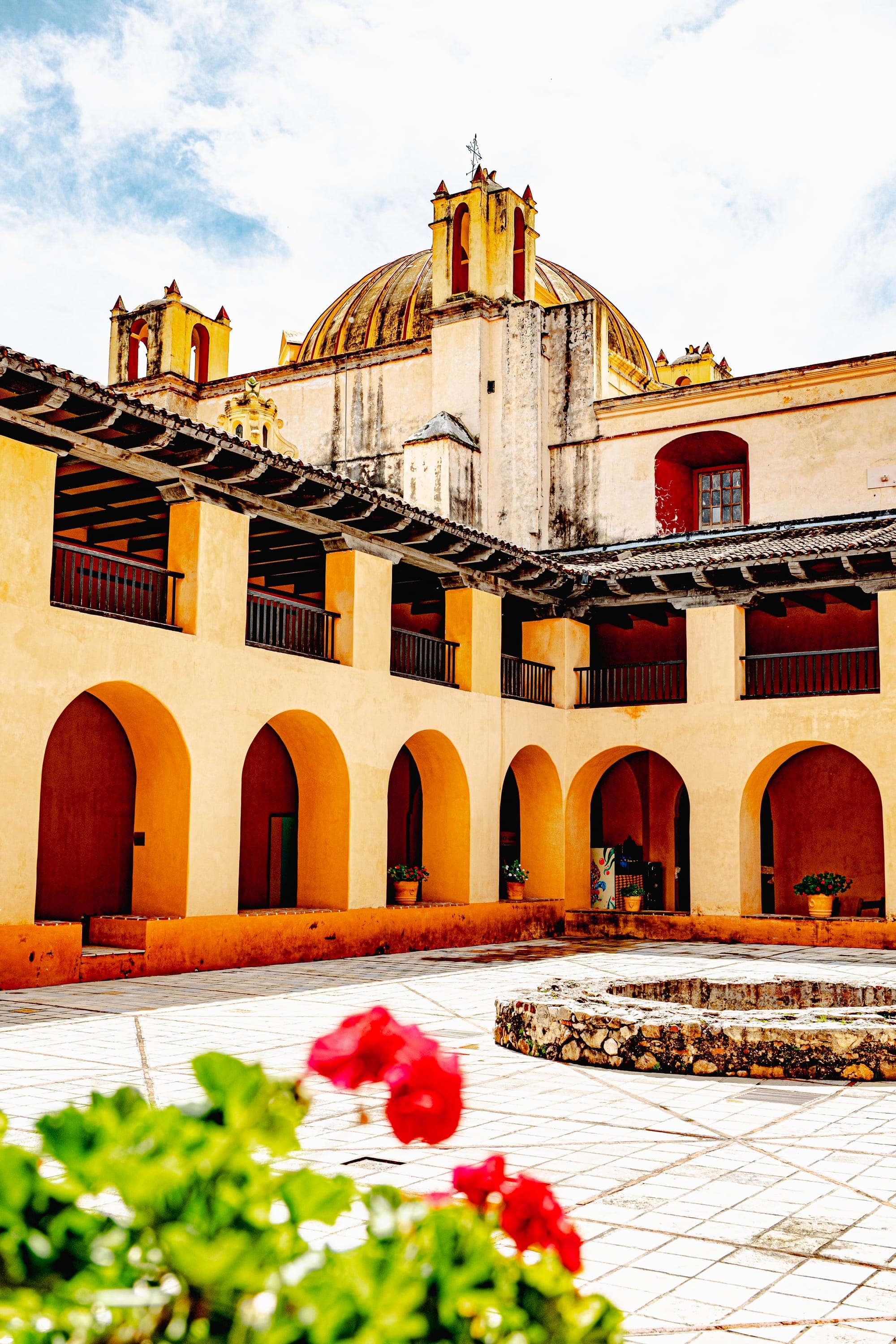
The archeological museum and courtyard
More than any single architectural detail, what defines Templo de Santo Domingo de Guzmán is its setting. You don’t see it in isolation or in silence; you see it amid traffic, conversation, bargaining, and movement. The church stands as one of the most visually elaborate structures in San Cristóbal de las Casas, yet it exists in constant negotiation with the city around it, framed as much by daily activity as by history.
Templo de Santo Domingo: the Baroque facade up close
INAH calls Santo Domingo and its ex-convent one of the main examples of Guatemalan Baroque in Mexico (INAH bulletin, 2024). The facade works like a giant altarpiece in stucco: Solomonic columns, niches of saints, and plant motifs, all modeled by hand. Between July and December 2023, INAH restorers cleaned it, repaired missing pieces with lime and sand mortar, fixed the cornices so rain no longer runs over the reliefs, and added netting to keep pigeons off the carvings.
The church was damaged in the 2017 earthquakes: a merlon fell from the facade and the wooden roof over the choir collapsed, hitting the 19th-century organ. It reopened after a full restoration under INAH's national reconstruction program (México Desconocido). Inside, gilded altarpieces run the length of the nave, and it's at its best in the late afternoon.
The ex-convent holds two museums: the Museo de los Altos de Chiapas (INAH) and the Centro de Textiles del Mundo Maya. The Museo de los Altos is listed as open Tuesday to Sunday, 9 am to 6 pm (2026, check before you go). Next door is Templo de la Caridad, built in 1712 as part of the city's first hospital for Indigenous people. Its facade is a two-level altarpiece with Tuscan columns.
INAH's listing for the Centro Cultural de los Altos de Chiapas gives entry as 145 pesos (about US$8) for foreign visitors and 80 pesos for Mexican visitors, with free entry on Sundays for Mexican citizens. Some recent guides report free entry, so check at the door before you go (2026). Flash photography isn't allowed inside, and professional cameras pay an extra fee.
Templo de Nuestra Señora de la Asunción
Templo de Nuestra Señora de la Asunción is located just a 2 minute walk away from Co404, slightly outside the main tourist core of San Cristóbal de las Casas. The church faces a small open plaza and is set back from the dense commercial activity of the historic center, giving it a calmer and more residential setting compared to Santo Domingo or the cathedral.
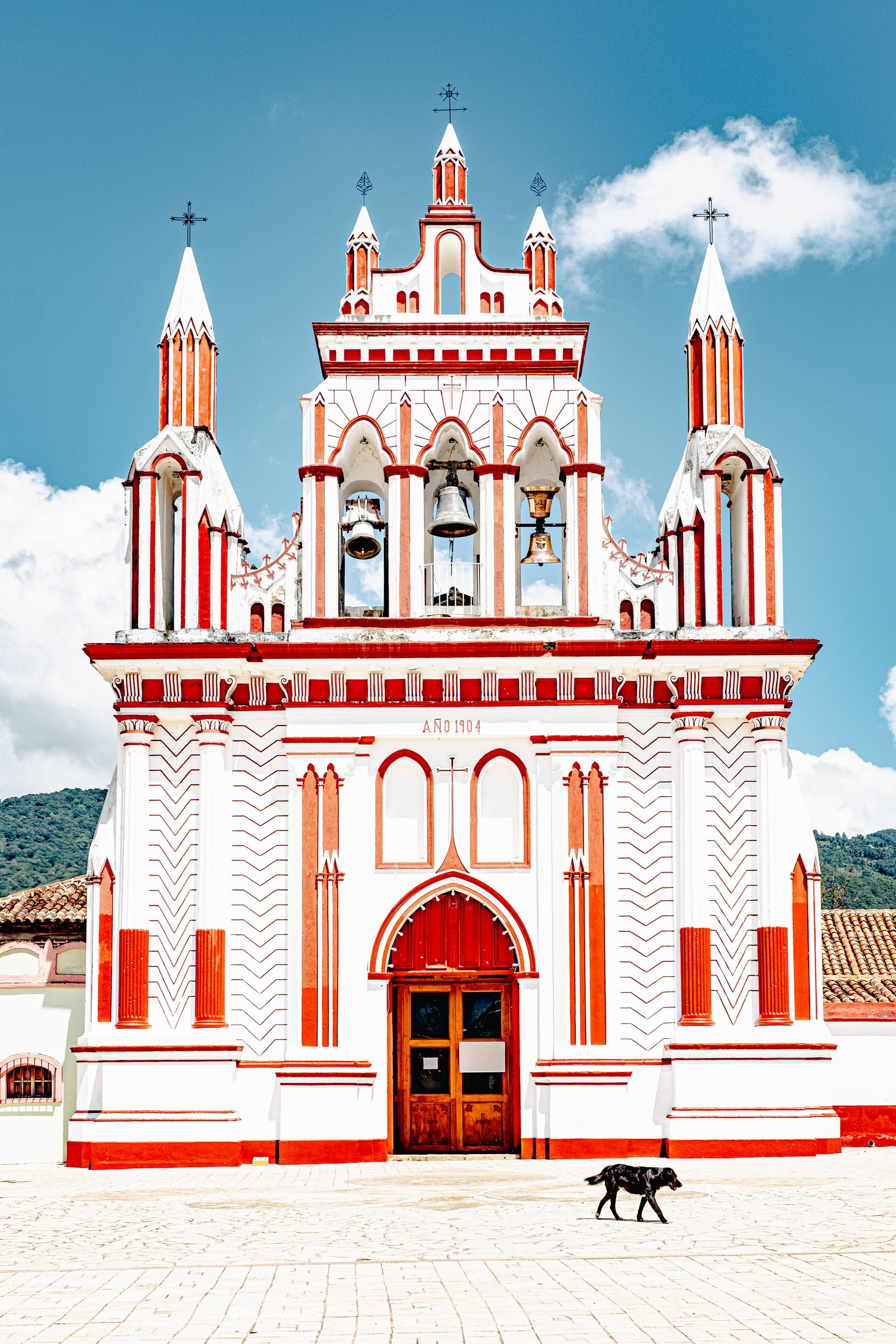
The church dates to the late 19th and early 20th century, with the year 1904 clearly inscribed on the façade. This places it well after the colonial period, and its architecture reflects that later moment in the city’s development. Unlike the Baroque churches built under Spanish colonial rule, this structure follows a neo-Gothic style, characterized by vertical emphasis, pointed arches, and a relatively clean, graphic use of form.
The façade is painted white with strong red detailing that outlines architectural features and creates a striking visual contrast. The design is symmetrical, with a central entrance framed by pointed arches and a tall upper section that houses an open bell structure. Several bells are visible from the exterior, suspended within arched openings above the main door. Slender spires rise from the upper façade and corners of the building, each topped with a metal cross.
Decoration on the exterior is restrained compared to earlier churches in the city. Rather than dense carvings or sculptural reliefs, the visual interest comes from repetition, proportion, and color contrast. The red trim highlights columns, arches, and vertical lines, giving the building a crisp and orderly appearance. The overall impression is clear and direct, without the visual complexity seen at Santo Domingo.
The plaza in front of the church is open and level, often used as a passageway by local residents rather than as a destination for visitors. It is common to see people crossing the space on foot, children playing nearby, or dogs resting in the shade. Traffic is limited, and the area generally feels calmer than the streets closer to the main market and central square.
The dedication to Our Lady of the Assumption places the church within a long Catholic tradition, but its architectural language reflects a period when San Cristóbal was expanding beyond its colonial core. Churches like this one were built to serve growing residential areas and new congregations, rather than to project colonial authority.
Templo de Nuestra Señora de la Asunción does not draw large crowds or feature prominently in most visitor itineraries, but it offers a useful counterpoint to the city’s more famous churches. It represents a later phase of religious construction in San Cristóbal de las Casas: one shaped by changing styles, expanding neighborhoods, and regular local use rather than monumentality.
This church was our personal favorite.
Templo de Nuestra Señora de Guadalupe
Templo de Nuestra Señora de Guadalupe is located on Cerro de Guadalupe, a hill rising to the east of San Cristóbal de las Casas. The church is one of the city’s most visible landmarks due to its elevated position and is accessible by climbing a long, straight staircase that begins at the base of the hill. The ascent consists of several dozen steps and offers increasingly wide views over the city as you climb.
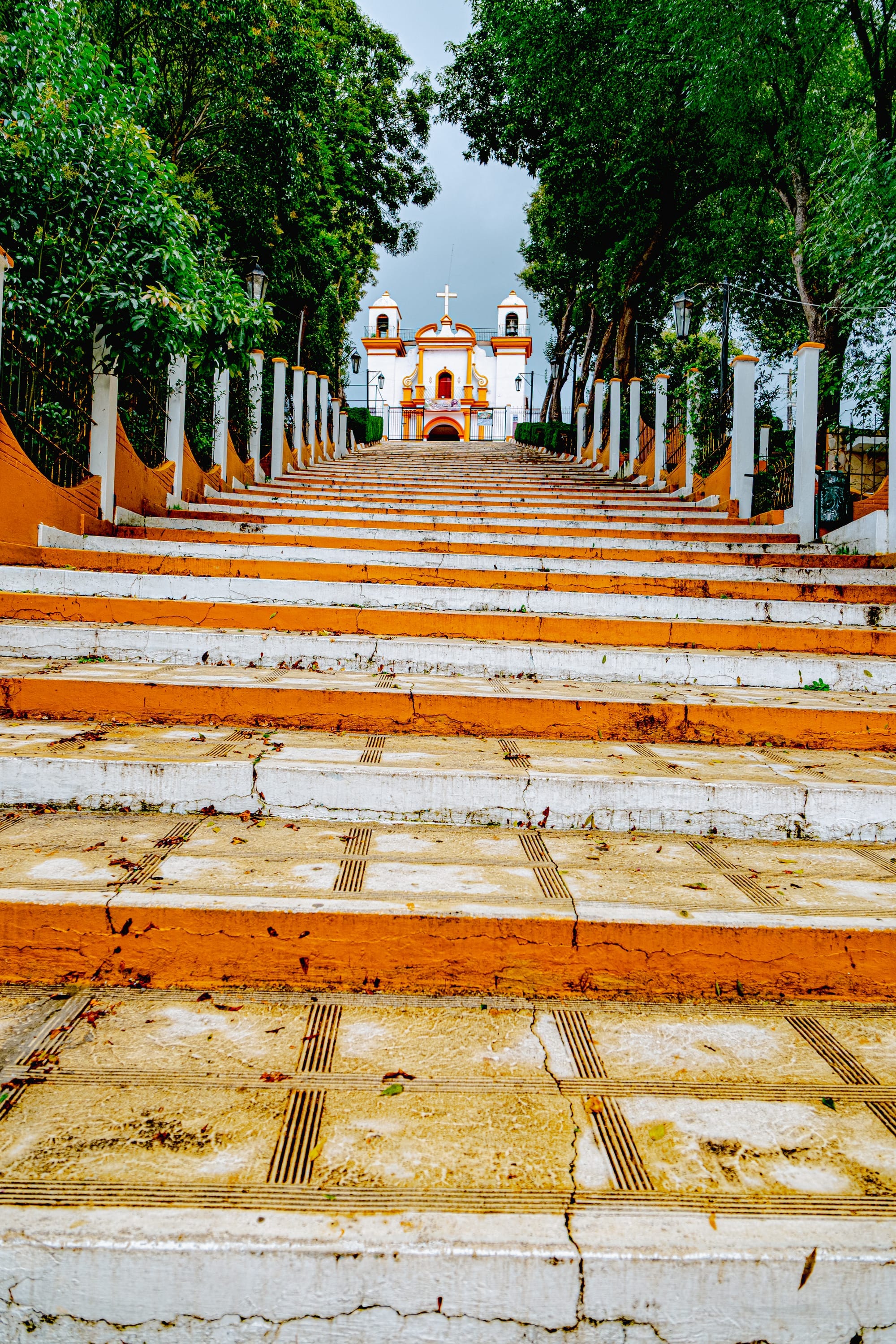
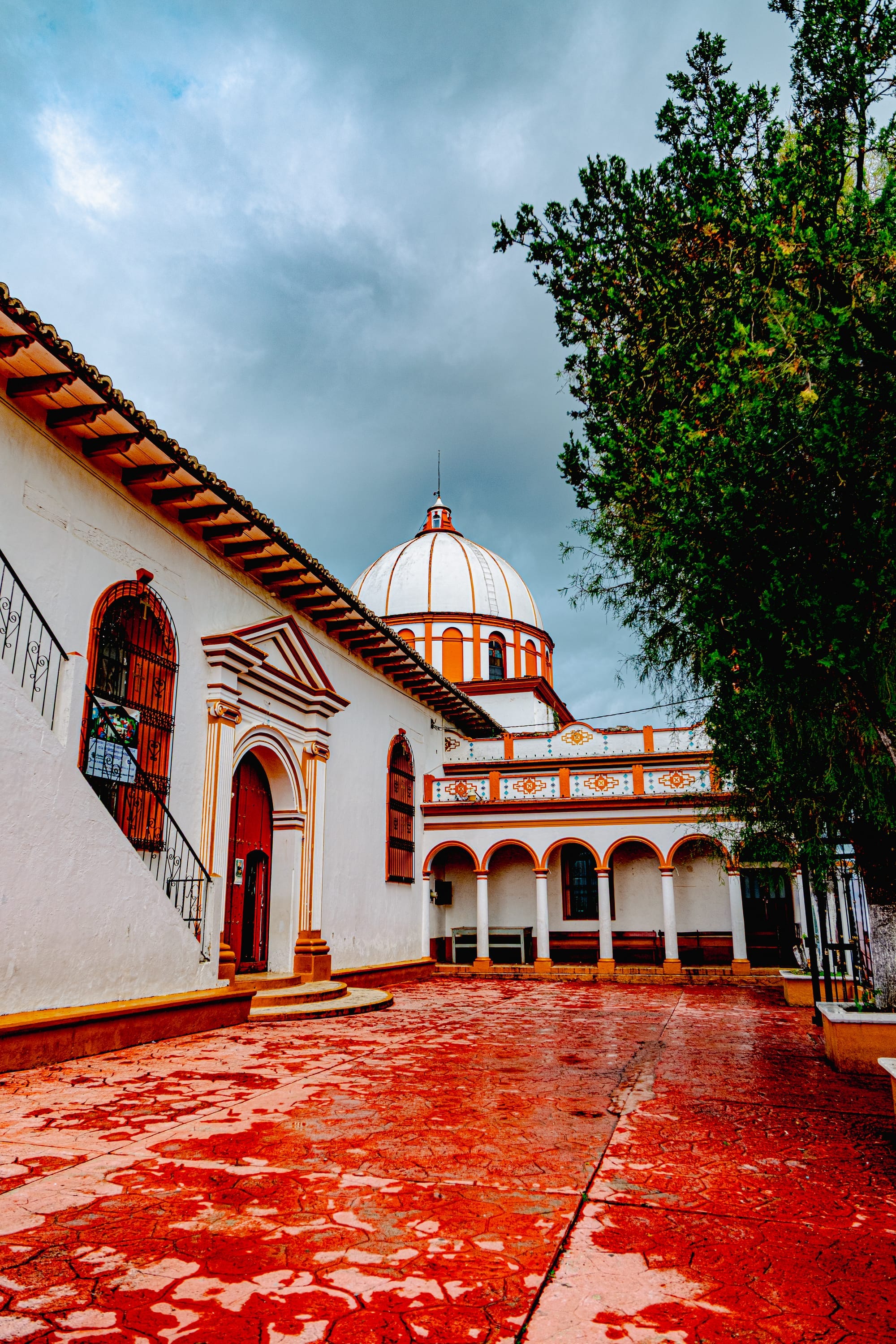
The staircase leading up to Templo de Nuestra Señora de Guadalupe
The church dates to 1834, according to Wikipedia. Like Templo de Nuestra Señora de la Asunción, it belongs to a later phase of church construction in San Cristóbal, well after the colonial Baroque period. Its architectural style is neo-Gothic, evident in the pointed arches, vertical proportions, and symmetrical layout.
The building features a central entrance with pointed arches and a tall, narrow upper section. Two slender towers rise on either side, each topped with a cross. The design emphasizes height and verticality rather than surface ornamentation, and the decoration is minimal, relying instead on form and color contrast.
At the top of the staircase, a broad open terrace extends in front of the church. This space functions both as a gathering area and as a viewpoint. From here, much of San Cristóbal de las Casas is visible, including the historic center, surrounding neighborhoods, and the hills that enclose the valley. The terrace is often busy, particularly in the late afternoon, with visitors resting after the climb, families spending time together, and vendors selling snacks or drinks.
The church is dedicated to Our Lady of Guadalupe, one of the most important religious figures in Mexico. As a result, it plays a significant role during religious celebrations, particularly on December 12, when festivities honoring the Virgin of Guadalupe take place. On these occasions, the staircase and terrace can become crowded with worshippers making the ascent as part of devotional practices.
More than any other church in San Cristóbal de las Casas, Templo de Nuestra Señora de Guadalupe is defined by elevation. The physical act of climbing sets it apart from churches encountered at street level and shapes how it is experienced. While the building itself is relatively modest, its position above the city makes it one of the most recognizable religious sites in San Cristóbal and a common point of reference in the city’s landscape.
Wikipedia dates Templo de Guadalupe to 1834 and puts the climb at 79 steps from the end of Real de Guadalupe, the pedestrian street that runs up from the center. Inside there's a single nave with a side chapel, an oil painting of the Virgin of Guadalupe over the main altar, and an 1850 sculpture of the Virgin in the chapel. Like El Cerrito, it's a daytime climb.
La Merced, El Carmen, and San Francisco churches
Three more churches are worth a short stop if you're walking between the plaza and the market. All three are in the historic center, and dates below come from Wikipedia and INAH's historic-zone listing.
Templo de la Merced
La Merced was the city's first monastery, founded by Mercedarian friars from Guatemala in 1537. It was built like a fortress, with a huge wooden door and few windows. The church has a single nave remodeled in Neoclassical style, and the oldest piece left is an arch and columns in the sacristy. The convent later served as a barracks and, from 1960 to 1993, as the city jail. Since 2000 it has been the Museo del Ámbar, the amber museum. The plaza in front is a good place for a break.
Templo del Carmen and the Arco del Carmen
El Carmen is all that survives of the convent of La Encarnación, founded in 1597. The church burned at one point, and the rebuilt facade is plain, but the arch and tower beside it are the real draw. Built in 1680 in Mudéjar style, with three decorated levels, the Arco del Carmen once marked the entrance to the colonial city. It stands at the south end of the pedestrian street Andador Hidalgo, and the old convent next to it is now the Centro Cultural El Carmen, with a large garden.
Templo de San Francisco
The Franciscans founded a monastery here in 1577, but only the church survives, and most of what you see is 18th century. It has a single nave, a three-level facade between two towers, six Baroque altarpieces, and fourteen oil paintings high up in the nave. Look for the carved stone baptismal font in the atrium.
Santa Lucía, San Nicolás, El Calvario, and El Cerrillo
INAH counts 19 religious buildings in the historic zone, so there's always one more around the corner. These four are worth a look if you pass them:
Templo de Santa Lucía: the white and blue church in Barrio de Santa Lucía. You can pick out its facade from the top of Cerro de San Cristóbal, and the barrio fills with blue and white flags for its feast on December 13.
Templo de San Nicolás: the small yellow church just behind the cathedral, built by Augustinians between 1613 and 1621 and the least altered church in town (more on it in the cathedral section above).
Templo del Calvario: a small barrio church with its own plazuela, worth a look if you're walking past.
El Cerrillo (Templo del Señor de la Transfiguración): the barrio church just behind Santo Domingo, on a plaza where marimba bands play. It's the center of our El Cerrillo street art walk.
A walking route to the churches of San Cristóbal de las Casas
This route covers the main churches in San Cristóbal de las Casas in one loop. It starts with the climb to Guadalupe while it's cool and ends on the San Cristóbal staircase in early afternoon, so both hills are done in daylight. Allow four to five hours with stops, or a full day if you go into the museums.
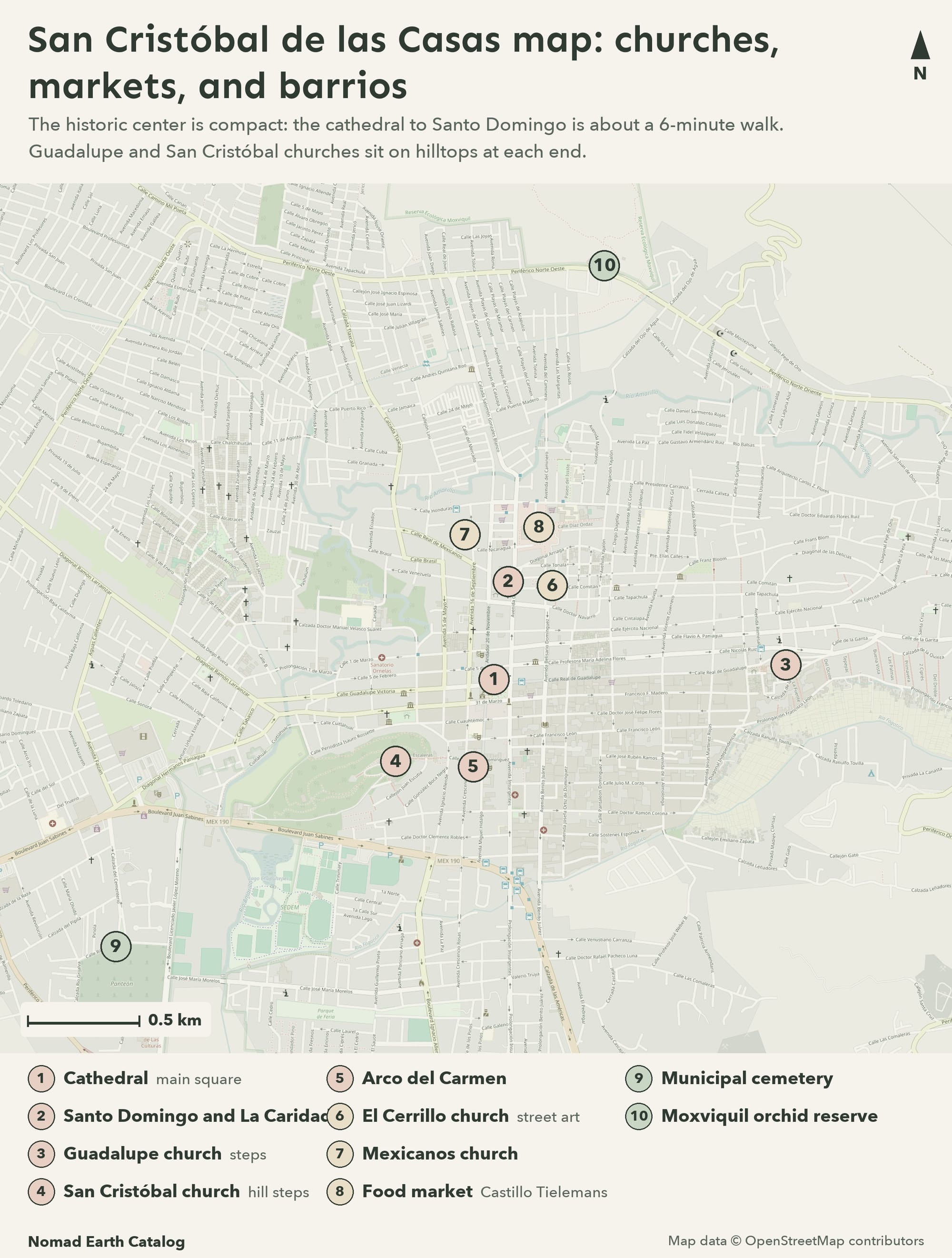
1. Templo de Guadalupe. Walk east along the pedestrian street Real de Guadalupe to the end and climb the 79 steps. Go early: the light over the city is better, and the terrace is emptier.
2. The cathedral and San Nicolás. Walk back down Real de Guadalupe to Plaza 31 de Marzo. Look at the cathedral facade from the plaza, go inside for the pulpit, then walk around the back to San Nicolás.
3. Santo Domingo and La Caridad. Head north on the Andador 20 de Noviembre, about five to ten minutes. Stop at the crafts market, the Museo de los Altos de Chiapas, and the textile center in the old convent. This is the best place for a coffee break.
4. El Carmen and San Francisco. Walk back through the plaza and south down the Andador Hidalgo to the Arco del Carmen. San Francisco is a block east, on Avenida Insurgentes.
5. La Merced. Cross west through the center to La Merced and the Amber Museum. The plaza in front is a good place to rest before the last climb.
6. San Cristóbalito. Finish at the staircase up Cerro de San Cristóbal, southwest of the center, and stay for the view. Plan to be back down well before dark.
Walking between the two hills takes about 30 minutes on its own, with a steep climb at each end, so skip one if you're short on time or energy. San Cristóbal sits at about 2,200 m, and the altitude makes the stairs harder than they look.
Church opening hours, entry, and what to wear
All the churches in San Cristóbal de las Casas are working churches, so they're free to enter and follow their own schedules. A few practical points:
Hours: most open from around 8 or 9 am until early evening. Some, including the cathedral, may close for a few hours in the middle of the day, and the hill churches are often locked outside Mass (2026, check locally).
Entry: free. The museums in the Santo Domingo, La Merced, and El Carmen ex-convents have their own hours and fees, so check before you go.
What to wear: there's no posted dress code, but covered shoulders, no hats, and nothing too short is the respectful choice, especially during Mass.
Photos: generally fine inside the city's churches without flash, but not during services, and never of people praying without asking. In nearby San Juan Chamula, photos inside the church are banned outright (see our Chamula guide).
Safety: climb the Guadalupe and El Cerrito staircases in daylight.
Wikivoyage adds that solo women have been harassed on Cerro de Guadalupe even during the day, so go with someone if you can, and after dark call a taxi rather than hailing one on the street.
Church etiquette during Mass and fiestas
These are working parish churches, and many people come in to pray between errands. A few habits help:
- Keep your voice low and your phone on silent, and stay at the back or along the side aisles if a Mass, wedding, or funeral is on.
- Don't walk up the center aisle or stand near the altar during a service, and don't touch candles, flowers, or offerings left at the altars and saints.
- Take your hat off inside and leave food and drinks outside.
- If you want to give something, use the offering box rather than handing money to people.
- During fiestas, expect fireworks, bands, and crowds on the steps. Stand aside for processions, and never photograph someone praying without asking first.
- Rules are much stricter in the nearby villages. Wikivoyage notes that Zinacantán bans photos of its church inside and out, and Chamula bans them inside.
Church feast days in San Cristóbal
Each church has its own fiesta, when the barrio fills with music, stalls, and fireworks. If your dates line up, it's the best time to see a church in use. Dates from Wikipedia in Spanish:
| Church | Feast day |
|---|---|
| San Cristóbal (El Cerrito) | July 25 |
| Mexicanos (Nuestra Señora de la Asunción) | July 31 to August 18 |
| El Cerrillo (Transfiguración) | August 6 |
| Santo Domingo | August 8 |
| La Merced | September 24 |
| San Francisco | October 4 |
| La Caridad | November 21 |
| Guadalupe | December 1 to 12 |
| Santa Lucía | December 13 |
The Guadalupe fiesta is the biggest. From December 1 to 12, pilgrims fill the church, its plaza, and part of Real de Guadalupe, so expect crowds on the steps and book your room early.
For where to eat, stay, and work between church visits, see our San Cristóbal guide. For more buildings worth traveling for, see our architecture guide.
Seeing the city through its churches
Taken together, these churches offer a useful way to understand San Cristóbal de las Casas beyond its streets and cafés. They show how the city is organized spatially (from the dense historic center to hillside neighborhoods) and how religious architecture remains part of the way people move around the city each day rather than set apart from it.
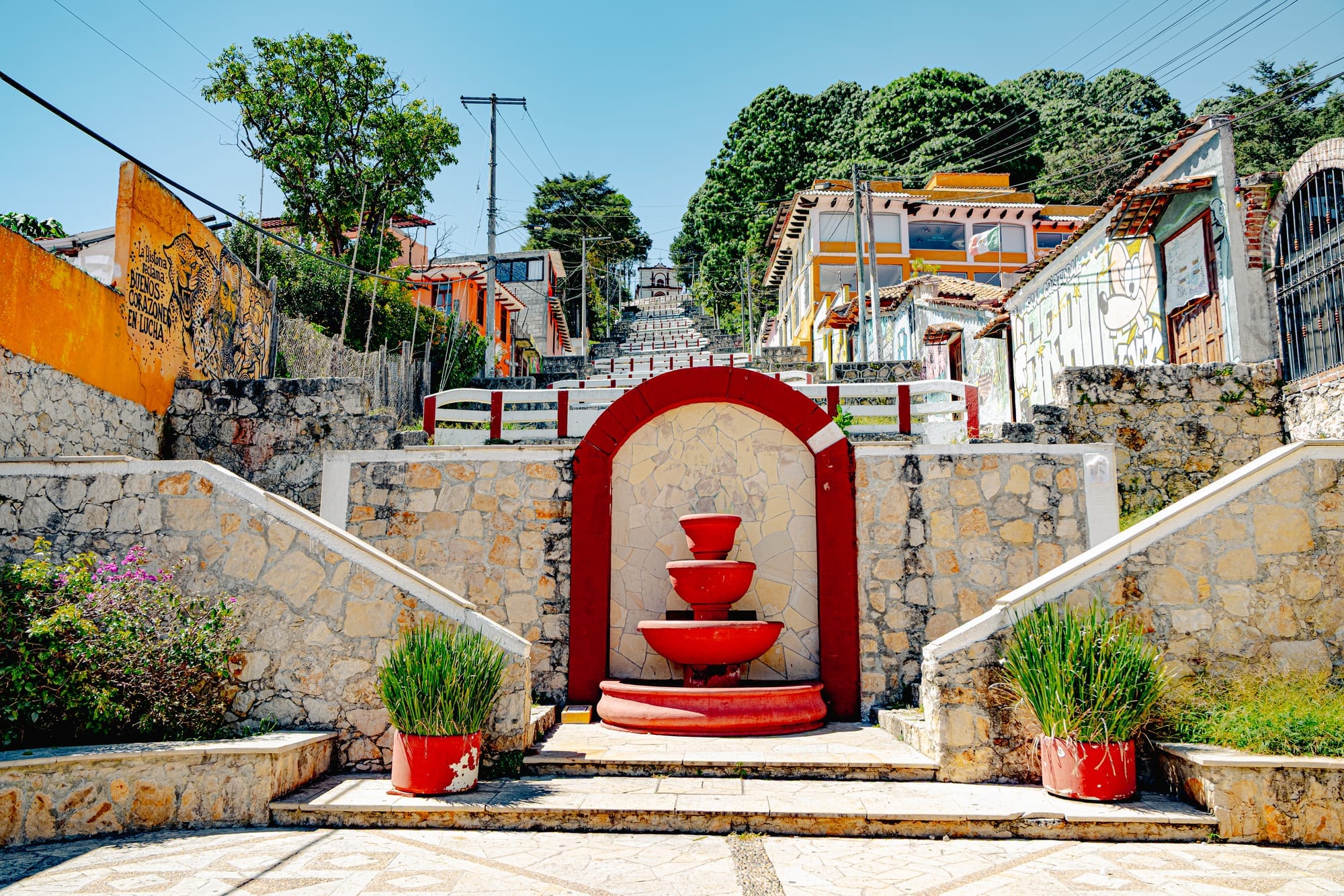
Some churches are encountered almost incidentally, fronting busy plazas or markets where the city carries on around them. Others require intention and physical effort, reached by staircases that pass through residential areas, street art, and viewpoints overlooking the city. The differences in approach matter, shaping how each place is experienced and remembered.
Architecturally, the range is equally clear. Baroque façades heavy with ornament sit alongside later neo-Gothic buildings defined by symmetry and color contrast. Some churches draw attention through detail and decoration, while others rely on elevation, visibility, or location to establish their presence. Together, they reflect different moments in San Cristóbal’s growth and different priorities in how religious spaces were built and placed.
Nearby, see the Moxviquil orchid garden.
Whatever your plans, travel with insurance. Stomach bugs, a fall on a cobbled street, or a stolen phone can happen anywhere, and it's much easier to enjoy the trip when you know you're covered. We'd recommend SafetyWing Nomad Insurance. It covers medical emergencies abroad, you can buy it even after you've left home, and it renews every four weeks, so it works for a short trip or months on the road.
Where to stay in San Cristóbal de las Casas
San Cristóbal de las Casas is the base for this, with the most places to stay and eat. These are well-reviewed options, all rated 9 or more on Booking:
- Parador Margarita: a well-run, good-value hotel a few blocks from the center, rated 9.1 from over 1,400 reviews.
- Casa Carmen: a small guesthouse with a courtyard, rated 9.6.
- Casa Santa Lucía: a colonial-style boutique stay in the center, rated 9.5.
Frequently asked questions
What are the most important churches in San Cristóbal de las Casas?
The cathedral on the main plaza and Templo de Santo Domingo are the two big ones. Add Guadalupe and San Cristóbal (El Cerrito) for the hilltop views, and La Merced, El Carmen, and San Francisco if you have time.
What is the most beautiful church in San Cristóbal de las Casas?
Most people say Templo de Santo Domingo, for its carved stucco Baroque facade and gilded interior. INAH counts it among the main examples of Guatemalan Baroque in Mexico.
When was Templo de Santo Domingo built?
Dominican friars laid the first stone in 1547 and finished the first monastery in 1551. The Baroque facade you see today dates from the 17th century, and INAH restored it again in 2023.
Are the churches in San Cristóbal de las Casas free to visit?
Yes, the churches are free. The museums in the ex-convents, like the Museo de los Altos de Chiapas at Santo Domingo, have their own hours and fees.
How many steps are there to the Guadalupe church in San Cristóbal?
About 79 steps lead up Cerro de Guadalupe from the end of Real de Guadalupe. The climb at 2,200 m is harder than it sounds, so take breaks and go in daylight.
What should I wear to visit churches in San Cristóbal de las Casas?
There's no formal dress code, but covered shoulders, no hats, and nothing too short is respectful, especially if Mass is on. Bring a light jacket anyway: churches are cool inside, and so are highland mornings.
Can you take photos inside churches in San Cristóbal de las Casas?
In the city's churches, generally yes, without flash and not during services. Don't photograph people praying without asking. In San Juan Chamula, photography inside the church is not allowed at all.
How long do you need to see the churches in San Cristóbal de las Casas?
A morning covers the cathedral, Santo Domingo, and La Caridad, plus one hill church. For all the main churches, including both hill climbs, allow four to five hours, or a full day with the museums in the old convents.
Which church in San Cristóbal has the best view?
Templo de Guadalupe, on the hill at the east end of Real de Guadalupe, has the classic view back over the center. San Cristóbalito, on the hill to the southwest, has a wider view of the rooftops and the hills around the valley. Both are daytime climbs.
Is it safe to climb to the Guadalupe and San Cristóbal churches?
By day, generally yes, but both staircases are best avoided after dark, and Wikivoyage reports that solo women have been harassed at Guadalupe even in daylight. Go in the morning or early afternoon, ideally with someone.
What is the oldest church in San Cristóbal de las Casas?
The cathedral stands on the site of the city's first church, begun in 1528, though the current facade dates from 1721. La Merced was the first monastery, founded in 1537, and San Nicolás, built from 1613 to 1621, is the church that has changed least since it was built.
When is the Guadalupe festival in San Cristóbal?
The fiesta runs from December 1 to 12 and peaks on December 12, the day of the Virgin of Guadalupe. The church, its plaza, and the lower part of Real de Guadalupe get very crowded.
Is there an entry fee for the Santo Domingo museum?
INAH lists 145 pesos (about US$8) for foreign visitors and 80 pesos for Mexican visitors at the Centro Cultural de los Altos de Chiapas, open Tuesday to Sunday, 9 am to 6 pm. Some guides report free entry, so check at the door (2026). The church itself is free.
Useful links: San Cristóbal historic monuments zone (INAH), Santo Domingo conservation bulletin (INAH, 2024), San Cristóbal de las Casas (Wikipedia), and San Cristóbal de las Casas (Wikivoyage).
More from San Cristóbal and Chiapas: the El Cerrillo street art, El Arcotete, a fungi hike in the highlands, the Panteón Municipal, the Palenque ruins, and our San Cristóbal guide.


