


San Juan Chamula, usually just called Chamula, is a Tsotsil Maya town about 10 km from San Cristóbal de las Casas in Chiapas, Mexico, famous for its church of San Juan Bautista, where pine needles cover the floor and families hold healing rituals by candlelight. Entry to the church costs about 25 to 35 pesos, and photos inside are strictly banned. A colectivo gets you there in about 20 minutes for around 20 pesos. Most people pair it with neighboring Zinacantán, known for flowers and weaving, in a half-day trip. Sunday, market day, is the busiest and most interesting time to go.
In the highlands of Chiapas, just a short drive from San Cristóbal de las Casas, two neighboring towns, San Juan Chamula and Zinacantán, are home to the living traditions, resilience, and syncretic spirituality of the Tzotzil Maya people. Though separated by only ten kilometers, each town has a distinct identity, shaped by centuries of history, ritual practice, and a lasting connection to land and lineage.
Visitors to these towns often come for color and culture: the woven textiles of Zinacantán and the incense-filled rituals of Chamula. If you take your time and visit with respect, you find something deeper: a continuity of belief that has survived conquest, colonization, and modern tourism alike.
If you want to visit these two communities with context and care, we recommend joining a locally guided tour such as this Chamula and Zinacantán Guided Tour from San Cristóbal. You travel with knowledgeable local guides who explain Tzotzil culture, language, and customs, and who make sure visits are respectful and sustainable.
San Juan Chamula and Zinacantán at a glance
Here are the practical basics before we get into the history and rituals. Fees and fares are set locally and change often, so treat these as 2026 guides and carry small bills in pesos.
Where: both towns sit in the Chiapas highlands, northwest of San Cristóbal. Chamula is about 10 km away by road and Zinacantán about 11 km, with roughly 5 km between them.
Who lives there: the Tsotsil (also spelled Tzotzil) Maya, whose language is the first language in both towns. Chamula's municipality had about 102,000 residents in the 2020 census, though the town center itself is small.
Chamula church fee: about 25 to 35 pesos, paid at the ticket office by the main square. No photos or video inside.
Zinacantán fee: a small fee or donation for the churches. Visitors report different amounts, so ask on arrival.
Getting there: colectivo vans for about 20 to 25 pesos each way, a taxi for about 100 to 150 pesos, or a half-day tour that covers both towns.
Time needed: two hours for Chamula, two for Zinacantán, so a morning or a half day for both.
Best day: Sunday, when both towns hold their markets. Go early, as Zinacantán's market wraps up by late morning.
Altitude: Chamula sits at about 2,200 m and Zinacantán higher still, so mornings are cold. Bring a warm sweater.
San Juan Chamula vs Zinacantán
The two towns are only a few kilometers apart, but they're very different visits. This is how they compare (fees and fares as reported in 2026, so check on arrival):
| San Juan Chamula | Zinacantán | |
|---|---|---|
| Distance from San Cristóbal | About 10 km, 20 minutes | About 11 km, 20 minutes |
| Main church | San Juan Bautista: pine-needle floor, no pews, candles, and healing rituals | San Lorenzo: pews, altars covered in fresh flowers |
| Church fee | About 25 to 35 pesos, ticket office by the square | Small donation, often around 15 to 20 pesos |
| Photos inside | Strictly banned, enforced with fines or confiscation | Generally not allowed; always ask |
| Known for | Rituals, community self-government, Carnaval | Flower greenhouses, backstrap weaving, embroidered clothing |
| Market | Sunday, big and local, into the afternoon | Sunday morning, smaller, ends by late morning |
| Population (2020 census) | About 102,000 in the municipality | About 45,000 in the municipality |
| San Juan Chamula | Zinacantán | |
|---|---|---|
| Distance from San Cristóbal | About 10 km | About 11 km (5 km from Chamula) |
| People | Tsotsil Maya; about 102,000 in the municipality (2020) | Tsotsil Maya |
| Church fee | About 30 to 35 pesos, no photos inside | Small fee or donation, ask on arrival |
| Getting there | Colectivo 20 to 25 pesos each way, taxi 100 to 150 pesos | Same options, or a half-day tour of both |
| Time needed | Two hours | Two hours |
| Sunday market | Yes | Yes, wraps up by late morning |
| Altitude | About 2,200 m | Higher than Chamula |
The Chiapas highlands: a brief context
Chiapas is one of Mexico’s most culturally diverse states, home to more than a dozen Indigenous groups. The Tzotzil and Tzeltal Maya, who live in the central highlands, trace their roots to pre-Columbian civilizations that once flourished across southern Mexico and Guatemala. After Spanish colonization in the 16th century, many communities retreated into the mountains, preserving their languages and customs through a careful blend of Indigenous and Catholic practices.
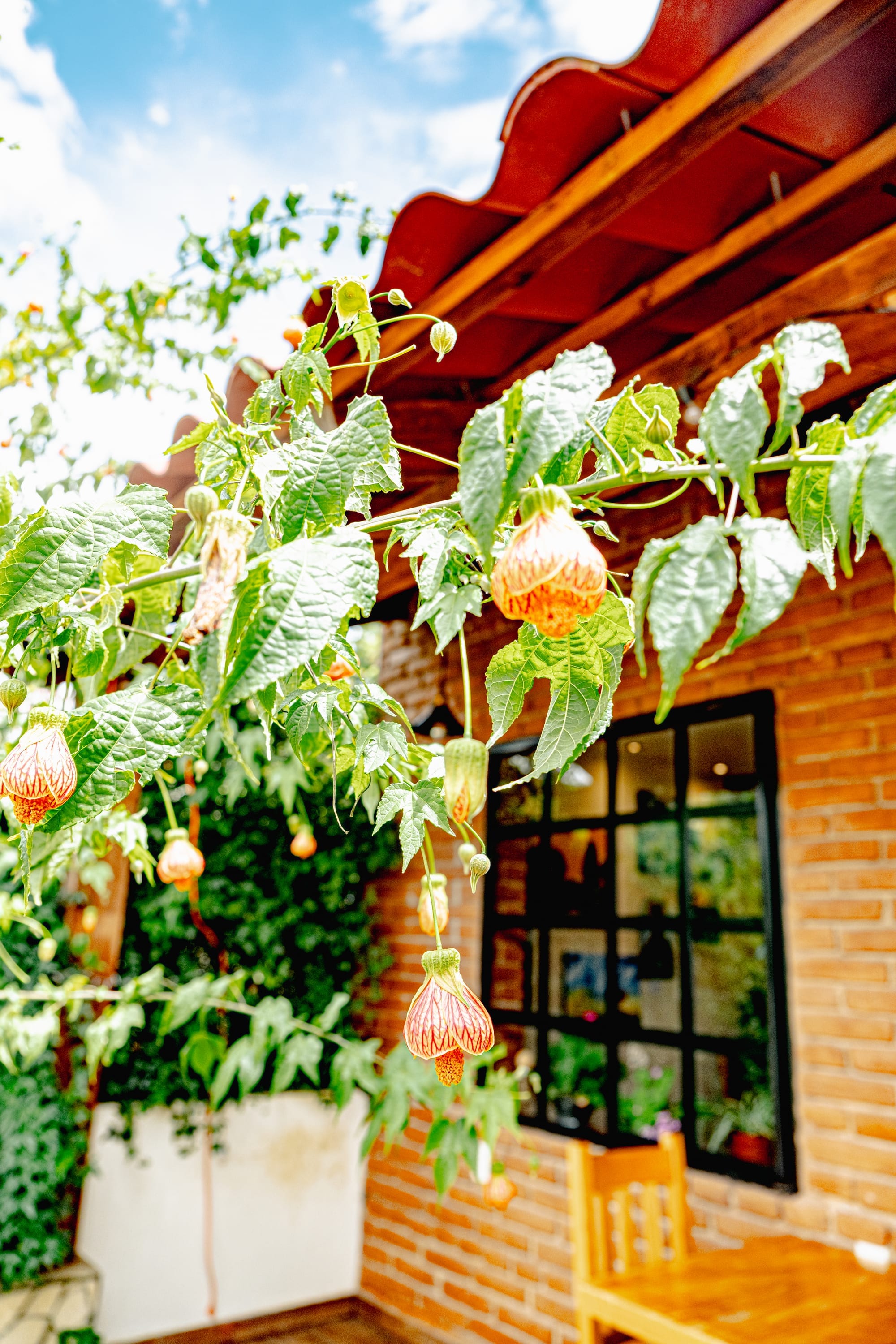
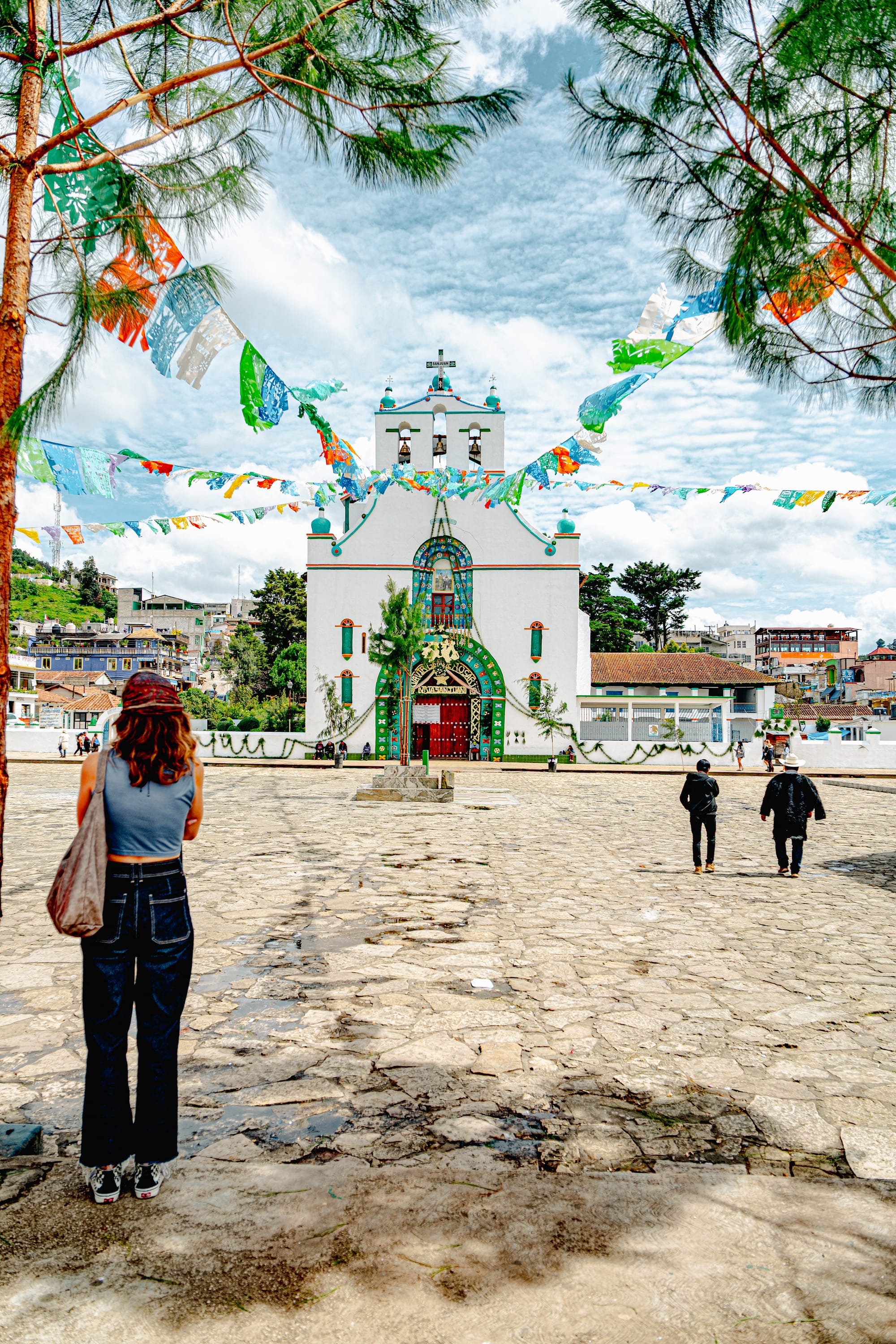
Scenes from San Juan Chamula and Zinacantán
The region’s cool climate and rugged terrain have long shaped local life. Most families farm maize, beans, and squash on steep milpas, combining agriculture with weaving, trade, and artisanal work. Religious festivals punctuate the agricultural calendar, blending elements of Catholic feast days with ancient rituals honoring nature’s cycles.
San Juan Chamula: faith, ritual, and resistance
San Juan Chamula sits at 2,200 meters above sea level, surrounded by pine forests and mist. Its population of about 102,000 (2020 census) is overwhelmingly Tzotzil-speaking, and the town functions as a semi-autonomous municipality with its own internal governance. Outsiders are welcome to visit, but always on local terms. Photography inside sacred spaces is strictly prohibited, and rituals should be watched in silence and with respect.
The church of San Juan Bautista
At the heart of Chamula stands the church of San Juan Bautista, one of the most remarkable sacred sites in Mexico. From the outside, it looks like a typical colonial church, with whitewashed walls and a green and blue-painted archway. Inside, it is unlike any typical church.
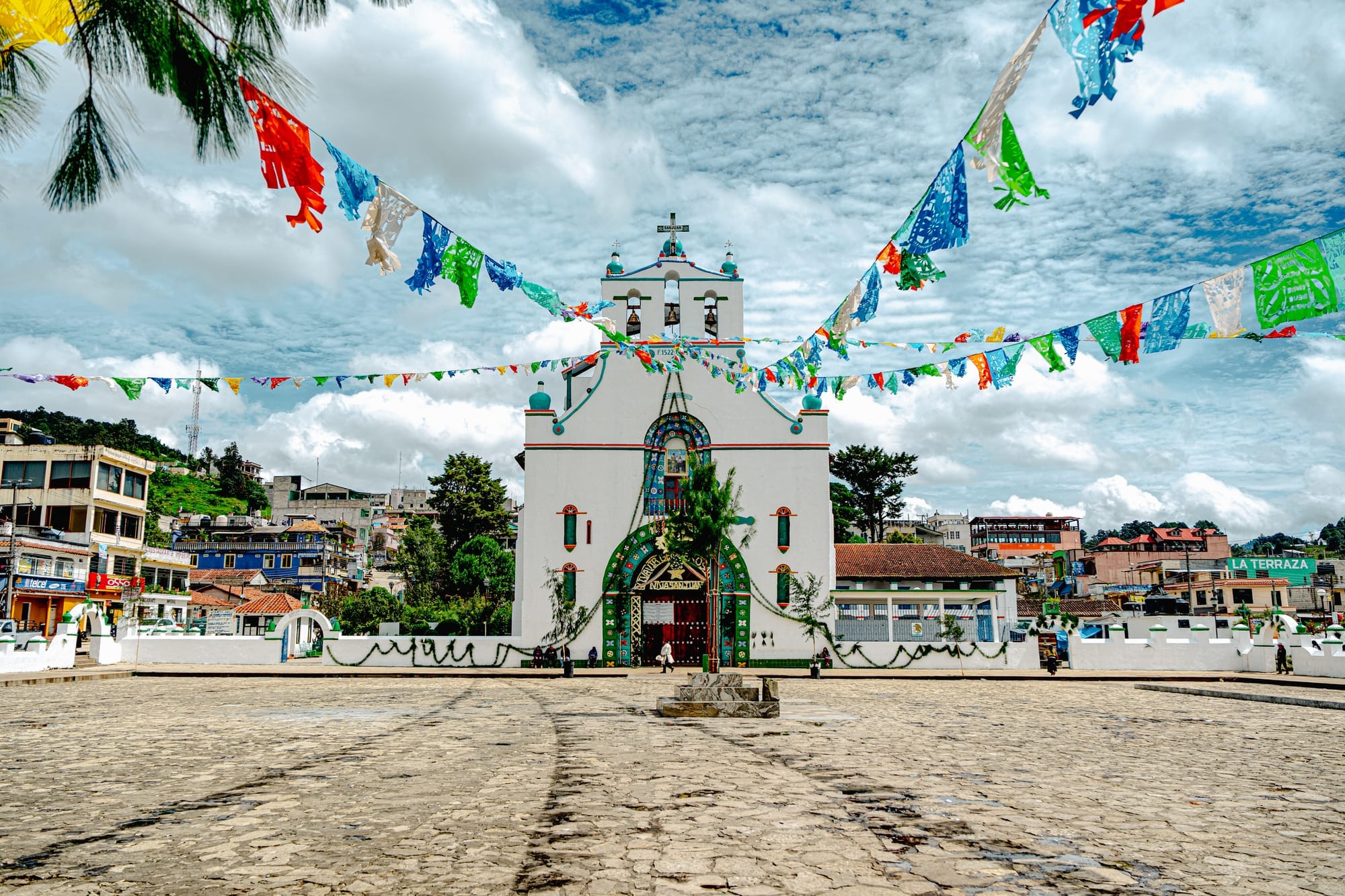
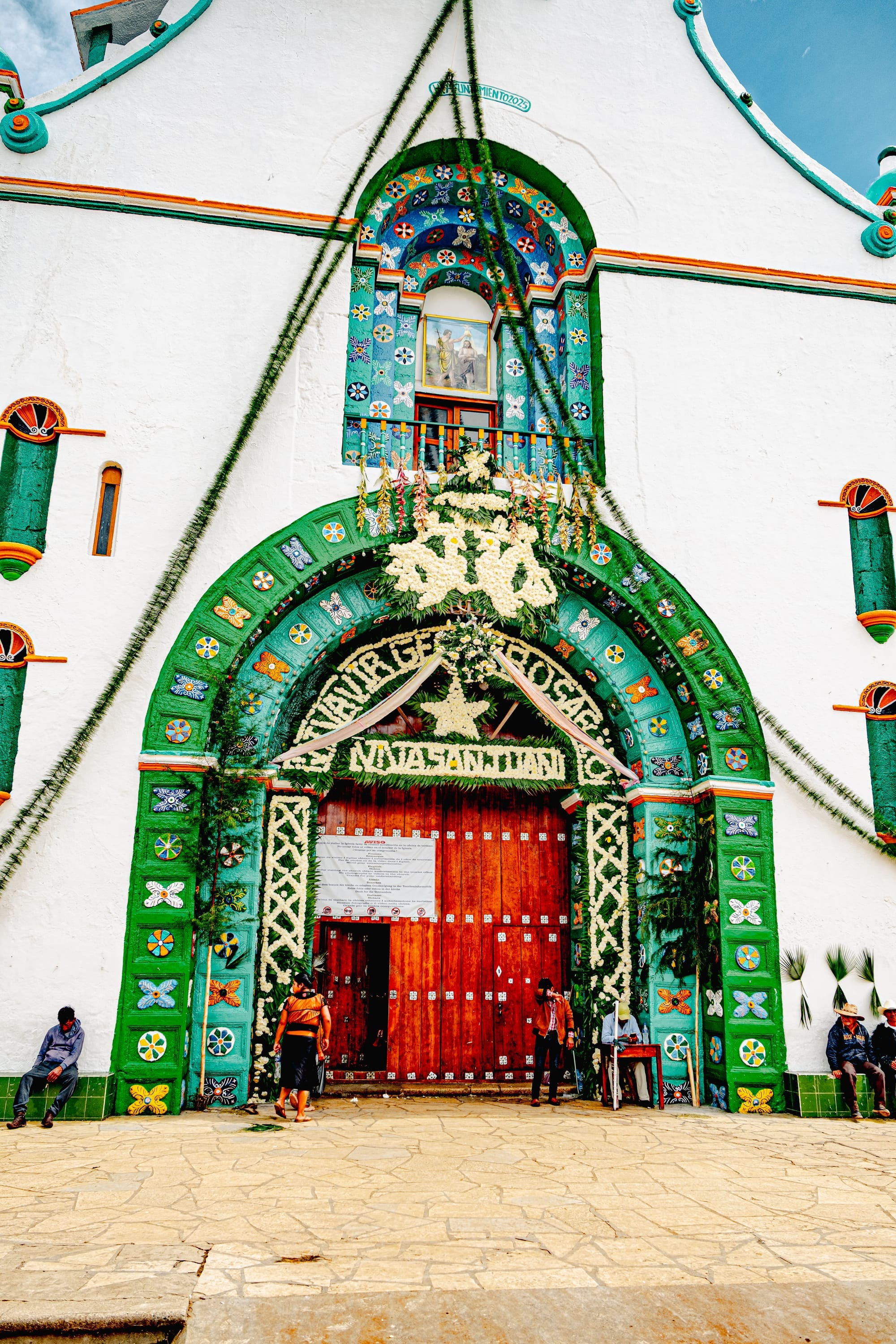
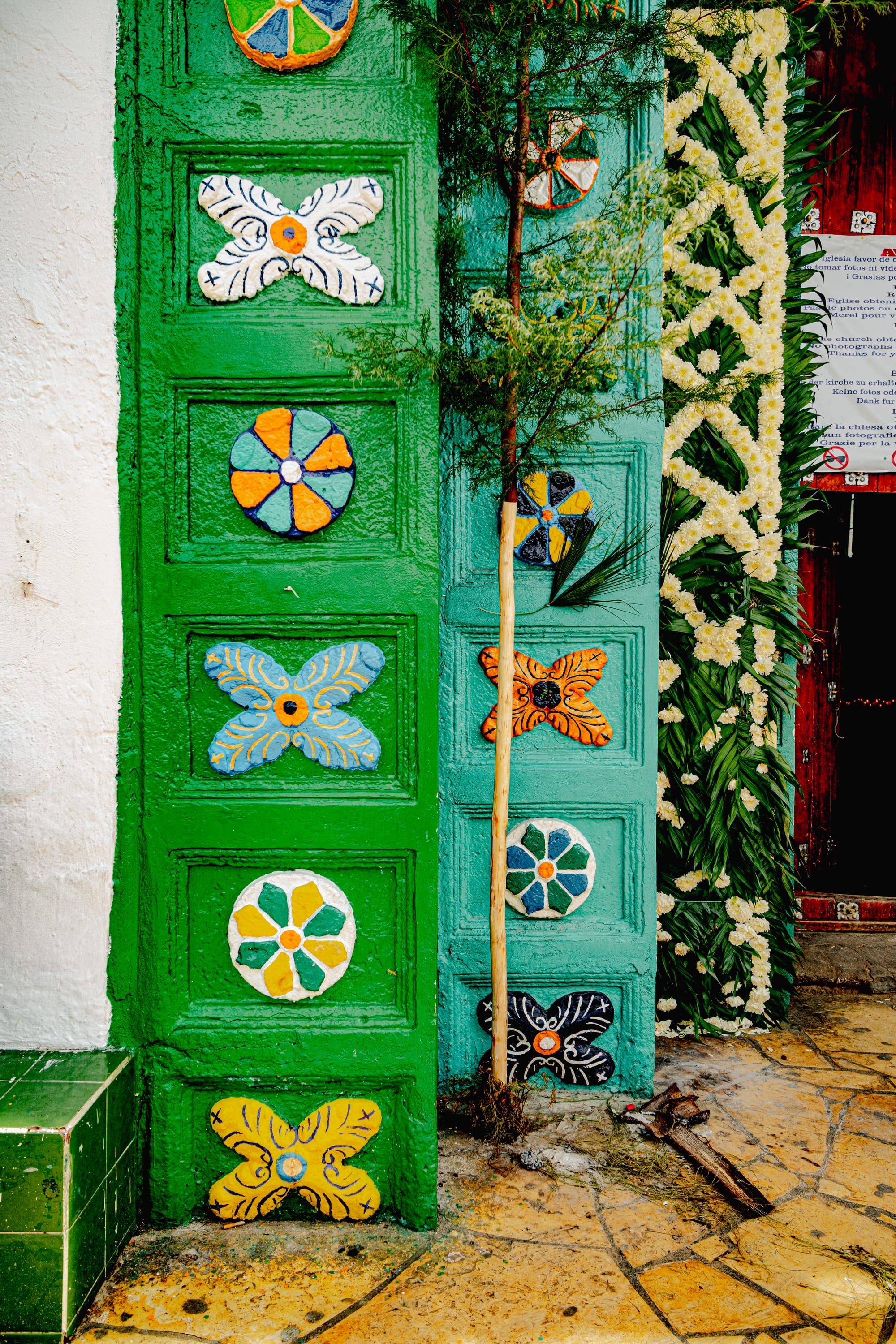
The church of San Juan Bautista in San Juan Chamula
The floor is carpeted with pine needles, replaced weekly to keep the space fresh and fragrant. There are no pews, no priest, and no centralized altar. Instead, hundreds of candles of different colors and sizes burn directly on the floor, their wax pooling among the pine needles. The air is thick with the smoke of copal resin incense, an offering that predates Spanish colonization.
The walls are lined with glass cases holding statues of saints. They carry Catholic names but are often considered embodiments of older, pre-Christian deities. Devotees kneel before these saints, lighting candles and whispering prayers in Tzotzil, sometimes with soft chanting or sobbing.
Chamula church entrance fee and photography rules
You buy your ticket for the church at the small tourism office beside the main square (look for the booth before you walk up to the doors). Expect to pay about 25 to 35 pesos in 2026. Tours usually include it. Local guides wait outside and offer a short explanation of what happens inside, mostly in Spanish, for around 100 pesos. Agree on the price before you start.
The photography rule is the one thing everyone needs to know: no photos or video inside the church, with any camera or phone. Wikipedia notes that the ban also covers the Christmas procession, and that people who break it can be fined and expelled from town. Visitors and guides also report cameras being confiscated. Put your phone away before you walk in, take your hat off, and keep your voice down. Photos of the outside of the church and the plaza are fine.
The church doesn't publish opening hours. It's used for prayer all day, and visitor reports on when tourists can go in vary, so mornings and early afternoons are the safest bet. It can close to visitors without notice during special ceremonies or community events. If the ticket office is shut, don't try to go in.
Pine needles, candles, pox, and Coca-Cola in Chamula rituals
Inside, families kneel on the pine needles, clear a small patch, and stick rows of thin candles to the floor with melted wax. The color and size of the candles depend on what they're asking for, and a healer (h'ilol) often guides the prayers in Tsotsil. Some saints wear small mirrors on their chests, which are said to reflect evil away.
Two drinks appear in almost every ceremony. The first is pox (pronounced "posh"), a strong local spirit distilled from sugarcane and corn that is shared as an offering. The second is fizzy soda, most often Coca-Cola. Burping is believed to release bad spirits from the body, which is why bottles of Coke, Pepsi, and Fanta stand among the candles. Eggs and live chickens are also used in healing, as we explain below. If you visit, you may see an animal sacrifice, so be prepared for that.
For why soda became part of these rituals, and how it ties into the city's water story, see our explainer on the Zapatistas, Coca-Cola, and water in San Cristóbal.
Pox is strong: Wikivoyage puts it at about 40 to 50% alcohol. You'll see it sold in small bottles near the church. If someone offers you a sip during a home visit, a small taste is polite, and it's fine to say no.
The chicken ritual
One of the most distinctive, and often misunderstood, rituals practiced in Chamula is the use of live chickens in healing ceremonies. Locals believe that illness can be caused by spiritual imbalance or the intrusion of negative forces. To restore harmony, a healer known as a curandero or h’ilol performs a cleansing ritual inside the church.
During the ceremony, the curandero passes a live chicken over the body of the sick person, transferring the illness or negative energy into the bird. Prayers are recited, candles are lit, and soft drinks (often Coca-Cola, now a culturally integrated symbol) are shared and burped to help expel the sickness. When the ritual is complete, the chicken is sacrificed, its spirit carrying away the ailment. The act is solemn, not violent; it represents exchange, not cruelty.
Outsiders may find the ritual unsettling, but within the Chamula worldview, it embodies reciprocity: life given to restore balance. Seeing it shows you a form of spirituality that bridges Catholic symbolism and Maya cosmology, where every living thing takes part in the circulation of life energy.
Syncretism and self-governance
Chamula’s religious system is an intricate blend of Catholic and Indigenous belief. Saints are revered not only as Christian figures but also as mediators of cosmic forces tied to rain, fertility, and protection. The town’s hierarchy of mayordomos (stewards) and alfereces (festival leaders) maintains this balance, organizing ceremonies throughout the year that match the farming calendar with spiritual observance.
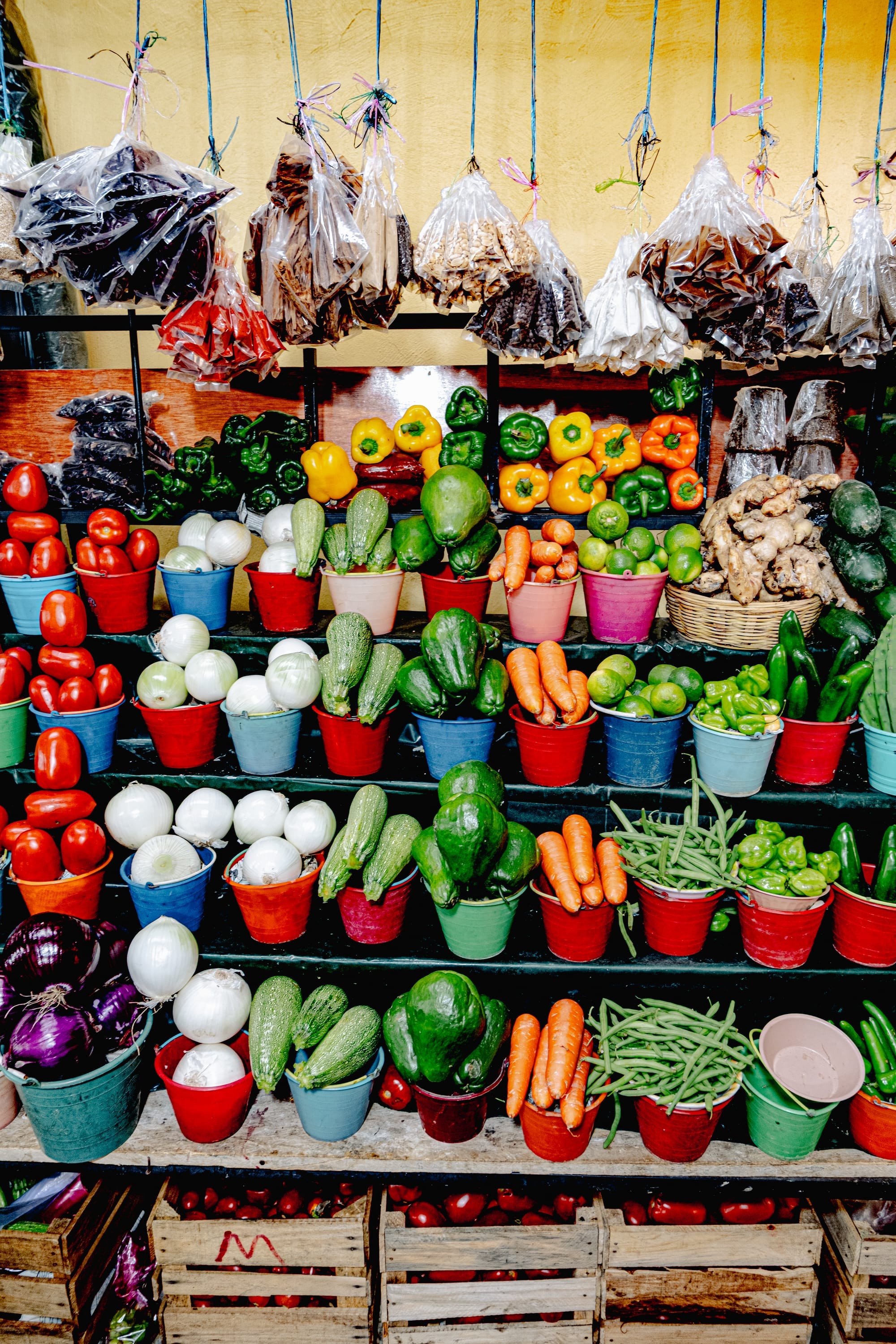
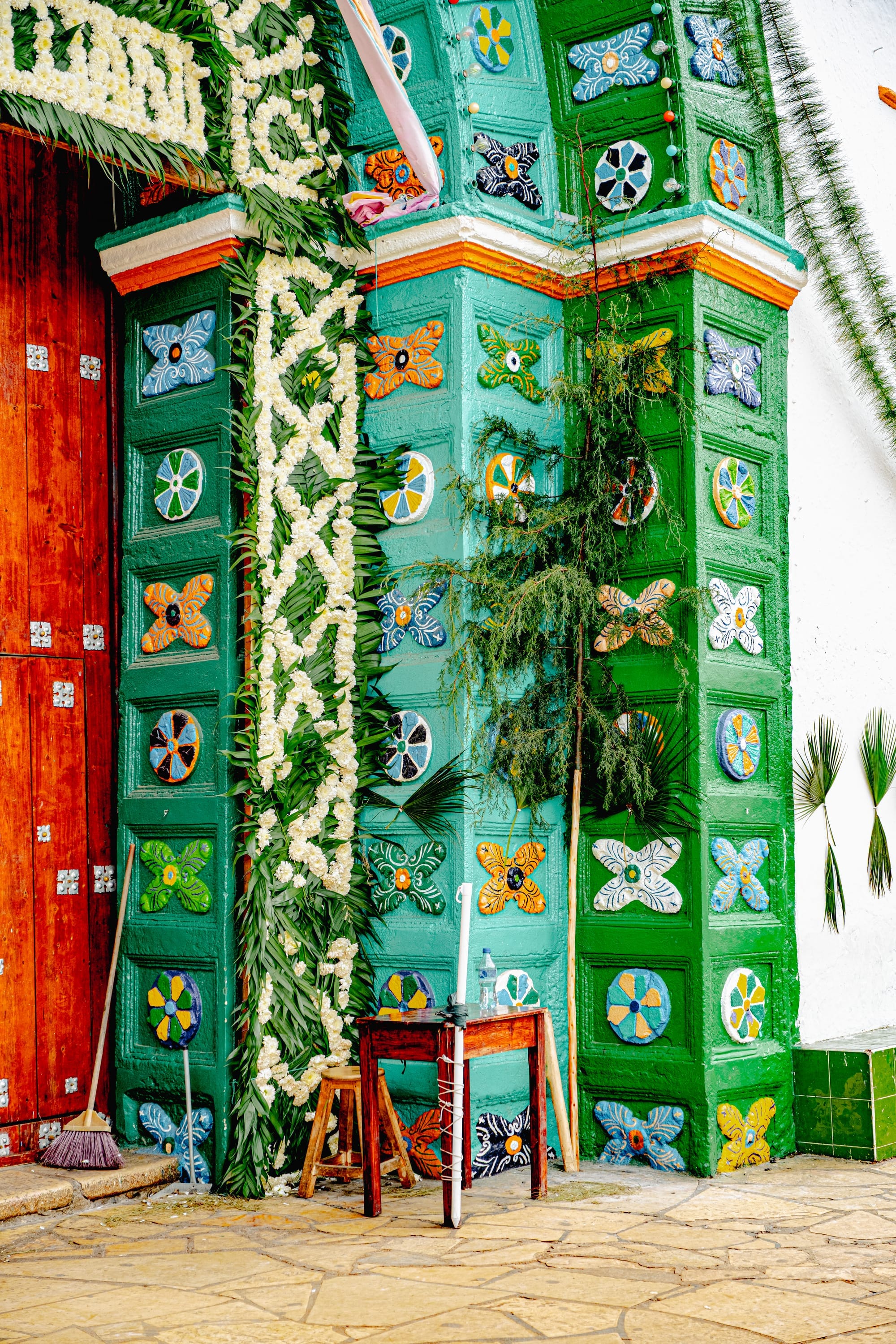
Colorful market produce and decorated church facade in Chamula
Since the 19th century, Chamula has maintained a fiercely independent identity. Its residents expelled Catholic priests in the 1970s, choosing to conduct rituals without external clergy. Today, their version of Christianity (distinct, localized, and community-led) exists outside Vatican authority but within its own strong moral framework.
This autonomy extends to civic life. Chamula operates as a self-governing municipality with Indigenous law, language, and custom recognized under Mexican legislation. While tensions sometimes arise between traditionalists and evangelical converts, the community remains rooted in collective identity and ritual continuity.
Chamula's autonomy and its own police
Chamula has an unusual degree of self-government within Mexico. The community runs its own police force, and state police and the army do not normally operate inside the town. You'll see the community police and officials around the plaza in long wool tunics (white for authorities, black for most other men), often carrying staffs. Local disputes are settled by community authorities under local custom.
The church works the same way. There is no resident priest, and a priest from San Cristóbal comes only for baptisms. Each saint is looked after by a steward (mayordomo) who serves for a year and pays for its candles, flowers, and festivals, and the waiting list for these posts can run for decades. The flip side of this tight community control is that, since the 1970s, many families who converted to evangelical churches have been forced to leave, and a large number resettled on the edges of San Cristóbal.
Zinacantán: the valley of flowers and weavers
Just 15 minutes west of Chamula lies Zinacantán, another Tzotzil-speaking town, but one with a very different feel. Where Chamula is austere and ceremonial, Zinacantán is colorful and open, known for its textiles, floriculture, and warm hospitality.
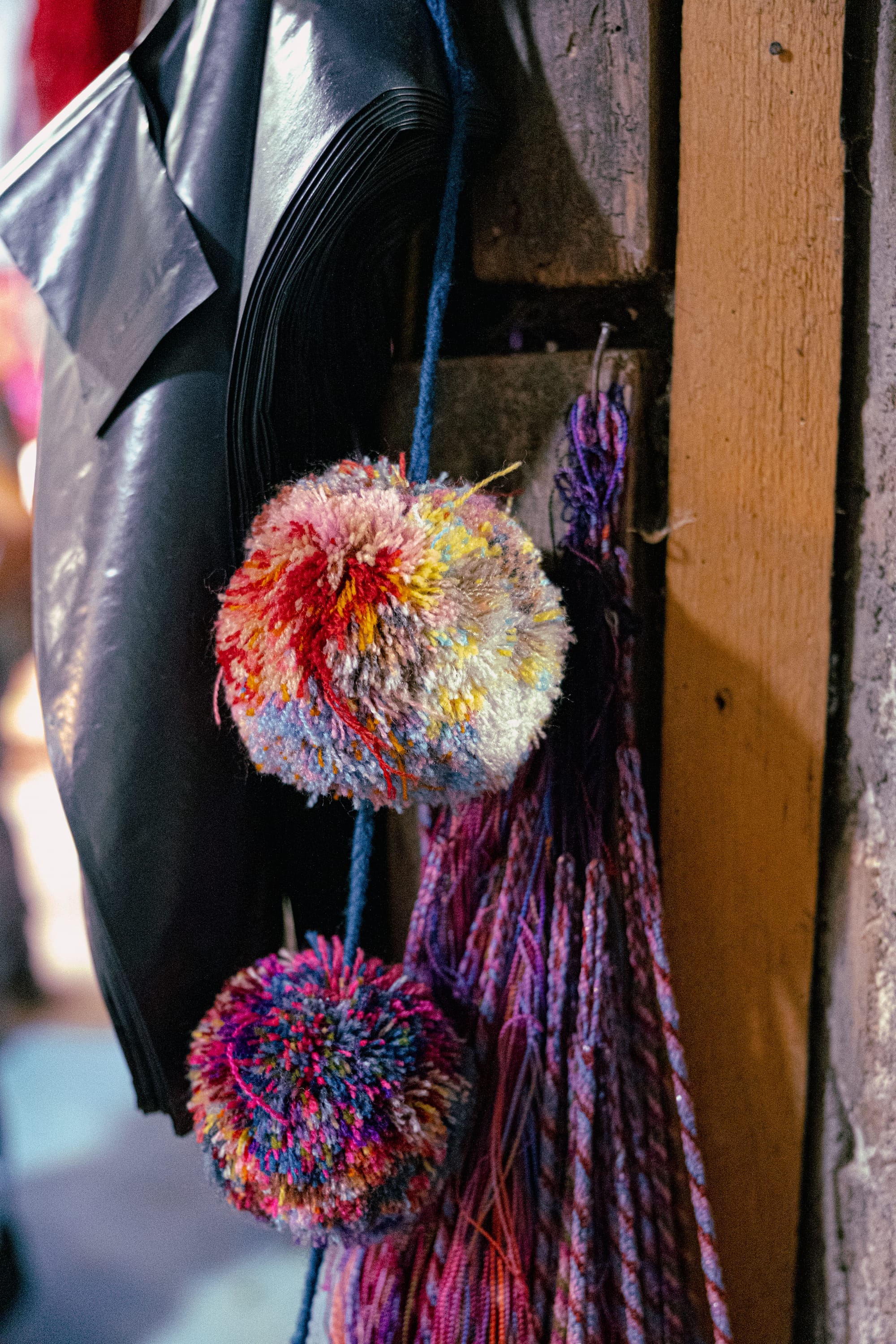
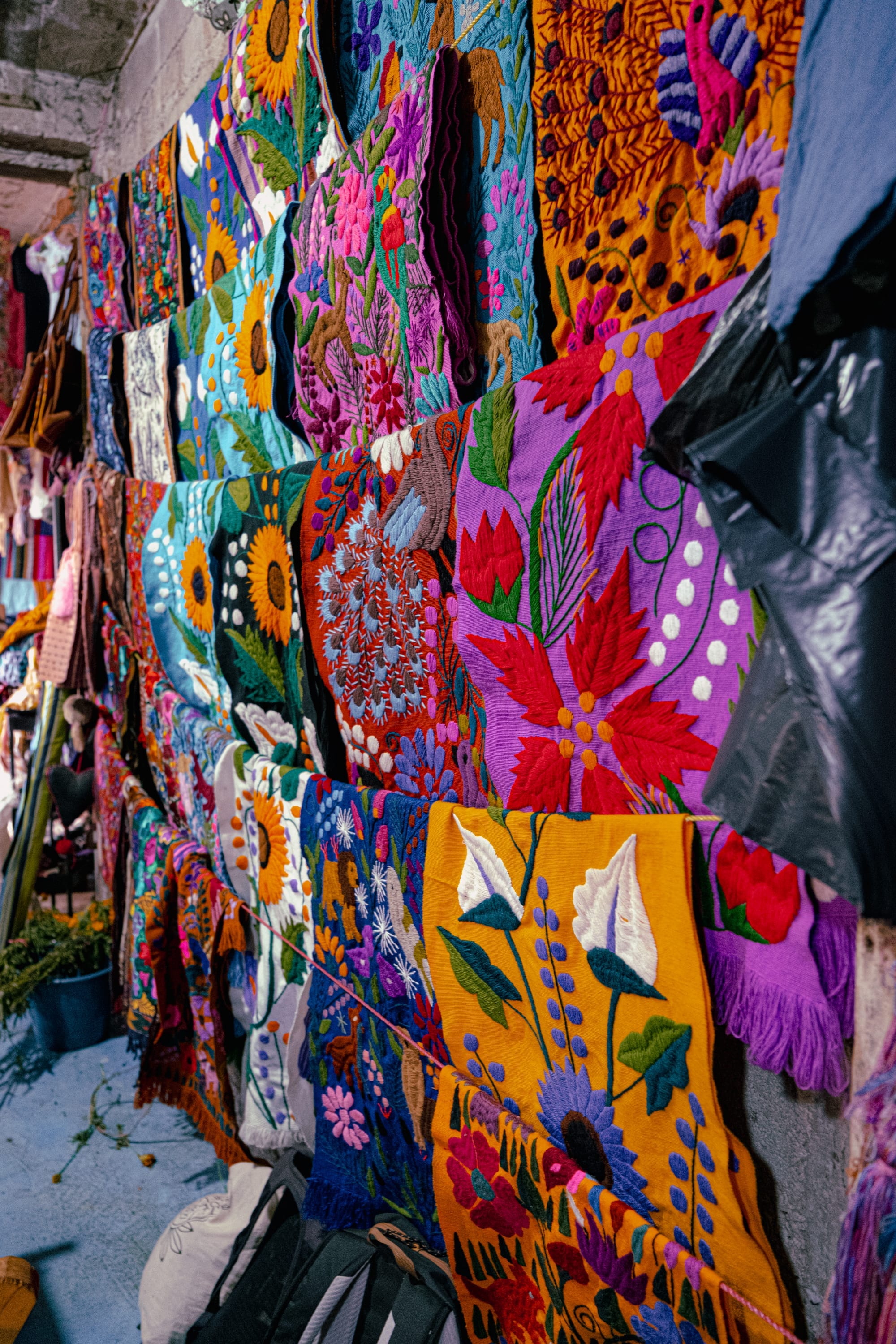
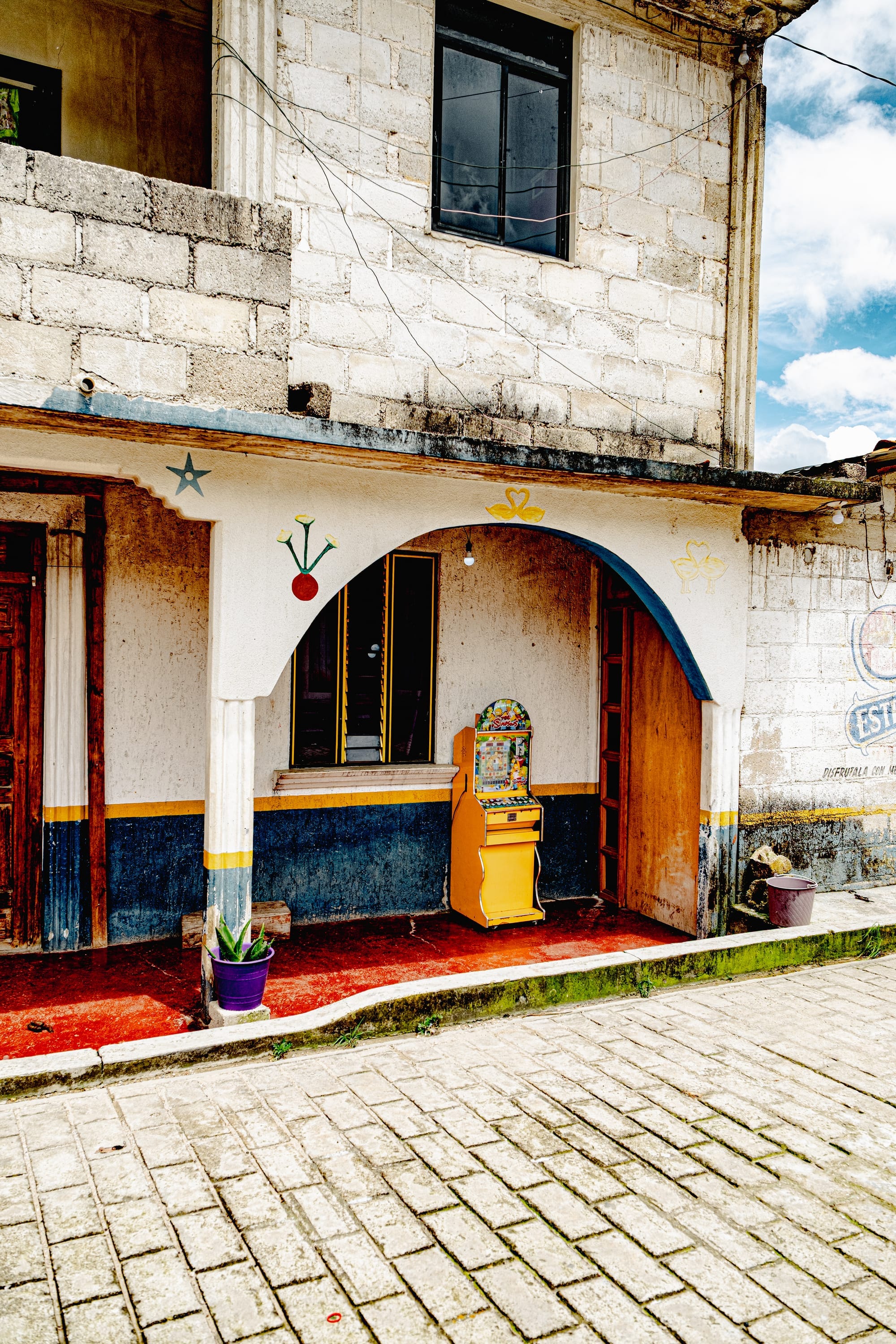
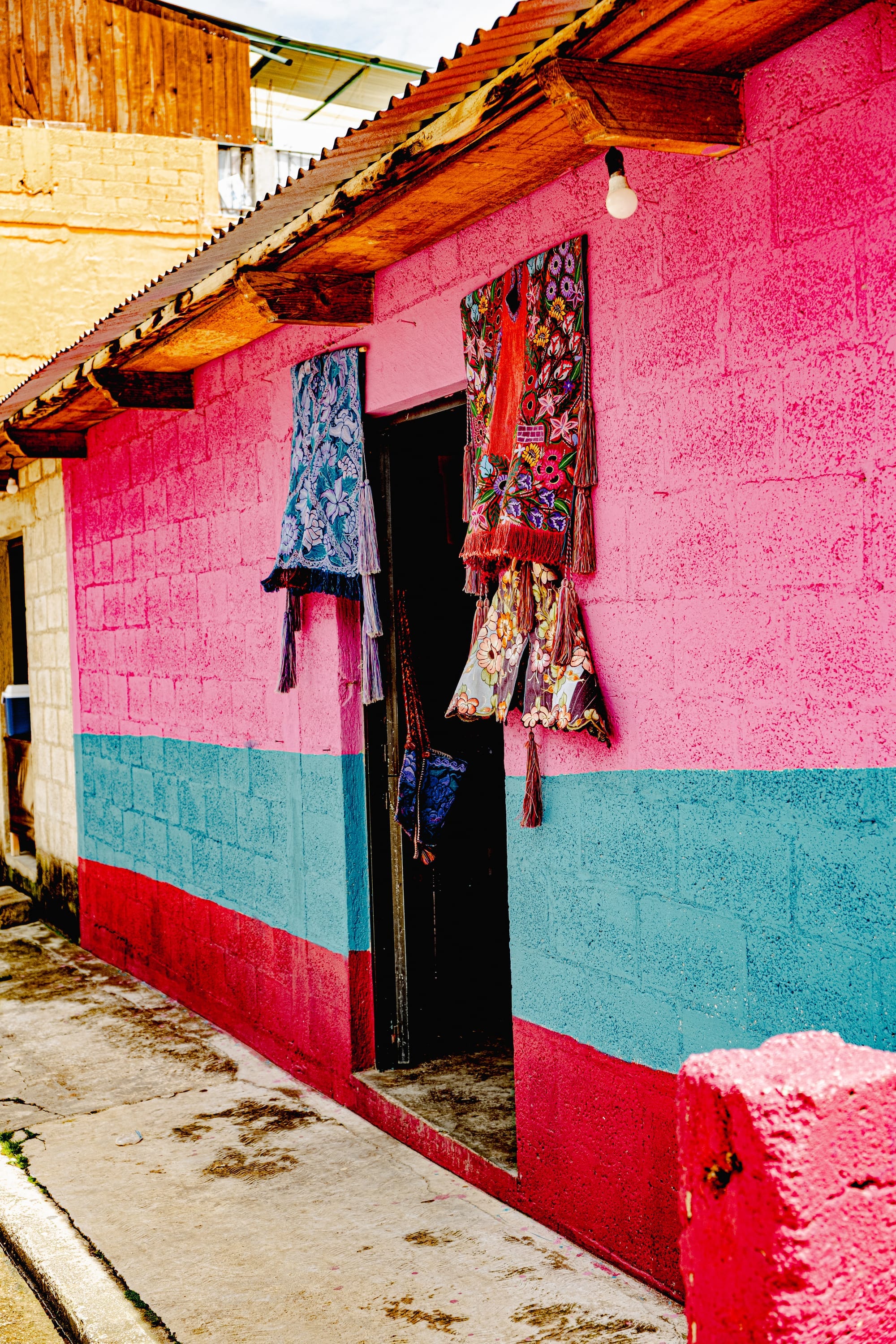
Colorful homes and embroidered textiles in Zinacantán
The name “Zinacantán” comes from the Nahuatl word Tzinacantlan, meaning “land of bats.” Its population of about 45,000 (2020 census) is spread across a fertile valley that bursts with flowers year-round. The town’s economy is rooted in agriculture and weaving, with many families cultivating flowers in greenhouses that paint the hillsides with rows of red, pink, and white blossoms.
A visit to Zinacantán Cemetery on Day of the Dead is an excellent showcase of the town's floral diversity, with colorful and elaborate flower arrangements adorning every grave.
The church of San Lorenzo in Zinacantán
The church of San Lorenzo Mártir stands on Zinacantán's main square, with the smaller church of San Sebastián close by. According to VisitMexico, San Lorenzo was damaged in the 2017 earthquake and has since been restored. Inside it looks more like a familiar Catholic church than Chamula's (there are pews), but the altars and doorway are covered in fresh roses, carnations, and chrysanthemums, and the decoration mixes Catholic and Maya beliefs.
Expect a small entry fee or donation. Visitors report anything from a suggested donation of around 15 pesos at San Sebastián to a fee at San Lorenzo, and tours usually cover it. Photography inside the churches is generally not allowed, so ask before you raise your phone, even in the churchyard.
Zinacantán's flower greenhouses
You'll see the greenhouses before you see the town: hundreds of plastic-covered frames line the valley as you drive in. Flower growing is Zinacantán's main business, and the blooms supply markets across Chiapas and beyond. The same flowers turn up on church altars, home shrines, and the embroidered clothing people wear. Some tours stop at a family greenhouse. If you go independently, look from the road and don't walk into a greenhouse without an invitation, as they're private farms.
The weaving tradition
Zinacantán’s textiles are among the most beautiful in Chiapas, with intricate floral embroidery in vivid purples, blues, and pinks. Women weave on backstrap looms, a technique passed down through generations. The patterns are not merely decorative: they represent local cosmology, ancestry, and identity.
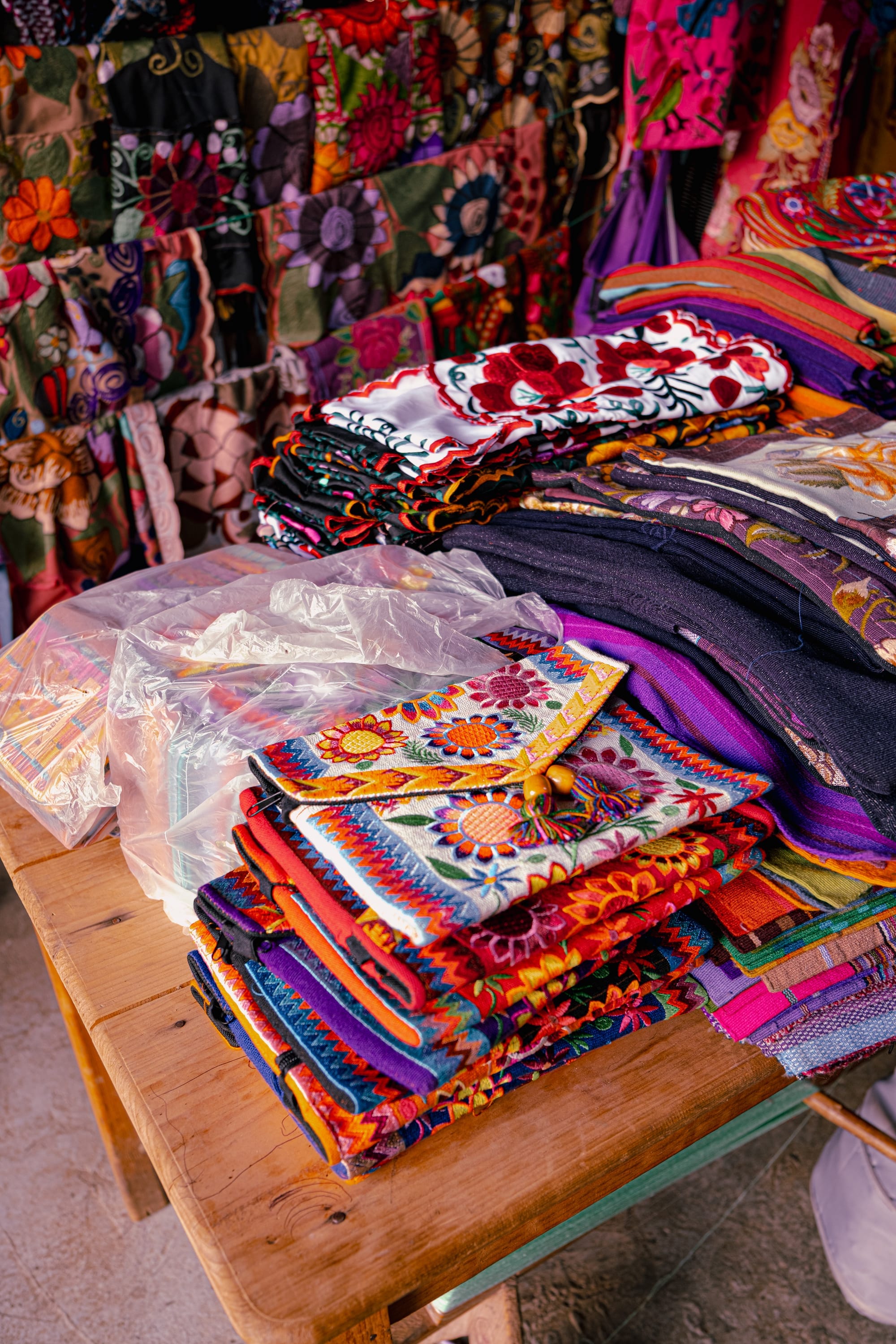
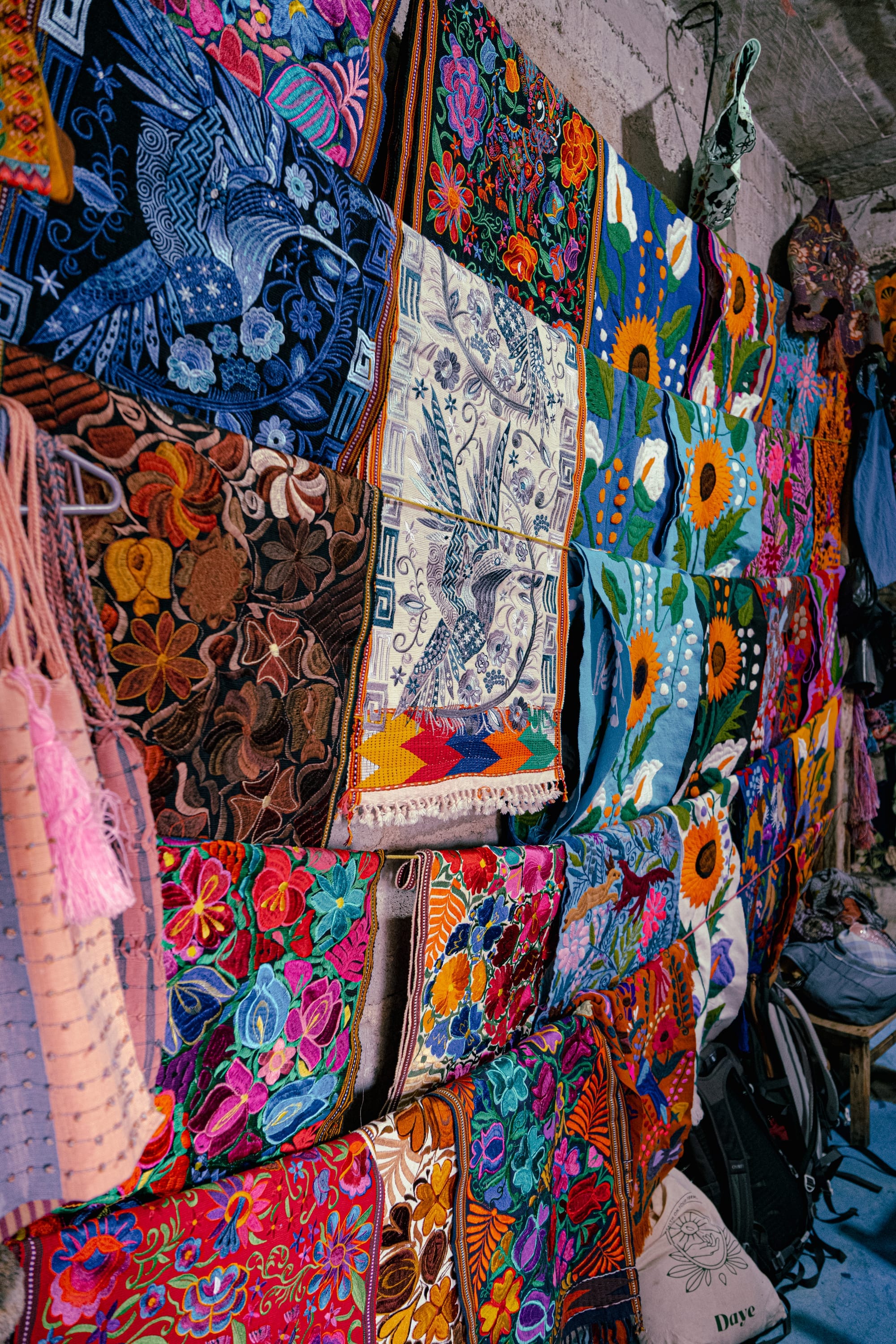
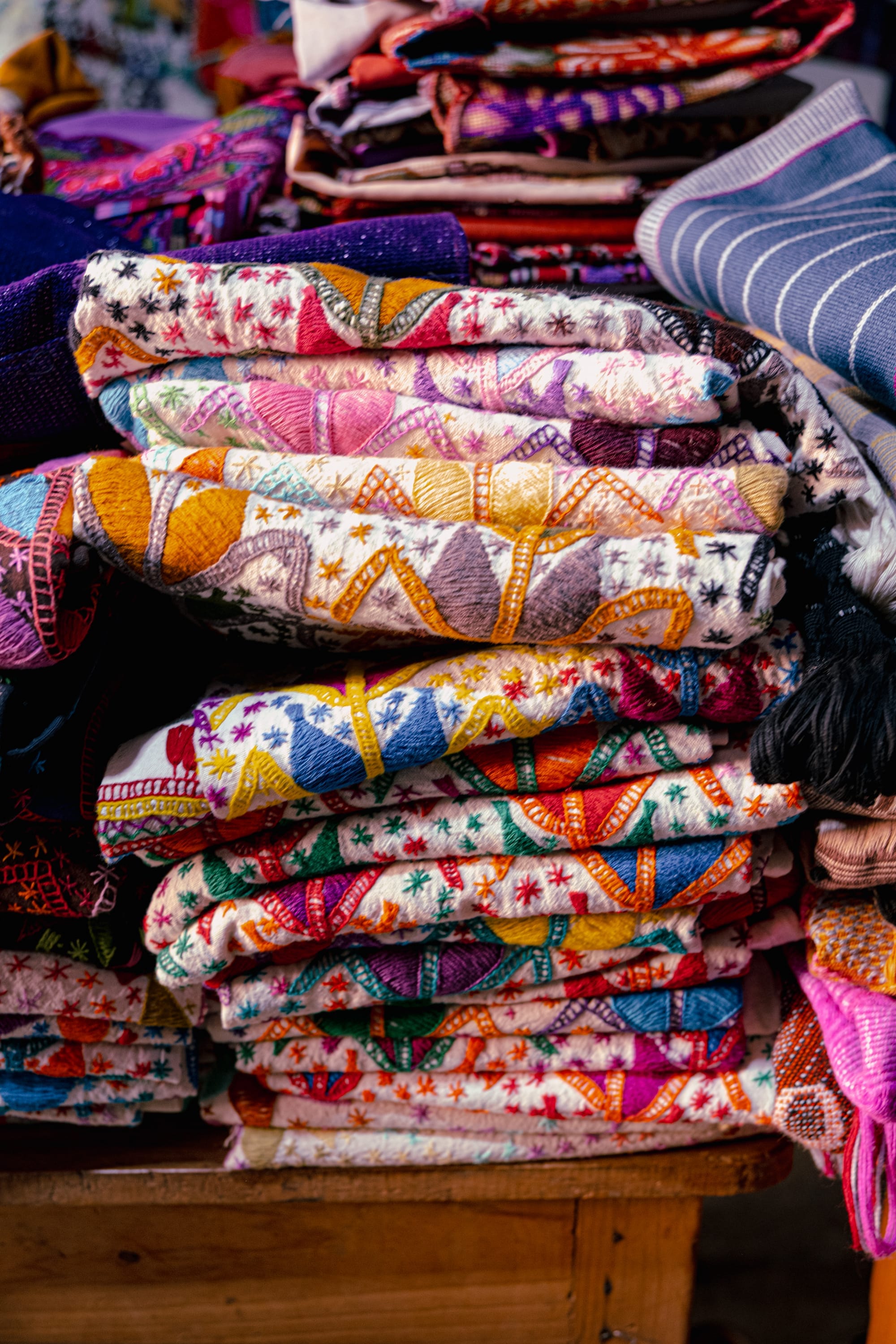
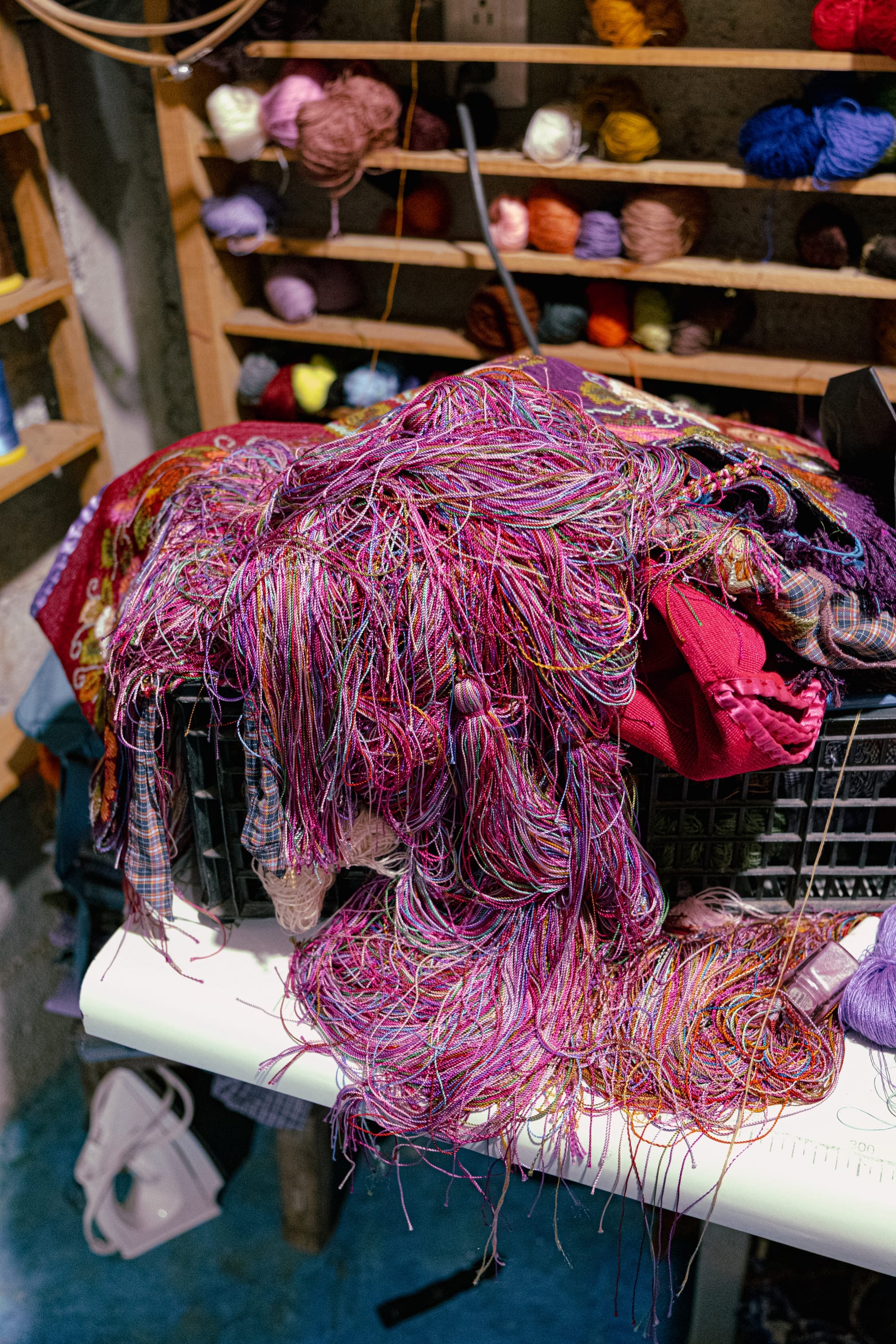
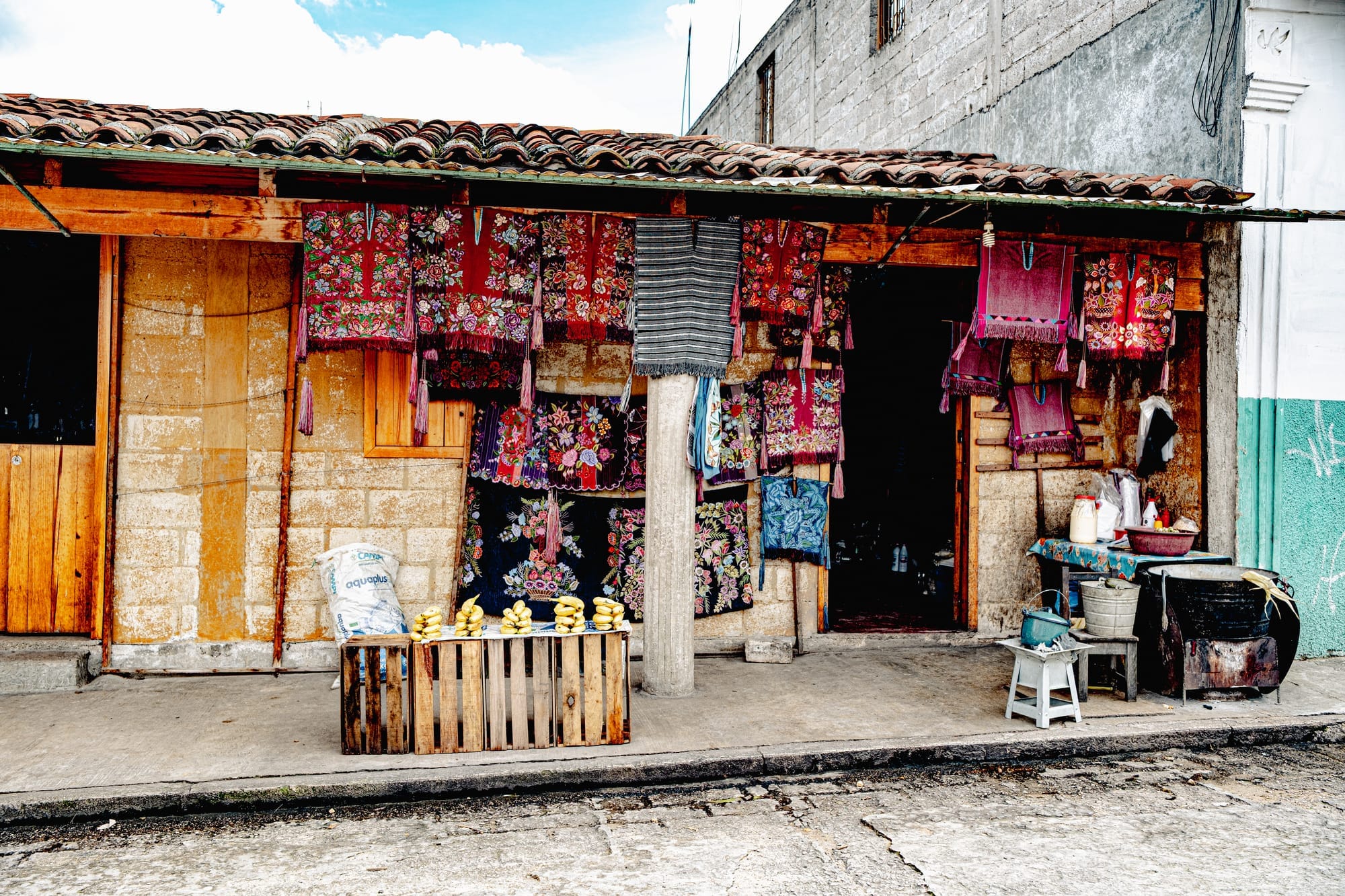
In many households, weaving is still done every day. Mothers teach daughters to weave from an early age, and finished textiles serve both practical and ceremonial functions: huipiles (traditional blouses), shawls, tablecloths, and altar cloths used in religious celebrations. Each stitch carries cultural meaning, a form of storytelling that resists erasure.
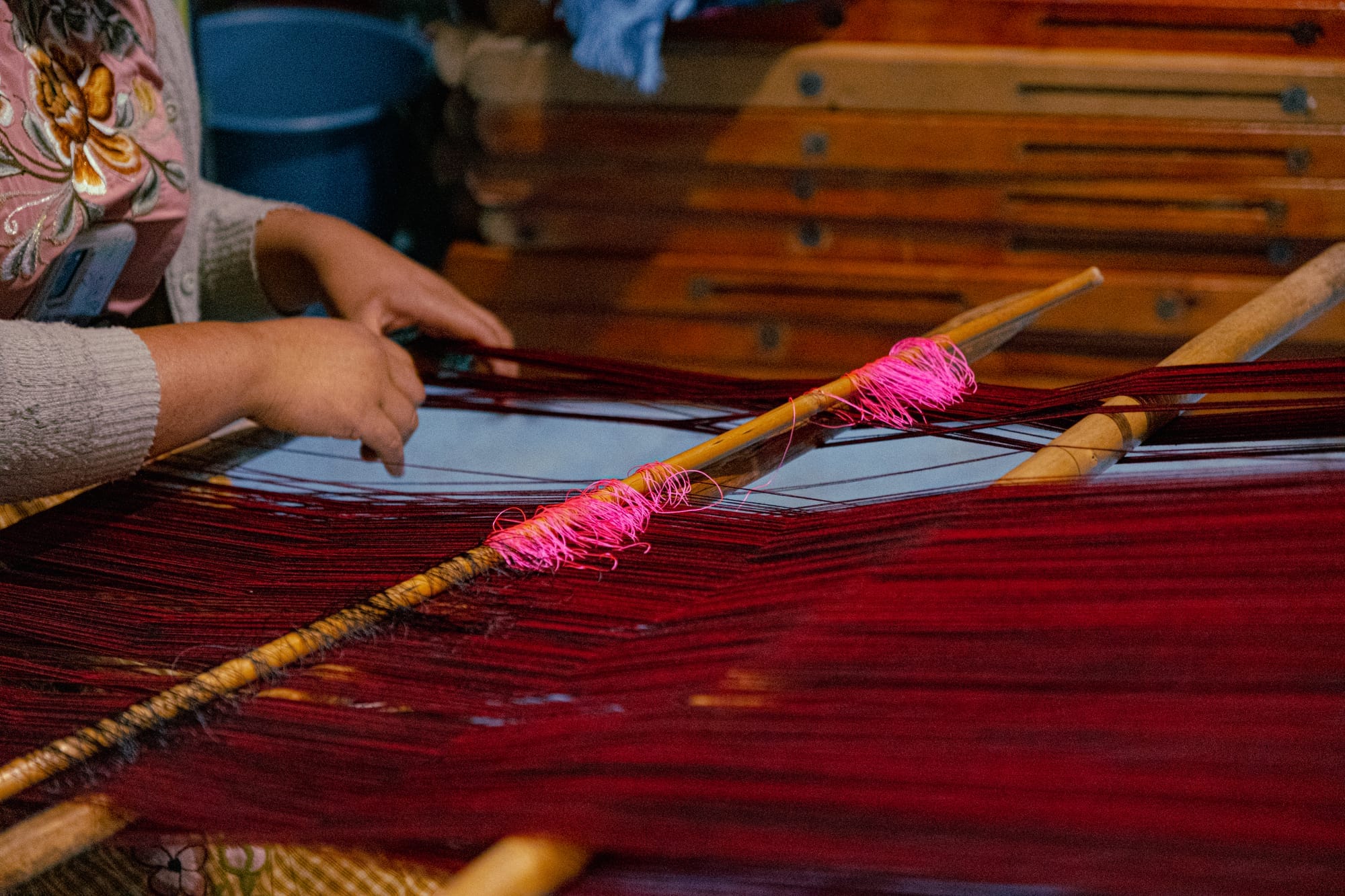
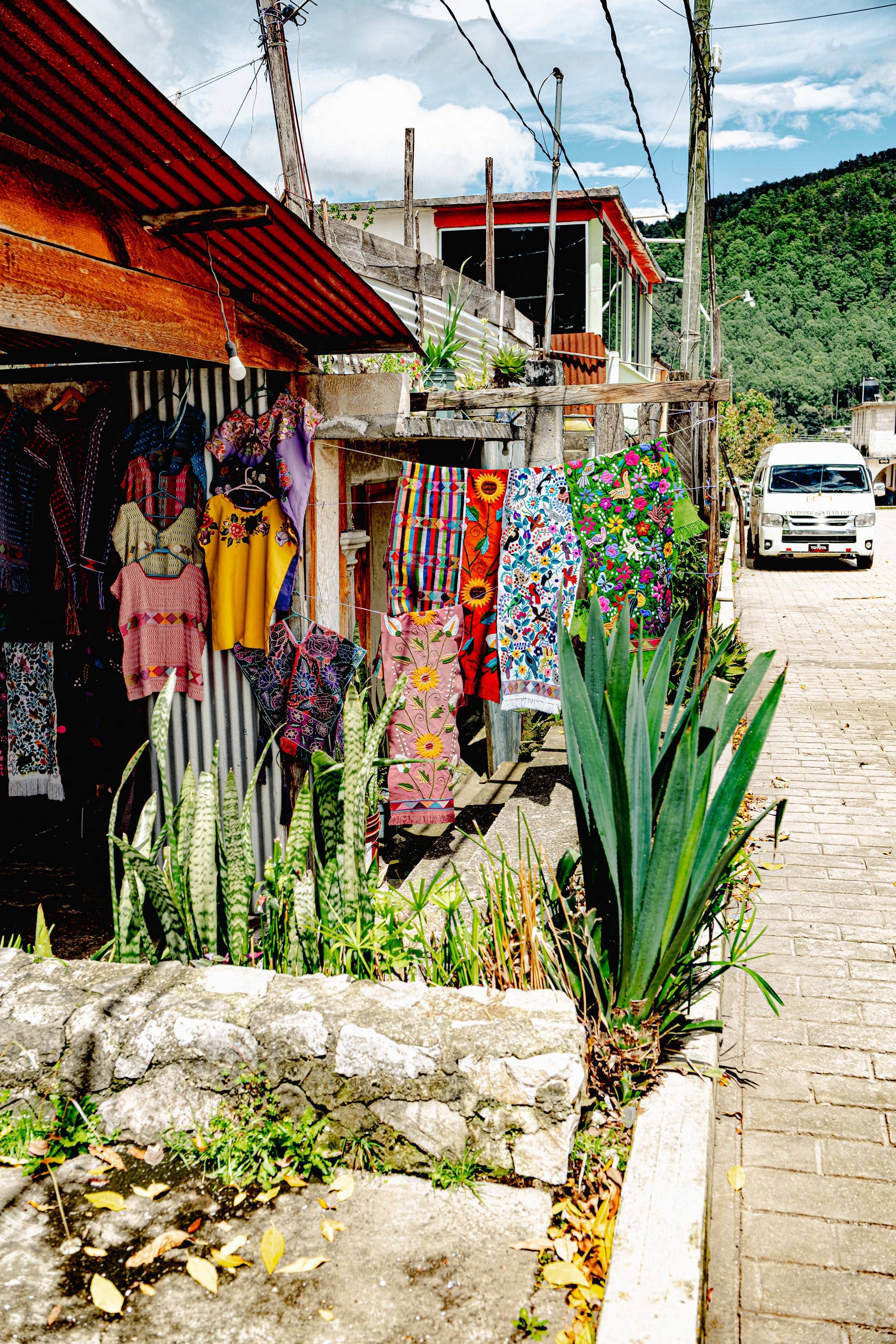
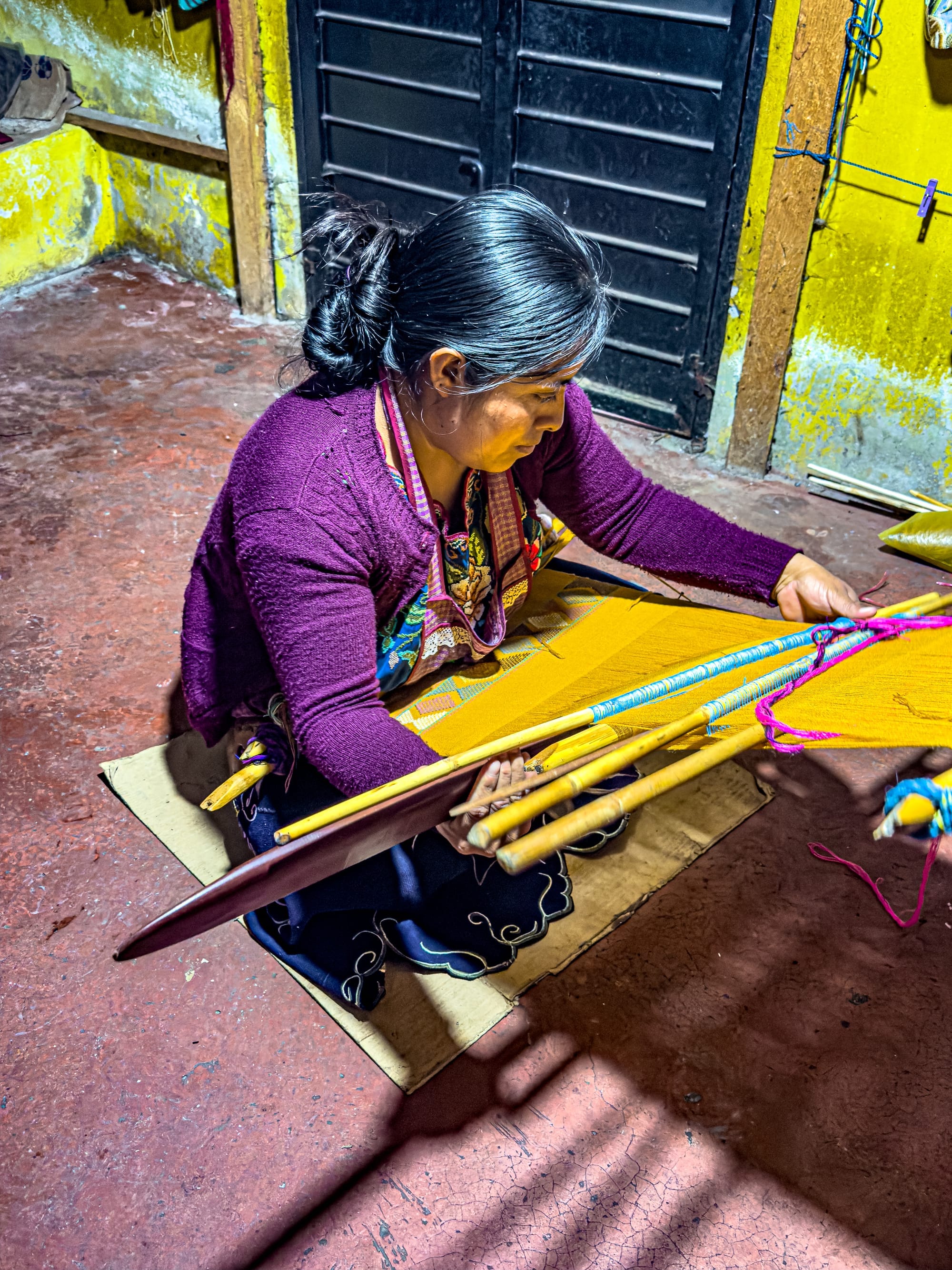
Textile shops and a woman weaving in Zinacantán
Visitors are often invited into family workshops to watch the process. The sound of the loom, the scent of dyed threads, and the warm, shared conversation make it clear that weaving here is about continuity as much as craft.
Weaving co-ops and backstrap looms in Zinacantán
The easiest way to see weaving is at a family workshop or a women's cooperative near the main square. A weaver usually shows how the backstrap loom works: one end ties to a post, the other to a strap around her back, and she controls the tension by leaning back. You'll see blouses (huipiles), shawls, and table runners in Zinacantán's floral designs, and you can often try on a skirt and shawl. Prices are similar to San Cristóbal's markets, and buying here puts the money straight into the weavers' hands.
Home visits and meals (with vegan options)
Most tours, including the guided tour we mention above, include a stop at a family home. You sit in the kitchen while a woman makes corn tortillas on the comal, often served with salt and toasted, ground pumpkin seeds. Both are vegan. Some visits add beans, coffee, or a taste of pox. If you're vegan, ask whether the beans are cooked with lard ("¿lleva manteca?"), as it's common in the highlands. Tamales sold at the markets often contain lard too. For more choice, eat back in town: our vegan San Cristóbal guide has our favorite places.
Religious and community life
Like Chamula, Zinacantán blends Catholic and pre-Hispanic practices. The church of San Lorenzo, the town’s patron saint, is central to communal life. Inside, flowers cover the altars, and candles burn throughout the day. Outside, during festivals, processions wind through the streets accompanied by drumming, flutes, and bursts of fireworks.
Unlike Chamula’s stricter photography and ritual rules, Zinacantán is more welcoming to visitors. However, respect remains crucial, especially when entering homes or photographing people. Many families supplement their income through tourism, but their hospitality is grounded in cultural pride rather than performance.
The role of flowers
Flowers hold a special place in Zinacantán’s cultural and spiritual life. They are offerings, decorations, and symbols of renewal. Every household keeps vases of fresh flowers on altars. During festivals, floral arches frame doorways and saints’ statues. The landscape itself seems to echo this devotion: fields of marigold, carnation, and rose stretch across the valley, cultivated for both ritual and livelihood.
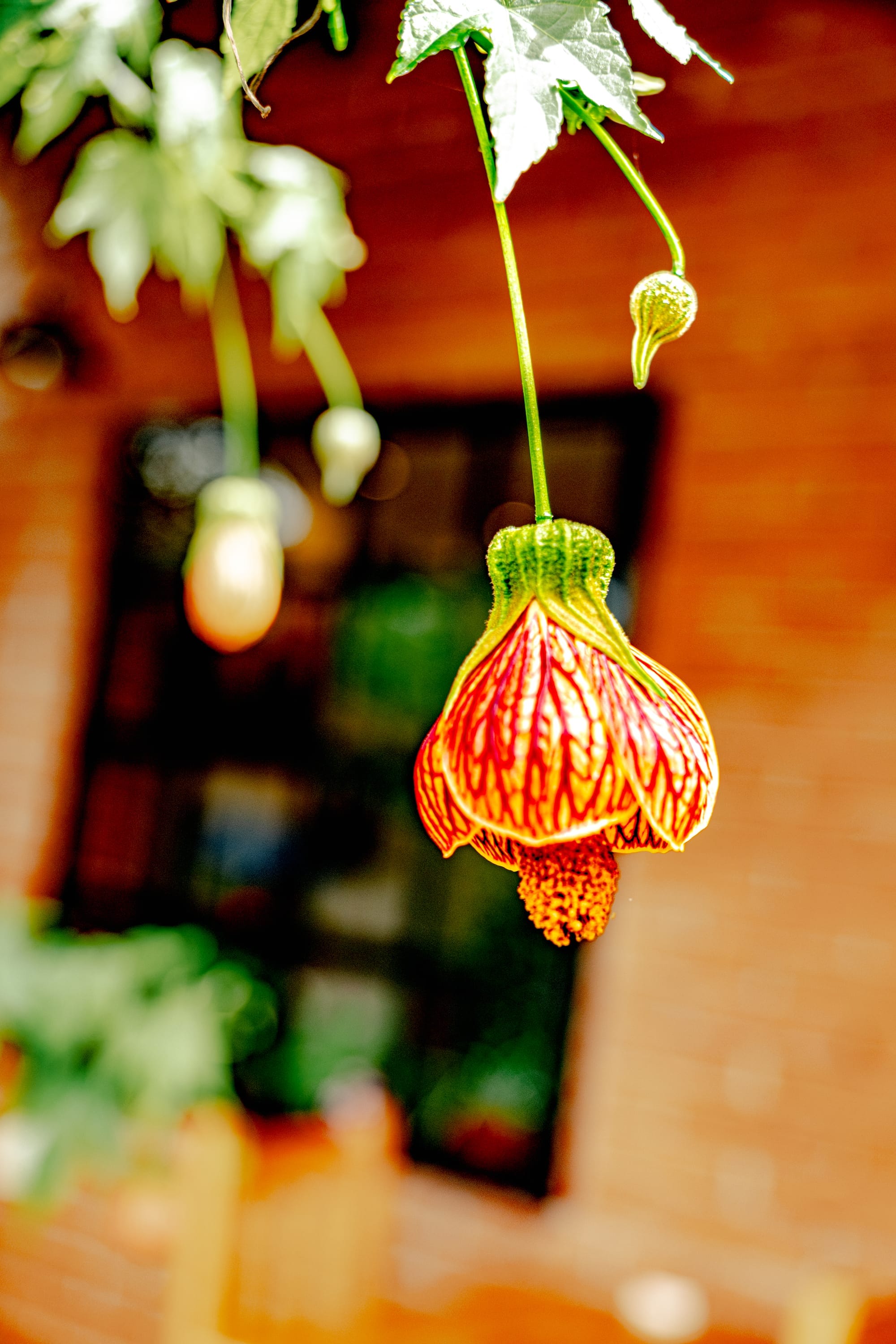
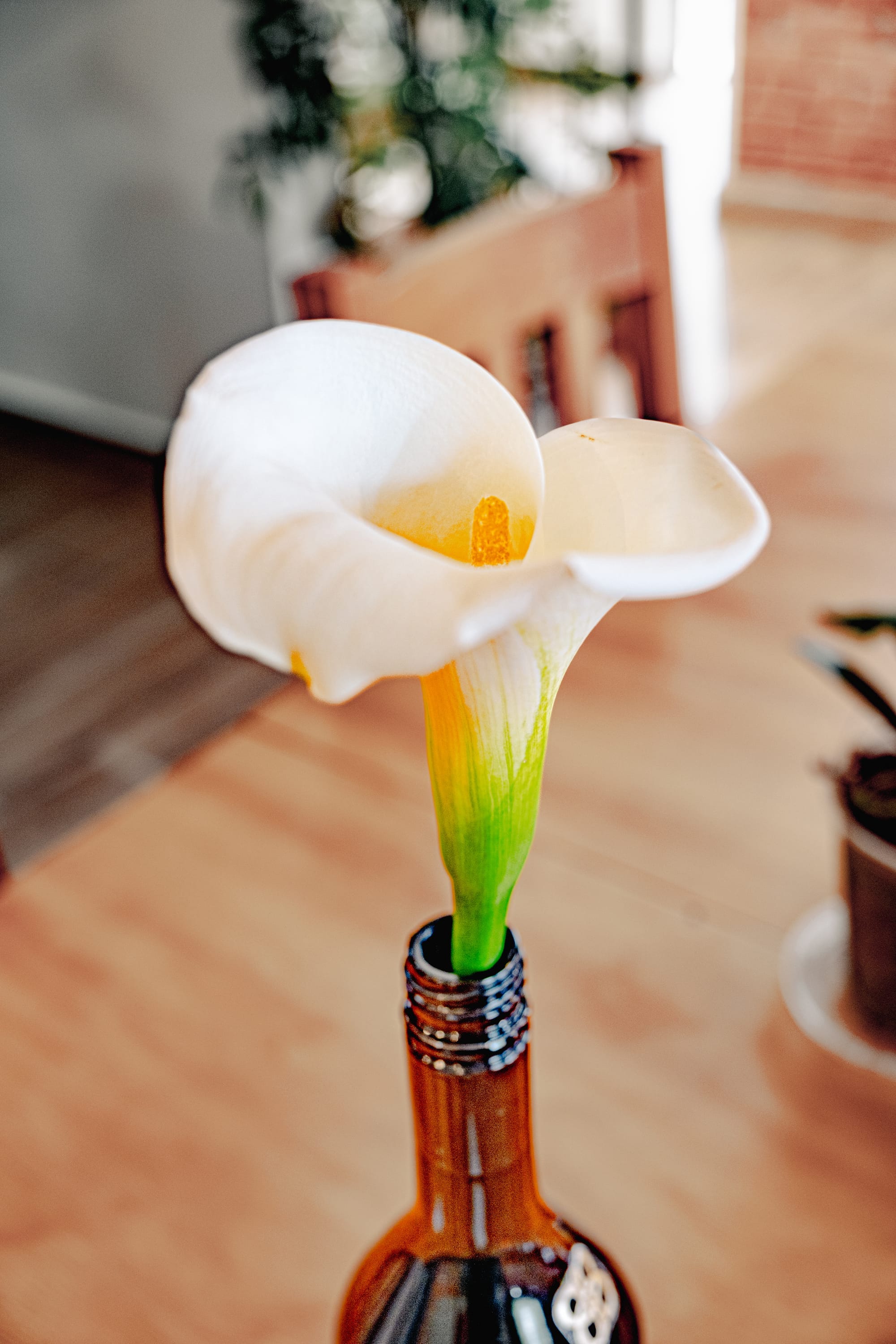
Flowers commonly used in Zinacantán’s weaving and rituals
The annual festival of San Lorenzo in August is one of the most important events in Zinacantán. It brings together processions, music, dance, and communal meals. Participants wear traditional clothing adorned with embroidered flowers that mirror the surrounding fields, blurring the boundary between person and landscape.
Festivals in Chamula and Zinacantán
Festival days are the busiest and most colorful times to visit, and also the times when respect matters most. Dates follow the religious calendar, so check them each year.
Chamula Carnaval (K'in Tajimoltik)
Chamula's Carnaval, called K'in Tajimoltik in Tsotsil (often translated as the "festival of games"), runs over the five days before Ash Wednesday. Mexico Desconocido links these days to the five "lost days" at the end of the Maya calendar year. The festival is organized by the paxones, sponsors from each of the town's three neighborhoods who pay for the celebrations. On the final Tuesday, after dawn ceremonies at hilltop crosses and springs, they run across burning grass in front of the church carrying flags, a purification ritual, while groups dance to harp, guitar, and accordion. VisitMexico listed the main days in 2026 as February 15 to 17. In 2027, Ash Wednesday falls on February 10, so expect the festival in the days before that.
For 2027, that puts Carnaval at roughly February 5 to 9, with the biggest crowds on the last days and the fire run on Tuesday, February 9. These dates come from the church calendar, not an official program, so confirm them closer to the time on VisitMexico or locally in San Cristóbal. Expect the colectivos to be packed and the plaza very crowded, and keep the camera rules in mind: the processions and officials are off limits without permission.
Day of the Dead in Chamula and Zinacantán
On November 1 and 2, families gather at the cemeteries with marigolds, candles, food, and music. In Chamula, the main cemetery surrounds the roofless ruins of the old San Sebastián church, a few blocks from the plaza, where graves are simple earth mounds covered in pine needles. The Chamula hamlet of Romerillo has the famous tall blue and green crosses (see our Romerillo cemetery post). Ask before photographing anyone at a grave, and keep a respectful distance.
Other feast days
Chamula celebrates its patron saint, San Juan Bautista, on June 24, with the fiesta starting at sunset on June 23. In Zinacantán, the San Lorenzo fiesta runs from August 8 to 10, and San Sebastián (around January 18 to 22) is the other big one, according to Wikipedia. Expect processions, fireworks, music, and plenty of pox.
Shared history, distinct character
While Chamula and Zinacantán share language, geography, and ancestry, their paths diverged through history. Chamula’s reputation for autonomy and closed tradition contrasts with Zinacantán’s openness and economic integration. Yet both show resilience: the ability to maintain distinct ways of life in a globalized world.
During colonial rule, both towns were part of the encomienda system, supplying labor and tribute to Spanish authorities. Yet they also served as centers of Indigenous governance, where ancestral leadership structures persisted under the surface of imposed Catholic hierarchy. Over time, the communities adapted the religion of the colonizers to their own cosmology, creating a uniquely Chiapaneco synthesis of faith.
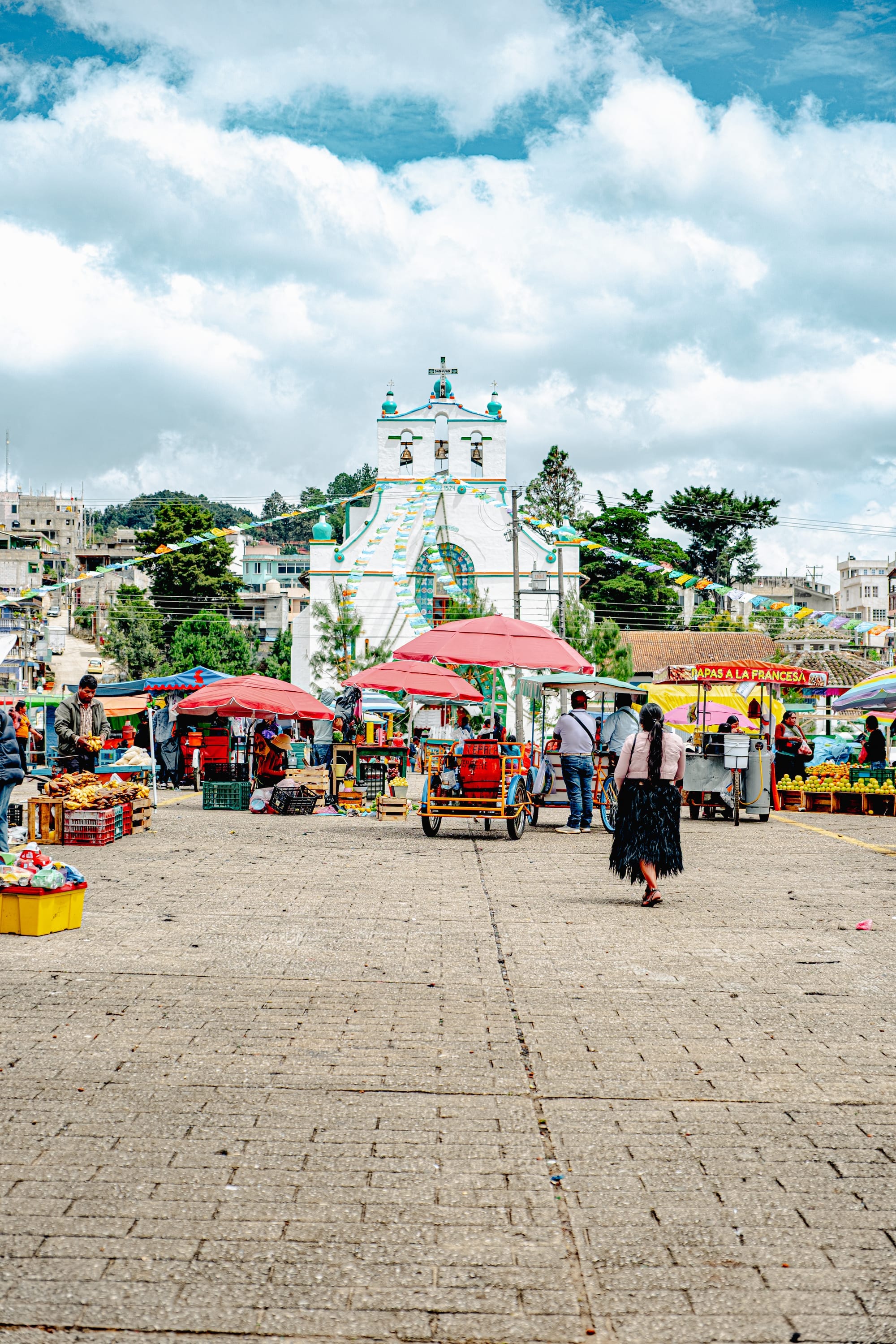
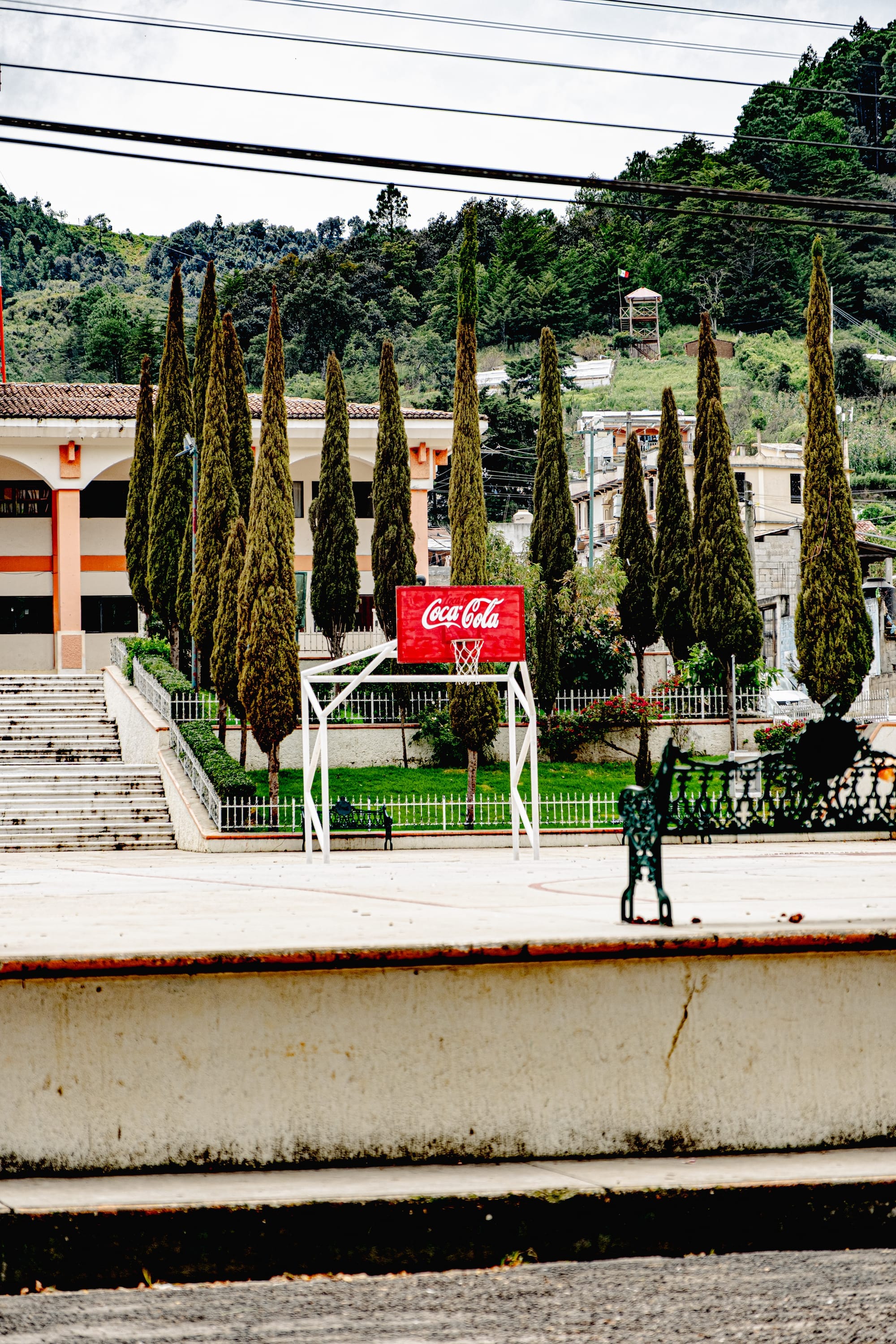
Scenes from San Juan Chamula and Zinacantán
That syncretism continues today. In Chamula, saints stand in for ancient deities, and the pine-needle-covered church floor transforms Catholic ritual into a Maya cosmology of renewal. In Zinacantán, woven flowers and embroidered textiles keep alive symbols of fertility and abundance once tied to Maya earth rituals.
Both towns stand as living archives of Indigenous adaptation. They have survived centuries of external pressure (colonial, political, and economic) by holding fast to collective identity.
Prefer to go with a guide? One popular option is a guided tour of Chamula and Zinacantán from San Cristóbal. You can check dates and prices here:
How to get to San Juan Chamula from San Cristóbal
Chamula is easy to reach on your own. You have four options, and the colectivo is the cheapest.
Colectivo: white shared vans leave from the streets around the municipal market (Calle Honduras and nearby), every few minutes, and go when full. The ride takes about 20 minutes and costs about 20 to 25 pesos in 2026. You pay when you get off by Chamula's main square, and vans back to San Cristóbal leave from the same area.
Taxi: about 100 to 150 pesos one way for the 15 to 20 minute drive. Agree on the price first. There's no colectivo between Chamula and Zinacantán, so most people take a taxi between the two (about 100 to 120 pesos, 10 to 15 minutes).
Guided tour: half-day tours leave San Cristóbal around 9 or 9:30 am and last four to five hours, usually for about 200 to 450 pesos with church entry included. Spanish-speaking guides are the norm, and English guides cost more. The context a good local guide gives is worth it, which is why we recommend the tour we link above.
Walking or cycling: it's about 10 km each way, uphill on the way out, on roads you share with traffic. Local operators run guided mountain-bike tours to Chamula and Zinacantán (around 30 km round trip, with a lot of climbing), and some routes return past El Arcotete. Only ride if you're fit and comfortable on mountain roads.
Chamula tour or on your own: which is better?
Both work. Going on your own is cheaper and lets you stay as long as you like, while a tour gives you the context you can't get from walking around. This is how they compare:
| On your own | Guided tour | |
|---|---|---|
| Cost (2026) | Colectivos about 20 to 25 pesos each way, plus church fee and taxi between towns | About 200 to 450 pesos, usually with church entry |
| Time | As long as you like | Four to five hours, leaving around 9 or 9:30 am |
| Explanation | Optional local guide at the church for about 100 pesos, mostly in Spanish | Guide explains the church, rituals, and customs; English guides cost more |
| Zinacantán | Taxi between the towns, about 100 to 120 pesos | Included, often with a weaving and home visit |
| Best for | Spanish speakers, return visitors, people who want time at the market | First-time visitors who want context and an easy day |
If you go on your own, carry small bills, note the time of the last colectivos back (they run through the afternoon).
Zinacantán colectivos also leave from near the market in San Cristóbal and take about 20 minutes. If you want both towns on a Sunday, go to Zinacantán first to catch its early market, then taxi to Chamula, whose market runs later. For more ideas from the city, see our San Cristóbal guide.
Chamula Sunday market
On Sundays, people from Chamula's many outlying villages come into town, and the plaza in front of the church fills with stalls. It's mainly a local market: produce, wool skirts and tunics, palm hats, pottery, and household goods, with some souvenirs around the edges. Prices for textiles can be higher than in San Cristóbal's markets, but your money stays in the community. The handicraft market by the plaza also opens the rest of the week. Ask before photographing any stall or vendor.
The covered handicraft market (Mercado de Artesanías) next to the plaza is open every day, roughly 8 am to 8 pm Monday to Saturday and 8 am to 6:30 pm on Sunday, according to Wikivoyage. Expect wool blankets and ponchos, embroidered blouses, bags, and toys. Bargaining is normal but keep it friendly, as these are small family businesses.
Best time to visit San Juan Chamula
Go on a Sunday morning if you can, for the markets and the busiest church. Weekday mornings are calmer if you'd rather see the church with fewer visitors. The dry season, November to April, brings clear mornings, though it can be close to freezing early on. From May to October, expect afternoon downpours, so go early. Festival days (Carnaval, Day of the Dead, and the June and August feasts) are the most memorable, but also the most crowded.
Visiting with respect
For travelers, visiting Chamula and Zinacantán is a privilege that comes with responsibility. These are not tourist attractions arranged for outsiders but living, breathing communities guided by faith, tradition, and mutual respect. Visiting them requires attention, humility, and an understanding that you are stepping into spaces where belief is a daily practice, not a spectacle.
In Chamula, visitors may enter the church of San Juan Bautista, but photography is strictly prohibited. This rule is about more than decorum: it reflects the sacred nature of what happens inside. The rituals, the candlelight, and the murmured prayers are not performed for others to watch. They are private acts of devotion, meant to stay that way. The best way to take part is in silence: stand still, breathe the pine-scented air, and let the people around you pray undisturbed.
In Zinacantán, the atmosphere is more open, though equally grounded in respect. Families often invite visitors into their homes or workshops to witness the weaving process. When purchasing textiles or flowers, fair payment is expected and appreciated. Every woven piece represents hours of labor and centuries of accumulated skill.
For more visits like this, with tips on going respectfully, see our list of cultural immersion experiences. For more experiences like this, see our cultural travel guide.
Traveling through these communities means engaging with them on their own terms. It means asking questions kindly, following local customs, and letting moments happen naturally. To visit with respect is to take part in a kind of exchange, not of money for experience, but of attention for generosity.
Chamula and Zinacantán etiquette: photos, dress, and tips
These are the rules local guides repeat to every group. Following them keeps the welcome open for the next visitors.
Ask before photographing people, even from a distance, and accept a no. Many Tsotsil people object to being photographed, and some may ask for a small payment.
No photos inside the Chamula church or the Zinacantán churches, and none of ceremonies, officials, or processions without clear permission.
Dress modestly: cover shoulders and knees, and take your hat off in the church. Bring a sweater for the altitude.
Stay out of the way of worshippers. Walk around the edges, don't step over candles, and never touch the saints or offerings.
Carry small bills and coins for fees, colectivos, and purchases. Cards are rarely accepted.
Don't hire children as guides, and decline politely if vendors follow you. A simple "no, gracias" works.
Living traditions in Chamula and Zinacantán
In both Chamula and Zinacantán, the preservation of tradition is not about freezing the past; it is about living it. Practices that date back to the colonial and pre-colonial periods remain active, evolving as new generations reinterpret them. The result is a living continuum, a culture that changes without breaking, rooted yet responsive.
In Chamula, the chicken ritual continues as a powerful symbol of spiritual renewal. It embodies the Maya understanding of balance, reciprocity, and the interconnectedness of all beings. Each ritual is both a personal and communal act of healing, carried out with reverence rather than superstition. Visitors who witness such moments should recognize the seriousness with which they are undertaken.
Zinacantán, meanwhile, shows how art can carry culture forward. The weaving of textiles, with its bright threads and floral motifs, keeps alive a cosmology in which nature, fertility, and the feminine are central. Each woven garment is an archive of memory, a tangible record of lineage, land, and labor. The women who weave are both artisans and custodians of meaning, their looms connecting household life to cosmic order.
These practices speak to a broader truth about Indigenous life in Chiapas: resilience is not resistance alone; it is creativity, adaptation, and care. The people of Chamula and Zinacantán continue to move between worlds (ancient and modern, rural and global) without losing their grounding. Their strength lies not in isolation but in continuity.
Is San Juan Chamula safe?
Chamula and Zinacantán receive tourists every day, and daytime visits around the plaza, church, and market are generally trouble-free for respectful visitors. The risks come from breaking local rules: photography inside the church or of people who said no has led to confiscations, fines, and angry confrontations. Stay around the center, visit in daylight, and don't wander into residential areas without a guide.
Wider Chiapas has occasional roadblocks and protests, which can delay transport. The UK government's regional travel advice warns against travel near the Guatemalan border and on Highway 199 toward Palenque, not on the short roads to Chamula and Zinacantán. Check current advice before you go and ask your accommodation if anything is happening locally.
Nearby, see El Arcotete.
Whatever your plans, travel with insurance. Stomach bugs, a fall on a cobbled street, or a stolen phone can happen anywhere, and it's much easier to enjoy the trip when you know you're covered. We'd recommend SafetyWing Nomad Insurance. It covers medical emergencies abroad, you can buy it even after you've left home, and it renews every four weeks, so it works for a short trip or months on the road.
Where to stay for Chamula and Zinacantán
San Cristóbal de las Casas is the base for this, with the most places to stay and eat. These are well-reviewed options, all rated 9 or more on Booking:
There's no visitor accommodation in Chamula itself, so nearly everyone visits as a day trip from San Cristóbal.
- Parador Margarita: a well-run, good-value hotel a few blocks from the center, rated 9.1 from over 1,400 reviews.
- Casa Carmen: a small guesthouse with a courtyard, rated 9.6.
- Casa Santa Lucía: a colonial-style boutique stay in the center, rated 9.5.
Frequently asked questions
How much is the entrance fee for the Chamula church?
About 25 to 35 pesos in 2026, paid at the tourism office beside the main square. Tours usually include it. The fee is set locally and can change, so carry small bills.
Can you take photos inside the San Juan Chamula church?
No. Photos and video are strictly banned inside the church, and breaking the rule can mean a fine, losing your camera, or being asked to leave town. Photos of the outside and the plaza are fine, but ask before photographing people.
How do you get to San Juan Chamula from San Cristóbal de las Casas?
Take a colectivo from the streets around the municipal market (Calle Honduras). The ride takes about 20 minutes and costs about 20 to 25 pesos. A taxi costs about 100 to 150 pesos, and half-day tours combine Chamula with Zinacantán.
Is San Juan Chamula worth visiting?
Yes, if you go with respect and ideally with a guide. The Chamula church is one of the most remarkable religious spaces in Mexico, and a short trip from San Cristóbal. If you aren't comfortable with possible animal sacrifice or strict photo rules, Zinacantán may suit you better.
What day is the market in Chamula?
Sunday. People from the surrounding villages come in to buy and sell produce, textiles, and household goods in the plaza in front of the church. Zinacantán's Sunday market is earlier and ends by late morning.
Is there an entrance fee for Zinacantán?
Expect a small fee or donation at the churches. Amounts vary between visitor reports, and tours usually include it. Weaving co-ops and family workshops don't charge entry, but buying something supports them.
Why do people drink Coca-Cola in the Chamula church?
Burping is believed to release bad spirits from the body, so soft drinks (mostly Coca-Cola) are part of healing rituals, alongside pox, a local sugarcane spirit, candles, eggs, and sometimes chickens.
When is Carnaval in San Juan Chamula?
Chamula's Carnaval, K'in Tajimoltik, runs over the five days before Ash Wednesday, usually in February. The last day, Tuesday, is the biggest, with the run across burning grass in front of the church.
What should I wear to San Juan Chamula?
Modest clothes that cover shoulders and knees, and take off your hat inside the church. At about 2,200 m, Chamula is cold in the morning, so bring a sweater and a rain jacket from May to October.
Can you visit San Juan Chamula without a tour?
Yes. Colectivos run from the streets around the municipal market in San Cristóbal (Calle Honduras) and take about 20 minutes. Buy your church ticket at the office by the main square and follow the photo rules. A local guide at the church can explain what you're seeing for about 100 pesos.
What are the opening hours of the Chamula church?
There are no published hours, and visitor reports vary. Go in the morning or early afternoon, and expect it to close to tourists during some ceremonies.
How long do you need in San Juan Chamula?
About two hours covers the church, the plaza, and the market. Add two more hours if you're also visiting Zinacantán, or half a day if you're there for the Sunday market.
Can you stay overnight in San Juan Chamula?
Not really. There's no tourist accommodation in the town, so stay in San Cristóbal de las Casas, 20 minutes away, and visit as a day trip.
Can you take photos inside the Zinacantán church?
Usually not. Photography inside the San Lorenzo and San Sebastián churches is generally banned, and some visitors report it also applies in the churchyard. Ask before taking any photo, and follow what the church caretakers tell you.
When is the Chamula Carnaval in 2027?
Ash Wednesday is February 10, 2027, so Carnaval should run from about February 5 to 9, with the fire run on Tuesday, February 9. Confirm the dates locally nearer the time.
Useful links: Chamula on Wikipedia, Zinacantán on VisitMexico, Chamula Carnaval on VisitMexico, Zinacantán on Wikipedia, and UK travel advice for Mexico.


