


The best waterfalls in Chiapas are El Chiflón near Comitán, Misol-Há and Roberto Barrios near Palenque, the famous Agua Azul, Las Nubes on the Río Santo Domingo, and El Aguacero in the El Ocote canyon. From San Cristóbal de las Casas, El Chiflón is the easiest day trip (about 2.5 to 3 hours each way). The Palenque falls are better done from Palenque town. We swam at El Chiflón, Misol-Há, and Roberto Barrios, and Roberto Barrios was our favorite. For turquoise water, go in the dry season, roughly November to April.
We lived in San Cristóbal for a season and saw these on day trips and a Palenque weekend. We didn't make it to Agua Azul, Las Nubes, or El Aguacero, so those sections are marked and based on official and news sources. Fees are set by the local ejidos (communities that hold the land in common) and change often, so treat every price as a 2026 guide.
Chiapas waterfalls at a glance
Drive times are by car in good conditions. Roadblocks, topes (speed bumps), and checkpoints can add a lot, especially on Highway 199.
| Waterfall | Distance and drive time | Entry fee (2026, approx.) | Swimming | Best months | Did we go? |
|---|---|---|---|---|---|
| El Chiflón | About 100 km from San Cristóbal, 2.5 to 3 hours | About 80 pesos | Yes, in the marked area by the entrance | November to April (clearest February to April) | Yes |
| Roberto Barrios | 25 to 38 km from Palenque, 45 to 60 minutes | About 20 to 40 pesos, plus a small road fee | Yes | November to April | Yes (our favorite) |
| Misol-Há | About 20 km from Palenque, about 30 minutes | About 30 pesos, sometimes a second booth | Yes, in the dry season | November to April | Yes |
| Agua Azul | About 69 km from Palenque, about 1.5 hours; about 4 hours from San Cristóbal | About 40 to 80 pesos in total, often paid at two booths | Only in calm, marked spots | About December to April | No |
| Las Nubes | About 130 km from Comitán; roughly 5 to 6 hours from San Cristóbal | About 30 pesos (camping extra) | Limited, strong currents | November to April | No |
| El Aguacero | About 51 km from Tuxtla Gutiérrez; roughly 2 to 2.5 hours from San Cristóbal | About 50 pesos (camping extra) | Depends on water levels | November to April | No |
| El Arcotete (river and arch, bonus) | About 4 to 6 km from San Cristóbal, 20 minutes | About 10 pesos, caves about 15 pesos | Not a swim stop | All year, weekday mornings | Yes |
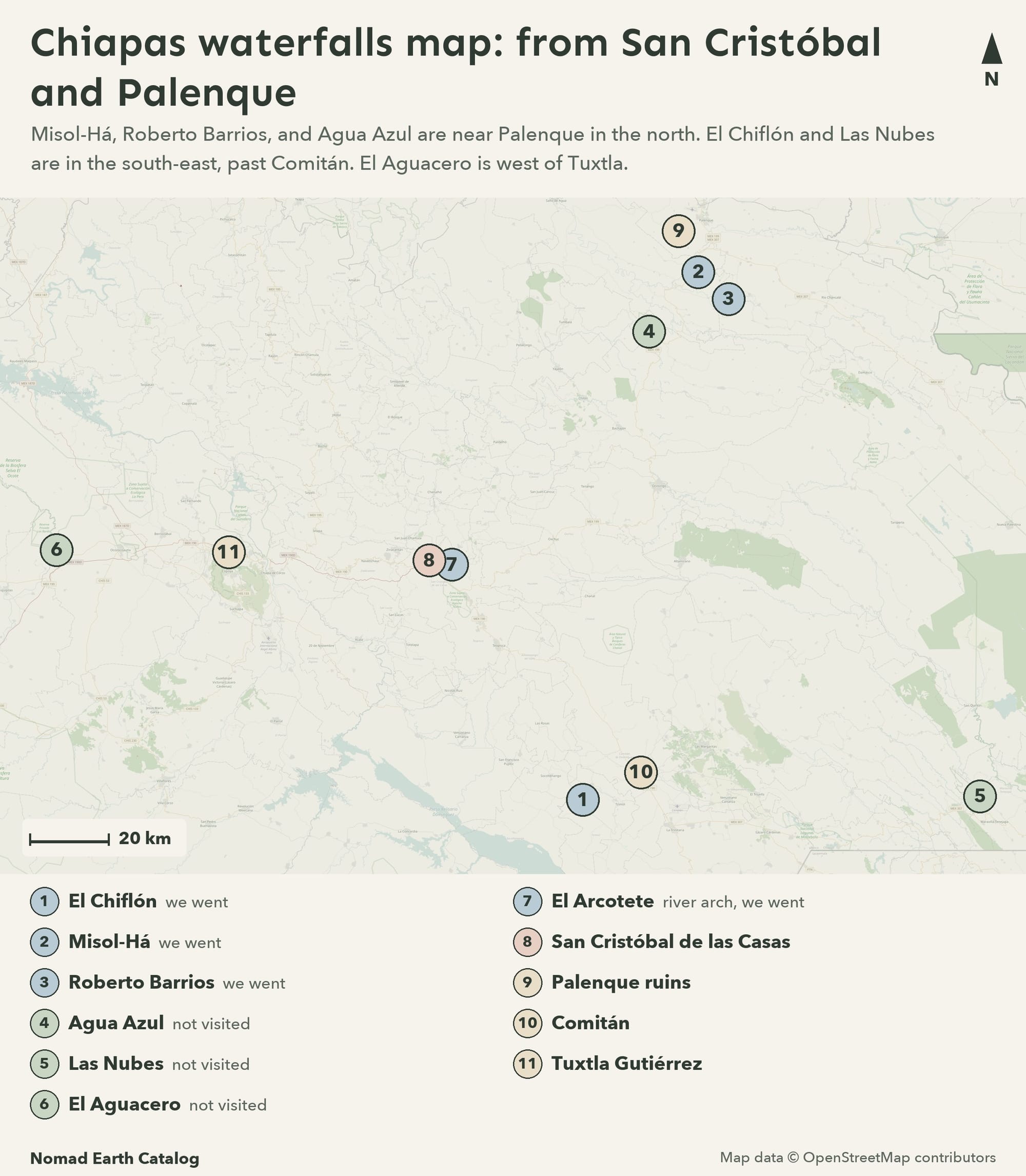
The six waterfalls fall into three groups. El Chiflón and Las Nubes are on the Comitán side, south of San Cristóbal. Misol-Há, Roberto Barrios, and Agua Azul are in the jungle around Palenque, in the north. El Aguacero is west of Tuxtla Gutiérrez, in the El Ocote Biosphere Reserve. Plan by group, not by list, and you'll spend much less time in a van.
1. Cascadas El Chiflón, near Comitán
El Chiflón is a chain of five waterfalls on the San Vicente River in the municipality of Tzimol, about 20 km southwest of Comitán. A paved trail with plenty of stairs climbs a little over 1 km to the biggest fall, and a rougher dirt path continues to two more. It's the best waterfall day trip from San Cristóbal.
We went with friends from Co404, our coliving in San Cristóbal, and spent several hours there. We swam in the river, walked up to Velo de Novia, and took our time between sections of the trail. One honest note: in photos El Chiflón is bright turquoise, but on our day the water was more green than blue. Full details are in our El Chiflón guide.
- Getting there: about 2.5 to 3 hours by car from San Cristóbal via Comitán, or a bus to Comitán and a colectivo toward Tzimol (about 3 to 3.5 hours in total).
- Entry: about 80 pesos per person in 2025, cash only, with ziplines extra.
- Hours: daily, about 7:30 or 8 am to 5 pm.
- Swimming: only in the designated stretch of river near the entrance. Lifeguards keep people out of the pools under the falls.
Velo de Novia, El Chiflón's main waterfall
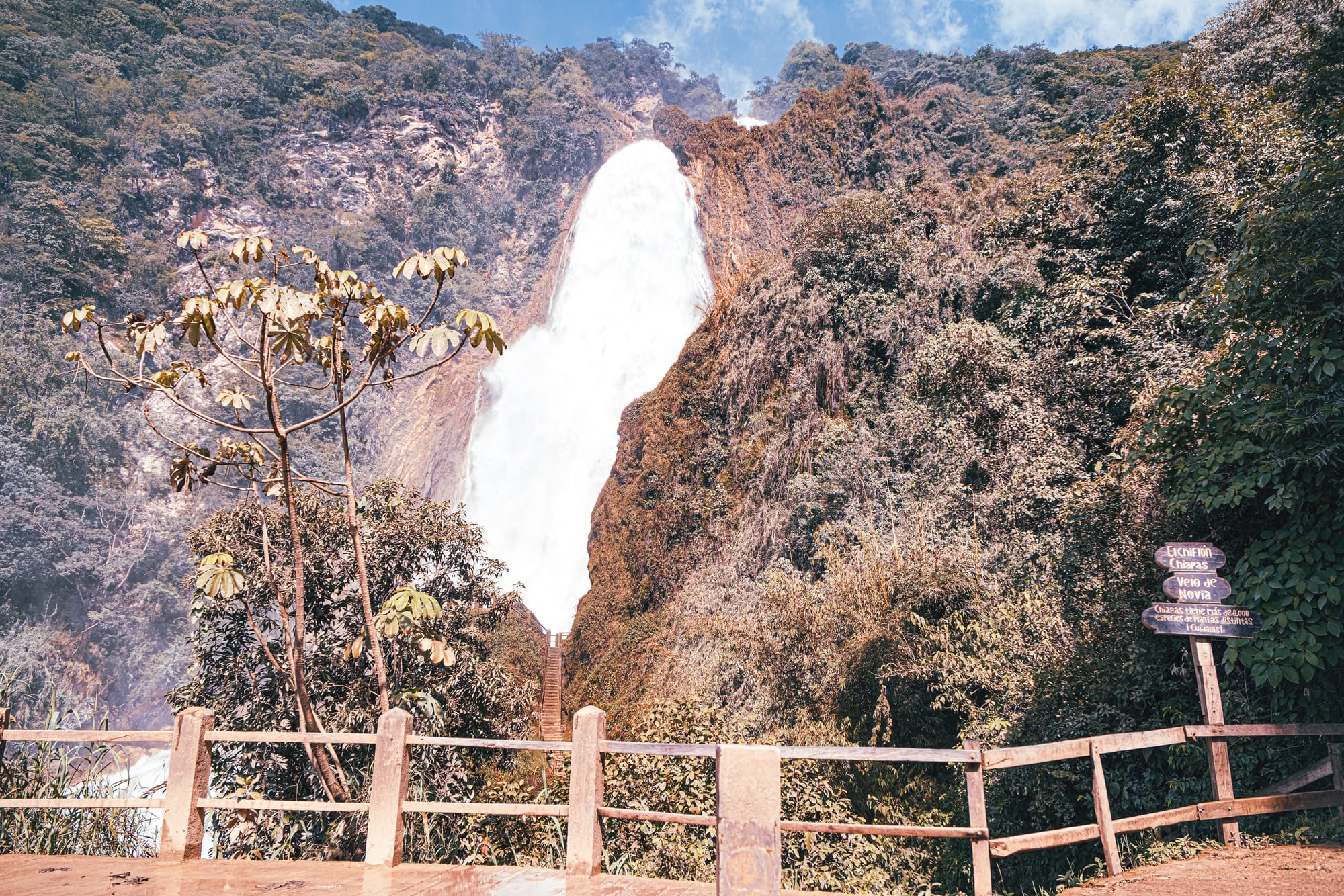
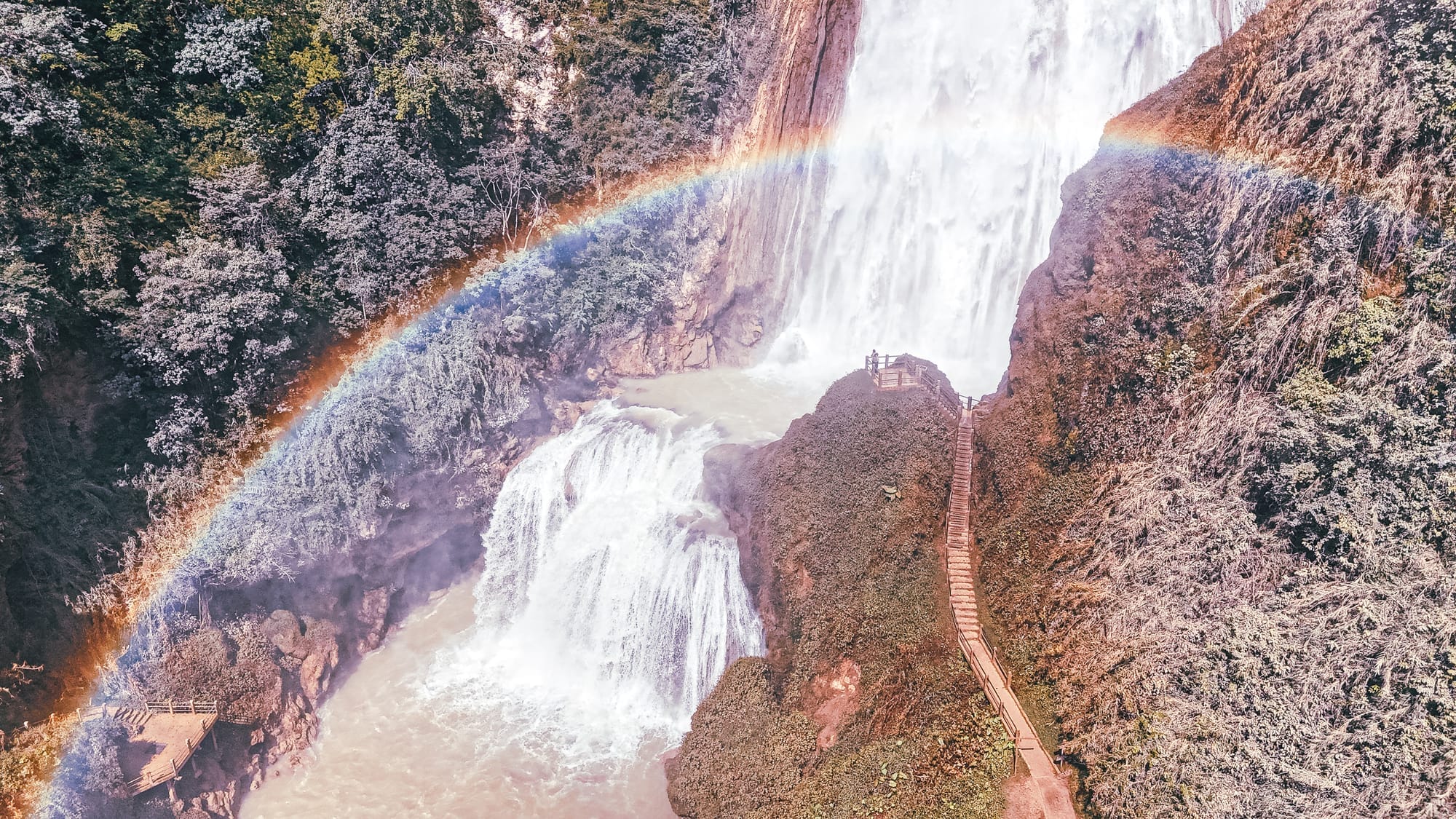
Velo de Novia (Bridal Veil) is the third of El Chiflón's five falls and the one you see in every photo. It drops about 120 meters, according to Visit Mexico and the Chiapas tourism board. It takes most people 20 to 45 minutes to walk up from the entrance. There are several viewpoints, and the closest, up a slippery concrete staircase, will soak you in spray. On the day we visited, there was a rainbow in the mist.
Velo de Novia isn't a separate trip. It's the main fall of El Chiflón, and you can see it from two parks, one on each side of the river. The main park in Tzimol has the swimming area, the ziplines, and the best view. Across the river, the smaller Velo de Novia tourist center in Socoltenango has its own viewpoints and cabins. If you only visit one, choose the main park, which is where most colectivos and tours go.
Tours from San Cristóbal pair El Chiflón with Lagos de Montebello in a 12-hour day. We saw them on separate days, which leaves time to swim and reach the upper falls.
2. Cascadas Roberto Barrios, near Palenque
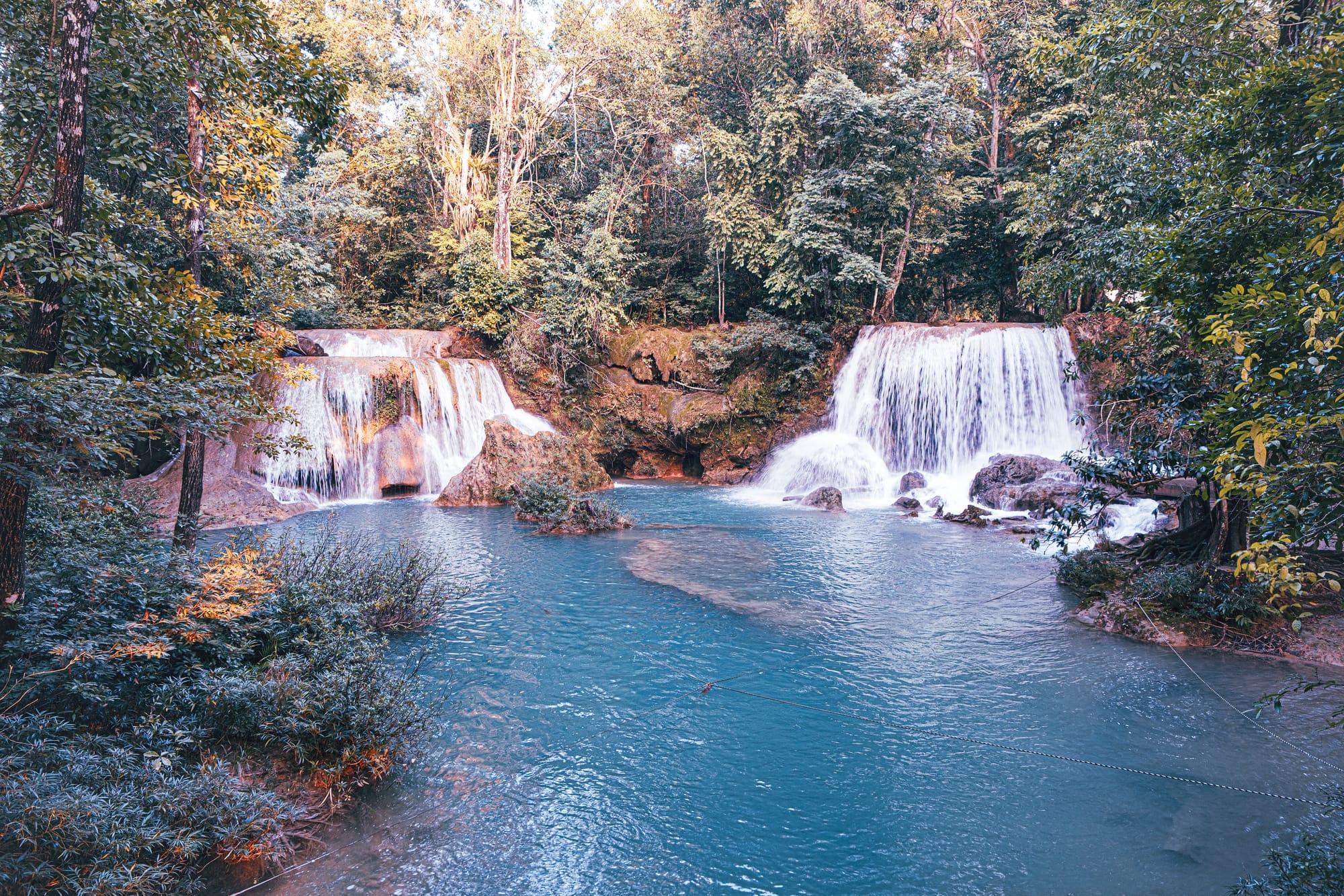
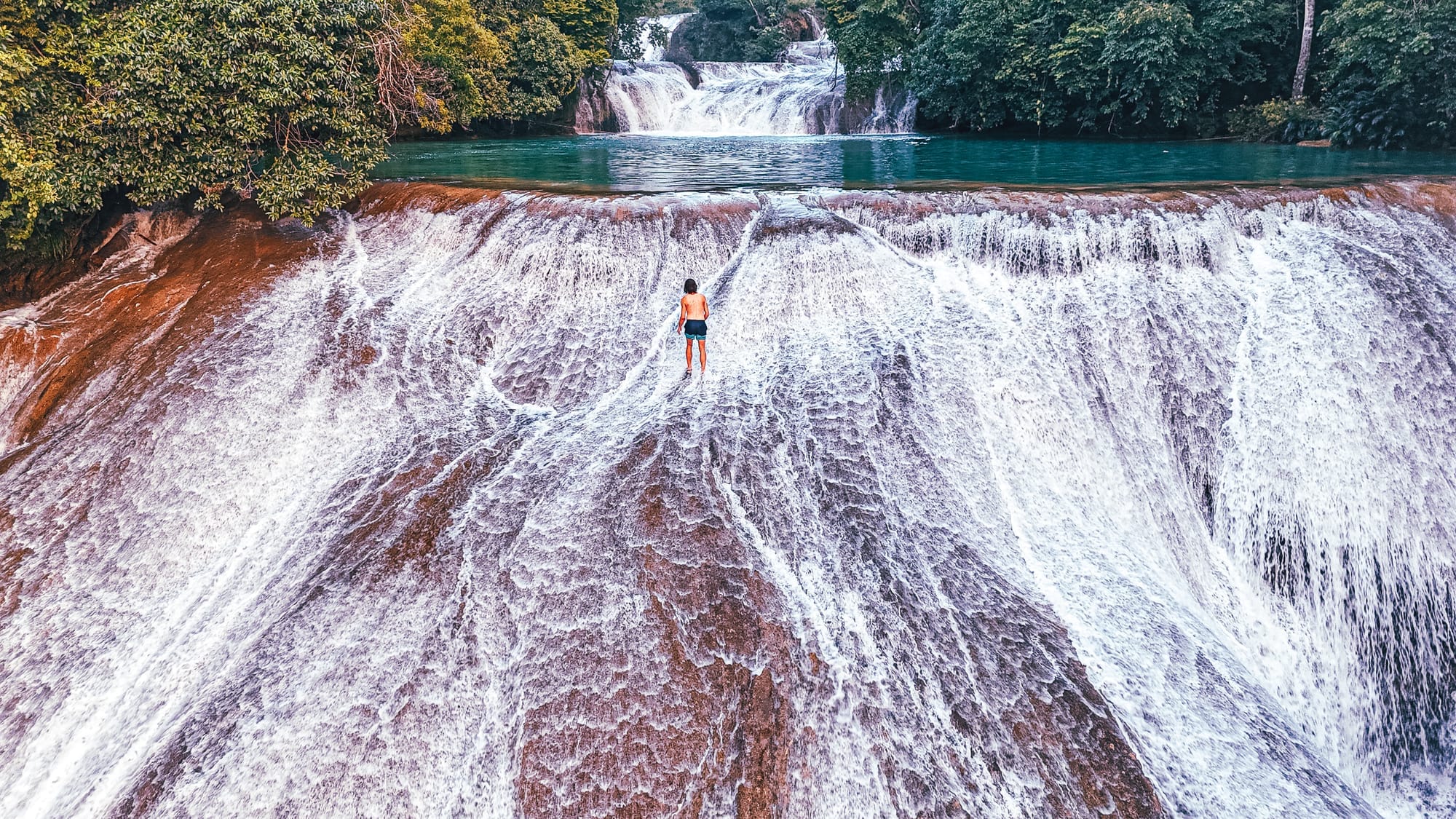
Roberto Barrios is a stepped chain of turquoise falls and pools in the jungle beside the village of the same name, about 45 minutes to an hour from Palenque town. Of all the waterfalls we visited in Chiapas, it's the one we'd go back to first. You climb the limestone shelves, swim between pools, and stand behind some of the falls.
We went on the day we arrived in Palenque, after Misol-Há, and saved the ruins for the next morning. The falls are spread out, so it's easy to find an emptier pool. Read our Roberto Barrios waterfalls guide for the colectivo, taxi, and driving details.
- Getting there: colectivo from near the market in Palenque (about 45 minutes, roughly 50 pesos each way), a taxi with waiting time (about 600 to 750 pesos round trip), or a tour that goes only there.
- Entry: about 20 to 40 pesos per person in recent reports, plus a small road fee on the access road some days.
- Hours: about 8 am to 5 pm. Head back by about 4 or 5 pm if you came by colectivo.
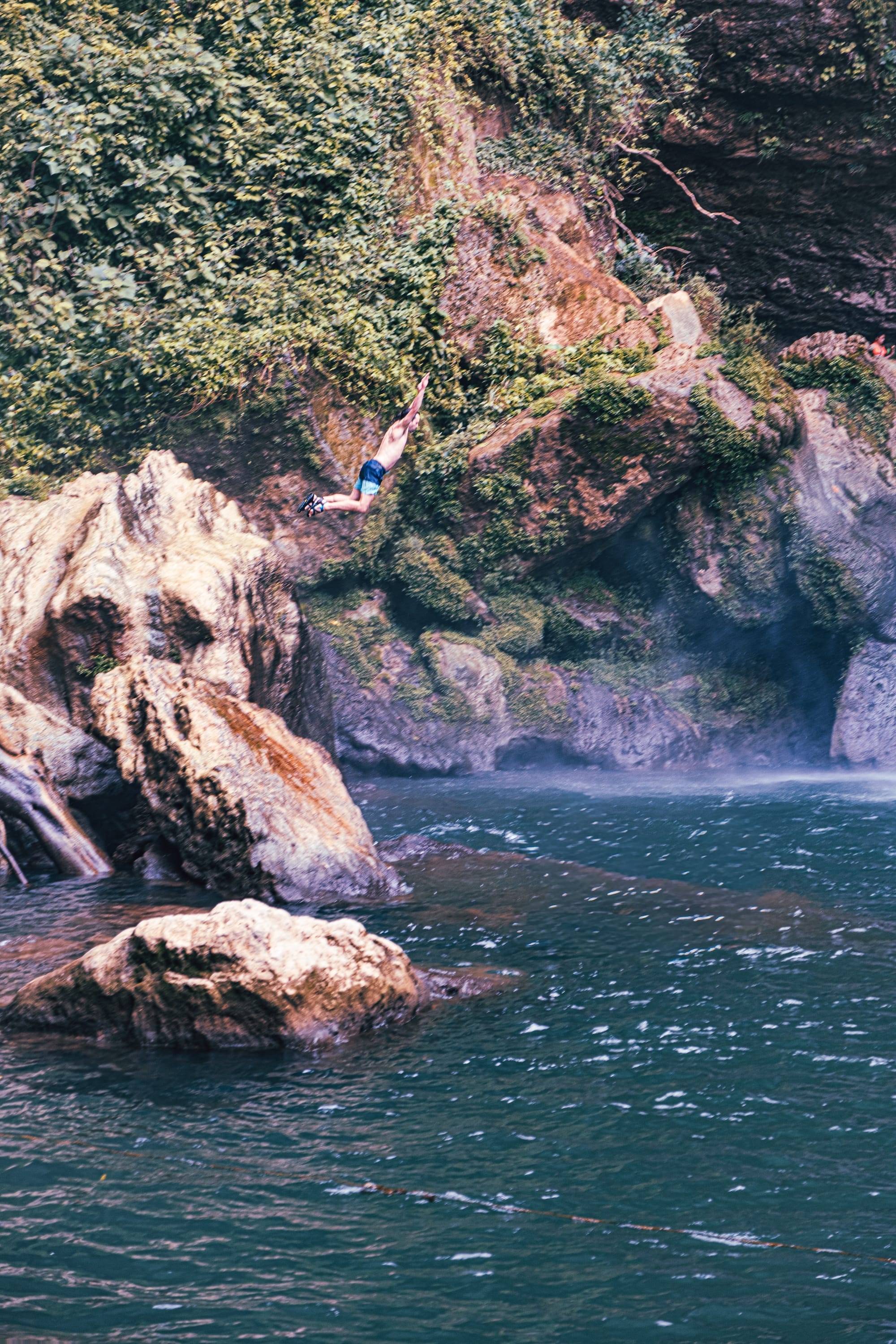
- Swimming: yes, but there are no lifeguards. Only jump where a local shows you it's deep enough.
The village is also the seat of a Zapatista caracol, which is not a tourist site. Stick to the falls, and ask before photographing people.
3. Cascada Misol-Há, near Palenque
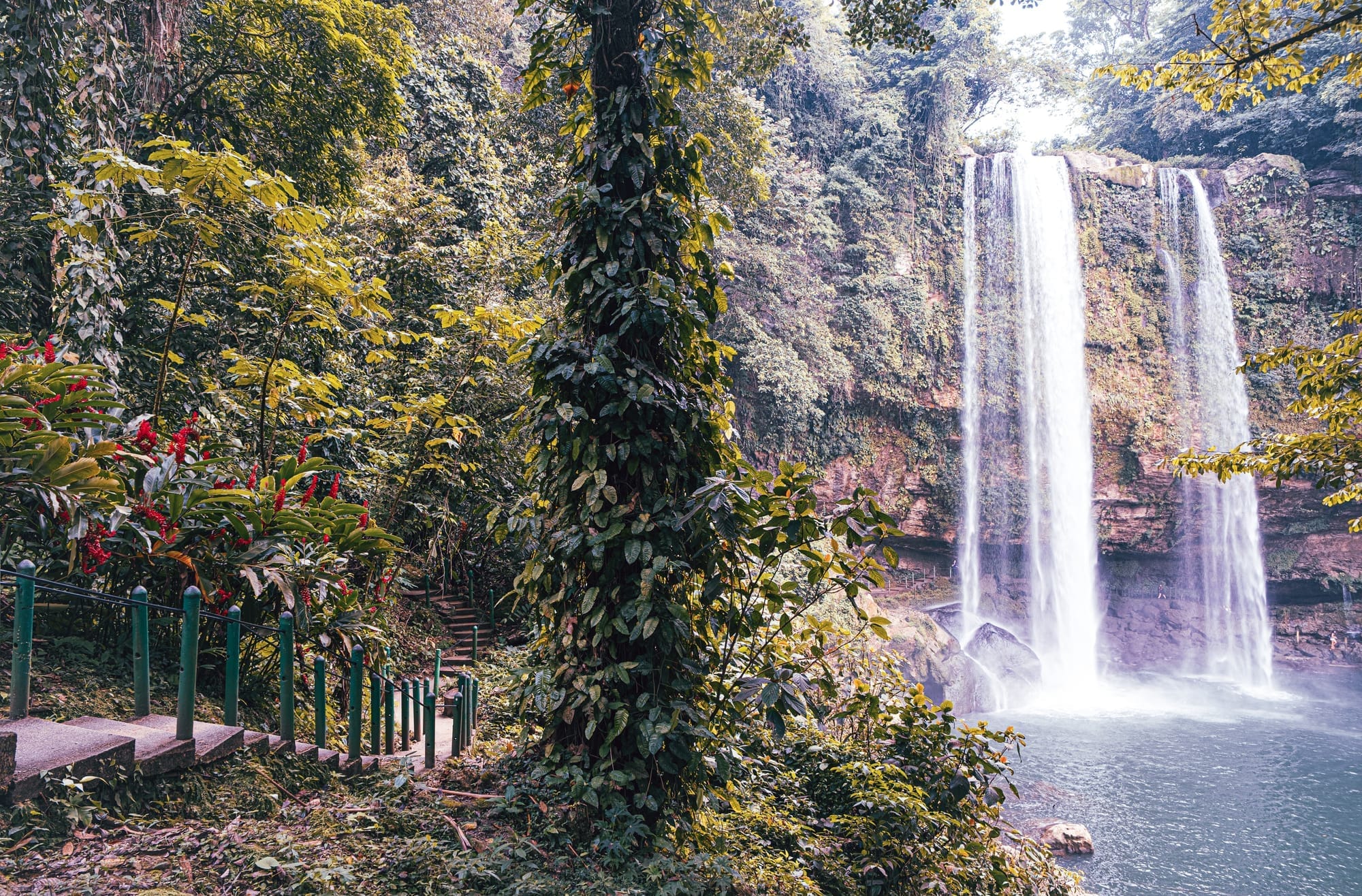
Misol-Há is a single waterfall of about 35 meters that drops into a round pool, about 20 km south of Palenque, just off Highway 199. It's the easiest waterfall to add to a Palenque trip, and most shuttles between San Cristóbal and Palenque stop here. Plan one to two hours.
It was the first stop on our Palenque weekend. We swam in the pool, which is cold even on a hot day, and walked the path that runs behind the curtain of water to the cave. Our Misol-Há guide covers the cave tour, the cabins, and how to get there by colectivo.
- Getting there: a colectivo toward Ocosingo from near the ADO station in Palenque, then a 1.5 km walk from the junction, or about 30 minutes by taxi.
- Entry: about 30 pesos per person, cash only. You may pass a second small booth on the access road. Only pay at official booths.
- Hours: usually 8 am to 5 pm (some listings say 7 am to 6 pm).
- Swimming: yes, in the dry season. The middle of the pool is deep, so weaker swimmers should stay near the edges. Swimming is often banned when the water turns brown in the rainy season.
4. Cascadas de Agua Azul (we didn't go)
Agua Azul is the best-known waterfall in Chiapas: a long run of wide, low cascades and blue pools on the Xanil River in the municipality of Tumbalá, about 69 km from Palenque. The water carries a lot of calcium carbonate, which coats the rocks and gives the river its color. It has been a federal flora and fauna protection area since 2000, according to Wikipedia. The biggest single drops are only about 6 meters, so it's about the length of the cascades rather than height.
We planned to stop here on the way to Palenque, but someone in our group was unwell, and we skipped it. Everything below comes from official and news sources, not a visit.
- Getting there: most people see it on a shuttle tour between San Cristóbal and Palenque, or a day tour from Palenque that adds Misol-Há. Both use Highway 199 (see the safety section below).
- Entry: recent traveler reports range from about 40 to 80 pesos in total, often paid at two booths run by different communities: one on the access road and one at the entrance. Tours usually include it.
- Hours: roughly 7:30 am to 5 pm.
- Swimming: only in calmer sections, when conditions allow. The current is strong between the cascades.
- Best months: the dry season. After heavy rain, the water often runs brown.
Agua Azul access in 2026
Checked on 28 November 2026. On 1 April 2026, part of the panoramic viewing area at Agua Azul collapsed. Chiapas Civil Protection said it was a natural collapse caused by the force and weight of the water, that nobody was hurt, and that the area was closed off while specialists assessed it (reported by La Jornada and Alerta Chiapas). We couldn't find a later official notice about reopening that section, so expect some viewpoints to be fenced off.
Agua Azul also has a long history of disputes between neighboring communities over who collects the fees. Over the years, these have closed the access road at times. Before you go, ask your tour operator or hotel in Palenque whether the road and the park are open that week.
5. Las Nubes, on the Río Santo Domingo (we didn't go)
Centro Ecoturístico Las Nubes is a community-run center on the Río Santo Domingo in the municipality of Maravilla Tenejapa, on the edge of the Lacandon Jungle. Here the river runs through a narrow, forested channel in a series of turquoise rapids and small falls, crossed by a suspension bridge. It isn't one big drop, and it's remote: about 130 km from Comitán along the Carretera Fronteriza, the highway that runs close to the Guatemala border, and then a side road down to the village.
The Chiapas tourism board lists entry at 30 pesos per person, hours from 8 am to 8 pm, cabins, a camping area for up to 200 people, a restaurant, toilets, and parking, plus walking trails, a viewpoint, and rafting. A traveler on iOverlander reported paying about 200 pesos per tent to camp. Most people stay at least one night, because it's roughly 5 to 6 hours each way from San Cristóbal. Guides warn that there's no mobile signal on the way, so download offline maps first.
The current is strong, so swimming is limited to the calmer spots. Ask the staff where it's safe. Las Nubes is close to the Guatemalan border, and parts of the Chiapas border area are covered by government travel advisories, so check the latest UK travel advice for Mexico before you plan the drive.
6. Cascada El Aguacero, near Ocozocoautla (we didn't go)
El Aguacero is a waterfall that pours out of the wall of the Río La Venta canyon, inside the El Ocote Biosphere Reserve in the municipality of Ocozocoautla de Espinosa. The water comes out of a cave fed by an underground river and falls down the canyon wall. Aguacero means downpour. From Tuxtla Gutiérrez, follow Highway 190 west toward Ocozocoautla and Cintalapa for about 48 km, then take a 3 km dirt road to the entrance.
The catch is the stairs. You walk down about 740 steps through the forest to the canyon floor, according to the Chiapas tourism board, and then climb them all back up in the heat. Bring plenty of water. The tourism board lists the center as open daily from 7 am to 5 pm, with guided walks to the waterfall and the underground river, boat trips, and river descents.
Travelers report an entry fee of about 50 pesos per person and camping for about 100 pesos, with toilets, showers, and a restaurant. Camping lets you walk down early, before the day visitors arrive. Go in the dry season: visitor guides say the walk along the river at the bottom of the canyon needs low water, and the canyon is hot. Swimming depends on the water level on the day.
Bonus: El Arcotete, a river near town
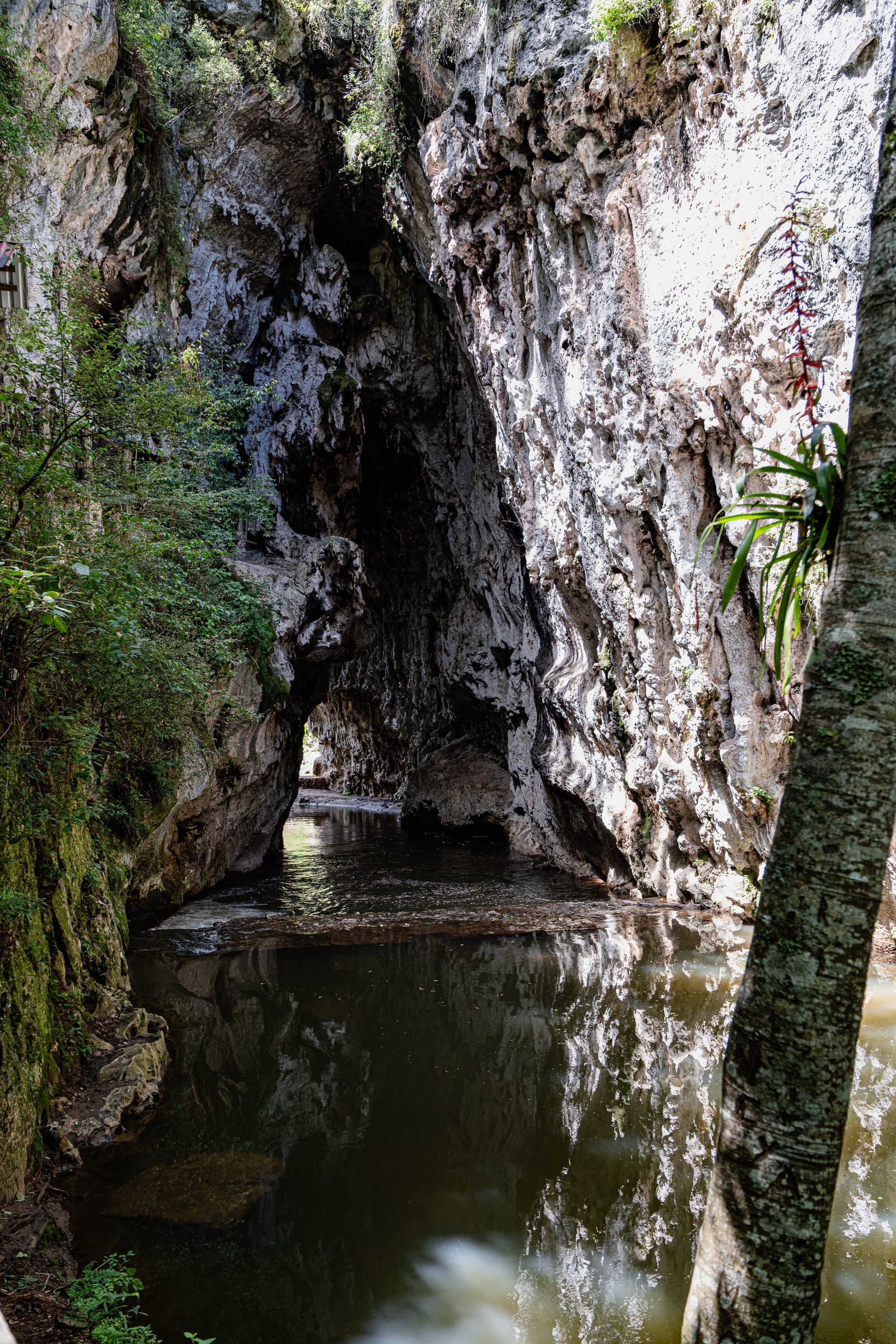
El Arcotete isn't a waterfall, so it isn't in our count, but it's the easiest water stop from San Cristóbal. The Río Fogótico runs under a natural limestone arch about 30 to 40 meters high, about 20 minutes east of town on the road to Tenejapa. There's a small fall along the lancha path, caves you can walk through above the arch, and grassy riverbanks for a picnic.
We spent a morning there with friends. It costs a few dozen pesos with the caves, and a colectivo is about 10 to 15 pesos. See our El Arcotete guide.
Which Chiapas waterfall should you pick?
It depends on where you're based and how much driving you'll put up with.
For everything else in the state, from Sumidero Canyon to Palenque, see our list of things to do in Chiapas.
- You're in San Cristóbal for a day trip: El Chiflón. It's the only big waterfall within 3 hours, it has a proper swimming area, and you can add Montebello on the same tour or the next day.
- You're in Palenque and want to swim: Roberto Barrios. More pools, more room, and fewer tour buses. It's also reached on Highway 307, not 199.
- You're on the road between San Cristóbal and Palenque: Misol-Há, and Agua Azul if the road and park are open. A shuttle tour stops at both.
- You want the famous photo: Agua Azul, in the dry season, after checking access.
- You want to camp by the river: Las Nubes, for two or more days on the Comitán side, or El Aguacero if you're near Tuxtla and fine with 740 steps.
- You have a free morning in town: El Arcotete.
If you only see one, our pick is Roberto Barrios. If you're short on time in San Cristóbal and not heading north, it's El Chiflón.
Best time to visit waterfalls in Chiapas
The dry season, roughly November to April, is the best time for turquoise water, calm pools, and firm trails. February to April is usually the clearest. From about May or June to October, the rains make the falls bigger and louder, but the water often turns green or brown, trails get muddy, and some sites close swimming. Rain usually comes in the afternoon, so go early in any month.
Weekends and holidays (Semana Santa especially) are the busiest. Go on a weekday morning.
Safety, roads, and swimming
The road matters more than the waterfall. The UK government advises against "all but essential travel" on Federal Highway 199 between Rancho Nuevo, just outside San Cristóbal, and the Chancalá junction near Palenque, because of frequent illegal roadblocks and a risk of kidnapping (FCDO regional risks). Misol-Há and Agua Azul are both on that road. If you'd rather avoid it, take the bus to Palenque via Villahermosa and visit Roberto Barrios, which is reached on Highway 307, from Palenque town. Our Palenque guide compares the routes.
- Travel by day. Don't drive these roads after dark.
- Bring cash in small notes. None of these sites takes cards, and there are no ATMs.
- Only pay at official booths, and ask your driver or tour what road fees to expect.
- Respect swimming rules. Currents under big falls are strong. El Chiflón and Misol-Há usually have lifeguards; Roberto Barrios doesn't.
- Carry your passport for immigration checkpoints near the border.
What to bring
Swimwear, a quick-dry towel, water shoes or sandals with grip, a dry bag for your phone, insect repellent, a hat, and plenty of water. Use mineral sunscreen if you're swimming, and cover up with long sleeves at dusk instead of spraying on more repellent. Food at the sites is basic and rarely vegan beyond beans, rice, and tortillas, so pack a lunch. If you're based in San Cristóbal, stock up from our vegan San Cristóbal guide before you go.
Frequently asked questions
What are the best waterfalls in Chiapas?
El Chiflón, Roberto Barrios, Misol-Há, Agua Azul, Las Nubes, and El Aguacero. Our favorite is Roberto Barrios for swimming, and El Chiflón is the best day trip from San Cristóbal.
What is the most beautiful waterfall in Chiapas?
Agua Azul is the most famous, for its long blue cascades in the dry season. Of the ones we visited, we liked Roberto Barrios most, because you can swim and climb across the falls instead of looking at them from a viewpoint.
Which waterfalls can you visit from San Cristóbal de las Casas in a day?
El Chiflón (2.5 to 3 hours each way) is the main one, often combined with the Montebello lakes. El Aguacero works if you leave early. Agua Azul and Misol-Há are possible on a long shuttle tour toward Palenque, using Highway 199.
Is Agua Azul open in 2026?
Part of the panoramic viewing area collapsed on 1 April 2026, and Civil Protection closed off that area. We found no later official reopening notice as of 28 November 2026. Fee disputes have also closed the road at times, so check with a tour operator or your hotel before you go.
Where is Velo de Novia in Chiapas?
Velo de Novia is the main waterfall at El Chiflón, about 20 km southwest of Comitán. It's about 120 meters high, a walk of 20 to 45 minutes up from the main park's entrance in Tzimol.
Can you swim in the Chiapas waterfalls?
Yes, at most of them, but only in the right places. El Chiflón has a marked swimming area, Misol-Há's pool is open in the dry season, and Roberto Barrios has many pools. Never swim directly under the big falls.
When is the best time to see the waterfalls in Chiapas?
The dry season, roughly November to April, for blue water and safe swimming. The rainy season (about June to October) gives bigger falls but often brown water.
Can you camp at waterfalls in Chiapas?
Yes. Las Nubes has cabins and a large camping area, El Aguacero has a campsite, and El Chiflón has cabins and a camping area. Misol-Há has cabins run by the local ejido.
What is Chiapas famous for?
Waterfalls, the Maya ruins of Palenque, Sumidero Canyon, the Montebello lakes, coffee and cacao, and the Tsotsil and Tseltal towns around San Cristóbal de las Casas.
More from Chiapas: things to do in San Cristóbal, Cañón del Sumidero, where to stay in San Cristóbal, living in San Cristóbal, and our San Cristóbal guide.


